Best Adrenaline Activities in Oahu, Hawaii for First-Timers
Oahu is a rare place where a first-time adventure trip can move between sea, sky, and mountains without changing islands. You could learn to surf in Waikīkī, look into a shark cage off Haleʻiwa, or fly over Honolulu under a parasail. But a bigger collection of thrills does not automatically make a better vacation. The better question is which activity fits your comfort in the water, budget, group, and time on the island.
For most first-timers, the most practical approach is to choose one headline experience, one lower-commitment activity, and a flexible backup for wind or surf. A guided surf lesson in suitable conditions and a professionally operated parasailing flight can be approachable entry points. Cage diving is mechanically simple but puts you on an offshore boat. Tandem skydiving is a genuine high-intensity leap, not the default recommendation for someone merely curious about adventure.
This guide compares actual activities available on Oahu, not imaginary all-inclusive packages or a ranking of operator safety. Publicly posted examples were checked in November 2026; prices, permits, schedules and requirements can change. Confirm the final details directly at booking.
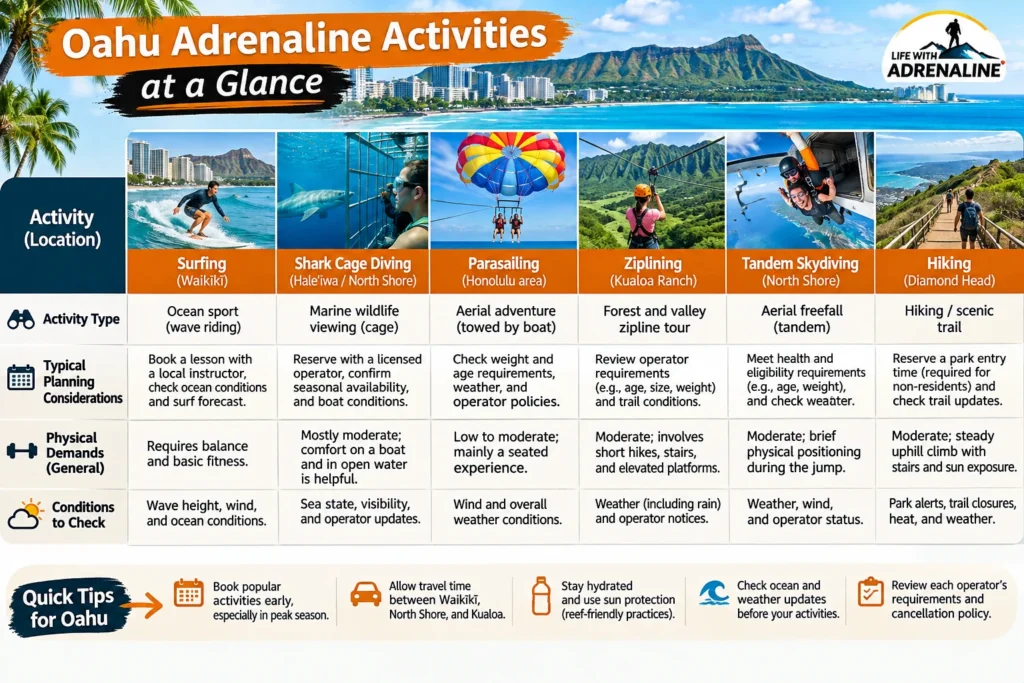
Oahu Adrenaline Activities at a Glance
| Experience | Best fit for a first-timer | Area | Planning caution |
| Guided surfing lesson | Learning a new skill with an instructor | Waikīkī / South Shore | Ocean conditions and swimming ability matter |
| Shark cage experience | Wildlife nerves without scuba certification | Haleʻiwa / North Shore | Open-ocean boat motion and cage ladder |
| Parasailing | Airborne views with little active steering | Honolulu / Waikīkī | Wind, harness fit and captain approval |
| Kualoa zipline | Land-based height adventure and scenery | Windward Oahu | Height, weight, waist and thigh rules |
| Tandem skydive | Major freefall experience | North Shore | Adult-only at referenced operator, health and weather |
| Diamond Head hike | Low-cost physical challenge and big views | Near Waikīkī | Reservations, sun and steep stairs |
| Guided snorkeling | Underwater wildlife and calm-day exploration | Site varies | Not appropriate for inexperienced ocean swimmers |
“Beginner-friendly” here means the learning curve can be approachable for an eligible first-time participant on a suitable day. It does not mean risk-free, suitable for every child, or appropriate in all weather.
1. Learn to Surf in Waikīkī — Best for a First Adventure Skill
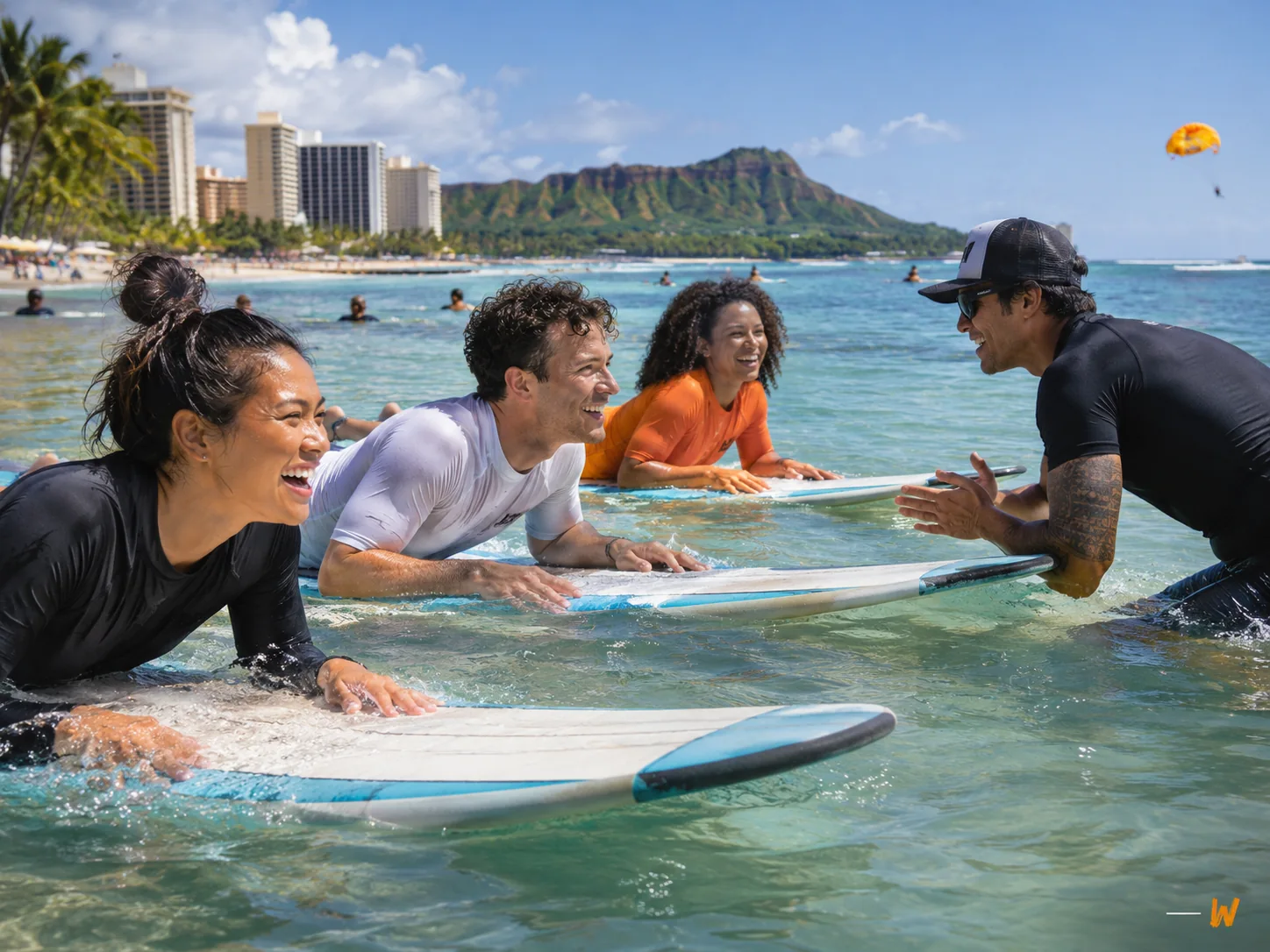
Your first real Oahu adrenaline moment does not need to involve aircraft. A surf instructor pushing a board into a small, rolling wave can provide a surprising burst of speed. The achievement is personal: going from falling off the board to briefly standing up. Waikīkī is a practical introduction because its generally long-running breaks support surf instruction, and lessons operate near the visitor infrastructure of Honolulu.
Hawaiʻi’s official visitor information identifies Waikīkī as one of the island’s best-known places to learn surfing, but it also warns that beach conditions are variable. Do not confuse a location’s reputation for beginner lessons with a daily guarantee of gentle surf. Ask the instructor which break is appropriate, where you will enter, how the lesson handles other surfers, and whether you need independent swimming confidence.
What it actually feels like
Expect an awkward first few attempts: paddle, listen for the cue, push up, and suddenly realize the water is carrying the board. Many newcomers spend more time getting on and off the board than elegantly riding waves. That is normal. Even a short successful ride can be memorable enough to make the whole lesson worthwhile.
What to confirm before paying
- Group size and whether the instructor stays in the water.
- Board, rash guard, and other equipment included.
- Lesson length versus actual time in the ocean.
- Swimming expectations and age or health rules.
- Cancellation or rebooking policy when surf is unsuitable.
Do not book a lesson at an exposed North Shore big-wave break simply because a striking video appeared in your feed. Start with the instructor’s conditions-based recommendation and current lifeguard guidance.
2. Shark Cage Diving off Haleʻiwa — Best Wildlife Adrenaline
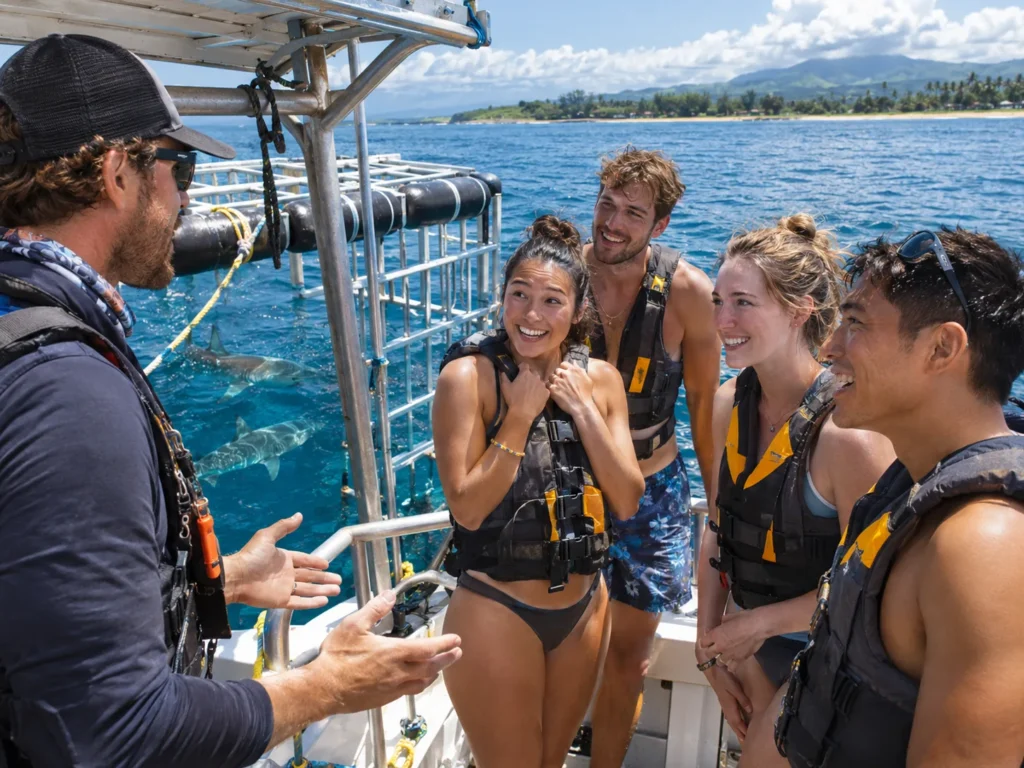
Few Oahu activities bring a more immediate combination of anticipation and awe. A boat leaves Haleʻiwa on the North Shore, travels into open ocean, and participants climb down into a cage secured beside the vessel. Seeing a shark glide through blue water is very different from watching one in a documentary. You are not learning scuba diving: the standard surface-cage format uses masks and snorkels.
Hawaii Shark Encounters advertises a roughly two-hour North Shore outing, ages five and older, with prices starting from $90 on its tour page. That is an operator-specific advertised starting price, not a universal Oahu fare. Other providers may have different age categories and seasonal or booking rates. Before reserving, compare the exact age threshold for the cage, the available observer option, the total duration and the refund terms.
The real beginner obstacle is often the boat
The cage can feel reassuring compared with unprotected immersion, but this is still an ocean-based wildlife trip. Rolling seas, motion sickness, wet decks and a ladder at the cage entrance may be more challenging than looking at the sharks. Clarify the required mobility, flotation arrangements, whether you must swim, and how much in-water time your ticket actually includes.
A cage-free shark swim is a different activity, with greater water exposure and a different participant profile. Do not substitute one booking for the other because both are advertised as “shark diving.” A traveler who is calm in a pool but anxious in open water might choose the cage format—or skip the ocean encounter entirely.
For an operator-by-operator breakdown, read our Oahu shark cage diving guide. For other U.S. destinations and differences in the types of encounters available, compare the best shark cage diving experiences in the USA. If you are comparing enclosed and open-water experiences on Oahu, check the dedicated cage-versus-cage-free article after confirming its URL on the live site.
3. Parasailing over Waikīkī — Best Accessible Height Thrill
Parasailing is visually dramatic without the freefall of a skydive. You are fitted into a harness on a boat, then rise as the boat pays out the parasail line. From the air you may see a sweep of Honolulu high-rises, turquoise water, and the shape of Diamond Head. Compared with surfing, you are generally not learning a complicated motor skill during the flight.
Hawaiian Parasail advertises $89 for its 800-foot-line option and $99 for its 1,000-foot-line option, before tax, with an approximately one-hour boat excursion and several minutes aloft. These numbers are rope or line lengths—not precise heights above the sea. Its operator policy starts at age five, but weather, individual health, weight combinations, harness suitability and the captain’s decision govern participation.
X-Treme Parasail lists another set of packages, including a 700-foot-line Standard option at $75 and higher-priced longer-line options. It also identifies additional cash charges at check-in. These are useful examples of why a “from” price is not the same as a fully settled checkout total.
What the flight is like
The most startling part may be leaving the boat rather than being airborne. After ascent, the air can feel quieter than expected, while the boat and coastline suddenly seem small. Wind and boat movement may still be noticeable, and a flight can end earlier than you imagine. If a companion wants the boat ride but not the flight, compare observer pricing.
Ask whether the price is per passenger, whether a photograph package is optional, how long you are actually in the air, and whether hotel transportation exists. Reserve a weather-sensitive activity early in the trip so there is an opportunity to reschedule.
4. Ziplining at Kualoa Ranch — Best Forest-and-Valley Adventure
Kualoa’s zipline is a different kind of Oahu thrill: instead of looking down at open sea, you move across a green valley framed by dramatic mountains. The operator’s published tour covers seven zipline sections, two suspension bridges and five short nature walks during a three-hour outing. That makes it a half-day commitment once check-in and travel are considered.
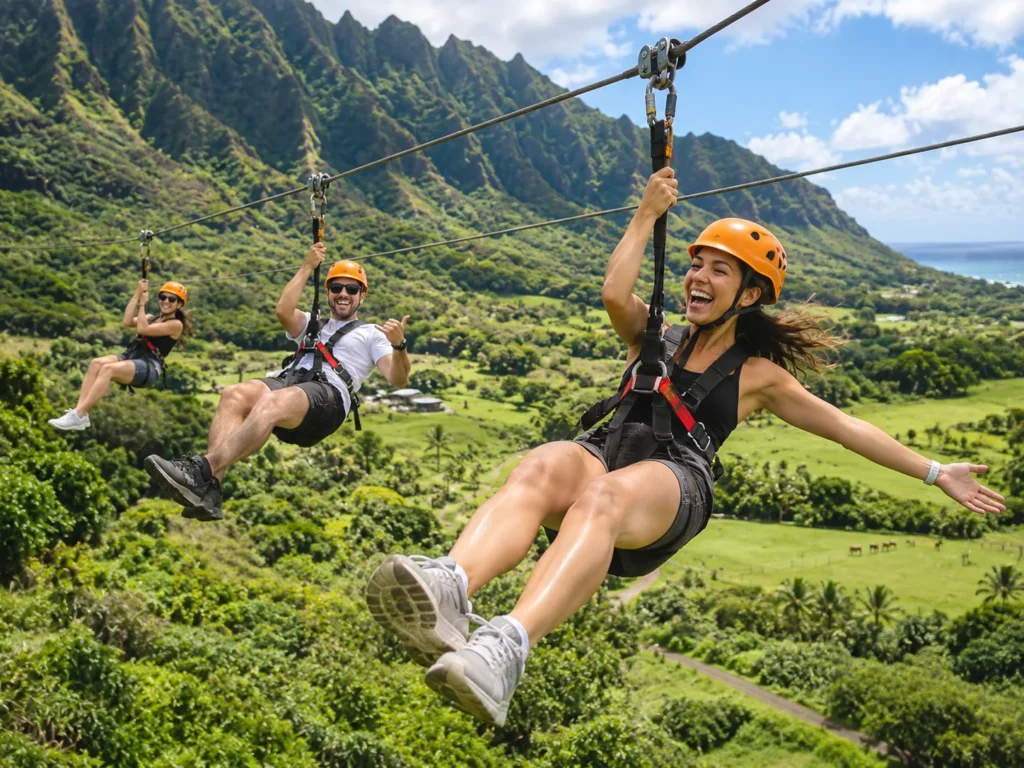
Kualoa currently advertises $184.95 per adult before tax. Its published zipline rules require an age of at least ten for participating children, height between 4 feet 8 inches and 6 feet 9 inches, weight between 70 and 280 pounds, and specific waist and upper-thigh measurements. A participant must meet the actual harness requirements at check-in; a number on a ticket is not a waiver of equipment limits.
Closed-toe, closed-heel shoes are required. The paths and bridges mean this is not simply a chairlift ride with an occasional glide. Travelers worried about height should ask how the course handles hesitation; travelers with mobility limitations should ask about walking terrain and transfers rather than assuming ziplining requires no exertion.
The experience is most compelling when you want scenery, a guided adventure, and height without the instant intensity of freefall. Bookings may fill up, so leave enough time to reach the windward side of the island rather than trying to squeeze it between two timed Honolulu reservations.
5. Tandem Skydiving on the North Shore — Biggest Adrenaline Leap
For travelers who explicitly want to fall through open air, a tandem skydive is the standout option. You are attached to an instructor, receive a briefing, board an aircraft and jump at the approved altitude. The sensation is not comparable to a short parasail flight: the freefall and canopy descent make it a larger psychological and financial commitment.
Skydive Hawaii’s published booking page lists a 14,000-foot online special of $198, a standard rate of $245, a $20 fuel surcharge and possible additional charges above a stated weight threshold. It says participants must be at least 18 and sets a maximum published weight of 250 pounds. These are snapshots from a specific provider, not a guaranteed price or eligibility outcome on any given day.
The most important Oahu-specific planning issue is that northern weather and flight operations can shift. Leave most of the day flexible, avoid scheduling another nonrefundable tour immediately afterward, and confirm how the operator treats cancellation, deposits, photo packages, and transport.
Who should choose it?
Choose skydiving if a tandem jump is a genuine priority and you are comfortable with the operator’s physical requirements. Do not choose it because an activity list makes it sound like a compulsory rite of passage. You can build an outstanding Oahu adventure trip without leaving an aircraft. For a broader comparison, our guide to the best places to skydive in the USA includes Oahu among its ocean-view destinations.
6. Diamond Head — Best Affordable Active Challenge
Diamond Head, also known as Lēʻahi, delivers a strong sense of place for comparatively little money. The reward comes from walking uphill, climbing stairs, moving through a tunnel, and reaching a summit view over Honolulu and the ocean. It is a physical effort rather than a guided commercial thrill ride, and that difference makes it a useful balance in an Oahu itinerary.
Hawaiʻi State Parks currently lists a $5 nonresident entry fee, with a separate $10 nonresident vehicle parking fee. Nonresidents must reserve entry and parking if applicable. Published park hours are generally 6 a.m. to 6 p.m., with a last-entry cutoff and holiday exceptions. The summit trail has uneven surfaces and steep stairs; the park estimates about 1.5 to 2 hours for the hike.
This is a good candidate for an early start, not an activity to add after hours of midday heat or after a strenuous water tour. Bring appropriate footwear, water and sun protection. A low admission price does not make the effort negligible, especially for a visitor unused to stairs or exposed sun.
7. Snorkeling or an Outrigger Canoe — Quieter Alternatives
Not every first-time Oahu adventure needs an “extreme” label. In suitable conditions, a guided outrigger canoe outing gives a sense of wave motion and teamwork with less personal skill development than surfing. A guided snorkel tour can reveal reef life, but snorkeling should not be casually sold as harmless or automatically appropriate for non-swimmers.
Hawaiʻi Ocean Safety’s June 2026 snorkeling guidance explicitly says participants should be experienced ocean swimmers. It highlights high surf, currents, poor visibility and fatigue as hazards. Beginners should check the day’s conditions, use a buddy, choose lifeguarded sites when possible and ask an appropriate operator about individual limitations. Someone uncomfortable swimming in the sea can enjoy the island from the shoreline, a lookout, a boat tour or a canoe with suitable guidance instead.
How the Same Oahu Adventure Changes with Season and Weather
Oahu is not a single interchangeable beach. Wind direction, swell, rain, visibility and local geography shape each experience. A lesson organized near Waikīkī can take place in conditions quite different from a North Shore shark boat departure on the same morning. A rain shower over a green windward valley does not necessarily tell you what the sea is doing offshore. That is why a map of tour locations and a review of weather exposure are more useful than treating every adventure as “a day on Oahu.”
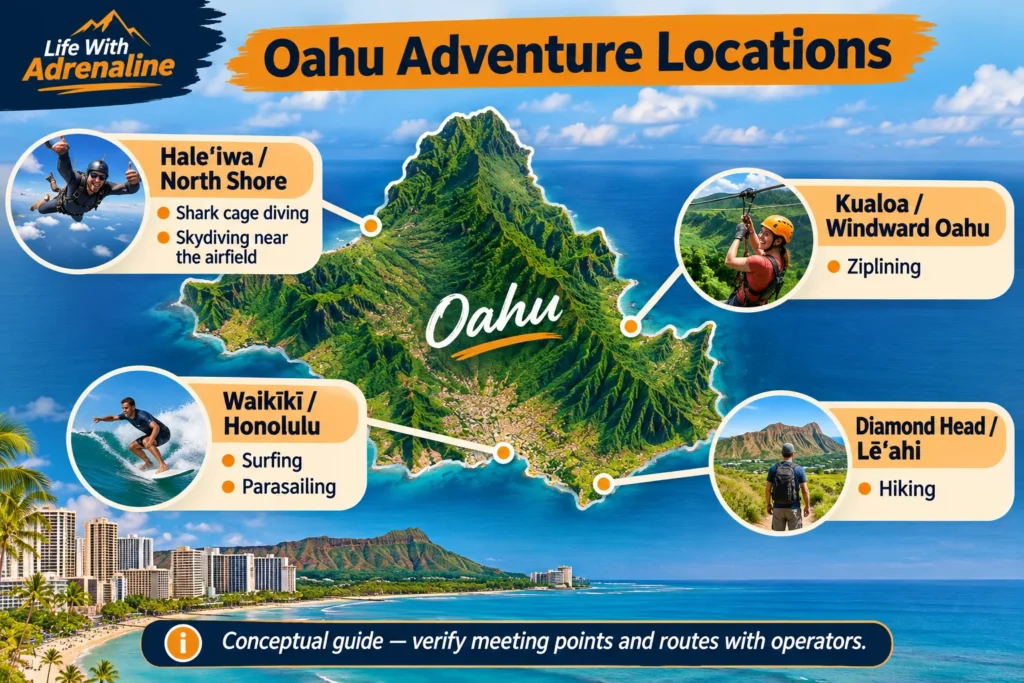
During the Hawaiian winter, North Shore waves can grow dramatically; some stretches become destinations for experts and spectators rather than places for a visitor to enter the water. In other seasons there can still be currents, shorebreak and unsafe surf. For beginner activities, ask the operator how conditions affect its chosen site, not whether the island generally has good weather that month. The official Hawaii Ocean Safety service publishes warnings and directs beachgoers to lifeguards and live conditions.
Sun exposure deserves as much planning as rain. An early Diamond Head reservation, a morning surf lesson and a midday Kualoa activity have different shade, hydration and clothing requirements. If an adventure is strenuous, a second equally strenuous reservation on the same day can be a poor trade even if driving times technically allow it.
Cage, Boat, Board or Air: Match the Type of Fear
Fear of height is not identical to fear of ocean depth. On a parasail, some visitors dislike the feeling of leaving the boat but soon enjoy the view; others find the suspended feeling unpleasant even when the ride is technically smooth. For a shark cage, watching wildlife is the purpose, but feeling the cage move in open water is the aspect some travelers find more demanding. In a surf lesson, falling off the board may feel less frightening than being in a crowded line-up.
Before booking, ask yourself which specific part sounds difficult. If the answer is not knowing what to do, a lesson format with repeated instructor feedback may help. If it is loss of control, read the procedures for stopping or returning. If it is deep water or motion sickness, a land-based zipline or scenic hike may be more enjoyable. The aim is not to “beat” a fear by ignoring it; it is to choose a setting in which the experience is challenging but appropriate.
What Changes When You Travel with Children or a Mixed-Ability Group?
Group bookings introduce a second kind of planning: what can everyone genuinely participate in? A child may meet a general tour minimum age but fail a specific weight or harness criterion. A person comfortable walking on level pavement may not be able to climb a ladder from a moving cage. And a friend who enjoys watching sharks from a boat may not want to get into the water.
Whenever possible, look for a format in which nonparticipants can still be part of the day without being pressured into the activity. Parasailing operators sometimes sell observer tickets; shark-boat providers may distinguish a cage participant from a boat rider. Those observer rates may not be trivial, so include them in your budget rather than assuming the group can come along for free.
For mixed abilities, consider a simple day structure: one bookable activity for those who want it, a nearby meal or coastal viewpoint for everyone, and no pressure to fill the rest of the schedule. A traveler who skips a jump should still feel that the trip was built for them.
Which Oahu Activity Is Best for You?
| Your priority | Strong first choice | Why | What could change the answer |
| Learn something tangible | Surf lesson | Technique plus a sense of progress | Swimming confidence; surf on the day |
| See wildlife up close | Shark cage | Dramatic experience without scuba | Seasickness, ladder mobility, cage eligibility |
| Enjoy an airborne view | Parasailing | Short guided air experience | Wind, harness fit, boat motion |
| Combine scenery and height | Kualoa zipline | Guided valley tour | Harness measurement rules and walking |
| Seek an intense lifetime goal | Tandem skydive | Actual freefall with instructor | Cost, adult eligibility, weather, health |
| Spend less while staying active | Diamond Head hike | Recognizable island view | Reservation, heat, steep stair sections |
There is no evidence-based ranking here of which operator is “safest.” The table is a fit guide. It reflects how the activity works, not a guarantee about conditions, risks or the suitability of a specific traveler.
A Practical Three-Day Oahu Adventure Plan
Day 1 — Stay Near Waikīkī and Build Confidence
Choose a morning surf lesson in conditions appropriate for your ability. Leave your afternoon open for beach time, a walk along Waikīkī or a light recovery activity. If you want an extra height experience, you could substitute parasailing for surfing rather than trying to stack both with an evening reservation. Get used to the time zone and heat before a more physically demanding outing.
Day 2 — North Shore: Choose Sharks or Skydiving
Drive to Haleʻiwa or your confirmed North Shore meeting point with plenty of buffer time. Select one major scheduled experience: a shark cage excursion or a tandem jump. Neither should be treated as a quick stop on a sightseeing loop. When it is over, enjoy lunch and the North Shore at a relaxed pace; do not plan swimming at an exposed beach unless current lifeguard guidance supports it.
Day 3 — Windward Valley or Summit View
Book the Kualoa zipline if you want a guided land-based adventure and your group meets its harness limits. Alternatively, reserve Diamond Head for an early hike and devote the rest of the day to unstructured island time. These alternatives are in different parts of Oahu, so do not combine them under a fantasy 15-minute transfer assumption.
For a four- or five-day trip, the most useful upgrade is a weather-buffer day, not an additional extreme sport. Oahu’s ocean and wind decide which days work for which activities.
What Does an Oahu Adventure Day Really Cost?
A sensible budget separates operator ticket prices from the rest of the day. The figures below are published snapshots from selected operators, not island-wide price averages. Taxes, transit, booking fees, optional photos, equipment, and gratuities may change the final bill.
| Activity | Published example | Pricing note |
| Hawaii Shark Encounters cage tour | From $90 | Operator starting price; confirm age category and final fare |
| Hawaiian Parasail | From $89 | 800-foot line; tax extra; flight minutes shorter than excursion |
| X-Treme Parasail | From $75 | 700-foot line; extra check-in charges listed |
| Kualoa zipline | $184.95 adult | Tax extra; size and harness requirements apply |
| Skydive Hawaii | $198 online special | Specific booking terms; fuel and weight charges possible |
| Diamond Head | $5 nonresident entry | Parking extra; required nonresident reservations |
A visitor planning two paid adventures can easily discover that ground transport and the price of a last-minute change matter as much as the second ticket. For example, parasailing and a Kualoa zipline at the published base rates would total $273.95 before any taxes or extras. That is arithmetic, not a checkout quote: the activities are run in separate places, and their time commitments are different.
A Realistic Planning Example: Two Travelers, Three Different Budgets
Imagine two adults staying in Waikīkī. One wants the feeling of flying; the other wants wildlife but is worried about getting seasick. There are several sensible approaches, and they have different costs without implying that one is objectively the best.
Option A is a small, city-focused adventure day: both choose Hawaiian Parasail’s published $89 base option. The two base tickets sum to $178 before tax, photos or travel. That is not a fixed final price and does not tell you whether the weather will permit the flight. It is simply a transparent ticket calculation.
Option B focuses on scenic land adventure: both are eligible for Kualoa’s published $184.95 adult zipline ticket. Their two base tickets sum to $369.90 before tax, transportation, food or photos. That outing also takes several hours and requires travel to the windward side of Oahu. It is not interchangeable with a one-hour Honolulu boat trip.
Option C mixes preferences: one traveler books a different tour while the other spends the day in a town or at an overlook. The full budget may be lower, and neither traveler is obliged to buy a ticket just to stay together. If two separate operator experiences are essential, schedule them on different days so a delayed boat or weather cancellation does not undermine the second booking.
These examples intentionally omit invented hotel, gas, parking and photo charges. Instead of guessing them, use the operator’s checkout, a realistic transport quotation and your actual itinerary. Record which costs are mandatory, optional, refundable and shared across the group. That is enough to compare choices honestly.
How to Book Without Spoiling the Trip
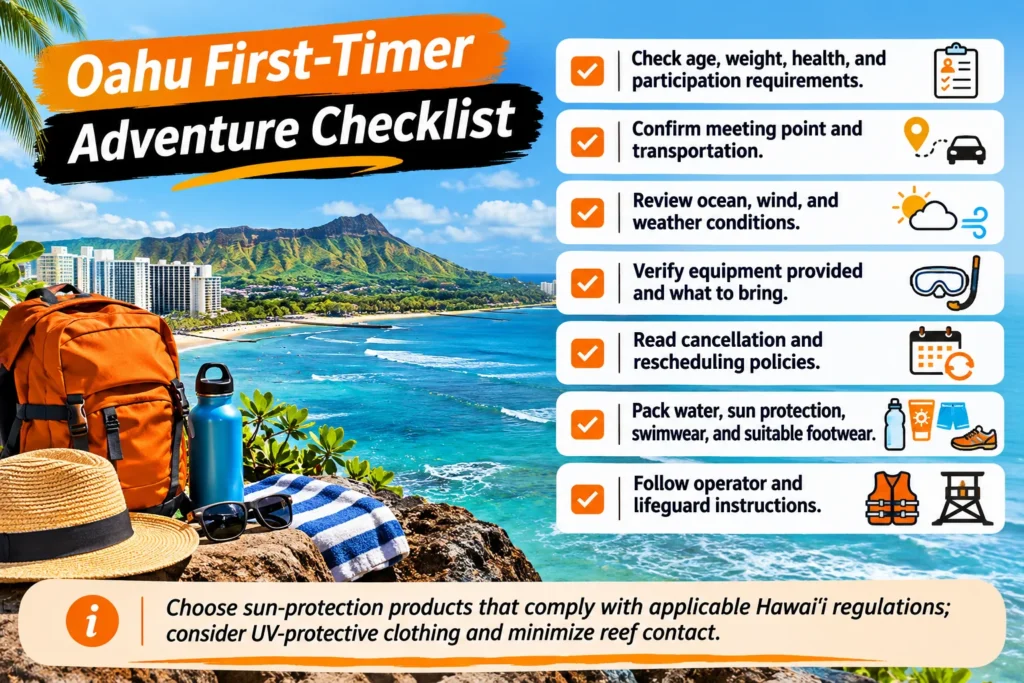
- Pick the activity you most want to do before selecting a specific tour operator.
- For ocean activities, check the exact departure harbor, boat exposure, swimming and mobility conditions.
- For aerial activities, check age, weight, harness or medical restrictions before checkout.
- Ask how much of a stated tour length is actual activity time.
- Compare the all-in fare: taxes, harbor fees, transport, photos, observers and deposits.
- Reserve weather-sensitive activities early in the vacation rather than on departure day.
- Avoid back-to-back nonrefundable tours in far-apart regions.
- Read cancellation and rescheduling rules, then keep copies of the real booking confirmations.
- Confirm all water conditions with local authorities and lifeguards on the activity day.
- Never assume the best social-media photograph is the easiest or safest trip for your group.
Oahu Ocean Safety Is Not Optional
Hawaiʻi Ocean Safety advises visitors to choose lifeguarded beaches, observe warnings, ask lifeguards about current hazards, and swim with a buddy. Shorebreak, rip currents and surf can change rapidly. The North Shore is particularly exposed to seasonal high surf, and a beach that looks manageable from a parking lot may be unsuitable once you approach the water.
Do not describe a beach as safe solely because a guidebook says its waves are “usually small.” Review local warnings before entering. If the ocean is not appropriate for swimming that day, enjoy the coastline from shore or change to a land-based activity. Similarly, a wind cancellation from a parasail or zipline operator is not a challenge to bargain around.
Frequently Asked Questions
What is the best first adrenaline activity in Oahu?
For many visitors seeking a manageable introduction, a guided Waikīkī surf lesson in suitable conditions or a professionally operated parasailing tour is a strong option. A shark cage is compelling for wildlife fans who tolerate ocean travel. None is appropriate for everyone; eligibility and day-of conditions govern.
Can non-swimmers go shark cage diving in Oahu?
Some surface-cage operators state that swimming ability is not required, but participants still need to meet the operator’s physical and ladder requirements. Confirm this directly and never assume that a cage-free swim uses the same rules.
Is Oahu skydiving suitable for a first jump?
Tandem skydiving is designed as an introductory skydiving format with an instructor, but it remains a high-intensity activity. The referenced operator requires adults and has weight and other eligibility rules. Book only after reviewing the operator’s current restrictions.
How many adventures should I book on a three-day Oahu trip?
Two substantial guided experiences and a flexible third day is often a more enjoyable plan than forcing five reservations into tight geographic windows. Allow travel, waiting, check-in, weather disruption and recovery time.
Is Kualoa Ranch ziplining for everyone?
No. Kualoa publishes age, height, weight and body-measurement requirements, and the tour includes bridges and walking. Every participant must fit the required equipment and meet the operator’s conditions.
Can I do Oahu adventure activities without renting a car?
Some Honolulu activities are relatively convenient from Waikīkī, but North Shore and windward-side excursions demand more planning. Check whether your operator provides transportation, whether pickup is included in your fare, and how you will return if the activity ends late or is canceled.
Seven Mistakes That Make a First Oahu Adventure Harder Than Necessary
The first is choosing the name of an activity instead of the format. “Shark diving” could mean a surface cage with a ladder or a cage-free open-water swim. “Flying” could mean several minutes suspended beneath a parasail or an actual tandem freefall. Ask for the physical process from check-in through return, not just the marketing headline.
The second is using a tour length as if it were time in action. A one-hour parasailing outing can include only minutes in the sky; a shark excursion includes transit and rotations; Kualoa’s three-hour zipline outing includes briefing and walking. All can be worthwhile, but they answer different expectations.
The third is ignoring the nonparticipant. A partner or child who cannot meet a weight requirement may still be charged as an observer on a boat. In some activities there is no useful observer ticket at all. Plan the entire group’s day instead of assuming everyone can join every reservation.
The fourth is turning an advertised price into a promised total. Taxes, optional photos, fuel charges, extra transportation, and eligibility-related fees can change the arithmetic. Screenshot the selected package and check its exact conditions before payment. Do not compare a promotional skydive with a regular-price alternative without explaining why the prices differ.
The fifth is scheduling too tightly. Honolulu, Haleʻiwa and the windward coast are distinct travel areas. A single traffic delay, late boat return or weather hold can make your next timed ticket impossible to use. Choose a day’s main activity before adding smaller stops.
The sixth is treating good online reviews as a safety certificate. Reviews can describe guide communication, booking convenience or scenery, but they do not establish that a tour is suitable for a traveler with specific medical, swimming or mobility limitations. Read operator requirements and ask direct questions instead.
The seventh is forgetting that taking a day off is part of an adventure vacation. After an anxious first ocean outing or a demanding hike, a relaxed meal and sunset may be more memorable than another rushed activity. Keeping open time is a deliberate choice, not a failure to see Oahu.
The Bottom Line
The best first Oahu adventure is not the one with the most intimidating name. It is the one you understand, are eligible for, and can comfortably fit into your visit. Waikīkī surfing rewards practice; shark cage diving rewards nerve and flexibility; parasailing gives a taste of flight; Kualoa offers a scenic height adventure; skydiving delivers the strongest freefall experience; and Diamond Head makes an outstanding lower-cost counterpoint.
Choose based on your actual limits and goals, book from a live source, and leave room for the weather to change the plan. Your vacation will be better for it.
Sources and Verification
Hawaiʻi Tourism Authority / Go Hawaiʻi — Waikīkī Beach: https://www.gohawaii.com/islands/oahu/things-to-do/beaches/waikiki-beach
Hawaiʻi Ocean Safety — ocean conditions and beach warnings: https://oceansafety.hawaii.gov/
Hawaiʻi Ocean Safety — snorkeling guidance (updated June 2026): https://oceansafety.hawaii.gov/snorkeling-safety/
Hawaii Shark Encounters — cage tour and published starting price: https://hawaiisharkencounters.com/tours/
One Ocean Diving — cage-free operator context: https://oneoceandiving.com/
Hawaiian Parasail — published prices and restrictions: https://hawaiianparasail.com/parasailing/
X-Treme Parasail — current package examples: https://xtremeparasail.com/parasailing
Kualoa Ranch — zipline itinerary, pricing and physical restrictions: https://www.kualoa.com/tours-and-activities/zipline-tour
Skydive Hawaii — published booking terms: https://go.skydivehawaii.com/booking/
Hawaiʻi DLNR — Diamond Head State Monument: https://dlnr.hawaii.gov/dsp/parks/Oahu/diamond-head-state-monument/