
Oahu shark cage diving is one of the island’s easiest ways to get a serious wildlife adrenaline rush without learning to scuba dive. Current direct adult cage prices checked on August 27, 2026 were $112 with an online special at North Shore Shark Adventures, $125 at Hawaii Shark Encounters, and $135 at Haleiwa Shark Tours. The main tours leave Haleiwa on Oahu’s North Shore, run about 1.5 to 2 hours, and travel roughly 3 miles offshore. [S1][S3][S5]
For a first-timer, the sharks are only part of the decision. The more practical questions are whether you handle open-ocean motion well, whether you can climb in and out of a surface cage, whether the operator’s age rules fit your group, and what happens if wind or swell changes the schedule. At least two current operators say swimming ability is not required, but ladder mobility still matters. [S1][S4]
If you are choosing between Oahu shark tours, focus less on who has the loudest “bucket list” marketing and more on the exact tour format, morning departure time, total checkout cost, cancellation policy, and how the boat portion fits the rest of your North Shore day.
Oahu Shark Cage Diving at a Glance
| Question | Practical answer |
| Where do tours leave from? | Haleiwa Small Boat Harbor on Oahu’s North Shore. [S1][S3][S10] |
| How far offshore? | Roughly 3 miles, depending on the operator and tour site. [S1][S3][S5] |
| How long does it take? | About 1.5 to 2 hours for the tour, plus early check-in. [S1][S3][S5] |
| Do you need scuba certification? | No. These are surface-cage snorkel experiences. [S3][S4] |
| Do you need to swim? | North Shore Shark Adventures and Hawaii Shark Encounters currently say no swimming skill is required for their cage format. [S1][S4] |
| What sharks are common? | Galapagos and sandbar sharks are the main species associated with the Haleiwa cage sites. [S3][S8] |
| Is this a great-white dive? | No. Great whites are not the normal target of Oahu’s North Shore cage tours. |
| Biggest beginner challenge? | Often the moving boat, seasickness, and ladder entry rather than technical diving skill. [S2][S4] |
| Best time of day? | Early morning is the strongest practical choice because operators say winds and sea conditions are often calmer earlier. [S1][S4] |
| Is it year-round? | Current operators advertise daily or year-round operation, but individual departures remain weather-dependent. [S1][S3][S5] |
How Much Does Oahu Shark Cage Diving Cost?
There is no single Oahu shark cage diving price. Each operator sets its own age bands, observer rates, promotions, and policies, and third-party booking sites can display a different price from the operator’s own page.
The most useful comparison is the current direct price.
Current Direct Prices Checked August 27, 2026
| Operator | Adult cage diver | Child cage diver | Boat rider | Posted duration |
| North Shore Shark Adventures | $112 online special, age 14+ | $90, ages 3–13 | $90 | 1.5 hours; about 2 hours from check-in to completion [S1] |
| Hawaii Shark Encounters | $125, age 13+ | $90, age 12 and under | $100 | 2 hours [S3] |
| Haleiwa Shark Tours | $135, age 13+ | $95, age 12 and under | $105 | 1.5–2 hours [S5] |
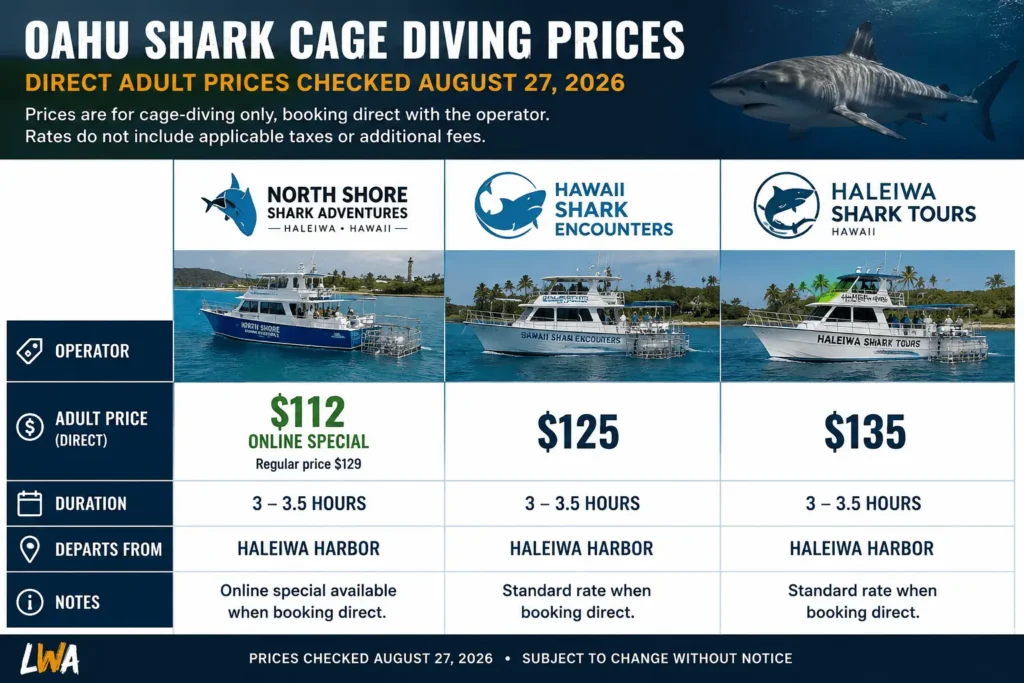
These are published prices, not guaranteed checkout totals. North Shore Shark Adventures explicitly states that its listed prices do not include tax. For the other operators, confirm taxes, booking charges, and any optional media add-ons on the live checkout screen before paying. [S1]
North Shore Shark Adventures also currently offers selected round-trip transportation from Waikiki for $75 per person plus tax. That makes its published adult online-special tour plus transportation $187 before tax. The operator warns that its transportation charge is not refundable if the shark tour is canceled on the day of the trip, so read that term carefully before using the shuttle instead of driving. [S1]
For a couple self-driving, the published base cage cost is currently about $224 at North Shore Shark Adventures using the online special, $250 at Hawaii Shark Encounters, or $270 at Haleiwa Shark Tours before taxes and extras. Those numbers are specific examples, not an average price for shark diving in Hawaii.
A family should compare age rules before comparing totals. A “child” category does not mean the same thing at every operator, and a boat-rider age rule may not be the same as actual cage eligibility.
Which Operator Looks Like the Best Fit?
This is not a safety ranking. The current operator pages simply emphasize different things.
North Shore Shark Adventures is worth comparing if you want a clearly published early-morning schedule, an optional Waikiki transportation service, a posted 24-hour cancellation policy, and a tour that specifically says no swimming is required. It currently describes one cage session per passenger, with the cage dropped up to three times per tour for about 20 minutes each drop. [S1]
Hawaii Shark Encounters is useful for travelers who want very explicit beginner information before booking. Its FAQ explains the ladder entry, the physical effort needed to pull yourself back onto the boat, seasickness, special-needs arrangements, what equipment is supplied, and a minimum age of 5. Its current tour page lists Galapagos and sandbar sharks as the expected species. [S3][S4]
Haleiwa Shark Tours stands out for its Native Hawaiian ownership and its emphasis on Hawaiian cultural interpretation. Its current page lists two boat capacities, up to six or 12 passengers depending on the boat, and includes water, masks, and snorkels. The page lists the tour as “all ages,” but it does not clearly separate the minimum age for entering the cage from the general passenger age. Families with very young children should confirm cage eligibility directly before paying. [S5]
What to Expect, Step by Step
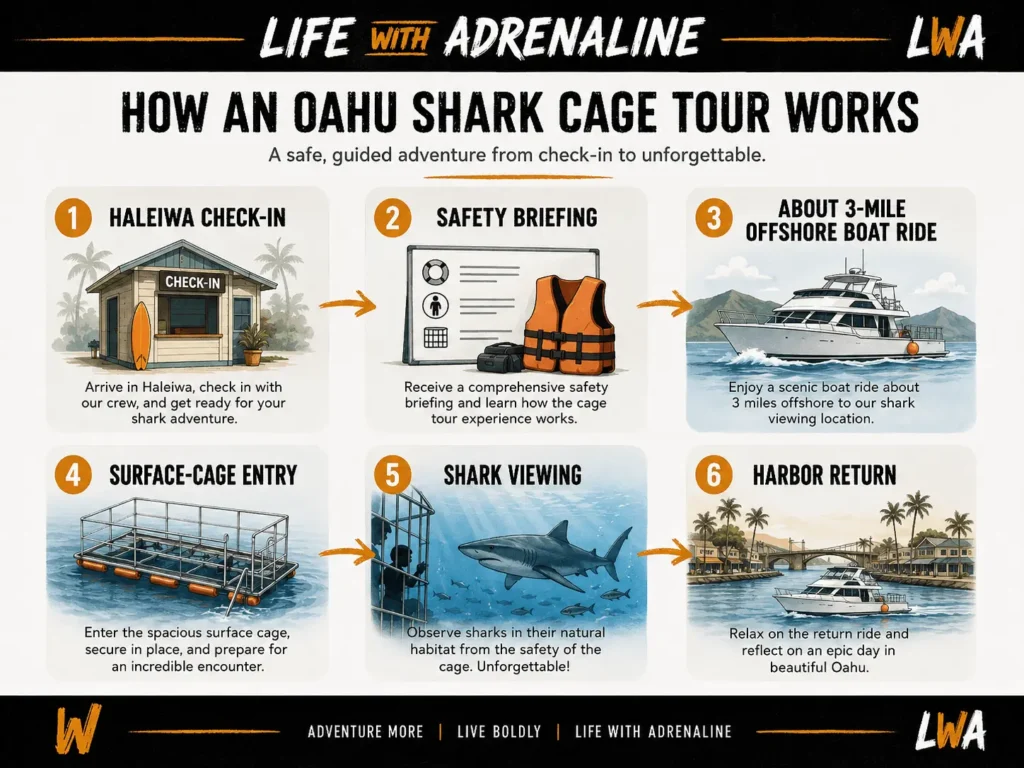
1. Drive to Haleiwa and Check In Early
The shark-cage operators in this guide depart from Haleiwa on Oahu’s North Shore. Hawaii’s Division of Boating and Ocean Recreation lists Haleiwa Harbor at 66-105 Haleiwa Road and confirms that the harbor has restrooms, loading docks, and boat-launch facilities. [S10]
North Shore Shark Adventures and Hawaii Shark Encounters both tell guests to check in about 30 minutes before departure. Do not build a tight schedule that gets you to the harbor at the exact departure time. [S1][S4]
If you are staying in Waikiki, one current operator estimates the drive at roughly 1.25 hours. Leave extra time for traffic, finding the harbor entrance, parking, and check-in. [S1]
2. Listen to the Safety Briefing and Get Your Gear
Expect a boat and cage briefing before you enter the water. North Shore Shark Adventures says it begins tours with a safety briefing and supplies masks and snorkels. Hawaii Shark Encounters also provides a mask and snorkel and says no scuba or snorkeling experience is required. [S1][S4]
This is not a scuba dive. The cage floats at the surface beside the boat, so you breathe through a snorkel and can raise your head above the water.
3. Ride About 3 Miles Offshore
The trip to the shark-viewing area is short in distance but very different from a protected bay cruise. Hawaii Shark Encounters says the run is about 3 miles and usually takes around 15 to 20 minutes depending on conditions. [S4]
That open-ocean setting is the part many first-timers underestimate. The boat can keep rolling while groups rotate through the cage, even on a day that looks calm from the beach.
If you are prone to motion sickness, take the risk seriously. Operator FAQs specifically warn about seasickness. If you use motion-sickness medication, follow the product directions or guidance from an appropriate healthcare professional rather than improvising a dose on tour day. [S2][S4]
4. Enter the Surface Cage
You do not jump into deep water and descend with scuba gear.
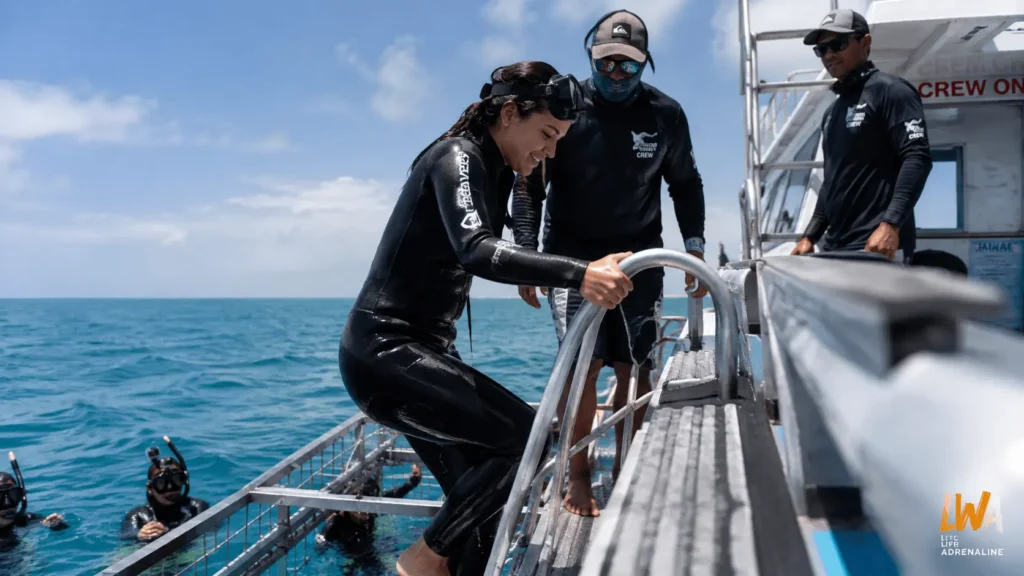
The cage is secured beside the boat. At Hawaii Shark Encounters, guests climb down a short ladder and hold a handrail inside the cage. The operator says you must be able to climb into the cage and pull your own body weight back up the ladder. [S4]
North Shore Shark Adventures similarly says staff can assist, but the customer should have enough strength and agility to descend and ascend a vertical ladder. [S2]
That makes mobility a more useful screening question than “Am I a strong swimmer?”
5. Watch Sharks at Eye Level and Below You
Galapagos and sandbar sharks are the main animals to expect. Hawaii Shark Encounters currently names those two species as its most common visitors, and University of Hawaii research at the Haleiwa cage-dive sites found that Galapagos and sandbar sharks made up 98% of sharks observed in the study. [S4][S8]
They may pass close to the cage, but proximity, visibility, number of sharks, and exact behavior are wildlife variables. Do not book because a social-media clip promises a particular number of sharks or a particular species.
North Shore Shark Adventures currently advertises a shark-sighting guarantee, and Hawaii Shark Encounters says you do not pay if no sharks are seen. Treat those as operator-specific commercial policies, not a guarantee of a certain viewing quality. [S1][S4]
6. Rotate Back to the Boat and Return to Haleiwa
Your actual cage time is shorter than the total tour. North Shore Shark Adventures currently describes about 20 minutes for each cage drop, with passengers generally receiving one drop. [S1]
Other operators may organize rotations differently, so ask if in-water time matters to you.
Once your group is back aboard, the ride returns to Haleiwa. One practical detail: North Shore Shark Adventures says there is no bathroom on its boats, so use the harbor restroom before departure. [S2][S10]
Is Oahu Shark Cage Diving Safe?
“Safe” is too simple a word for an open-ocean wildlife activity.
A shark cage creates a physical barrier between the participant and the animals, and current tours use a structured boat-to-cage process rather than asking beginners to scuba dive freely. That reduces some forms of exposure, but it does not remove the normal hazards of boating, ocean motion, wet ladders, changing weather, or being around large wild animals.
A sensible safety decision separates four things.
The Cage and Operator Procedure
Read the current briefing, entry method, age limits, and physical requirements for the exact operator you book. Do not assume one company’s “all ages” language, swimming policy, or ladder design applies to another company.
If you have limited mobility, a recent injury, pregnancy, a health condition, or another concern that could affect climbing a moving ladder or tolerating a small boat offshore, contact the operator before paying and seek appropriate medical advice when needed.
The Open-Ocean Environment
For many beginners, this is the biggest practical issue.
Wind and swell can change the ride, and operators sometimes cancel or reschedule. Hawaii Shark Encounters recommends leaving flexibility in your itinerary because weather can force a change. North Shore Shark Adventures strongly encourages early departures because winds are typically lighter earlier in the day and later tours can be canceled. [S1][S3]
That is why the smartest booking strategy is to schedule the shark tour early in your Oahu trip, not on the last morning before your flight home.
What Research Says About the Haleiwa Shark Sites
University of Hawaii researchers studied sharks associated with the North Shore cage-dive sites using acoustic tracking. Their research found that inshore movements by tagged sharks associated with the sites were extremely rare and found no evidence that the sharks followed tour boats back to Haleiwa Harbor. The project concluded that it found no evidence that the cage-dive operations studied were a threat to public safety. [S8]
That work is valuable context, but it dates to the operations studied in the 2000s. It is not a current accident-rate audit, it does not certify an individual operator, and it cannot guarantee the outcome of a future trip. Use it for ecological and public-safety context, not as a substitute for reviewing today’s operator procedures. [S8][S9]
Shark-Feeding Rules and Wildlife Ethics
Hawaii law prohibits activities related to feeding sharks in state waters as part of a commercial activity. Hawaii also protects sharks and rays from intentional capture, entanglement, or killing in state marine waters. [S6]
North Shore Shark Adventures currently states that it does not need to chum the water and says sharks are attracted to the sound of its motors. [S1]
If wildlife-conditioning practices matter to your decision, ask the specific operator how sharks are attracted and where the viewing activity occurs. Do not rely on an old blog post or a third-party description, because practices and laws can change.
What Sharks Will You Actually See?
Book Oahu cage diving for Galapagos and sandbar sharks, not for great whites.
Those are the two species most consistently documented at the North Shore cage-tour sites. University of Hawaii research identified them as 98% of sharks observed in its study, and Hawaii Shark Encounters currently lists both as its common visitors. [S4][S8]
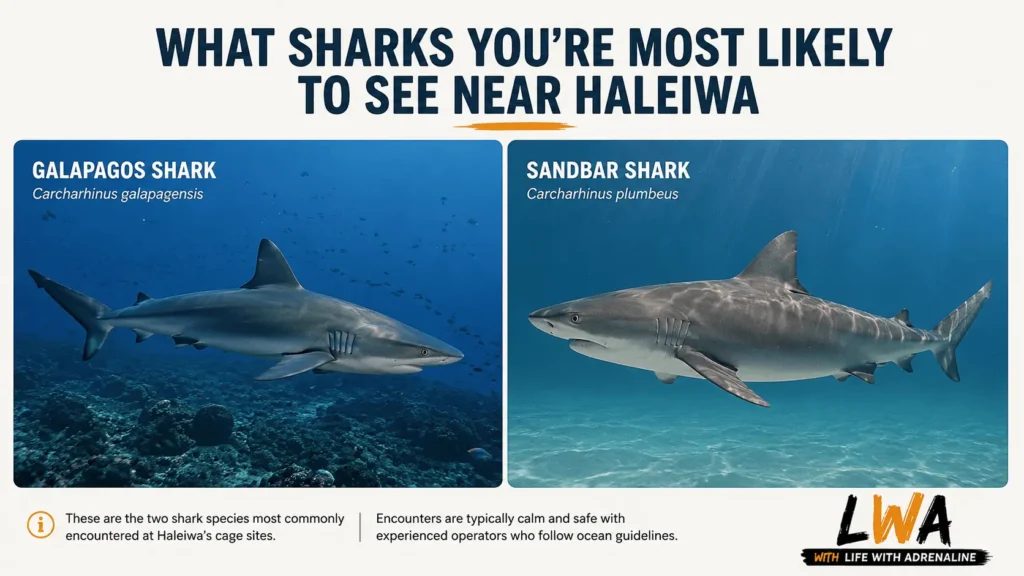
Other species can appear, but they should be treated as a bonus rather than a promise. If your goal is specifically to see a tiger shark, hammerhead, or great white, this is the wrong experience to book around a guaranteed species expectation.
That distinction matters because “shark cage diving” looks like one activity in search results, but Oahu’s surface-cage experience is very different from destinations historically known for great-white cage diving.
When Is the Best Time to Go?
The current Oahu North Shore cage tours are advertised as year-round or daily operations. The better planning question is usually what time of day, not what month. [S1][S3][S5]
Both North Shore Shark Adventures and Hawaii Shark Encounters favor early trips because North Shore winds often build later. North Shore Shark Adventures starts at 6 a.m. during June through August and otherwise lists a first departure at 7 a.m. [S1][S4]
An early tour also gives you more room to reschedule if weather cancels the first attempt.
Do not interpret “year-round” as “guaranteed to run every day.” Ocean conditions control the final decision.
What to Bring
You do not need to buy specialized diving gear for a standard surface-cage trip.
- a swimsuit;
- a towel;
- sunscreen;
- a dry shirt or light windbreaker for the ride back;
- any personal mask/snorkel you strongly prefer, if the operator allows it;
- a secure underwater camera only if the operator permits it;
- water or a small snack if your operator allows outside drinks and food.

Masks and snorkels are currently included by the operators reviewed here. Haleiwa Shark Tours also says it supplies water. [S1][S4][S5]
Avoid turning this into a gear-shopping project. The main preparation is being ready for a wet, windy, moving boat.
Who Should Book — and Who Should Think Twice?
Oahu shark cage diving is a strong fit if you want:
- a high-fear wildlife experience with relatively low technical skill;
- a North Shore activity that fits into roughly half a day;
- a shark encounter without scuba certification;
- an activity where a non-diving companion may still be able to ride on the boat;
- a memorable first adrenaline experience that is more about nerve than athletic endurance.
Think twice, or talk directly with the operator first, if:
- you become severely motion sick on small boats;
- climbing a vertical ladder in moving water could be difficult;
- your group includes very young children and the cage-age rule is unclear;
- you have a health or mobility concern affected by open-ocean conditions;
- your Oahu schedule leaves no room for weather cancellation;
- you are booking specifically because you expect a great white shark.
Before-You-Book Checklist
[ ] Confirm the live adult, child, and boat-rider prices.
[ ] Check whether taxes or booking fees are added at checkout.
[ ] Verify the exact minimum age for entering the cage, not just riding the boat.
[ ] Check the ladder and mobility requirements.
[ ] Ask about accommodations before booking if anyone has special needs.
[ ] Choose an early-morning departure when possible.
[ ] Leave another day available in case weather forces a reschedule.
[ ] Read the cancellation deadline and no-show policy.
[ ] Confirm whether hotel transportation is included, optional, or unavailable.
[ ] Ask how much time you can expect inside the cage.
[ ] Confirm what gear is supplied.
[ ] Use the restroom before boarding.
[ ] Bring a towel and a dry layer.
[ ] If you are prone to motion sickness, make a plan before tour day.
[ ] Do not book based on a guaranteed sighting of a specific shark species.
FAQ
Do you need scuba certification for Oahu shark cage diving?
No. The North Shore cage tours reviewed here are surface-cage snorkeling experiences, not scuba dives. Hawaii Shark Encounters explicitly states that no scuba or snorkeling experience is required. [S3][S4]
Do you need to know how to swim?
Not necessarily. North Shore Shark Adventures says no swimming is required, and Hawaii Shark Encounters says it takes guests who do not know how to swim. You still need to meet the operator’s cage-entry and ladder requirements and follow the crew’s instructions. [S1][S4]
How much is shark cage diving in Oahu?
For adult cage divers, the direct published prices checked August 27, 2026 were $112 online at North Shore Shark Adventures, $125 at Hawaii Shark Encounters, and $135 at Haleiwa Shark Tours, before any applicable tax or added fees. [S1][S3][S5]
How long is an Oahu shark cage tour?
Current operator pages list about 1.5 to 2 hours. North Shore Shark Adventures asks guests to check in 30 minutes early and says total time from check-in to completion is about two hours. [S1][S3][S5]
What kinds of sharks do you see?
Galapagos and sandbar sharks are the main species to expect at the North Shore sites. They accounted for 98% of sharks observed in a University of Hawaii study of the cage-dive sites. [S4][S8]
Can kids go shark cage diving on Oahu?
Yes, but the age rules vary. Hawaii Shark Encounters currently lists ages 5+, North Shore Shark Adventures has child categories beginning at age 3 and permits infants on early tours as boat passengers, and Haleiwa Shark Tours lists the experience as all ages while its price categories separate adults 13+ from children 12 and under. Confirm actual cage-entry eligibility for young children directly with the operator. [S1][S3][S5]
What happens if the weather is bad?
Tours can be changed, rescheduled, or canceled when ocean conditions are unsuitable. Policies differ. North Shore Shark Adventures currently offers refunds for operator-canceled tour fees but says some outside costs and its transportation charge may not be refundable. Hawaii Shark Encounters advises guests to leave flexibility for weather rescheduling. [S1][S3]
Is the earliest tour really better?
It is usually the best planning choice. Two current operators say North Shore conditions are commonly calmer earlier and wind tends to build later in the day. That does not guarantee smooth water, but it gives you the strongest practical odds and more time to reschedule if needed. [S1][S4]
Final Recommendation
For most first-time visitors, Oahu shark cage diving makes sense when you treat it as an open-ocean boat experience first and a shark encounter second.
Choose an early departure from Haleiwa, compare the operator’s direct price and cancellation terms, verify the age and ladder requirements for every person in your group, and schedule the trip early enough in your vacation to survive a weather change.
You do not need scuba skills to get the adrenaline. You do need realistic expectations.
Expect Galapagos and sandbar sharks, a short surface-cage session, a moving boat, and a lot more calm observation than movie-style chaos. If that combination sounds exciting rather than disappointing, Oahu’s North Shore is one of the most approachable places in the United States to try shark cage diving.
Sources
[S1] North Shore Shark Adventures — Oahu Shark Diving Tour. https://sharktourshawaii.com/shark-diving-tour/
[S2] North Shore Shark Adventures — FAQ. https://sharktourshawaii.com/faq/ https://hawaiisharkencounters.com/shark-cage-diving/
[S4] Hawaii Shark Encounters — FAQ. https://hawaiisharkencounters.com/faq/
[S5] Haleiwa Shark Tours — O’ahu Shark Diving Tour. https://www.haleiwasharktours.com/shark-cage-diving/
[S6] Hawaii DLNR Division of Aquatic Resources — Special Provisions, Licenses and Permits. https://dlnr.hawaii.gov/dar/fishing/fishing-regulations/special-provisions-licenses-and-permits/
[S7] Hawaii DLNR Division of Aquatic Resources — Marine Protected Species. https://dlnr.hawaii.gov/dar/marine-protected-species/
[S8] Hawaii Institute of Marine Biology — Movements of Sharks Associated with Cage Dive Ecotourism. https://www.himb.hawaii.edu/ReefPredator/Shark%20Ecotourism.html
[S9] University of Hawaii at Manoa — Shark cage diving study news. https://manoa.hawaii.edu/news/article.php?aId=2964
[S10] Hawaii DLNR Division of Boating and Ocean Recreation — Haleiwa Harbor. https://dlnr.hawaii.gov/dobor/haleiwa-harbor/