New River Gorge Adventure Guide: Rafting, Bridge Walks, Ziplines, and More
New River Gorge is the kind of place where a single vacation can feel like three different trips. In the morning you can watch mist lift from a forested canyon; later you can paddle through whitewater, walk beneath a bridge hundreds of feet above the river, or clip into a zipline course. The challenge is not finding adventure. It is choosing a combination that fits your comfort level, budget, and time.
This guide is for a first visit of two to four days based around Fayetteville, West Virginia. It compares genuinely different experiences, suggests a realistic itinerary instead of a race between activities, and explains what to reserve before you arrive. It does not claim that every river section or aerial course is beginner-friendly, or that published prices and eligibility rules will remain unchanged.
Quick Answer: The Best New River Gorge Adventures for a First Visit
For a two-day visit, pick one paid centerpiece—either an Upper New River rafting trip for gentler water, a Lower New River trip if your group is comfortable with more forceful whitewater, or the guided Bridge Walk for an unforgettable height experience. Add Canyon Rim Visitor Center and one trail rather than trying to fit every booking into the same afternoon.
With three days, a common combination is one river day, one Bridge Walk or zipline day, and one flexible overlook-and-hiking day. With four days, you can add a second guided experience or explore farther into the park. The right choice is personal: a visitor seeking spectacular views but minimal adrenaline has very different priorities from someone who wants a hard-paddling day.
| Experience | Why go | Important planning reality |
| Upper New rafting | Gentler river introduction | River section, age, and flows vary by outfitter |
| Lower New rafting | Stronger whitewater and gorge views | NPS describes powerful Class III–V rapids; not a universal beginner trip |
| Bridge Walk | Harnessed exposure beneath the famous bridge | Age 8+, at least 48 in; 2+ hours; harness fit required |
| TreeTops zipline | Guided canopy travel over forest and bridges | 10+ with adult; 90–260 lb; hikes between lines |
| Canyon Rim overlook | Fast bridge views and visitor information | Free park entry; lower deck involves stairs |
| Long Point or Endless Wall | Classic rim scenery and bridge photographs | Uneven trails; exposed cliff edges and limited parking |
Where to Stay: Use Fayetteville as Your Base
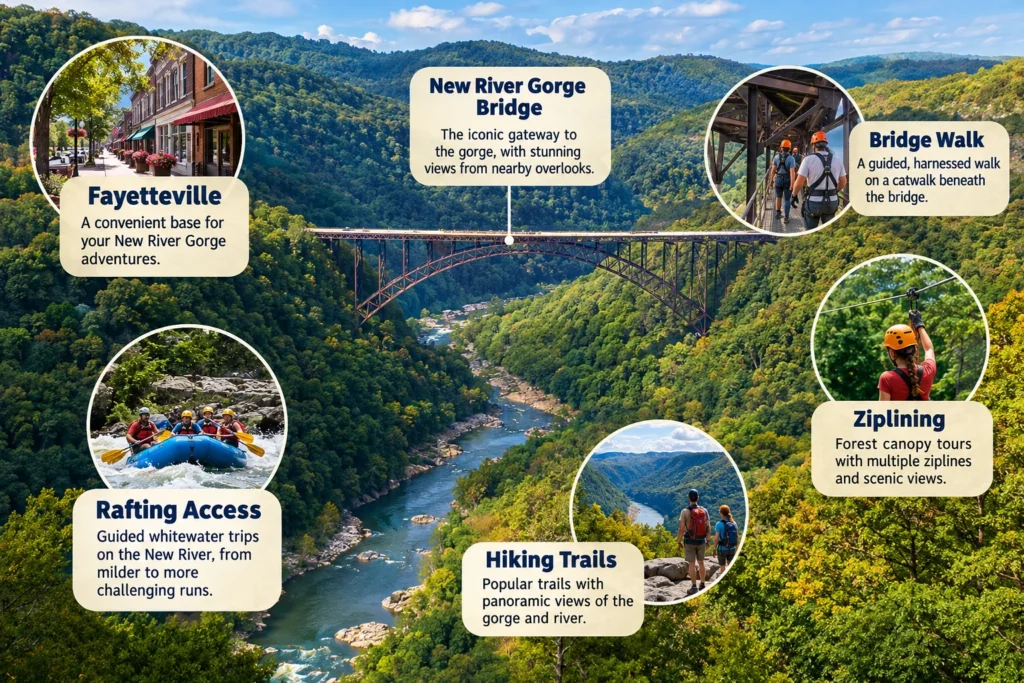
Fayetteville is a practical first-time base because it puts restaurants, groceries, independent lodging, the Canyon Rim area, and several adventure check-ins within the same general region. Nearby Lansing, Oak Hill, and Hico also offer outfitter lodging, cabins, camping, and resort-style stays. Choose the accommodation after you know where your activity actually starts; a zipline campus and a river put-in may require separate check-in locations.
A car gives you the most flexibility. Do not plan this park like a compact urban attraction with one shuttle connecting every sight. The national park follows a long corridor of river, and some scenic sites are well beyond the bridge area. Download maps before leaving town, especially if you want to explore quieter roads or the southern end of the park.
If you dislike morning logistics, staying at an outfitter campus can simplify one or more paid activities. Compare the complete lodging rate, arrival instructions, meal options, and cancellation terms with independent accommodation in Fayetteville. Convenience is valuable, but it does not automatically mean a cheaper trip.
1. Whitewater Rafting: Choose the Right Section of the New River
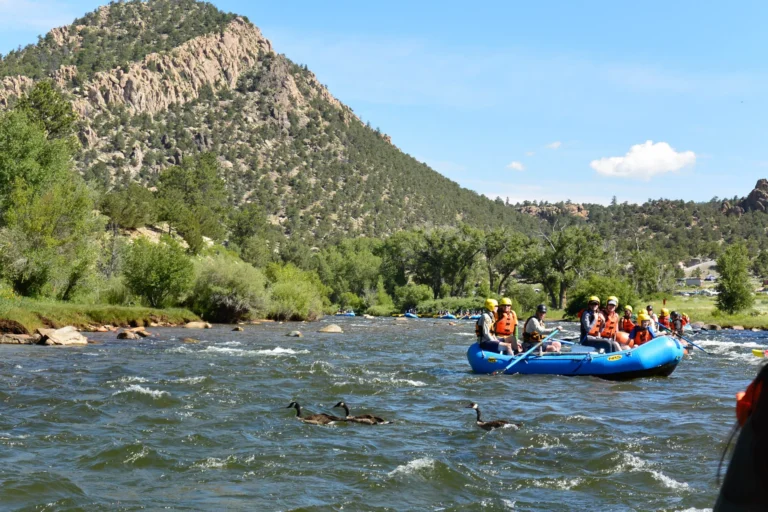
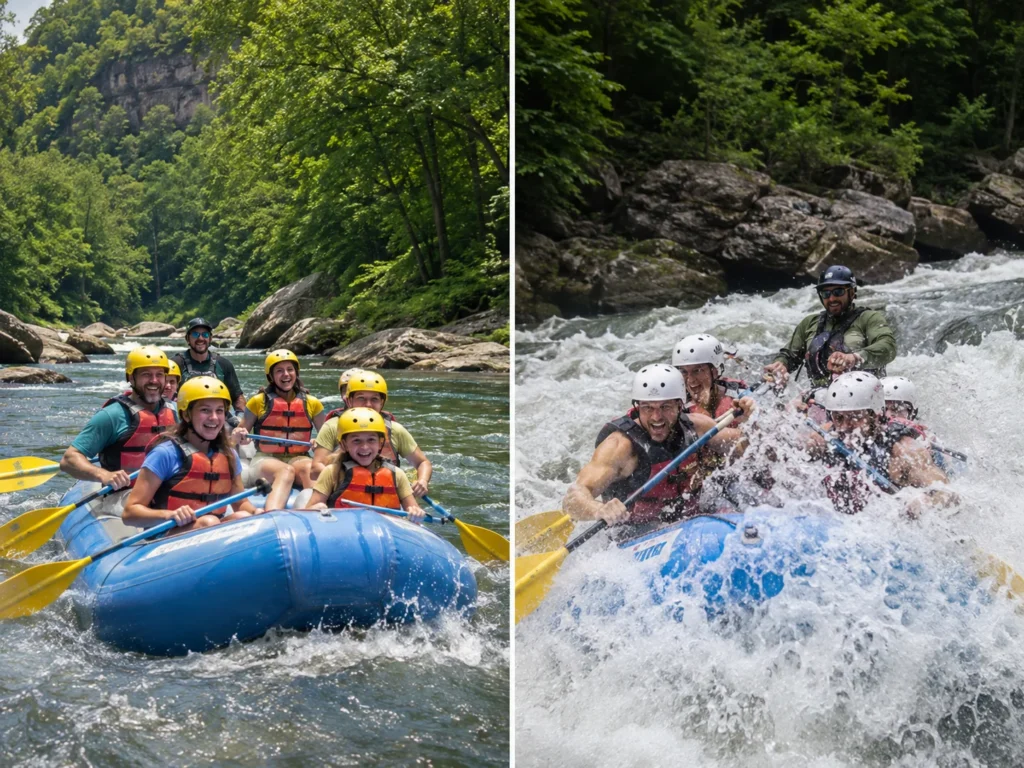
Rafting is the region’s signature water adventure, but the name “New River” hides a critical difference. The upper river has milder pools and riffles, while the lower gorge contains much more demanding hydraulics and rock obstacles. The National Park Service describes some Lower Gorge rapids as Class III–V. Your guide and outfitter—not a broad “family-friendly” claim—must determine whether a specific run suits your group and the water level on the day.
Upper New: the calmer starting point
For someone who wants river scenery, a guided team experience, and a reasonable introduction to moving water, start by researching an Upper New commercial trip. It can still involve spray, paddling, balance, and occasional surprises. “Upper” is a geographic section, not a promise of perfectly flat water, and some departures may change with current conditions.
Ask which exact put-in and take-out are used, how long the group spends on the water, the minimum age, whether participants need to swim, and whether a child or hesitant adult can realistically complete the day. Do not infer those answers from another company’s Upper New listing.
Lower New: more powerful water, not simply a faster version
The Lower New is the iconic whitewater choice for visitors who knowingly want more action. Expect a more demanding day than a gentle introductory float: larger waves, forceful currents, and the possibility of swimming if a boat tips or someone falls out. The NPS identifies undercut rock hazards in the Lower Gorge, a reason to take the briefing and the guide’s instructions seriously.
Some first-time adults do book Lower New commercial trips, but that does not make it the correct default for every beginner. Health, age, swimming confidence, fear of submersion, river flow, and the operator’s requirements all matter. If half the group wants excitement and the other half is genuinely uncomfortable, book a milder trip or separate activities rather than pressuring anyone.
For section-by-section planning and published operator examples, use our New River Gorge rafting guide for beginners. If the price is your main uncertainty, the whitewater rafting cost guide explains why headline fares, transport, gear, and optional extras need to be separated.
What a rafting day really consumes
A “half-day” or “full-day” name is not the same as time spent paddling. Allow for check-in, waivers, fitting gear, a shuttle, safety instruction, time on the river, and a return trip. A full-day raft tour should normally be the main event that day. Putting a narrowly timed Bridge Walk reservation immediately after it creates unnecessary stress if water, transport, or group logistics run late.
Commercial rafting is seasonal and flows vary; the NPS describes the principal New River season broadly as April through October, although particular outfitters and trip types differ. Gauley River trips become a separate, more advanced conversation in the fall release season; do not substitute the Gauley for the Upper New because the dates happen to overlap.
2. Bridge Walk: The Height Adventure Under the Bridge
The New River Gorge Bridge is a highway bridge, not an everyday public pedestrian crossing. The paid Bridge Walk tour uses a maintenance catwalk approximately 25 feet beneath the road deck. Guests wear fitted harnesses and remain attached to the guiding safety system while crossing with a guide. This is substantially different from a scenic overlook, and it is not walking on top of the highway.
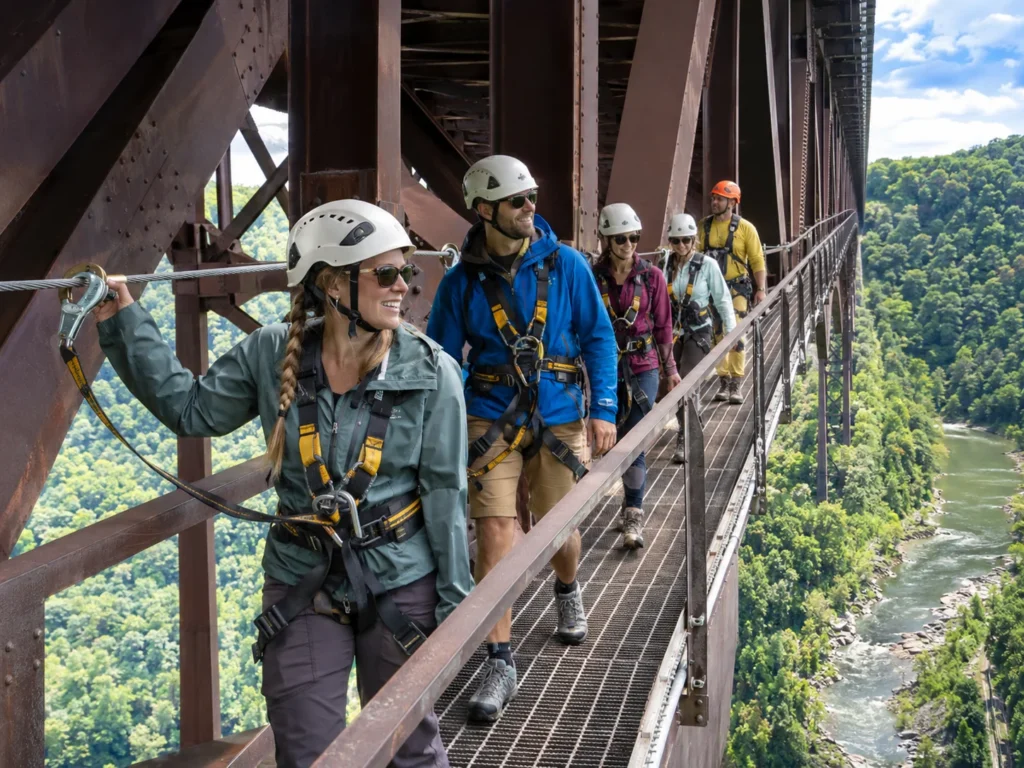
Bridge Walk currently describes the catwalk as roughly 851 feet above the river, with the bridge itself spanning 3,030 feet. The experience takes more than two hours including check-in and related logistics. The company lists tickets starting at $79 per person, but the actual date, options, taxes and booking terms need to be checked at checkout. Availability is not guaranteed by a published listing.
Its published eligibility guidance includes a minimum age of eight and minimum height of 48 inches. The operator also publishes harness fit limits and warns about conditions that may affect coordination or balance. Those are real booking gates: anyone near a harness limit or with a mobility concern should contact Bridge Walk before purchasing. Review the current FAQ rather than relying on an outdated reseller description.
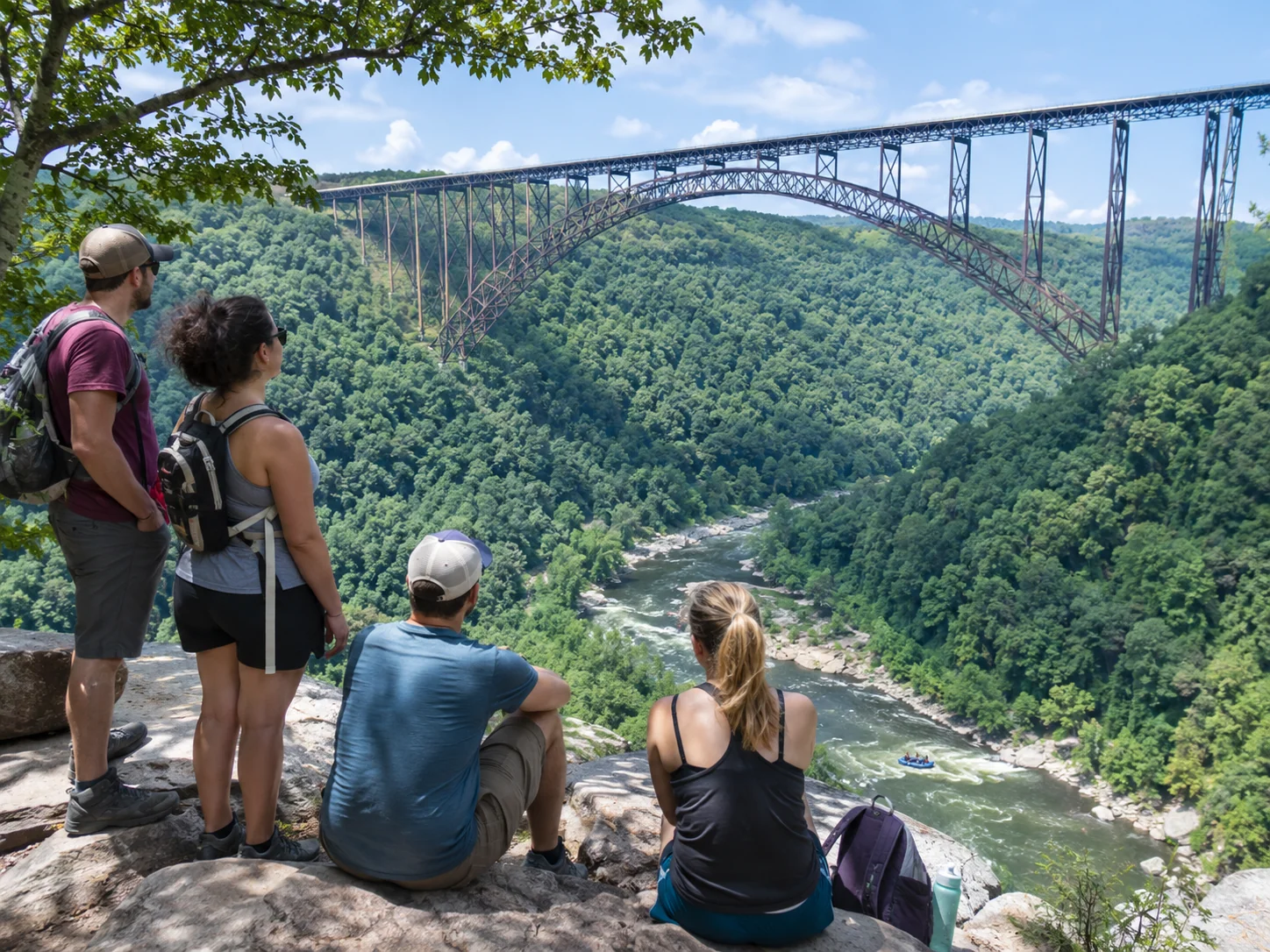
If heights make you nervous, decide what is appealing about the experience. Many visitors enjoy the unusually open view and the guided engineering story; others may find the exposure deeply uncomfortable. You can still have an excellent bridge-focused visit without buying a catwalk tour: Canyon Rim and Long Point offer rewarding perspectives from land, though Long Point ends at an unprotected rock overlook.
For a detailed decision about requirements, weather, cost and the walking experience, read our New River Gorge Bridge Walk cost and height guide. Our best bridge walks in the USA article provides context for how this specific catwalk differs from ordinary public bridges and glass walkways.
3. Ziplining: Forest Canopy or Bigger Speed?
Ziplining is a useful second adventure because it gives you the forest from a different perspective, but course design matters. Do not book based on the word “zipline” alone. A guided canopy course with bridges, hikes and smaller lines feels very different from a high-speed line intended to deliver a short burst of intense exposure.
At Adventures on the Gorge, the currently published TreeTops Canopy Tour description includes 11 ziplines, seven sky bridges, several hikes between lines, and about three to three-and-a-half hours of activity. The listed minimum age is 10 with an accompanying adult, with an independent age minimum of 14, and participants must weigh 90–260 pounds. The operator calls for closed-toe shoes and notes roughly one mile of hiking across four rigorous connecting walks. Confirm current rules and availability directly.
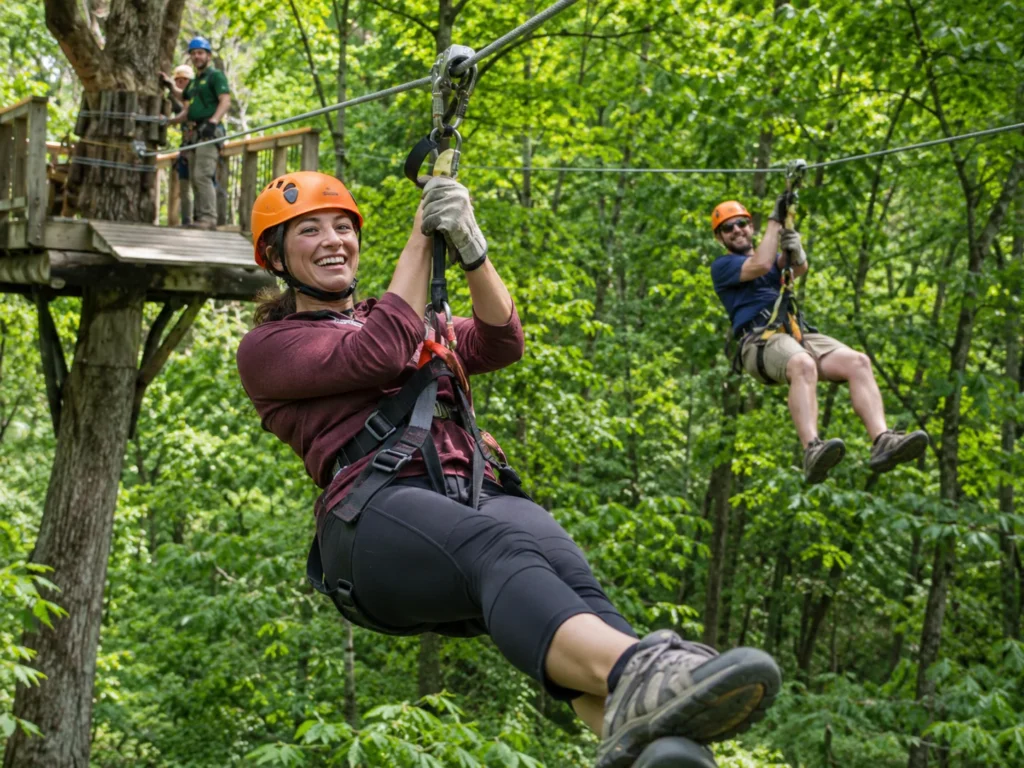
This makes TreeTops a forest-and-movement activity, not merely a flight simulator. Someone comfortable with harnesses but worried about hiking or elevated bridges needs to ask those questions before booking. Alternative courses in the area emphasize different speeds and obstacles, so assess the specific format, staff supervision, physical exertion, and weather policy rather than treating every aerial activity as interchangeable.
If this will be your first aerial experience anywhere, our best zipline destinations in the USA for first-timers article explains why practice, harness fit, brakes, and physical course demands deserve more attention than advertised top speed. For this New River Gorge trip, choose one course that matches your actual comfort—not the longest line in a marketing montage.
4. Free Views and Hiking: Build Flexibility Into the Trip
Canyon Rim Visitor Center: the sensible first stop
Start with Canyon Rim if you have never seen the bridge in person. The National Park Service visitor center provides orientation, exhibits, and overlooks reached by a boardwalk. The lower observation deck involves stairs; the visitor center area itself does not begin a major hiking trail. The park currently charges no entrance fee, although guided commercial activities are separate purchases.
This is a good arrival-day activity because it helps you understand the scale of the gorge and find ranger updates on parking, trail conditions, and closures. It is also an intelligent backup when you are too tired after traveling to start a strenuous hike.
Long Point: the postcard bridge angle
The NPS lists Long Point as approximately 3.2 miles round trip. The pay-off is one of the classic bridge views, but the final viewpoint is an exposed rock outcrop without a protective rail. Wear shoes suited to roots and wet rock, and never step backward for a photograph near the edge. It is a better deliberate hike than a rushed stop between paid tour check-ins.
Endless Wall: forest, cliffs, and Diamond Point
Endless Wall combines shaded forest with overlooks including Diamond Point. NPS hiking information gives a general 2.2–2.6-mile range depending on the route, and its specific trail page describes about 2.4 miles one-way; the popular Diamond Point out-and-back from Fern Creek can be roughly two miles. Route descriptions vary according to start, turnaround, and whether you complete the point-to-point walk.
The trailheads have limited parking. Do not leave a car along the narrow road when lots are full, and do not improvise a road walk without understanding the route. A short, well-planned hike with an early start is more enjoyable than hunting unsuccessfully for parking at midday.
Fayette Station Road and the wider park
If you want a different perspective without another paid attraction, research the NPS Fayette Station Road driving tour beneath the bridge. It is a narrow, winding, one-way historic route and is not suitable for every oversized vehicle. Read current traffic and vehicle advice; it is a scenic outing, not a high-speed shortcut.
The broader park extends well beyond Fayetteville. Grandview, Thurmond, and Sandstone Falls can enrich a longer visit, but each takes travel time. Do not squeeze Sandstone Falls into a ten-minute gap after a zipline booking simply because it appears within the same national-park boundary.
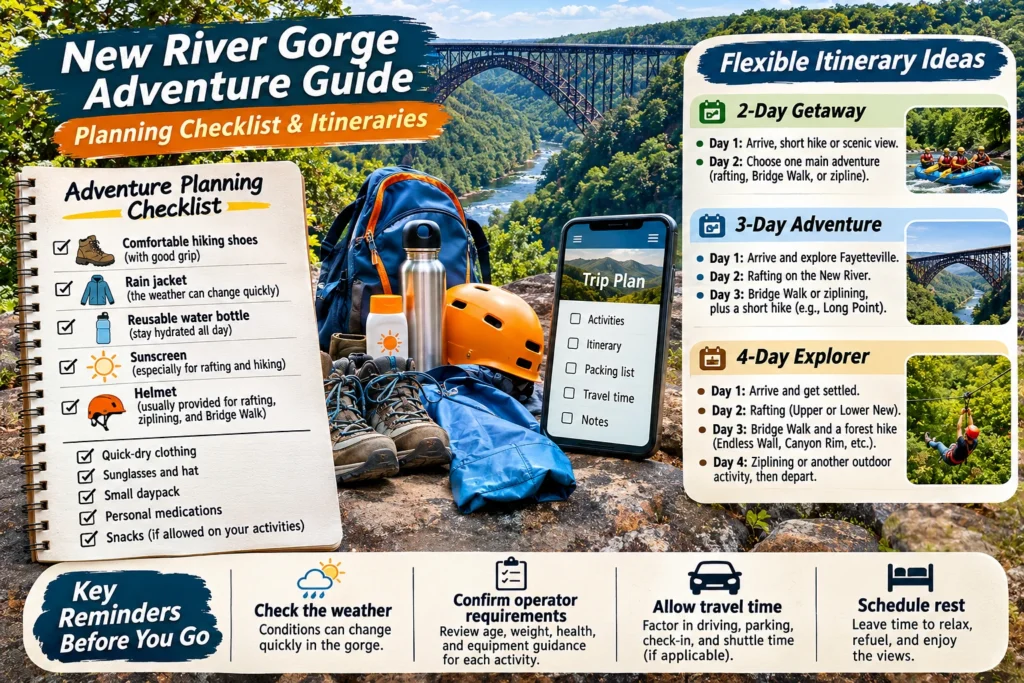
Two-Day New River Gorge Itinerary: One Big Adventure
| Day | Morning | Afternoon / evening |
| Day 1 | Arrive, Canyon Rim Visitor Center and overlook | Fayetteville check-in; optional short scenic drive or relaxed meal |
| Day 2 | Pre-booked Upper New rafting OR Bridge Walk | Recovery, river-view stop or a short flexible walk if timing allows |
For two days, do not buy two full-length guided reservations before confirming their check-in and end times. A rafting day can absorb most of the daylight. If your second day is a Bridge Walk instead, you may have more room for a trail, but allow time for the catwalk check-in and transport.
If you are traveling with children or people who dislike height exposure, swap the Bridge Walk for a suitable easy overlook or a different operator-reviewed family activity. A good two-day trip should feel like a vacation, not a pass/fail test of courage.
Three-Day Itinerary: The Best Balance for Most First-Timers
| Day | Anchor activity | Flexible complement |
| Day 1 | Canyon Rim + Long Point OR Endless Wall | Explore Fayetteville; confirm check-in details |
| Day 2 | Guided rafting on the chosen New River section | Rest, eat, and avoid another tight departure |
| Day 3 | Bridge Walk OR TreeTops zipline | Short overlook, town stop or early travel home |
This arrangement keeps the river on its own day and places the aerial or height activity after you already understand the terrain. It also creates more resilience if a storm changes plans. Tour operators decide whether conditions permit departure; do not assume an indoor-style guarantee just because your ticket is paid.
If the bridge is nonnegotiable, reserve that slot first and fit the river around it. If river flows or a particular trip format matter most, secure the outfitter departure and avoid scheduling another paid activity until you see the exact reporting time. The itinerary is a sequencing framework, not a confirmed timetable.
Four-Day Itinerary: Add Depth, Not Just More Tickets
| Day | Priority | Alternative if weather or fatigue intervenes |
| Day 1 | Arrive, Canyon Rim, Fayetteville | Visitor center + easy overlook |
| Day 2 | Upper or Lower New rafting | Different operator-approved river trip or cultural stop |
| Day 3 | Bridge Walk and relaxed local time | Scenic trail or rescheduled guided activity |
| Day 4 | TreeTops zipline OR farther park exploration | Grandview, Thurmond or Sandstone if driving fits |
A fourth day is useful because it separates experiences that use different muscles and require different preparation. Rafting can be wet and exhausting. Aerial tours can involve uneven walking, harness discomfort, and exposure to height. A schedule that ignores recovery and weather is less realistic than one that leaves a free morning.
The southern park areas are an option, not a mandatory checklist. Pick them when scenery, history, and quiet time appeal more than another adrenaline booking. Even a “more adventures” guide should make room for the afternoon when the best choice is simply watching the river.
How Much Should You Budget for a New River Gorge Adventure Weekend?
The national park itself does not charge an entrance fee, and hikes and overlooks can be low-cost when you already have transportation. Guided activities are separate purchases. As a dated example, Bridge Walk advertises a starting price of $79 per person, while TreeTops advertises starting rates around $84; check the operator’s current date-specific terms. These figures are not a package quote or real-time availability.
For planning, build the budget bottom-up rather than inventing a single universal “weekend cost.” Use this simple formula: lodging nights + activity tickets + mandatory checkout fees + transport and parking + meals + any optional photos or gratuities. River excursion rates vary particularly sharply by Upper versus Lower section, season, duration, and the company you book.
| Example cost line | How to estimate it | What to verify |
| Lodging | Your nightly rate × nights | Taxes, cancellation, location and parking |
| Rafting | One quoted ticket × participants | Section, shuttle, equipment, meals, river fees |
| Bridge Walk | Date-specific ticket × eligible guests | Age, height, harness fit, weather and booking policy |
| Zipline | Selected course × eligible guests | Age/weight, hikes, footwear, reservation terms |
| Food + transport | Your personal allowance | Drive time, gas, meals and any extras |
A pair of travelers can easily have a very different bill from a four-person group even with the same chosen activities. Anyone quoting a neat national average is hiding too much variability. The value is in asking for the actual check-out total from each company and comparing equally demanding experiences.
Choosing the Right Adventure for Your Group
Traveling with children? Begin with eligibility. The Bridge Walk currently states age eight and at least 48 inches. TreeTops states age ten with an adult and a specific weight range, but also requires substantial hiking. Whitewater companies have their own age and swimming rules; a river that one operator markets to families may not be appropriate for your entire party.
Traveling with a nervous first-timer? Ask whether the fear is about water, heights, speed, enclosed spaces, or lack of control. Rafting means sitting in a shared boat and following commands. Bridge Walk means sustained height exposure while harnessed on a narrow catwalk. Ziplining means a combination of brief launches and forest walks. These are not interchangeable kinds of “thrill.”
Traveling with different abilities? Build around the most restrictive participation requirement without assuming that all physical limitations rule out adventure. Contact each provider about its actual route and modifications. A national-park overlook can also be a genuinely memorable shared experience when a paid activity is unsuitable for one person.
Visiting for photography rather than pure adrenaline? Schedule Canyon Rim early, consider a suitable viewpoint walk, and avoid letting a guided departure consume the only daylight window you have. Use realistic photos of the gorge as trip inspiration, but do not mistake promotional imagery for a guarantee of weather, water level, or crowd-free viewpoints.
When to Visit: Season, Water Levels, and Weather
Spring can bring stronger flows and unsettled conditions; summer is popular for guided outings and family travel; fall foliage is a major draw for trails and views. Guided New River trips are commonly offered across a broad April–October season, with exact offerings and departures set by outfitters. The Gauley’s principal commercial release period is concentrated in early fall and can involve advanced rapids; do not treat it as the family substitute for the Upper New.
Bridge Walk publishes year-round operations, although significant weather can alter departures. TreeTops also advertises multiple seasons, but weather and capacity remain operator decisions. In every season, carry a flexible indoor or short-outlook alternative and avoid booking two immovable activities back to back.
For autumn foliage weekends, reserve lodging early rather than waiting to see whether all the trails look crowded on social media. At trailheads, follow NPS parking instructions; do not create a roadside hazard for the sake of a photograph.
Before You Book: A Seven-Point Checklist
Choose your most important experience first: river, Bridge Walk, or zipline.
Confirm the exact activity product—not just the operator name—and its actual meeting location.
Check age, height, weight, harness fit, mobility, health, and swimming requirements for every participant.
Compare the total checkout price and what is included, including shuttles and meals.
Leave substantial time for guided trips, not only the advertised moving or walking portion.
Keep a weather or fatigue backup that does not require a second nonrefundable reservation.
Download maps, check NPS trail alerts, and choose a safe parking alternative if a lot is full.
A satisfying New River Gorge trip has a deliberate mix: one thing that raises your pulse, one place where you slow down and look, and enough flexibility that neither becomes a rushed obligation. Start with the right experience for your group, then build the days around it.
Frequently Asked Questions
Can you do rafting and the Bridge Walk in one day?
It may be possible with specific departure times, but it is an unnecessarily fragile default plan for first-time visitors. Rafting often involves shuttles and variable return times. Unless both companies confirm the schedule and transfer, place the activities on separate days.
Do you need to pay to enter New River Gorge National Park?
No. The NPS currently lists no entrance fee for the park. Guided rafting, ziplining, Bridge Walk, commercial lodging, and other private services are separately priced.
Is the New River Gorge Bridge open to pedestrians?
The roadway is not a regular pedestrian walkway. The guided Bridge Walk uses the maintenance catwalk below the road deck. During the annual Bridge Day event special arrangements differ, but do not assume ordinary public access to the bridge deck.
Which is better for a first-time rafter: Upper New or Lower New?
The Upper New is generally the milder option. The Lower New features much more powerful water, including NPS-described Class III–V rapids. Have an outfitter match the specific trip and flow conditions to each participant’s experience and comfort.
Is a New River Gorge zipline tour suitable for someone afraid of heights?
That depends on the course and the person. TreeTops includes elevated bridges, ziplines and hikes. Ask whether there is a practice introduction, how long each launch lasts, and how the guide supports nervous participants; do not assume the ability to stop halfway through a course.
How many days do you need?
Two days is enough for one guided adventure and iconic bridge views. Three days gives most first-time visitors a balanced rafting-plus-height or zipline itinerary. Four days lets you add deeper sightseeing, recovery time, or another guided activity without cramming every afternoon.
The Bottom Line
New River Gorge is a rare destination where river adventure, an engineering landmark, high forest canopy and peaceful hiking all fit within one memorable vacation. Its strength is variety, not a single “best” attraction. Start with Fayetteville, select the river difficulty and height experience you genuinely want, reserve no more than one major guided activity per day, and leave room for the views that cost nothing.
This guide is a planning framework assembled from published National Park Service and operator information, not first-hand testing or a guarantee of ticket availability. Recheck policies and current conditions before committing money or beginning a trail.
Sources and Verification
Operator-specific figures and trail information were checked against official pages on November 7, 2026. Prices, participation limits, weather decisions, and routes can change; follow the booking page for your exact date. These are original sources rather than claims of personal experience.
NPS: Plan Your Visit — https://www.nps.gov/neri/planyourvisit/index.htm
NPS: Commercial Whitewater — https://www.nps.gov/neri/planyourvisit/whitewater_commercial.htm
NPS: Whitewater — https://www.nps.gov/neri/planyourvisit/whitewater.htm
NPS: Hiking — https://www.nps.gov/neri/planyourvisit/hiking.htm
NPS: Fees — https://home.nps.gov/neri/planyourvisit/fees.htm
NPS: Bridge — https://home.nps.gov/neri/planyourvisit/nrgbridge.htm
NPS: Basic Information — https://www.nps.gov/neri/planyourvisit/basicinfo.htm
Bridge Walk: FAQ — https://bridgewalk.com/faqs
Bridge Walk: Tour Information — https://bridgewalk.com/press-and-media/
Adventures on the Gorge: TreeTops — https://www.adventuresonthegorge.com/aerial/treetops-zipline-canopy-tour
NPS: Endless Wall — https://home.nps.gov/places/endless-wall-trail.htm