25 Best Adrenaline Activities in the USA for Beginners
You do not have to start your adventure life by jumping out of an airplane.
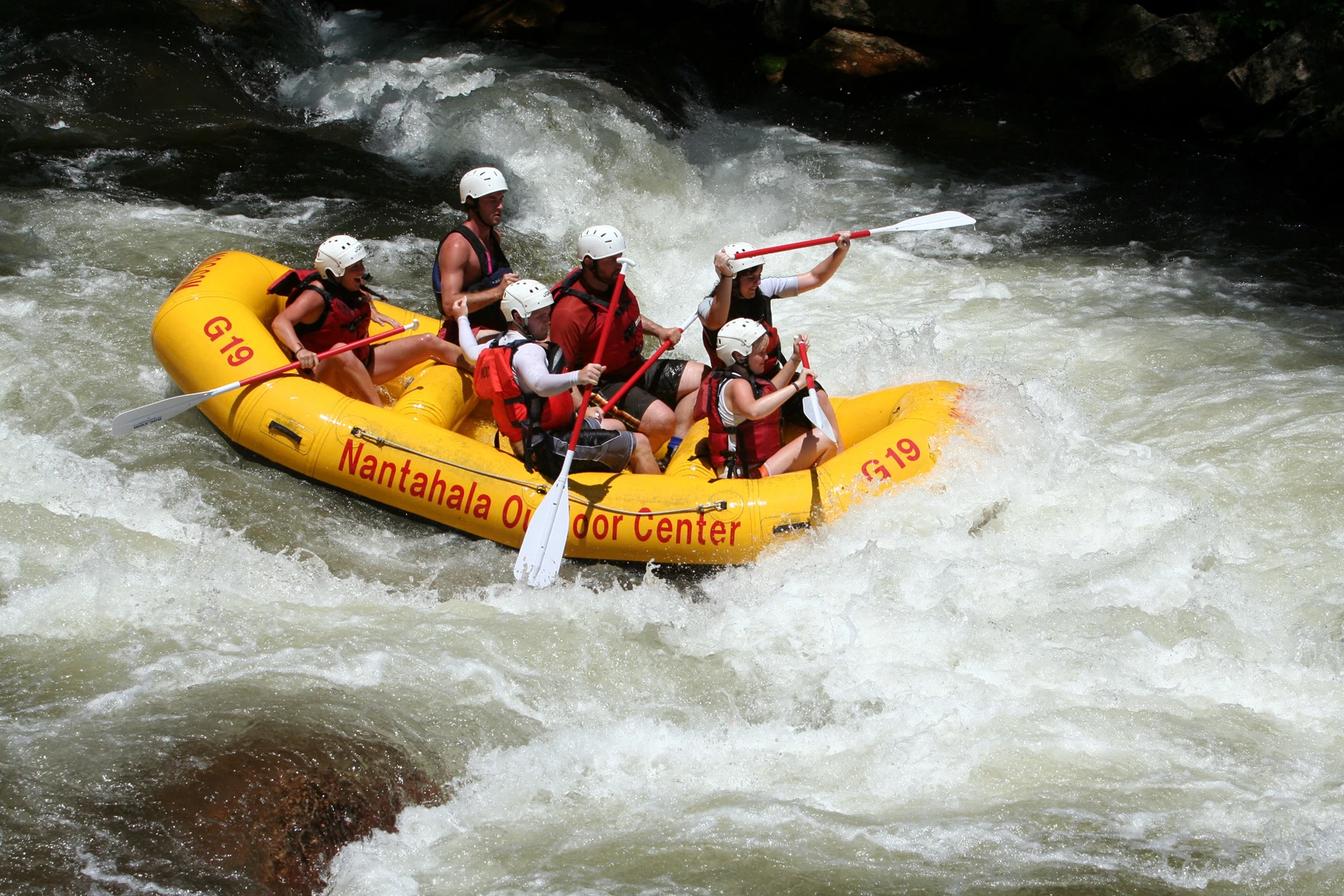
Rafters on the Nantahala River, North Carolina, in June 2009. Photo: anoldent, via Wikimedia Commons; CC BY-SA 2.0. Converted to WebP; the image remains under the same license. Historical illustration, not a current operator endorsement or a complete demonstration of paddling technique. Photo source · Image rights.
Some of the best adrenaline activities in the USA are surprisingly accessible to complete beginners. Indoor skydiving, ziplining, alpine coasters, jet boats, parasailing, guided off-roading, beginner rafting, surfing lessons, and dozens of other experiences can give you a genuine rush without requiring years of training.
The harder question is deciding which kind of adrenaline you actually want.
Some activities challenge your fear of heights. Others test your balance, stamina, or comfort in water. A few require almost no technical skill, while others introduce you to a sport you could spend years learning.
This guide compares 25 options so you can choose a first adventure that matches your comfort level rather than somebody else’s definition of “extreme.”
The Quick Answer: Where Should a Complete Beginner Start?
For the lowest barrier to entry, start with:
- Indoor skydiving if you want the sensation of flight.
- Ziplining if you want height without jumping.
- An alpine coaster if you want speed with minimal physical effort.
- A bridge walk if exposure is the main challenge.
- A jet boat ride if you prefer water and speed.
- Parasailing if you want a calmer introduction to being high above the ground.
If you want to learn a new skill, consider a surf lesson, top-rope climbing, beginner mountain biking, Discover Scuba Diving, or beginner whitewater rafting.
If the emotional challenge is what attracts you, tandem skydiving, paragliding, bungee jumping, giant swings, via ferrata, and guided canyoneering move much further up the intensity scale.
Not sure how to compare them? Our guide to how to choose your first adrenaline activity breaks the decision down by fear, fitness, guidance, time, and total cost.
How We Compared These Activities
Start with the level of challenge that fits you.
“Beginner-friendly” does not mean risk-free.
For this guide, it means that legitimate U.S. providers or recognized training organizations offer versions of the activity designed for people without previous experience.
We considered:
- prior skill required;
- physical effort;
- perceived exposure and fear;
- instruction available;
- logistics;
- equipment complexity;
- time commitment;
- how easily a first-timer can understand what they are signing up for.
The ratings below are editorial comparison scores, not accident-risk or safety ratings.
On small screens, scroll comparison tables sideways to see all columns.
| Activity | Fear | Physical effort | Learning curve | Beginner barrier |
|---|---|---|---|---|
| Indoor skydiving | 3/5 | 2/5 | 1/5 | Very low |
| Ziplining | 3/5 | 2/5 | 1/5 | Very low |
| Alpine coaster | 2/5 | 1/5 | 1/5 | Very low |
| Bridge walk | 3/5 | 2/5 | 1/5 | Very low |
| Jet boat ride | 2/5 | 1/5 | 1/5 | Very low |
| Parasailing | 3/5 | 1/5 | 1/5 | Low |
| Aerial ropes course | 3/5 | 3/5 | 2/5 | Low |
| Guided UTV tour | 2/5 | 2/5 | 2/5 | Low |
| Guided snowmobiling | 3/5 | 2/5 | 2/5 | Low–moderate |
| Sandboarding | 2/5 | 3/5 | 2/5 | Low |
| Beginner surf lesson | 2/5 | 4/5 | 3/5 | Moderate |
| Beginner rafting | 3/5 | 3/5 | 2/5 | Moderate |
| Top-rope climbing | 3/5 | 4/5 | 3/5 | Moderate |
| Beginner mountain biking | 2/5 | 4/5 | 3/5 | Moderate |
| Discover Scuba Diving | 3/5 | 2/5 | 3/5 | Moderate |
| Shark cage diving | 4/5 | 2/5 | 1/5 | Moderate |
| Via ferrata | 4/5 | 4/5 | 3/5 | Moderate–high |
| Guided canyoneering | 4/5 | 4/5 | 4/5 | High |
| Waterfall rappelling | 4/5 | 4/5 | 3/5 | High |
| Beginner hang gliding | 4/5 | 3/5 | 3/5 | High |
| Tandem paragliding | 4/5 | 2/5 | 2/5 | High |
| Tandem skydiving | 5/5 | 2/5 | 2/5 | High |
| Giant swing / Skycoaster | 5/5 | 1/5 | 1/5 | High |
| Bungee jumping | 5/5 | 1/5 | 1/5 | High |
| Beginner ice climbing | 4/5 | 5/5 | 4/5 | High |
Some adventures challenge your nerves; others challenge your body.
1. Indoor Skydiving
Best for: Your first taste of freefall without leaving an airplane.
Indoor skydiving uses a vertical wind tunnel to support your body in a column of moving air. You get the unusual sensation of floating and controlling your body in airflow while instructors remain close by.
That combination makes it one of the easiest adrenaline experiences to try before deciding whether real skydiving interests you.
If you are choosing between the two, our indoor skydiving vs. real skydiving comparison explains what a wind tunnel can and cannot reproduce.
Requirements vary by facility. As one current example, iFLY accepts young participants at many locations but applies health, waiver, and weight-related restrictions, including additional evaluation in certain weight ranges. Always check the location you plan to visit rather than assuming one facility’s rules apply nationwide. S2
Choose this if: You are curious about skydiving but not ready for an airplane exit.
2. Ziplining
Best for: Height, speed, and scenery with almost no technical learning.
Ziplining gives you one of the cleanest beginner adrenaline formulas: step off a platform, let the system do most of the work, and experience speed and exposure while moving above the landscape.
The details vary considerably between courses. CLIMB Works, for example, has its own height, age, weight, footwear, and health requirements, while other operators apply different limits. S13
If a full zipline tour sounds intimidating, some aerial parks offer introductory versions. Go Ape currently describes its one-hour Treetop Journey as an introductory zipline and ropes course designed for beginners. S24
Choose this if: You want to challenge your fear of heights without learning a complicated sport.
3. Alpine or Mountain Coasters
Best for: Speed lovers who want very little physical effort.
An alpine coaster is essentially a gravity-powered mountain ride on a fixed track. Depending on the design, riders can often control their speed with a braking system.
This can be a useful first adventure for someone who likes roller coasters but wants a more outdoor, landscape-driven experience.
If this sounds like your kind of first thrill, compare the best alpine coasters in the USA by ride length, price, scenery, and beginner logistics.
At Aspen Snowmass, for example, the Breathtaker Alpine Coaster currently advertises speeds of up to 28 mph and applies specific driver and passenger requirements. Its pricing and operating schedule are seasonal, so those details should be checked directly before planning a trip. S14
Choose this if: You want speed without jumping, climbing, swimming, or learning a technical skill.
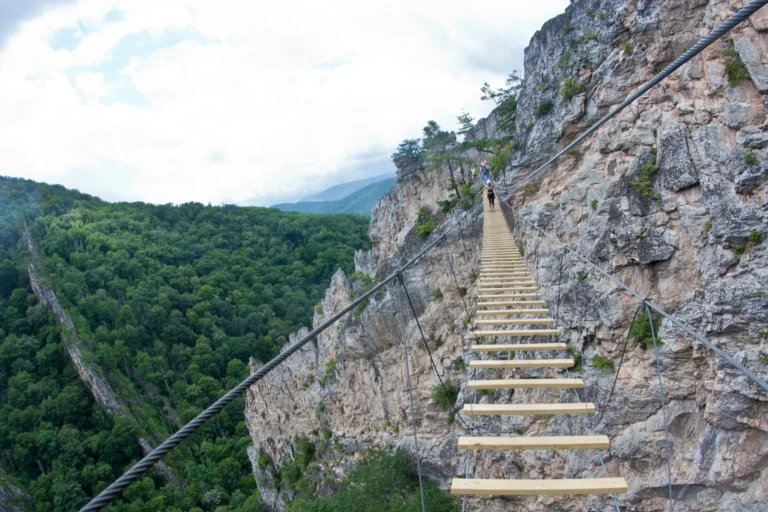
4. Bridge Walks and Bridge Climbs
Best for: Testing your reaction to serious height without jumping.
Walking through an exposed structure can feel very different from looking down from a normal observation deck.
A strong U.S. example is Bridge Walk at New River Gorge in West Virginia. The experience uses the catwalk beneath the New River Gorge Bridge and takes roughly three hours. The bridge itself rises 876 feet above the New River. S7
The adrenaline comes mainly from exposure rather than speed.
If that kind of controlled height challenge appeals to you, our guide to the best bridge walks in the USA compares harnessed catwalks, suspension bridges, glass skywalks, and easier public crossings.
That makes this an excellent diagnostic adventure: if standing hundreds of feet above a river feels exciting rather than miserable, you may be ready to explore ziplining, via ferrata, paragliding, or eventually skydiving.
Choose this if: Heights are what fascinate you, but jumping is still a hard no.
5. Jet Boat Rides
Best for: Speed and water without swimming or paddling.
Jet boat rides deliver acceleration, tight maneuvering, waves, and spray while a professional operates the boat.
For example, Whirlpool Jet Boat Tours operates from Lewiston, New York, with approximately 45-minute experiences and both wet and dry ride formats. S11
Your physical role is limited compared with rafting, surfing, or paddling, making this one of the more accessible ways to experience an adrenaline rush on water.
To compare short spin rides, Niagara whitewater trips, and longer wilderness experiences, see our guide to the best jet boat rides in the USA.
Motion sickness, mobility considerations, and operator restrictions still matter, so review the current requirements before booking.
Choose this if: You like speed but do not want your first adventure to depend on your athletic ability.
6. Parasailing
Best for: A relatively gentle introduction to height over water.
Parasailing can look more intimidating from shore than it feels once you are airborne. You are attached to a parachute-like canopy and towed behind a boat, gaining altitude as the boat moves.
The exact rules depend on wind, passenger combinations, and the operator. As a current example, H2O Sports Hawaii lists a minimum age of eight and a normal-condition minimum weight of 50 pounds, with a total parachute weight limit and weather-dependent requirements. Its listed experience involves approximately 45–60 minutes on the boat and around six minutes in the air. S25
Choose this if: You want an aerial experience but are not interested in freefall.
7. Aerial Ropes Courses
Best for: Building confidence gradually.
An aerial adventure course replaces one huge commitment with many small ones: suspended bridges, nets, obstacles, short ziplines, and platforms.
That can be psychologically easier for a beginner because you progress one challenge at a time.
Go Ape’s current introductory Treetop Journey is an example of this format, combining obstacles and ziplines in a one-hour beginner-oriented experience. Its more advanced courses increase both height and difficulty. S24
The physical demand can be higher than a standard zipline because you may need to balance, climb, step, and move through obstacles.
Choose this if: You want an adventure that feels like a challenge rather than a single thrill ride.
8. Guided UTV and Off-Road Tours
Best for: Couples or groups who want motorized adventure.
A side-by-side UTV can turn difficult-looking desert terrain into an accessible first off-road experience when paired with appropriate instruction and a guided route.
Moab is one of the best-known U.S. destinations for this style of adventure. Moab Tour Company currently offers guided UTV experiences for both first-time and experienced riders, with options to drive or ride with a guide depending on the tour. S21
Driving still requires attention and judgment. Terrain, vehicle rules, licensing requirements, minimum ages, and insurance conditions can vary substantially.
Choose this if: You want scenery, machinery, and excitement without a fear-of-heights test.
9. Guided Snowmobiling
Best for: Winter travelers who want speed plus wilderness scenery.
Snowmobiling combines engine power, winter conditions, and the feeling of traveling through terrain that may be inaccessible by normal road.
For a first ride, a guided experience is much more useful than simply renting a machine and trying to figure everything out alone.
Yellowstone National Park, for example, maintains current information on authorized guided winter tour providers, including snowmobile operators using several park entrances. S18
Winter weather, clothing, road access, operating rules, and machine requirements make snowmobiling more logistically involved than an alpine coaster or jet boat.
Choose this if: Your idea of adrenaline involves winter, machines, and open landscapes.
10. Sandboarding
Best for: A low-pressure introduction to board sports.
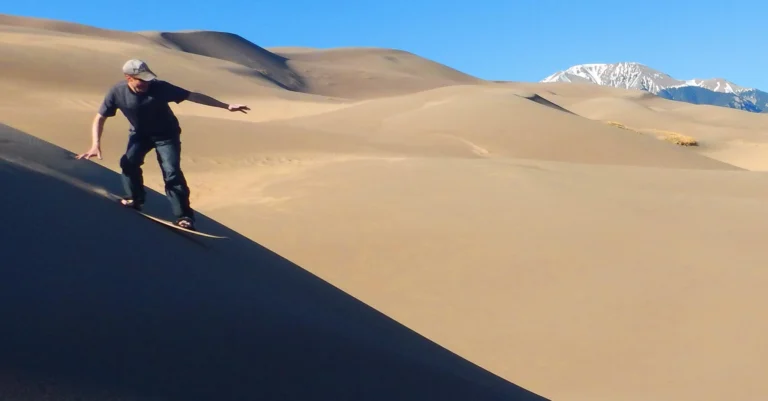
Sandboarding takes some of the appeal of snowboarding and moves it onto dunes. You climb, choose a slope, ride down, and repeat.
Great Sand Dunes National Park in Colorado is one of the most distinctive places to try it. The National Park Service notes that ordinary snowboards, skis, cardboard, and many casual substitutes do not work well on the sand; specialized sandboards or sand sleds are available from businesses outside the park. The NPS does not rent them itself. Reaching suitable slopes also requires walking into the dunefield. S4
If you want to turn it into a trip, compare the best sandboarding places in the USA before choosing a dune destination.
Choose this if: You want something playful, physical, and easy to understand.
11. A Beginner Surf Lesson
Best for: Learning a real sport while still getting an immediate thrill.
Surfing is harder physically than most activities near the beginning of this list, but a lesson lets you experience the sport without pretending you already know how to read waves, position the board, or choose an appropriate break.
Waikiki remains a classic learning environment, and current local schools advertise private, semi-private, and group instruction for first-time surfers and more experienced riders. S20
Expect paddling, repeated attempts, and a fair amount of falling. That is part of the experience.
Choose this if: You care as much about learning something as you do about getting an adrenaline rush.
12. Beginner Whitewater Rafting
Best for: Groups who want teamwork and real outdoor excitement.
Rafting provides one of the best combinations of scenery, physical involvement, uncertainty, and group energy.
The important word for a first-timer is appropriate. Rivers and individual sections can differ dramatically.
At New River Gorge, the National Park Service notes that licensed outfitters offer guided trips with trained guides, equipment, instruction, transportation, and different levels of difficulty, ranging from relatively quiet outings to serious whitewater. S6
Do not choose a trip simply because the river has a famous name. Ask which section, flow conditions, rapid class, swimming expectations, and trip format are appropriate for someone with no rafting experience.
For actual beginner-friendly options, our guide to the best beginner whitewater rafting trips in the USA compares specific river sections rather than ranking entire rivers.
Choose this if: You want a social adventure rather than a solo mental challenge.
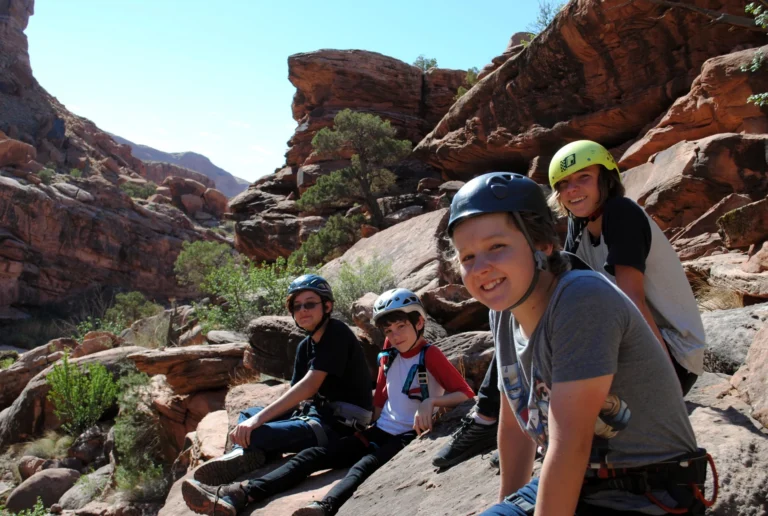
13. Introductory Top-Rope Rock Climbing
Best for: People who want to discover what climbing actually feels like.
Top-rope climbing is one of the most logical entry points into roped climbing.
A rope runs from the climber to an anchor above and back to the belayer, allowing beginners to focus more on movement than on advanced protection systems.
REI’s introductory climbing guidance recommends learning from a qualified instructor or guide and notes that a typical first course may cover equipment, knots, belay checks, climbing commands, belaying, and basic movement skills. S23
Outdoor climbing adds environmental factors that a climbing gym does not reproduce, so an indoor introduction can also be a sensible first step.
Choose this if: You want an adrenaline sport that can become a long-term hobby.
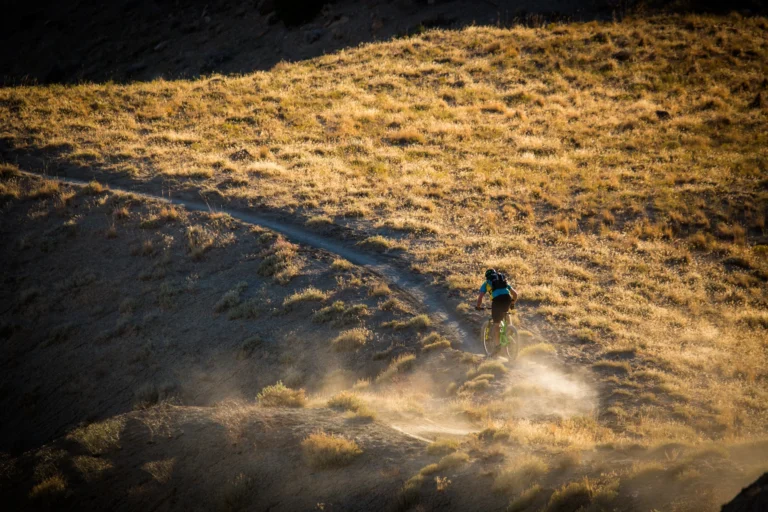
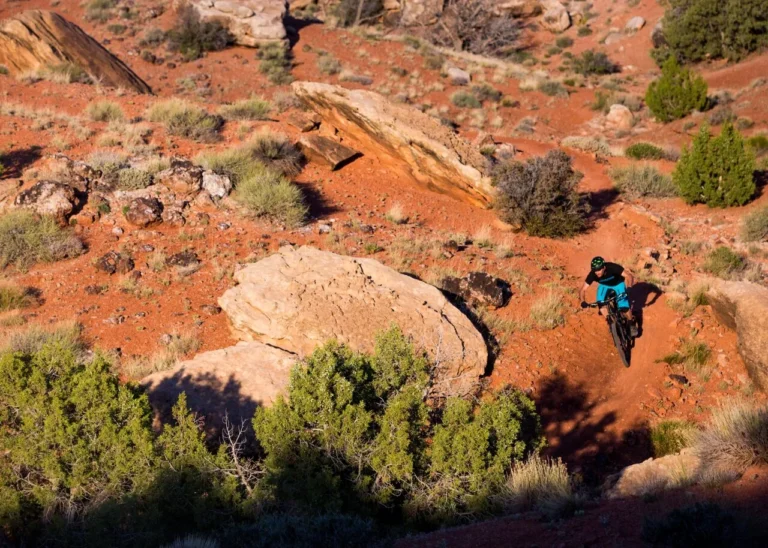
14. Beginner Mountain Biking
Best for: Active travelers who prefer speed close to the ground.
Mountain biking can range from gentle flowing trails to highly technical terrain involving jumps, rocks, drops, and steep descents.
Beginners should not judge the entire sport by videos of advanced riders.
Bentonville and Northwest Arkansas are useful examples of destinations where trail systems include experiences for different ability levels. Visit Bentonville reports more than 80 miles of trail within the city connected to a much larger regional network, including family-friendly trails and skills areas alongside advanced features. S17
For a first ride, prioritize a beginner trail, correctly sized bike, helmet, and basic braking and body-position instruction.
When you are ready to build a full trip around riding, compare our best beginner mountain biking destinations in the USA for trail progression, rentals, coaching, and beginner logistics.
Choose this if: You already enjoy cycling and want to add terrain and speed.
Water adventures can range from active skill-building to guided exploration.
15. Discover Scuba Diving
Best for: People fascinated by the underwater world but not ready for certification.
You do not necessarily have to earn a full scuba certification before discovering what breathing underwater feels like.
PADI’s Discover Scuba Diving format is designed as an introductory experience rather than a certification course. Participants learn basic concepts and skills under professional supervision before entering an appropriate confined or open-water environment. PADI currently sets a minimum age of 10 and uses a medical questionnaire to identify health factors that may require additional clearance. S3
Scuba can feel surprisingly calm after the first few minutes, but breathing underwater is psychologically unusual enough to create plenty of adrenaline for some beginners.
Choose this if: Your curiosity about the underwater world is stronger than your fear of heights.
16. Shark Cage Diving
Best for: Wildlife lovers who want fear without jumping from anything.
Few activities create such an immediate emotional reaction before they even begin.
The useful distinction is that many cage-diving experiences do not require you to swim freely beside a shark. You remain within a purpose-built cage while observing the animals underwater.
North Shore Shark Adventures in Oahu currently lists an approximately two-hour cage-diving experience and supplies masks and snorkels; its own current participation rules and trip conditions should be checked before booking. S15
If shark diving becomes the activity you want to plan a trip around, compare the best shark cage diving experiences in the USA before choosing a destination.
Ocean conditions can be a bigger practical issue than many first-timers expect. If you are prone to seasickness, factor the boat portion into your decision.
Choose this if: Wildlife gives you a bigger adrenaline rush than speed.
17. Via Ferrata
Best for: Hikers who want their first serious exposure to climbing terrain.
A via ferrata uses fixed protection such as cables and engineered climbing elements to make steep terrain accessible in a structured format.
If this sounds like the right step beyond hiking, our via ferrata for beginners guide explains equipment, grades, exposure, physical effort, and what to expect on your first route.
It can feel much more exposed than hiking while requiring less technical independence than traditional rock climbing.
Arapahoe Basin in Colorado currently offers guided half-day and full-day via ferrata experiences. Its published requirements include age and weight limits, which illustrates why checking the exact operator rules matters. S9
Expect sustained movement at elevation and significant exposure rather than one short burst of fear.
Choose this if: You enjoy hiking and want to find out whether vertical terrain is your next step.
18. Guided Canyoneering
Best for: Beginners who want a full adventure day rather than one attraction.
Canyoneering can combine hiking, scrambling, route finding, rappelling, water, narrow canyon passages, and changing environmental conditions.
That variety is exactly why a first experience should not be treated like a casual hike.
In Zion National Park, technical canyoneering trips require a Wilderness Permit, and the National Park Service specifically emphasizes the need for appropriate equipment and skills. S5
A properly selected guided beginner itinerary can introduce the techniques gradually while eliminating much of the route-planning burden.
To see what that looks like in practice, compare our best canyoneering trips in the USA for beginners, including Moab, East Zion, Ouray, Tucson, and other current options.
Choose this if: You want an adventure that feels like a journey rather than an amusement ride.
19. Waterfall Rappelling
Best for: Combining a rope challenge with dramatic scenery.
Rappelling down a cliff already demands trust in the equipment and technique. Add running water, slippery surroundings, jungle terrain, and a waterfall, and the experience becomes significantly more immersive.
Rappel Maui currently offers a guided waterfall-rappelling experience specifically stating that no previous experience is necessary and equipment is included. Its standard group tour was listed at $240.84 including tax when checked in August 2026. S26
That is one operator example, not a national average.
Choose this if: You like the idea of rappelling but want the environment to be as memorable as the descent.
Ready to move beyond the easy-entry experiences
20. Beginner Hang Gliding
Best for: People who dream about flight but want a learning-oriented introduction.
Hang gliding does not have to begin by launching from a mountain.
Kitty Hawk Kites in North Carolina currently offers beginner lessons on the dunes at Jockey’s Ridge, using a format designed for first-time participants. The experience is listed at roughly three hours, with pricing starting at $149 plus a 6% fee when checked in August 2026. S12
USHPA also recognizes tandem instruction as a way for students to experience flight with direct instructor involvement before progressing toward independent skills. S8
Choose this if: Flying interests you enough that you may eventually want to learn the sport.
21. Tandem Paragliding
Best for: Scenic human flight without freefall.
Paragliding is very different from skydiving. Rather than exiting an aircraft and falling before the canopy opens, a paraglider launches already under its wing and flies using air currents.
For a beginner, tandem flight places the pilot in control while you experience the launch, altitude, movement, and landing.
At Torrey Pines Gliderport in California, tandem paragliding was listed at $200, or $190 cash, when checked in August 2026. Flights are highly weather dependent, and the facility states that tandem flying operates without reservations because conditions determine when flying is possible. S16
Choose this if: You want to fly but the freefall part of skydiving does not appeal to you.
22. Tandem Skydiving
Best for: The classic first major adrenaline challenge.
For many people, skydiving is the benchmark against which every other adrenaline activity is measured.
A tandem jump lets an experienced instructor handle the primary parachute system and much of the flight procedure while the first-time participant receives briefing and follows required body-position and landing instructions.
In the United States, USPA explains that current tandem-system manufacturers set 18 as the minimum age, making 18 the practical minimum for tandem skydiving at U.S. member drop zones. S1
Individual drop zones also maintain their own weight, mobility, weather, identification, and health requirements.
Choose this if: The mental act of leaving an airplane is exactly the challenge you want.
23. A Giant Swing or Skycoaster
Best for: Maximum fear with almost no technical skill.
A giant swing compresses the adrenaline experience into a few seconds: harness up, rise into position, release, and accelerate.
The Royal Rush Skycoaster at Royal Gorge Bridge & Park in Colorado illustrates how extreme the format can become. The operator describes a launch from a 100-foot tower, speeds of up to 50 mph, and a swing that places riders approximately 1,200 feet above the Arkansas River. S19
You do not need to learn a sport first. The challenge is almost entirely psychological.
Choose this if: You want a major fear challenge without committing to skydiving training or a physically demanding day.
24. Bungee Jumping
Best for: People who specifically want to confront the act of jumping.
Bungee jumping and skydiving produce very different mental challenges.
A bungee jump places the ground or water directly in your field of view, and you generally have to make a deliberate departure from the platform. For many first-timers, that voluntary step is the hardest part.
If that is exactly the challenge you want, compare the best bungee jumping places in the USA and verify which commercial operations are actually active before planning your trip.
Rules depend heavily on location and operator. Great Bungee Company in West Virginia currently lists a minimum age of 16 under state law, parental consent for participants under 18, and an 80-to-300-pound participant range for its operation. S10
Those limits are operator-specific and should not be assumed to apply elsewhere.
Choose this if: The jump itself is the experience you want to conquer.
25. Beginner Ice Climbing
Best for: Fit beginners who want a genuine technical challenge.
Ice climbing sits at the demanding end of this list because it combines cold-weather management, specialized equipment, movement technique, strength, balance, and objective environmental considerations.
That does not mean a novice cannot try it.
Professional guiding companies offer introductory courses. Mountain Madness, for example, runs a beginner ice course in the Ouray, Colorado area, a major U.S. ice-climbing destination. S22
Unlike a coaster or tandem flight, however, ice climbing asks you to actively perform the activity rather than simply tolerate the sensation.
Choose this if: You want your first adrenaline experience to double as the beginning of a serious outdoor skill.
Which Adrenaline Activity Is Best for You?
If You Are Nervous but Curious
Start with:
- alpine coaster;
- jet boat;
- indoor skydiving;
- zipline;
- parasailing.
These options can give you a meaningful thrill while keeping the learning curve relatively small.
If You Want to Learn a New Skill
Consider:
- surfing;
- rock climbing;
- mountain biking;
- scuba;
- rafting;
- sandboarding.
These adventures are not simply something you “survive.” You can improve every time you return.
If You Want to Challenge a Fear of Heights
Progress gradually through:
bridge walk → zipline → aerial ropes course → via ferrata → paragliding → skydiving or bungee.
You do not have to complete the whole progression. The point is to identify where excitement turns into genuine distress and choose accordingly.
If You Want a Big Thrill Without Extreme Fitness
Look hardest at:
- indoor skydiving;
- alpine coasters;
- jet boat rides;
- parasailing;
- tandem paragliding;
- tandem skydiving;
- giant swings.
Physical requirements still exist, and an operator may restrict participation based on mobility, body dimensions, health conditions, or equipment limitations.
If physical effort is one of your main concerns, see our full guide to adrenaline activities that don’t require extreme fitness.
If You Want an Adventure With Friends
Strong group options include:
- rafting;
- UTV touring;
- ziplining;
- aerial adventure courses;
- surf lessons;
- sandboarding;
- snowmobiling.
The shared experience often becomes as important as the adrenaline itself.
What Do Beginner Adrenaline Activities Cost?
There is no responsible national “average price” for these activities.
A 10-minute attraction, a three-hour lesson, and a full guided wilderness day are fundamentally different products. Prices also change with season, location, taxes, equipment, photography packages, and group size.
These current examples show the scale of that variation:
| Experience | Current example | Price checked |
|---|---|---|
| Aspen alpine coaster | Aspen Snowmass | $66 ride-all-day ticket listed for applicable operating period [S14] |
| Oahu parasailing | H2O Sports Hawaii | $90 standard / $105 higher-flight option [S25] |
| Beginner hang gliding | Kitty Hawk Kites | From $149 + 6% fee [S12] |
| A-Basin via ferrata | Arapahoe Basin | $159 half-day / $209 full-day [S9] |
| Tandem paragliding | Torrey Pines Gliderport | $200 / $190 cash [S16] |
| Maui waterfall rappelling | Rappel Maui | $240.84 including tax [S26] |
Prices were checked August 13, 2026 and are examples, not nationwide averages. Verify the live price and mandatory fees before booking.
Safety: What a Beginner Should Understand
A guided activity is not automatically a risk-free activity.
A good decision requires separating several different issues.
Inherent Risk
Activities involving height, moving water, speed, vehicles, weather, underwater environments, rock, or ice carry hazards that cannot simply be removed by calling the trip “beginner-friendly.”
Operator Procedures
Read the operator’s current participation rules, briefing process, cancellation policy, equipment information, and weather policy.
Do not assume the requirements of one operator apply to another.
Your Responsibilities
Listen to instructions, disclose requested health information accurately, use required equipment as directed, and do not hide a restriction because you want to participate.
Weather and Environment
Wind can stop paragliding. Water levels can change a rafting trip. Winter conditions can change snowmobile access. Heat can transform a desert hike. Ocean conditions can affect parasailing, surfing, scuba, and shark-cage trips.
Medical Considerations
This article cannot determine whether a particular activity is medically appropriate for you.
If an operator’s health questionnaire or restrictions raise a concern, discuss the activity with an appropriate healthcare professional before participating.
Check the restrictions before you commit.
Before You Book: First-Timer Checklist
Before paying for an experience, confirm:
- the exact activity format;
- whether previous experience is required;
- minimum and maximum age rules;
- height or weight restrictions;
- mobility requirements;
- health restrictions or medical questionnaires;
- what equipment is included;
- what clothing and footwear you need;
- active experience time versus total check-in time;
- weather and cancellation policies;
- transportation and parking arrangements;
- whether photos or videos cost extra;
- taxes and mandatory fees;
- whether permits are included where applicable;
- whether you will be expected to swim, hike, climb, paddle, drive, or jump;
- what happens if conditions change on the day.
A great first adrenaline experience begins before the exciting part. It begins with knowing what you are actually booking.
FAQ
What are the best adrenaline activities for a complete beginner?
Indoor skydiving, alpine coasters, jet boat rides, and many ziplines have particularly low technical barriers. “Easy,” however, depends on what scares you. Someone comfortable with speed may hate heights, while someone comfortable at altitude may dislike water.
What adrenaline activity should I try before skydiving?
Indoor skydiving is the most obvious choice if you are curious about the freefall body position. Ziplining, a bridge walk, parasailing, or tandem paragliding can also help you learn how you respond to exposure and height before you book a skydive.
Do I need to be athletic?
Not for every activity.
Coasters, parasailing, jet boats, and many tandem or ride-based experiences demand relatively little athletic effort. Surfing, mountain biking, via ferrata, canyoneering, climbing, and ice climbing require progressively more participation.
Fitness is only one factor. Operator-specific mobility, health, and equipment restrictions still apply.
What is the best adrenaline activity if I am afraid of heights?
You do not need heights at all.
Try guided UTV touring, beginner rafting, surfing, mountain biking, sandboarding, snowmobiling, or another ground- or water-based activity.
Is indoor skydiving the same as real skydiving?
No.
A wind tunnel can introduce the sensation of body flight, but it does not reproduce the aircraft ride, exit, real altitude, parachute deployment, canopy flight, weather exposure, or landing involved in an outdoor skydive.
Which activity gives the biggest adrenaline rush?
There is no objective answer.
A bungee jump may feel overwhelming to one person and straightforward to another. Someone else may be far more nervous breathing underwater during a first scuba experience.
Choose based on your fear trigger, not an internet ranking.
Should beginners always use a guide?
For activities involving technical skills, complex environments, or significant route decisions, professional instruction can be extremely important.
For example, REI recommends qualified instruction for beginning outdoor climbing, Zion’s technical canyoneering environment requires appropriate skills and permits, and PADI’s Discover Scuba program places first-time divers under professional supervision. S23 S5 S3
Final Recommendation
If this is your first adrenaline experience ever, do not choose the activity that sounds most impressive.
Choose the one that makes you think:
“That scares me a little, but I genuinely want to do it.”
For many people, that means starting with indoor skydiving, ziplining, an alpine coaster, a bridge walk, a jet boat, or parasailing.
If the first experience leaves you wanting more, move toward an activity that adds a new dimension: surfing for skill, rafting for teamwork, scuba for a new environment, via ferrata for exposure, canyoneering for exploration, or skydiving for a major psychological challenge.
The goal is not to prove that you are fearless.
The goal is to find an adventure worth remembering — and then decide what you want to try next.
Sources
[S1] United States Parachute Association — Tandem minimum-age guidance. https://www.uspa.org/minimum-age-to-skydive
[S2] iFLY — Frequently Asked Questions and participant requirements. https://www.iflyworld.com/discover/faq
[S3] PADI — Discover Scuba Diving program and participant guidance. https://blog.padi.com/discover-scuba-diving-faqs/
[S4] National Park Service — Sandboarding and sand sledding at Great Sand Dunes. https://www.nps.gov/grsa/planyourvisit/sandboardingsandsledding.htm
[S5] National Park Service — Zion canyoneering information. https://www.nps.gov/zion/planyourvisit/canyoneering.htm
[S6] National Park Service — Whitewater at New River Gorge. https://www.nps.gov/neri/planyourvisit/whitewater.htm
[S7] New River Gorge / Bridge Walk information. https://www.nps.gov/neri/planyourvisit/nrgbridge.htm
[S8] United States Hang Gliding and Paragliding Association — Becoming a pilot. https://www.ushpa.org/Public/LearnToFly/become-a-pilot.aspx
[S9] Arapahoe Basin — Via Ferrata. https://www.arapahoebasin.com/via-ferrata/
[S10] Great Bungee Company — Participant FAQ and requirements. https://greatbungee.com/faqs
[S11] Whirlpool Jet Boat Tours — Current tour information. https://whirlpooljet.com/
[S12] Kitty Hawk Kites — Beginner hang-gliding lesson. https://www.kittyhawk.com/adventures/hang-gliding/dune-hang-gliding/beginner-hang-gliding-lesson/
[S13] CLIMB Works — Zipline FAQ and requirements. https://www.climbworks.com/smoky-mountains/faqs/
[S14] Aspen Snowmass — Breathtaker Alpine Coaster. https://www.aspensnowmass.com/visit/activities/winter/breathtaker-alpine-coaster
[S15] North Shore Shark Adventures — Shark cage diving FAQ. https://sharktourshawaii.com/blog/faqs-for-shark-cage-diving/
[S16] Torrey Pines Gliderport — Tandem flight information. https://www.flytorrey.com/tandem-flights/
[S17] Visit Bentonville — Mountain biking. https://www.visitbentonville.com/bike/
[S18] National Park Service — Yellowstone guided winter tours. https://www.nps.gov/yell/planyourvisit/guidedtours.htm
[S19] Royal Gorge Bridge & Park — Royal Rush Skycoaster. https://royalgorgebridge.com/
[S20] Oahu Surf School — Beginner and first-time surf instruction. https://oahusurfschool.com/
[S21] Moab Tour Company — Guided UTV experiences. https://moabtourcompany.com/
[S22] Mountain Madness — Ouray beginner ice course. https://mountainmadness.com/classes/ouray-colorado-beginner-ice-course
[S23] REI Expert Advice — Introductory and outdoor climbing. https://www.rei.com/learn/expert-advice/learning-climb-outdoors.html
[S24] Go Ape — Introductory aerial adventure course. https://www.goape.com/
[S25] H2O Sports Hawaii — Parasailing information. https://www.h2osportshawaii.com/parasail
[S26] Rappel Maui — Waterfall rappelling. https://rappelmaui.com/
Still comparing this with another kind of adventure? Start Here helps you choose a reading path based on the questions you need answered before booking.
For the next part of your decision, see 15 Best Adrenaline Activities for Couples in the USA.
For the next part of your decision, see 15 Best Adventure Vacations in the USA for First-Timers.