
| Direct answer: For most first-time travelers who want a real wild-ocean cage dive, Oahu’s North Shore is the easiest U.S. place to start. North Shore Shark Adventures currently lists a $112 adult online cage-diver rate before tax, daily year-round operation, no swimming requirement, and a roughly two-hour total experience. If your priority is great white sharks, the Farallon Islands off San Francisco are the standout currently verified U.S. option—but the trip is seasonal, much longer, more expensive, and has no shark guarantee. [S1][S4] |
“Shark cage diving in the USA” sounds like one activity. It is not. A surface cage three miles off Oahu feels very different from a cold, all-day great-white expedition to the Farallon Islands, and both are different again from an indoor aquarium cage dive with a fixed schedule.
That difference matters when you are comparing your first shark dive. The best choice depends on which sharks you hope to see, how much open-ocean motion you can tolerate, how much time you can give the trip, whether wildlife uncertainty is part of the appeal, and what you are willing to spend.
This guide only ranks experiences that could be tied to a current, verifiable cage-dive offering when research was checked on August 26, 2026. That makes the list shorter than many “best shark diving” roundups, but it also avoids treating every shark snorkel or every destination with sharks as a bookable cage dive.
Best U.S. shark cage dives at a glance
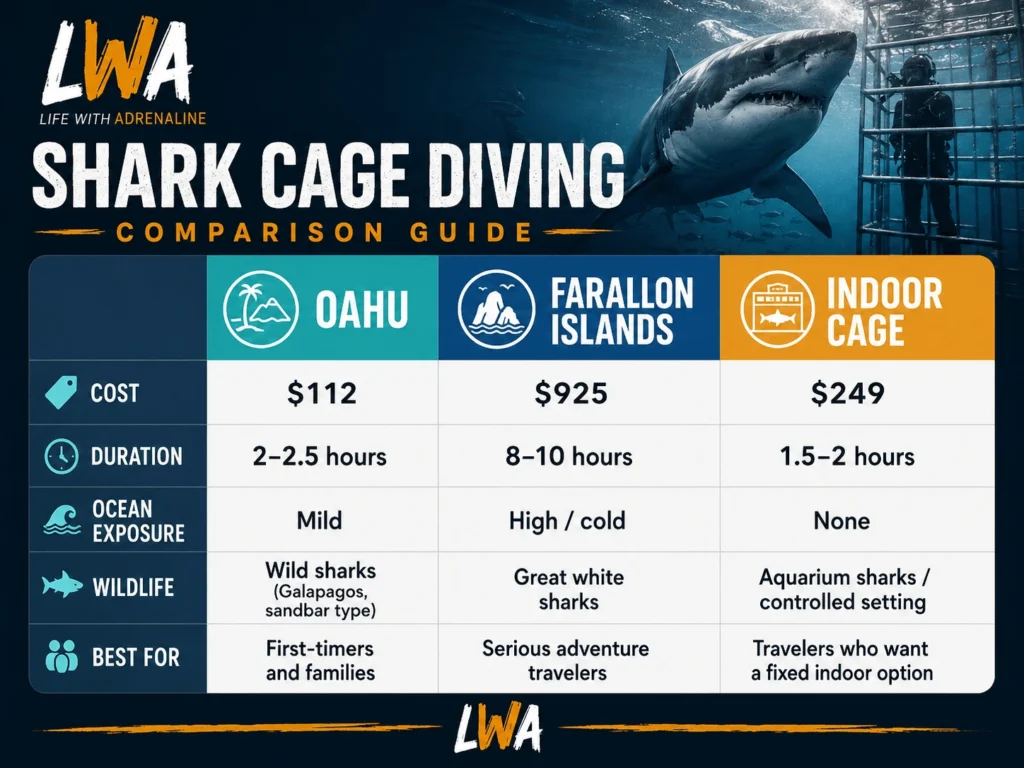
| Experience | Where | Format | Typical shark context | Time | Published price* | Best for |
| 1. North Shore Shark Adventures | Oahu, Hawaii | Wild ocean; surface cage | Haleiwa cage sites are dominated by Galapagos and sandbar sharks in UH research | About 2 hours total | $112 adult online special + tax | Best overall first wild cage dive |
| 2. Farallon Islands expedition | Off San Francisco, California | Wild ocean; great-white cage expedition | White sharks | Up to a full day; ~3 hours each way offshore | $925 cage diver; insurance required | Best for great whites |
| 3. Hawaii Shark Encounters | Oahu, Hawaii | Wild ocean; floating surface cage | Galapagos and sandbar sharks | 2 hours | $125 adult | Best education-focused Oahu option |
| 4. Haleiwa Shark Tours | Oahu, Hawaii | Wild ocean; cage dive | Wild North Shore sharks; species vary | 1.5–2 hours | $135 adult cage diver | Best for a culture-led / small-boat choice |
| 5. Long Island Aquarium Shark Dive | Riverhead, New York | Indoor aquarium cage | Current exhibit animals vary | Fixed daily program | $249 + admission + tax | Best indoor / East Coast cage option |
*Published prices were checked August 26, 2026. Taxes, optional transportation, lodging, insurance, and other travel costs are separate unless specifically stated.
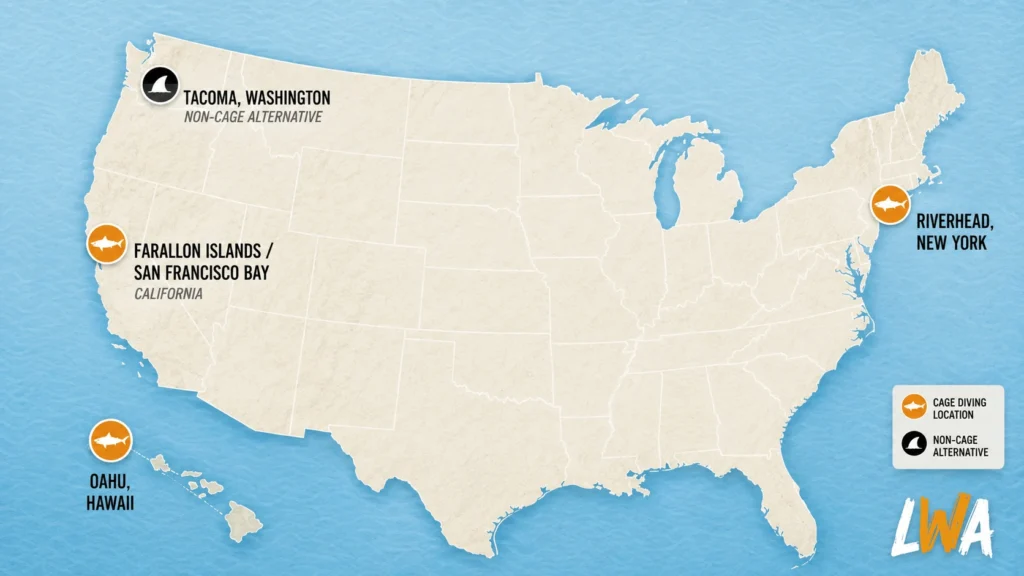
How we ranked these best shark cage diving experiences
This is not a ranking of which operator is “safest,” and it is not based on review scores or affiliate commissions. There is no credible basis here to declare one operator categorically safer than another. Instead, the ranking focuses on the questions that matter most to a first-time U.S. traveler.
- Is it a real cage experience? Cageless swims are excluded from the main ranking.
- Is the current offering verifiable on an official operator or facility page?
- What kind of shark encounter is realistic at the location?
- How beginner-friendly is the water-entry method?
- What are the current published price, time commitment, age rules, and booking conditions?
- How much travel friction, weather exposure, and wildlife uncertainty should you expect?
That method strongly favors Oahu for accessibility. It also explains why the Farallons rank high despite being harder and more expensive: they answer a different intent—seeing white sharks in a natural U.S. setting during their seasonal presence.
1. North Shore Shark Adventures, Oahu — Best overall for first-time wild cage diving
If you want the simplest path from “I have never done this” to “I am in a cage watching wild sharks,” North Shore Shark Adventures is the strongest all-around starting point in this comparison.
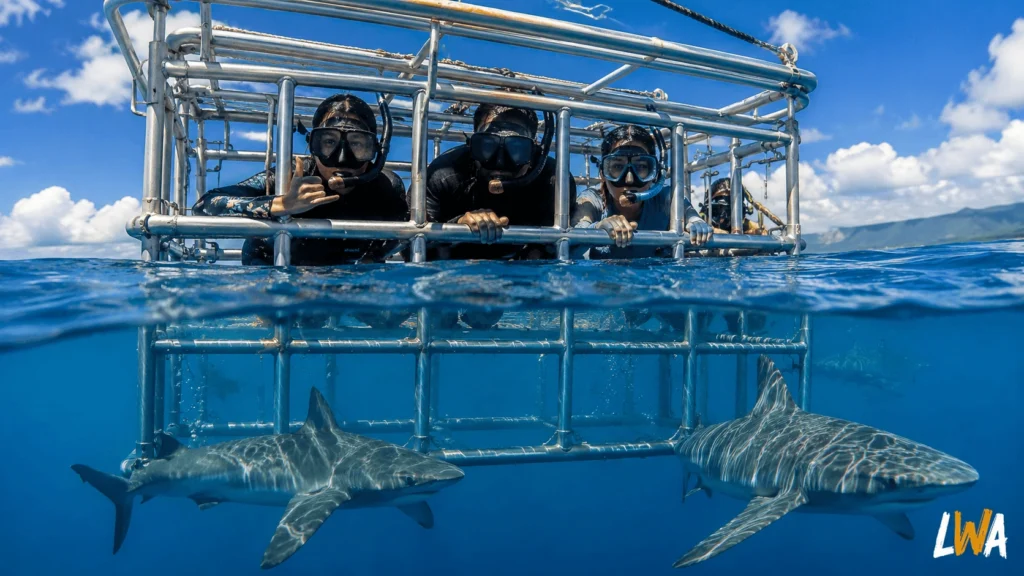
The operator’s current page lists a $112 online adult cage-diver special for ages 14 and older and $90 for children ages 3–13, with tax added. It operates daily year-round, says no swimming is required, provides masks and snorkels, and runs from Haleiwa Harbor. Its quick details call the tour 1.5 hours, while the detailed schedule says the total from check-in to completion is approximately two hours. Plan on the longer figure when building your day. [S1]
The cage is moored three to four miles offshore and can hold up to eight people. The operator says the cage may be dropped up to three times per tour for about 20 minutes per drop, with each cage passenger receiving one drop. That means your memorable in-water portion is relatively short even though the full experience takes around two hours. [S1]
What should you expect to see? University of Hawaii researchers studying the Haleiwa cage-diving sites found that Galapagos and sandbar sharks made up 98% of observed sharks in their study. That does not mean every trip will look the same, but it is more useful than expecting great whites or assuming every dramatic shark species shown in social media could appear. [S7]
Why it works well for beginners
The surface-cage format removes several barriers at once: you do not need a scuba certification, you do not need to swim freely with sharks, and the operator explicitly says swimming is not required. For a nervous first-timer, the bigger practical challenge may be the boat motion rather than the sharks themselves.
North Shore Shark Adventures repeatedly recommends early departures because winds are usually lighter earlier in the day and later tours can be canceled as conditions build. It also advises guests who are prone to motion sickness to take appropriate precautions. [S1]
The logistics advantage
A dedicated Waikiki transportation option is currently listed at $75 per person plus tax. Pickup begins around 5:45 a.m. and the return is about 2 p.m., which makes the shark tour itself short but can turn the experience into a substantial half-day if you are staying in Waikiki. The transportation charge is nonrefundable even if the shark tour is canceled that day, so read that policy before adding the shuttle. [S1]
Best fit: first-time shark divers, mixed-confidence couples or families, travelers already visiting Oahu, and people who want a short wild-ocean encounter without scuba.
Think twice if: you are highly prone to seasickness, you want guaranteed great whites, or your Hawaii schedule is so tight that a weather cancellation would ruin the plan.
2. Farallon Islands, California — Best for great white sharks
The Farallon Islands are the choice for travelers whose real question is not “Where can I cage dive?” but “Where can I cage dive with great white sharks in the United States?” The trade-off is major: this is a serious offshore expedition rather than a short vacation add-on.
NOAA says adult and sub-adult white sharks frequent Greater Farallones National Marine Sanctuary waters each fall, with adults seen most frequently in the broader area between Tomales Point, Año Nuevo Island, and the Farallon Islands where seals and sea lions are abundant. [S5]
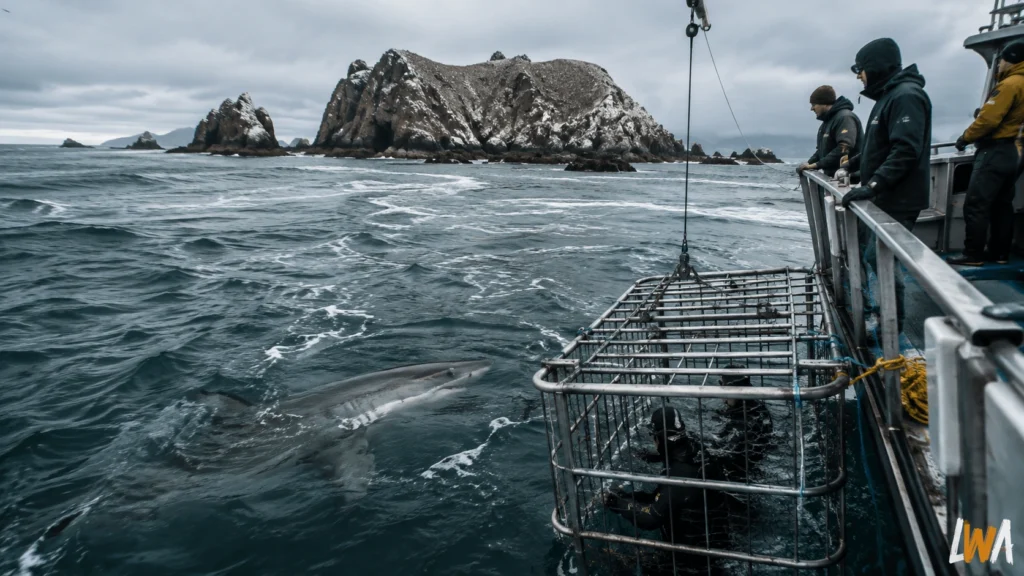
A current Dive Discovery listing describes a one-day Farallon cage-diving trip departing Marina Bay Yacht Harbor in Richmond. It lists a viewing season on select dates in September, October, and November; no dive certification requirement; a minimum age of 16; wetsuit rental and food included; and mandatory trip insurance. The current page checked in August 2026 is already advertising 2027 trip dates, so travelers looking for a 2026 departure should contact the operator rather than assume a date is still available. [S4]
The price and time commitment are in a different league
The current published price is $925 for a cage diver and $675 for a topside observer. The boat ride is typically about three hours each way, with departure by 9 a.m. and return to the dock no later than 9 p.m. The operator also describes the water as often murky and lists shark-sighting chances at about 50/50. There is no shark guarantee. [S4]
That combination changes the value equation. You are not paying for a guaranteed close pass by a white shark. You are paying for access to a remote seasonal habitat, a long day offshore, specialized logistics, and the possibility of a wildlife encounter that may or may not happen.
Know the sanctuary rules
Greater Farallones National Marine Sanctuary regulations prohibit attracting a white shark in the sanctuary and restrict close approaches in designated wildlife-protection zones. The current trip listing states that its operation is permitted to use a seal-shaped decoy and is not allowed to bait. Because permit conditions and regulations matter here, do not generalize one operator’s permitted practice to every vessel. [S4][S6]
Best fit: travelers specifically prioritizing great whites, adults who accept a long cold-water day, wildlife photographers who understand that sightings are not guaranteed, and people who can build flexibility into a San Francisco-area trip.
Think twice if: you want predictable in-water time, you are sensitive to long boat rides, your budget is tight, or you would be disappointed by a no-shark day.
3. Hawaii Shark Encounters, Oahu — Best for an education-focused surface-cage experience
Hawaii Shark Encounters offers a second strong North Shore option with a very clear beginner format: a floating cage more than three miles offshore, entered from above, while you stay at the surface using a mask and snorkel. The operator explicitly says no scuba experience is needed. [S2]
Its current pricing is $125 for adults ages 13 and older, $90 for children 12 and under, $100 for boat riders, and $1,350 for a private charter of up to 10 people. The experience is listed as two hours and ages 5+. [S2]
The operator specifically identifies Galapagos and sandbar sharks as the species commonly viewed on the tour and frames the outing around shark biology, behavior, Hawaiian culture, and conservation. That makes it a particularly good fit for travelers who want the experience to feel like wildlife interpretation rather than a stunt. [S2]
How it differs from the #1 pick
The biggest difference for a typical first-time buyer is not the core wildlife setting—the tours operate from the same general North Shore environment—but the operator package and price. North Shore Shark Adventures currently lists the lower adult online special and a dedicated Waikiki transport option, while Hawaii Shark Encounters has a clean two-hour format and explicit 5+ minimum age. Compare the live checkout terms before booking because taxes and availability can change.
Best fit: families with children who meet the current age requirement, travelers who value conservation interpretation, and beginners who want to stay at the surface in a cage.
4. Haleiwa Shark Tours, Oahu — Best for Native Hawaiian cultural context and a small-boat option
Haleiwa Shark Tours is another currently verified North Shore cage-dive operator, and its clearest differentiator is cultural context. The company states that it is the only North Shore cage-diving experience owned and operated by Native Hawaiians, and its tour description includes interpretation of sharks in Hawaiian culture and history. [S3]
The current adult cage-diver price is $135 for ages 13+, while the child cage-diver/boat-rider price is $95 for ages 12 and under. The tour is listed at 1.5 to two hours and is available daily. Masks, snorkels, and water are supplied. [S3]
The operator lists two boats, one holding up to six people and another up to 12. That can matter if you care about the feel of the outing, but do not assume a specific boat or group size unless you confirm what is assigned to your departure. [S3]
One detail is worth checking directly if you are booking for a young child: the page says “all ages” in quick details and lists a child cage-diver rate for ages 12 and under, while the separate boat-rider line is labeled ages 3+. Because the minimum cage-diver age is not expressed as a single unambiguous number, confirm it with the operator before paying for a child. [S3]
Best fit: travelers who want a North Shore cage dive with a Native Hawaiian-owned operator and cultural interpretation, or who are especially interested in the possibility of a smaller six-passenger boat.
5. Long Island Aquarium, New York — Best indoor shark cage dive
Long Island Aquarium is the outlier in this list, and that is exactly why it is useful. This is not a wild-ocean shark trip. It is an indoor aquarium experience in Riverhead, New York, where the aquarium says participants enter a cage in its Lost City of Atlantis shark exhibit. [S9]
The current Shark Dive is scheduled daily at 11 a.m., is limited to ages 12+, costs $249 plus tax, and requires separate aquarium admission. Adult aquarium admission is currently $52.50, so an adult’s minimum published spend is $301.50 before tax if standard admission applies. The dive must be booked 72 hours in advance. [S8]
The cancellation rules are much less flexible than many travelers expect from a day attraction: within 72 hours there is no refund, only aquarium credit, and a reschedule inside that window carries a $50 fee. [S8]
Why an aquarium cage dive belongs in this comparison
A wild-ocean dive has a type of uncertainty an aquarium cannot reproduce: boat conditions, open water, changing visibility, and wildlife that decides whether to appear. But some first-timers are not looking for that uncertainty. They want the physical experience of entering a cage around sharks without committing to an offshore crossing.
That makes Long Island Aquarium the best fit here for travelers who prioritize schedule predictability, an East Coast location, and an indoor setting over wild behavior. It should not be marketed as equivalent to seeing sharks in the ocean.
A strong beginner alternative that is not actually a cage dive
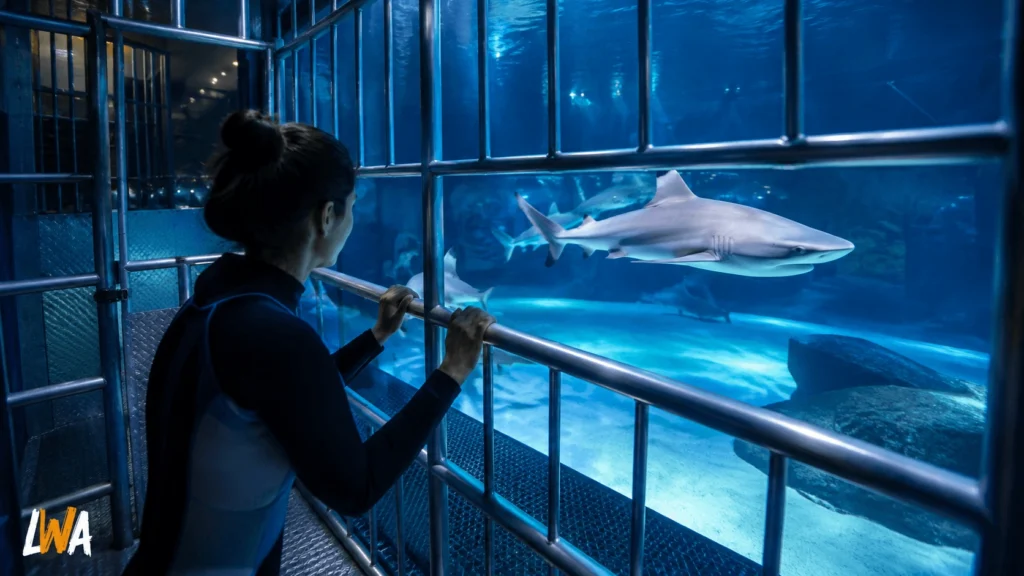
Point Defiance Zoo & Aquarium in Tacoma, Washington, is worth knowing about if your real goal is “get in the water near sharks in a controlled setting” rather than “enter a cage.” Its Eye-to-Eye Shark Dive uses a reserved corner of a 240,000-gallon warm-water habitat with surface-supplied air. The facility says no prior snorkeling, scuba, swimming, or dive experience is required. [S10][S11]
The program currently costs $130 plus tax for nonmembers, includes zoo admission and a staff-shot souvenir video, lasts about an hour with roughly 20 minutes in the water, and is open to ages 8+. It also offers a Hoyer lift for guests who use a wheelchair. [S10][S11]
The Outer Reef currently includes species such as blacktip reef sharks, whitetip reef sharks, grey reef sharks, tasselled wobbegongs, and Indo-Pacific leopard sharks. [S12]
It is not ranked in the main top five because it is not a traditional cage-diving product. For a nervous beginner, however, it may be a better personal fit than forcing an ocean cage trip simply because “cage diving” was the original search term.
Why this list is shorter than some “best shark cage diving USA” roundups
Some current search results label a long list of U.S. shark destinations as cage-diving locations. One June 2026 roundup, for example, includes the Florida Keys, Monterey Bay, the Outer Banks, San Diego, Cape Cod, South Padre Island, Seattle, Long Island, and Galveston in addition to Oahu and San Francisco. [S13]
The problem is that “sharks live here,” “shark dives happen here,” and “a current commercial cage dive is bookable here” are three different claims. Marketplace results reinforce the confusion by placing cage dives and cageless shark swims in the same shark-diving category. [S14]
For this article, a destination was not promoted as a cage-diving recommendation unless a current cage product could be verified. That also means famous historical references should be treated carefully. Older PADI and Scuba Diving articles are useful for Farallon context, but their original publication dates are 2015 and 2012 respectively, so current prices, operators, and rules must come from newer sources. [S15][S16]
How much does shark cage diving cost in the USA?
The headline price varies dramatically because you are buying different experiences, not different versions of the same ride.
| Experience | Base published price | Required / notable add-on | How to interpret it |
| North Shore Shark Adventures | $112 adult online special + tax | Optional Waikiki transport $75 + tax | Short wild-ocean tour; transport can materially change the day’s cost |
| Hawaii Shark Encounters | $125 adult | Private charter $1,350 if desired | Short wild-ocean surface cage |
| Haleiwa Shark Tours | $135 adult cage diver | No mandatory add-on identified on checked page | Short wild-ocean cage dive |
| Farallon Islands | $925 cage diver | Trip insurance required; price not stated on checked page | All-day seasonal great-white expedition |
| Long Island Aquarium | $249 + tax | Aquarium admission required; adult admission currently $52.50 | Indoor cage; minimum adult published spend $301.50 before tax |
Do not use a single “average shark cage diving price” to budget your trip. A $112 Oahu booking and a $925 Farallon booking are not interchangeable. The first is a roughly two-hour vacation activity; the second is a remote offshore expedition with mandatory insurance and a full-day time commitment.
For Oahu, the realistic trip budget may also include a rental car, rideshare, or operator shuttle from Waikiki. For the Farallons, add whatever the required trip-insurance policy costs plus your Bay Area lodging and ground transport. For Long Island Aquarium, remember that aquarium admission is mandatory and separate.
When is the best time to go?
Oahu: year-round, but early morning is the practical sweet spot
North Shore Shark Adventures lists daily, year-round operation. It strongly recommends early tours because morning winds are typically lighter, while later conditions can become rougher and may lead to cancellations. That advice is about comfort and operational reliability, not a guarantee of better shark numbers. [S1]
Hawaii Shark Encounters also presents its North Shore dive as a standard two-hour wild-ocean outing. On any Oahu boat tour, build weather flexibility into your trip rather than placing the dive on your last possible morning. [S2]
Farallon Islands: fall is the season that matters
NOAA describes fall as the period when adult and sub-adult white sharks frequent sanctuary waters, and the current trip listing schedules its viewing season on select September, October, and November dates. [S4][S5]
This is not an experience to book around a generic California vacation month. If white sharks are the point of your trip, build the trip around the published expedition calendar and keep room for marine conditions.
Long Island Aquarium: schedule certainty is the advantage
The current aquarium page lists the Shark Dive daily at 11 a.m. and requires booking at least 72 hours ahead. The aquarium itself is open year-round except Thanksgiving and Christmas Day. [S8][S9]
What first-time shark cage divers usually underestimate
1. Seasickness can matter more than fear
You may be mentally focused on sharks and discover that the moving boat is the harder part. This is especially relevant on Oahu and dramatically more relevant on the long Farallon run. If you know you are prone to motion sickness, follow the operator’s current guidance and speak with a healthcare professional or pharmacist if you need help choosing an appropriate option for you.
2. In-water time can be short
A two-hour tour does not mean two hours in the cage. North Shore Shark Adventures describes roughly 20-minute cage drops and one drop per cage passenger. Point Defiance’s non-cage aquarium alternative similarly gives about 20 minutes in the water during a one-hour program. [S1][S11]
3. Wildlife is not a performance schedule
The Farallon listing is explicit: there is no shark guarantee and it estimates sighting chances at about 50/50. North Shore Shark Adventures, by contrast, advertises a shark-sighting guarantee for its Oahu tour. Treat those as operator-specific policies, not universal truths about shark diving. [S1][S4]
4. “Beginner-friendly” does not mean risk-free
A surface cage can reduce the swimming skill required, but an open-ocean trip still involves boat movement, ladders or water entry, changing weather, and contact with saltwater. An aquarium program removes some environmental uncertainty but may have its own health, mobility, or equipment restrictions. Review the current waiver and participation rules before booking.
Safety, wildlife ethics, and what a cage does not solve
Shark cage diving is an inherently adventurous wildlife activity. A cage creates a physical boundary, but it does not eliminate risk from the boat, ocean conditions, equipment, participant behavior, or the broader environment. Follow the crew’s briefing and do not improvise around wildlife.
The Farallon Islands also require a stronger conservation lens because the dives occur in a national marine sanctuary. NOAA’s regulations prohibit white-shark attraction in the sanctuary and restrict approach in specific wildlife-protection zones; tourism and research activities may involve permits and specific conditions. [S6]
In Hawaii, University of Hawaii researchers studied sharks associated with the Haleiwa cage-diving sites. Their work found Galapagos and sandbar sharks were the dominant species observed and reported extremely rare inshore movements by tagged sharks from those sites. That research is useful context, but it is from 2009 and should not be stretched into a claim that any operator or activity is “completely safe.” [S7]
If you are pregnant, have a cardiovascular or respiratory condition, have mobility limitations, take medication that affects motion or alertness, or have another medical concern, review the operator’s current medical restrictions and seek individualized advice from an appropriate healthcare professional. This article cannot determine whether you personally should participate.
Before you book: a practical shark cage diving checklist
- Confirm that the experience is actually a cage dive, not a cageless snorkel or standard scuba shark dive.
- Check the current species context. Oahu’s Haleiwa cage sites are primarily associated with Galapagos and sandbar sharks; the Farallons are the U.S. great-white choice in this comparison.
- Read the exact minimum age and any health, swimming, mobility, or certification requirements for your chosen departure.
- Ask how much of the advertised duration is actual cage time.
- Check whether tax, aquarium admission, transport, wetsuit rental, media, parking, or trip insurance is extra.
- Read the weather and cancellation policy before buying nonrefundable flights or hotels around the activity.
- If you are prone to seasickness, do not treat motion planning as an afterthought.
- For wild-ocean trips, leave a backup day in your itinerary when possible.
- Do not book a Farallon trip expecting a guaranteed white-shark sighting.
- Recheck all prices and restrictions on the official operator page immediately before payment.
Which U.S. shark cage dive should you choose?
Choose North Shore Shark Adventures if you want the strongest all-around mix of beginner accessibility, current price transparency, short duration, year-round operation, and optional Waikiki transport. [S1]
Choose the Farallon Islands if seeing a great white shark in a wild U.S. setting is the main purpose of the trip and you are willing to accept a high price, a long offshore day, seasonal scheduling, cold and potentially murky water, and no sighting guarantee. [S4][S5]
Choose Hawaii Shark Encounters if you want Oahu’s surface-cage format with an explicit education and conservation emphasis. Choose Haleiwa Shark Tours if Native Hawaiian ownership and cultural interpretation are especially important to you. [S2][S3]
Choose Long Island Aquarium if you want a true cage experience but prefer an indoor, fixed-location program over an ocean crossing. If the cage itself is not essential and your main goal is a controlled first underwater shark encounter, Point Defiance’s Eye-to-Eye program is another strong beginner option. [S8][S9][S10][S11]
FAQ
Can beginners go shark cage diving in the USA?
Yes. Several current options are designed for people without scuba experience. North Shore Shark Adventures says no swimming is required, Hawaii Shark Encounters uses a surface cage with mask and snorkel and says no scuba experience is needed, and the current Farallon listing says no dive certification is necessary. Always check the specific operator’s age and health rules. [S1][S2][S4]
Where can you cage dive with great white sharks in the USA?
The Farallon Islands off the San Francisco Bay Area are the clearest currently verified U.S. option in this research. NOAA documents seasonal fall presence of adult and sub-adult white sharks in Greater Farallones National Marine Sanctuary, and a current commercial listing offers cage-diving expeditions on select fall dates. [S4][S5]
How much does shark cage diving cost in the USA?
For the experiences verified here, current adult pricing ranges from $112 plus tax for an Oahu cage-diver online special to $925 for a Farallon cage diver, before required trip insurance. Long Island Aquarium’s Shark Dive is $249 plus tax and requires separate aquarium admission. Prices were checked August 26, 2026. [S1][S4][S8]
Is Oahu or the Farallon Islands better for a first shark cage dive?
For most first-timers, Oahu is easier: shorter trip, warmer vacation setting, surface-cage format, and much lower current price. The Farallons are better when great whites are the priority and the traveler accepts the bigger time, cost, weather, and wildlife-uncertainty commitment.
Are shark sightings guaranteed?
Not universally. North Shore Shark Adventures advertises guaranteed shark sightings on its current Oahu page. The Farallon listing explicitly says there is no shark guarantee and estimates sighting chances around 50/50. Read the policy for the exact operator you book. [S1][S4]
Final recommendation
For the average U.S. traveler planning a first cage dive, start with Oahu’s North Shore. It offers the clearest combination of current bookable options, short duration, surface-cage access, and prices that can fit into a normal Hawaii vacation rather than defining the entire trip.
If the animal matters more than convenience and the animal you mean is a great white, the Farallons are a different category. Treat that as a dedicated wildlife expedition, not an upgraded version of an Oahu tour.
The key is to choose the format that matches your real goal. A two-hour Oahu cage, a 12-hour Farallon day, and an indoor aquarium cage can all be memorable—but they solve three different travel decisions. Book the one whose cost, uncertainty, physical comfort, and wildlife setting you actually want.
Sources
[S1] North Shore Shark Adventures — Oahu Shark Diving Tour — https://sharktourshawaii.com/shark-diving-tour/
[S2] Hawaii Shark Encounters — Shark Cage Diving in Oahu — https://hawaiisharkencounters.com/shark-cage-diving/
[S3] Haleiwa Shark Tours — O‘ahu Shark Diving Tour — https://www.haleiwasharktours.com/shark-cage-diving/
[S4] Dive Discovery — Great White Shark Cage Diving, Farallon Islands — https://www.divediscovery.com/shark-diving/divetours/great-white-shark-cage-diving-farallon-islands.php
[S5] NOAA Greater Farallones — White Shark Natural History — https://farallones.noaa.gov/eco/sharks/sharks_nat_history.html
[S6] NOAA Greater Farallones — White Shark Stewardship Project — https://farallones.noaa.gov/eco/sharks/
[S7] University of Hawaii HIMB — Movements of Sharks Associated With Cage Dive Ecotourism — https://www.himb.hawaii.edu/ReefPredator/Shark%20Ecotourism.html
[S8] Long Island Aquarium — Tickets & Aquatic Adventures — https://www.longislandaquarium.com/tickets-aquatic-adventures/
[S9] Long Island Aquarium — Aquarium Info — https://www.longislandaquarium.com/aquarium-info/
[S10] Point Defiance Zoo & Aquarium — Eye-to-Eye Shark Dives — https://www.pdza.org/discover/shark-dives/
[S11] Point Defiance Zoo & Aquarium — Shark Dive FAQ — https://www.pdza.org/discover/shark-dives/shark-dive-faq/
[S12] Point Defiance Zoo & Aquarium — Outer Reef — https://www.pdza.org/animals/tropical-reef-aquarium/outer-reef/