What Does Whitewater Rafting Feel Like? A First-Timer’s Guide
If you have watched a rafting video and thought, “That looks amazing—and slightly terrifying,” you are seeing only the noisy part. A first rafting trip is usually a mix of quiet drifting, listening for instructions, paddling with other people, and short bursts when the raft bounces through moving water. The bigger surprise is often how quickly the feeling changes: a flutter of nerves on the approach, a splash of cold water, then laughter or relief once the boat reaches a calmer stretch.
So what does whitewater rafting feel like? Imagine sitting on the flexible edge of an inflatable boat while the river pushes it forward, lifting your stomach briefly over some waves and making you brace with your legs as your paddle meets the water. It can feel playful, demanding, frightening, exhilarating—or several of those at once. A gentle guided Class I–II trip and a demanding Class IV run are not remotely the same experience.
This is an honest, first-timer-focused description of sensations, teamwork, fear, cold water and the possibility of an unexpected swim. It is not a first-person account of a trip we took, and it cannot replace the instructions from your own rafting outfitter.
The Short Answer: What Does a Rafting Rapid Actually Feel Like?
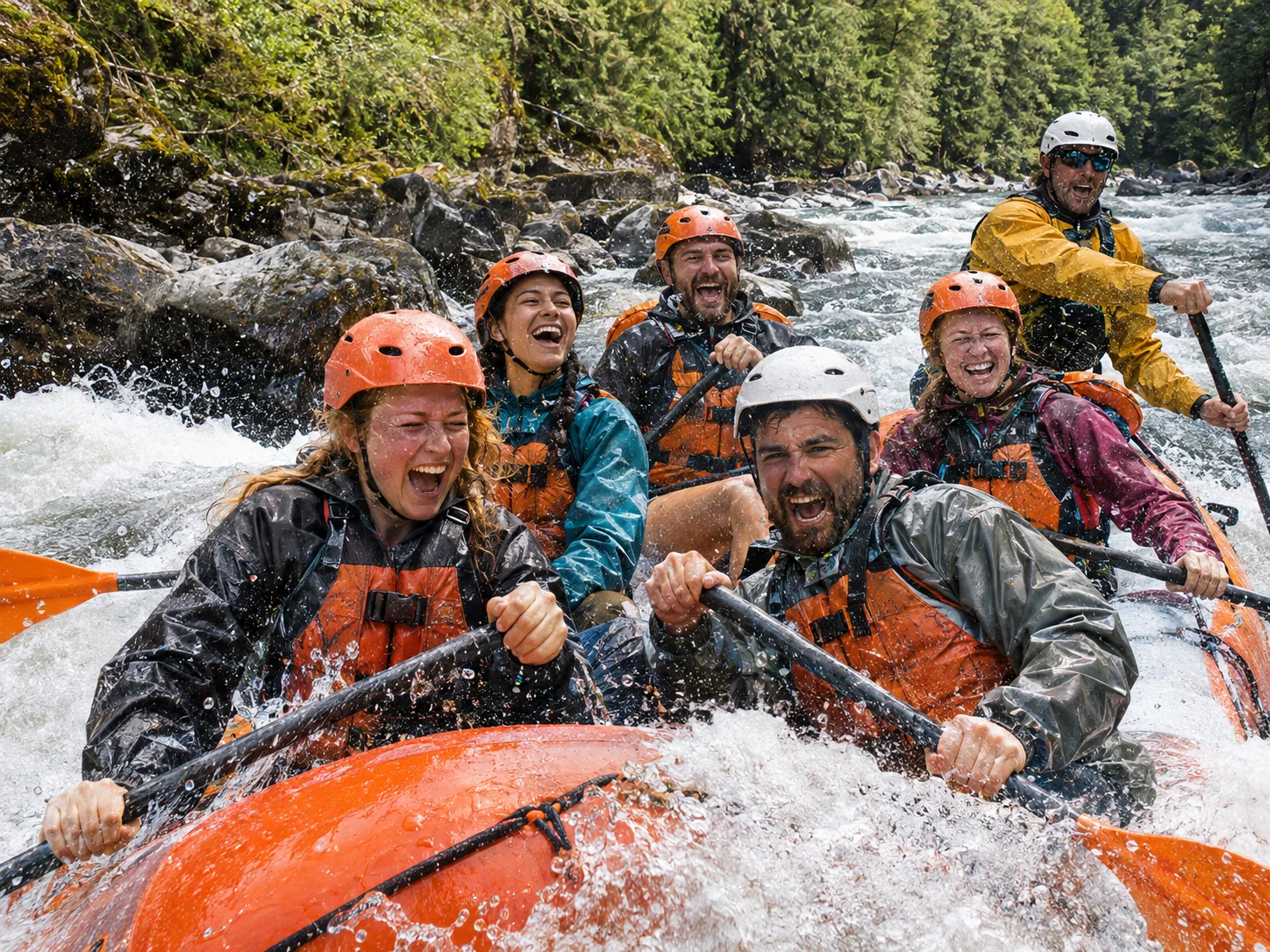
On an approachable rapid, the raft may dip into a wave, climb up the next one and slap down with a hollow thump. Your body rocks with the boat. Water may spray your face, your shoes get wet, and a guide calls a few short commands. The exciting part can last seconds, followed by enough quieter river to look around and notice the scenery.
On more powerful whitewater, the rocking can become abrupt: bigger irregular waves, stronger current, quick changes of direction and more demanding coordinated paddling. You may not see the next feature until the boat approaches it. The experience is physical rather than a smooth theme-park ride, and the outcome of any individual rapid is never guaranteed.
Before you book, ask which river section you will run and whether the tour is specifically designed for first-timers. A river name or a photograph is less useful than the exact itinerary. Our best beginner whitewater rafting trips in the USA compares actual trip formats instead of assuming an entire river has one difficulty.
The First Ten Minutes: The Part Most Videos Leave Out
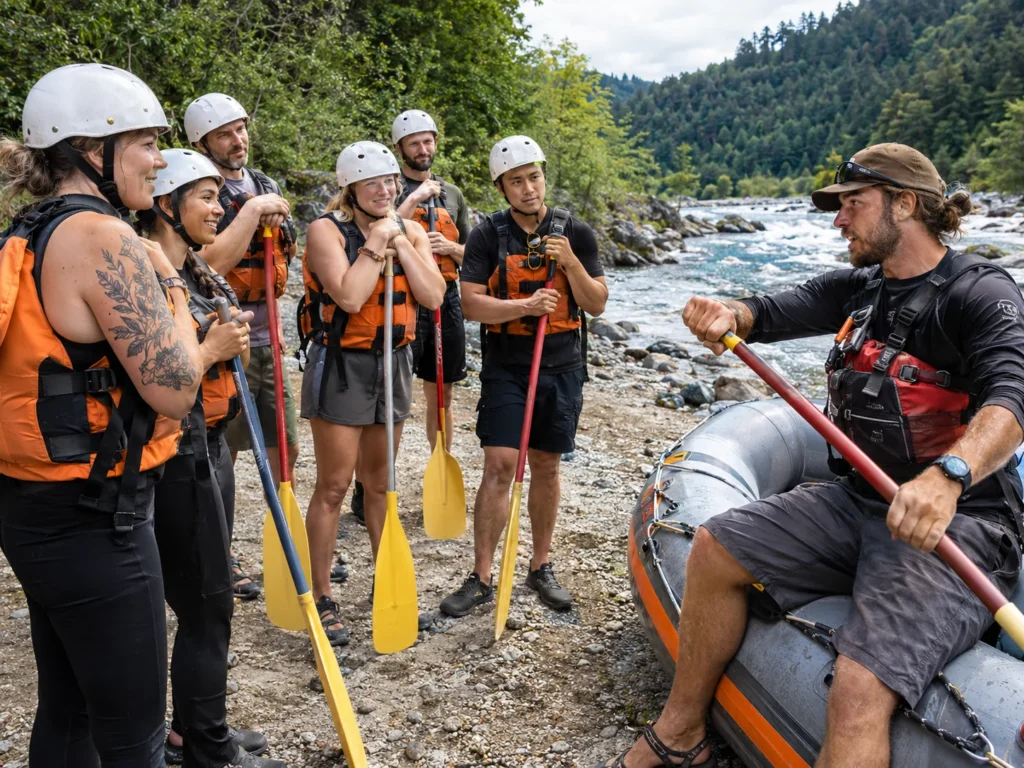
The experience begins on land, not in a wall of water. You check in, receive a properly fitted personal flotation device (PFD), put on a helmet if required, and hear the guide explain where to sit, how to hold the paddle and what to do if you leave the raft unexpectedly. Depending on the operator, there may be a shuttle, a walk across stones to the launch and a short period practicing commands.
If you feel nervous, that is an appropriate time to say so. Ask how strenuous the paddling is, whether the water is cold, where you should sit and which instructions matter most. If you cannot swim or have a medical or mobility concern, disclose that before payment and again during check-in as required. Operators vary in what they allow; wearing a PFD does not make every river suitable for a non-swimmer.
Once the raft starts moving, a surprising amount of attention goes into ordinary things: keeping both hands in useful positions, staying balanced and matching other paddlers rather than pulling as hard as possible. You do not need to arrive knowing how to steer a raft. You do need to listen and participate at the level your tour requires.
What Your Body Notices in the Rapids
The bounce. A raft is soft-sided and flexible. Instead of gliding evenly, it climbs and drops through waves. On a milder section that feels like repeated little jolts. On rougher water, a bump can knock your hips against the tube or send a surge of spray over your lap.
The sound. Rushing water can grow louder as you approach a rapid, and paddles tap, teammates shout and the guide gives commands. Then, once the raft clears the feature, normal conversation suddenly becomes easy again. That contrast is part of the experience.
The temperature. Even on a sunny day, a splash of cold river water can feel startling on your face or neck. Wind over soaked clothing can make you colder afterward. On snowmelt-fed rivers, the water may be much colder than the air. Appropriate clothing is based on water conditions, not just the weather forecast.
The effort. Paddling involves your shoulders, core and timing, but the required effort varies greatly. Some trips are largely guide-powered in an oar raft; others use paddle crews and require energetic strokes during multiple rapids. You might be more tired from staying alert than from the actual paddling.
The view. Between rapids, there may be trees, cliffs, birds, broad river bends and moments when nobody feels the need to speak. The quieter stretches are not filler: they give first-timers a chance to settle into the boat and decide whether the next rapid sounds exciting or daunting.
What Do the Guide’s Commands Feel Like in Practice?
The guide typically uses short, repeatable phrases. “Forward” means make coordinated forward strokes; “back paddle” or “back” means paddle in reverse; “stop” means hold; and “get down” or “high side” can be used in particular conditions. Exact commands differ by guide, boat and river. Do not memorize online instructions as a substitute for your own briefing.
Good teamwork rarely looks dramatic. Someone at the front sets a rhythm, you try to match that rhythm, and the boat responds to the combined effort. If one person misses a stroke, the guide adjusts. If everyone stops listening in a difficult spot, the consequences can be more serious. Paddling together is about timing and response, not proving you are strong.
A common misconception is that first-timers must read the river themselves. On a professionally guided trip, the guide plans the line and explains your role. You still need to remain aware, follow instructions and avoid distracting other paddlers during technical sections.
Is Whitewater Rafting Scary for Beginners?
It can be, especially during the waiting period before the first real rapid. The uncertainty—what will the splash feel like, will I stay in, what if I freeze—often makes people more anxious than the actual physical sensation. Other people love that anticipation. Both reactions are normal, and there is no obligation to enjoy being frightened.
The right starting point depends on how comfortable you are in moving water. For a cautious traveler, a reputable guided Class I–II outing generally gives more space to learn than a long sequence of more powerful rapids. A guided Class II–III route can provide more obvious waves, but “takes beginners” is not the same as “easy for every beginner.”
Class ratings describe relative river difficulty, not how scared a particular person will feel. American Whitewater warns that classifications are approximate and conditions can change with flow, hazards or weather. See our whitewater rafting classes explained guide for the differences between Class I and Class VI before selecting a trip.
Tell the outfitter exactly what worries you. “I want to see big scenery but I do not want a high chance of falling in” is much more useful to a booking agent than “Is rafting safe?” They can describe the current conditions and tell you whether a gentler trip is available. They cannot promise zero risk.
Can You Fall Out of a Raft? What That Risk Actually Means
Yes. People can fall out, and rafts can overturn, even on a guided trip. That is why a proper safety briefing should cover accidental immersion and rescue. A guide may explain how to orient your body in moving water, what to do if you are next to the raft and how to respond to a throw line. The exact response depends on current, obstacles, location and the guide’s judgment.
One critical general rule from National Park Service river-safety guidance: do not try to stand in fast-moving water, where a foot can become trapped among submerged rocks. In some situations guides teach a defensive floating position with feet up and pointing downstream; in others active swimming toward a safe exit may be needed. Learn and obey the procedure given for your actual river and conditions.
There is no need to imagine that falling out is inevitable. Equally, do not rely on reassuring claims that it “never happens.” Before booking, ask the company about swimming requirements, the guide’s instructions, support craft if used, and how a swim is handled on your selected section. A well-fitting PFD is an essential piece of risk management, not permission to underestimate the water.
Cold-water shock, current, submerged hazards and exhaustion are serious considerations in natural water, as emphasized by the National Park Service and the American Red Cross. No online guide can determine whether a specific trip is appropriate for your swimming ability, medical history or personal comfort.
Class II vs. Class III: How Different Do They Feel?
These descriptions are broad impressions, not promises about wave height or an individual river. Even two Class III trips can feel dramatically different.
| Rapid class | What you may feel | What to remember |
| Class I–II | Gentle current, manageable waves and brief bumps on many runs | Still moving water; ask about hazards and water temperature |
| Class III | Irregular waves, more active maneuvering and stronger jolts | Intermediate rating; guided first-timers may be accepted on selected trips |
| Class IV+ | More sustained, powerful water and technical demands | Not a default starting point for a nervous first-timer |
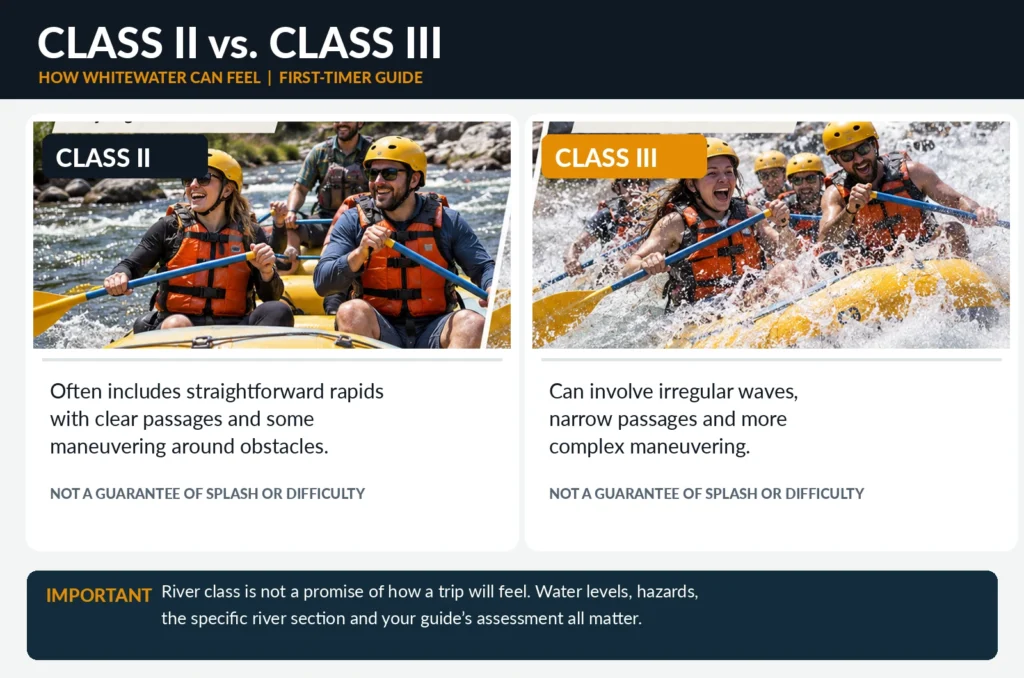
Water levels can change this picture. A mellow river may become faster and more technical when flows rise; low water can expose rocks and create different challenges. Check what the outfitter means by “beginner-friendly” for your date, not just the class printed on a brochure.
Will You Get Soaked, Cold or Exhausted?
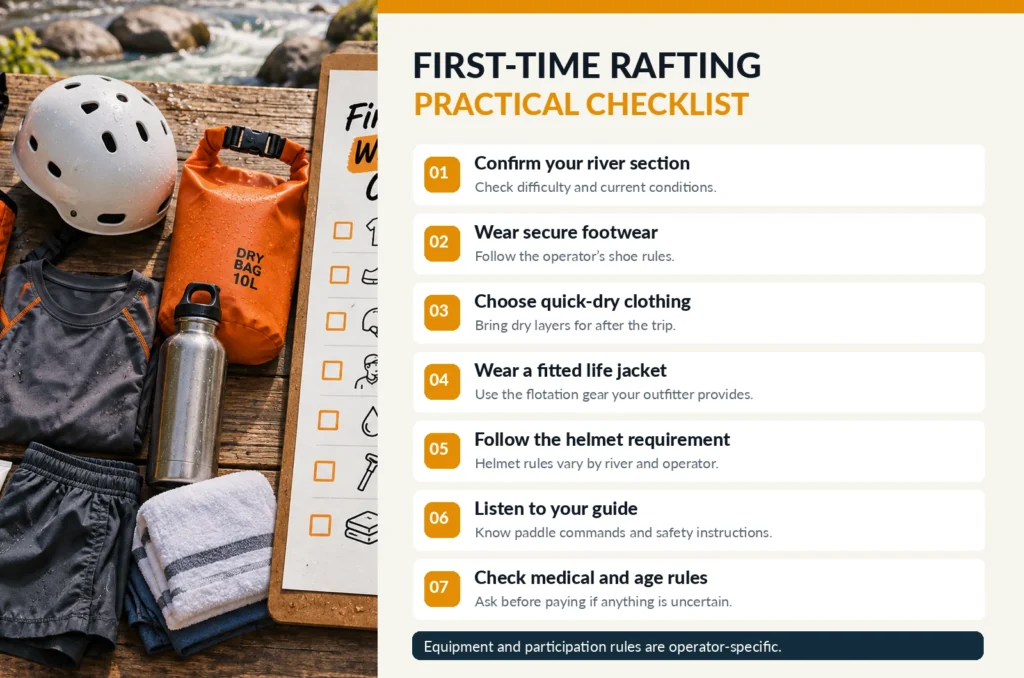
Plan to get wet, even if your actual trip has several calm miles. Spray often arrives unpredictably—from a wave breaking over the bow or someone else’s paddle—so a full set of dry clothes and shoes for afterward can matter more than a fancy waterproof phone case.
Cold is not just about comfort. The National Park Service notes that immersion in cold natural water can shock the body and impair swimming. Depending on the river, season and operator, you may be issued a wetsuit, splash jacket or other cold-water equipment. Ask what is included and wear the technical layers the operator specifies.
Choose footwear that stays on your feet, dress in materials that perform when wet and avoid bringing loose valuables into the raft. Our what to wear whitewater rafting guide covers warm-weather clothes, cold-water layers, shoes and a practical change-of-clothes checklist.
How tired will you be afterward? A relaxed scenic trip may leave you pleasantly energized. A long paddle-heavy trip can strain arms, shoulders and core. You can be a beginner and still need basic coordination, endurance or the ability to follow movement instructions. Fitness requirements must be checked with the operator, not assumed from the marketing photo.
A Realistic First-Timer Timeline
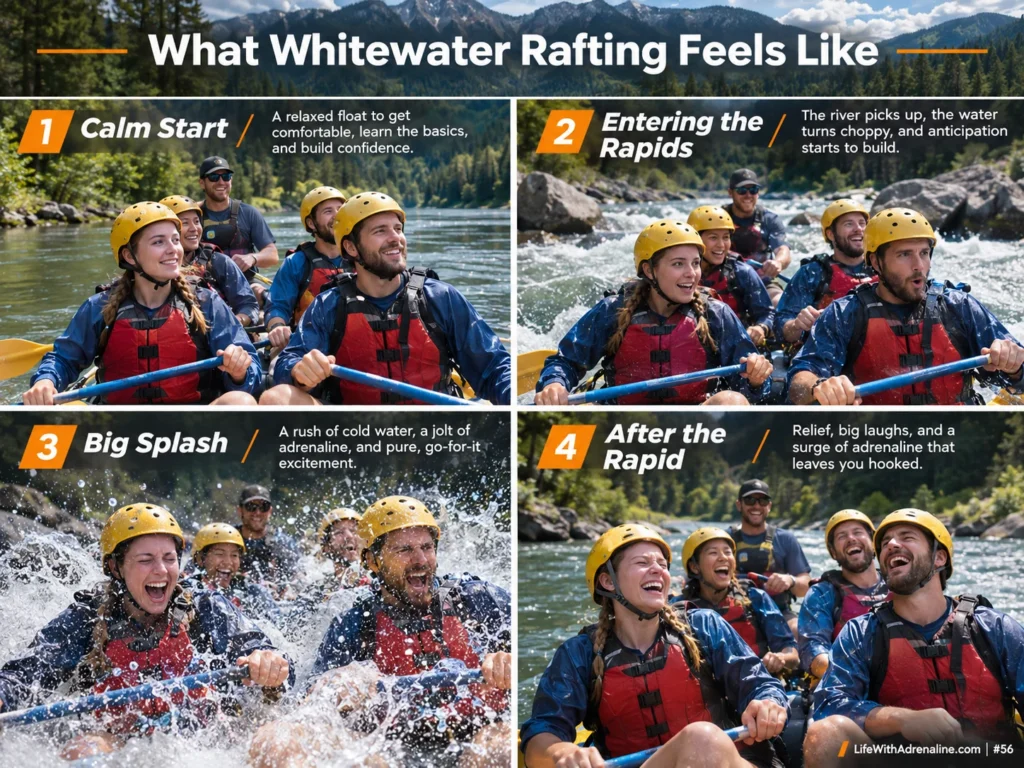
Before launch: You are a little awkward in a PFD, checking straps and watching the guide demonstrate where your feet and hands should go. You rehearse a short command and realize the person next to you has also never done this.
First easy water: The raft moves faster than it looked from shore. The guide talks, and the crew gets its paddles into a rhythm. Your shoulders relax as you notice where the river bends.
Approaching a rapid: The noise grows, the guide points to the route and you feel a flutter in your stomach. The group starts paddling together. A wave lifts the front of the raft and cold spray hits the side.
Seconds after: The raft is still moving, but the water is less chaotic. Some people cheer, some laugh, and someone admits they were more nervous than they expected. You may feel proud or simply relieved. Neither response is wrong.
At the take-out: You step onto uneven ground, possibly tired, wet and hungry, then change into dry clothes. The memory is often a mixture of specific splashes and the slower moments when the river seemed to fill the whole landscape.
This sequence is illustrative, not a claim that every guided trip follows the same script. Some rivers have long flat sections; others offer tightly spaced rapids; weather and flow can alter the experience significantly.
How to Choose a First Trip That Feels Exciting, Not Overwhelming
Start with the specific river section, not the biggest-sounding brand. Ask whether the trip uses a paddle raft, an oar raft or another craft; what the hardest rapid is; how much paddling is expected; how much time is actually on the water; and what happens if conditions change.
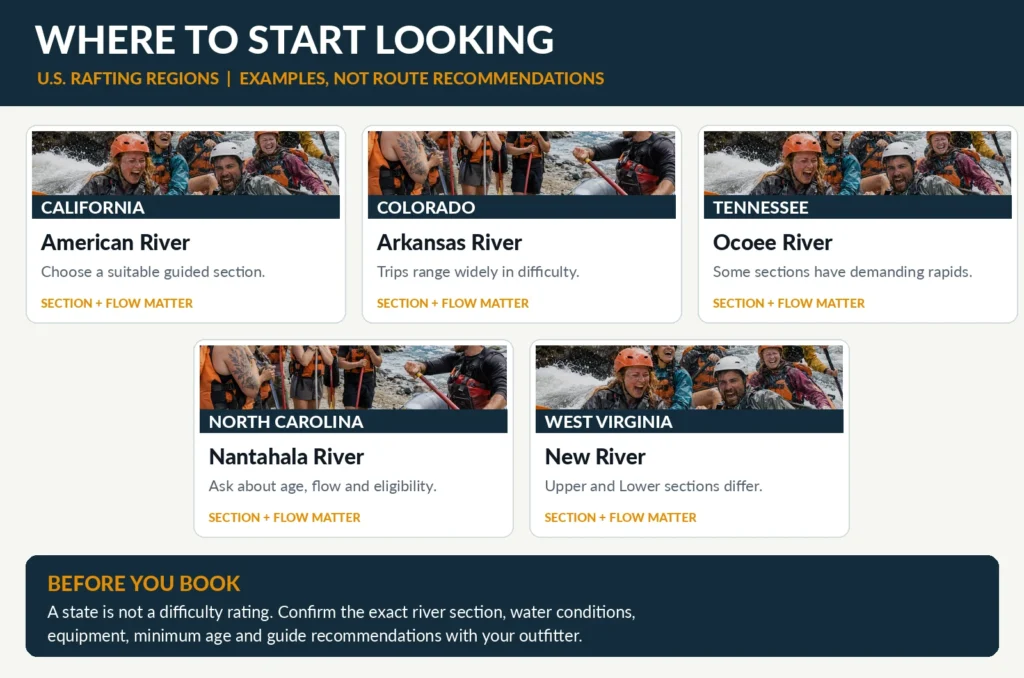
Be explicit about swimming confidence, fear of cold water, mobility constraints and the age of everyone in your group. Confirm the provider’s current age and size requirements and whether they accept complete beginners on that particular run. Some trips accept first-timers but require a level of physical participation that a cautious traveler may not enjoy.
Budget is a separate question. A low advertised fare should not persuade you to choose a difficult section. Once the river choice is sensible, our whitewater rafting cost in the USA guide explains ticket prices, additional fees, included gear and realistic all-in budgeting.
If you feel uncertain after discussing the actual river with the outfitter, choose a calmer option. The point of a first adventure is to find out what you enjoy, not to finish the most difficult trip you can technically book.
Quick Questions First-Time Rafters Ask
Does whitewater rafting feel like a roller coaster?
Sometimes, briefly: there can be a lifting or dropping feeling and a rush of anticipation. Unlike a controlled amusement-park track, a natural river changes with flow and has unpredictable hazards. The comparison is about sensation, not safety equivalence.
Will I feel motion sick?
It is possible, although boat movement, heat, fatigue and individual sensitivity differ. If you are prone to motion sickness, ask the operator about trip duration and conditions before booking. Do not take medication for the first time just before the excursion without checking its precautions.
Do I have to paddle the whole time?
Not necessarily. Some river stretches require coordinated paddling while others offer breaks; an oar raft may let the guide do most of the propulsion. Ask which boat type and crew role your ticket includes.
Does everyone get scared?
No. Some guests are delighted immediately, some feel uneasy until the first rapid is over and others do not enjoy the exposure or uncertainty. Anxiety does not prove you should push through. Select an activity compatible with your preferences.
What if I cannot swim?
Do not assume that a life jacket makes every commercial rafting trip appropriate. Tell the outfitter you cannot swim before purchasing. Ask whether that precise trip accepts non-swimmers, what its rescue procedures are and whether a calmer alternative is available.
The Bottom Line
Your first whitewater rafting trip may feel like a string of small surprises: a raft shifting beneath you, a cool splash, a shouted instruction, a short moment of uncertainty and then a broad, quiet reach of river. The best outcome is not necessarily “I was never scared.” It is understanding the experience you chose and feeling that the group and guide took the river seriously.
Start on a river section that matches your comfort, tell the outfitter about your limits, listen closely to the safety briefing and plan to get wet. The right first trip should leave room for both the adrenaline and the scenery.
Sources and Verification
American Whitewater — International Scale of River Difficulty: https://www.americanwhitewater.org/explore/safety/international-scale-of-river-difficulty/
American Whitewater — Safety Code (revised 2024): https://www.americanwhitewater.org/explore/safety/safety-code/
U.S. National Park Service — Commercial Whitewater Information, New River Gorge: https://www.nps.gov/neri/planyourvisit/whitewater_commercial.htm
U.S. National Park Service — River Safety (Canyonlands): https://www.nps.gov/cany/planyourvisit/riversafety.htm
U.S. National Park Service — Swimming in Natural Waters: https://www.nps.gov/articles/swimming-safety.htm
American Red Cross — Water Safety: https://www.redcross.org/get-help/how-to-prepare-for-emergencies/types-of-emergencies/water-safety.html
Information verified November 7, 2026. Sensory descriptions are explicitly illustrative, not a report of a personal trip.