
Direct answer: For most guided whitewater rafting day trips, wear a swimsuit or quick-dry synthetic base layer, quick-dry shorts or pants, and secure shoes that can get soaked without coming off. Add sun protection in warm weather and insulating layers plus a wetsuit, splash gear, or drysuit when cold water and cold conditions require them. The most important rule is to follow your outfitter’s trip-specific packing list because the operator may provide the PFD, helmet, wetsuit, splash jacket, or other technical gear. [S1][S4]
If this is your first rafting trip, the packing problem is easier than it looks. You do not need to show up dressed like a professional river guide, and you usually should not buy expensive technical gear before you know what the outfitter provides. What matters is choosing clothing that still works when it gets wet, footwear that stays on your feet, and enough protection for the water temperature, wind, and sun. Cold snowmelt can make a warm afternoon feel very different once you are splashed or swimming, which is why paddlesports guidance often says to “dress for the swim.” [S1][S2]
What to Wear Whitewater Rafting at a glance
| Conditions | What to wear | Footwear | Useful extras |
| Warm summer day | Swimsuit or synthetic base, quick-dry shorts/pants, synthetic or UPF top | Secure water shoes, old sneakers, or strapped river sandals | Sunglasses retainer, water-resistant sunscreen, dry clothes for afterward |
| Cool or shoulder season | Synthetic/wool base, insulating layer if needed, quick-dry bottoms | Secure shoes; wool or neoprene socks if appropriate | Ask whether wetsuit, splash jacket, or booties are provided |
| Cold water / cold air | Synthetic or wool layers under appropriate immersion protection | Secure footwear compatible with provided cold-water gear | Follow the outfitter’s exact wetsuit/drysuit and layering instructions |
| After the trip | Dry, comfortable change of clothes | Dry shoes/socks | Towel and warm layer waiting at the take-out or vehicle |
The best rafting outfit starts with the water, not the weather app
A common beginner mistake is dressing only for the air temperature. A sunny 80°F afternoon does not mean the river is warm, especially on snowmelt-fed rivers. REI advises paddlers to dress for the water temperature, while NRS uses the practical phrase “dress for the swim.” The National Park Service also warns about cold-water risk on whitewater rivers and recommends appropriate immersion protection for cold conditions. [S1][S2][S3]
For a guided trip, you do not have to translate those principles into a universal temperature formula by yourself. Different rivers, seasons, trip formats, and operators use different gear systems. Your outfitter knows the current river conditions and should tell you whether a wetsuit, splash jacket, paddling jacket, booties, or other cold-water protection is included or required. OARS, for example, says it supplies wetsuits on certain early-season trips, while other operators have different policies. [S4]
That is why the smartest pre-trip question is not “Do I need to buy a wetsuit?” It is: “What cold-water gear is provided for my specific trip, and what should I wear underneath it?”
What to wear rafting in warm summer weather
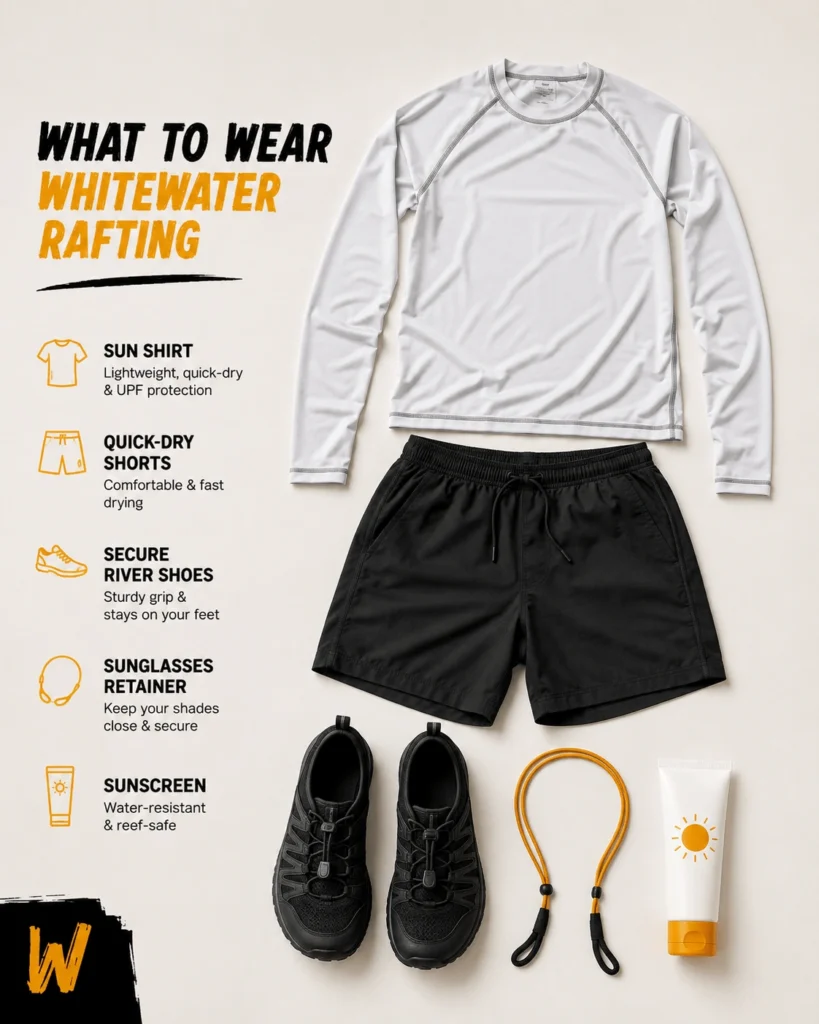
On a genuinely warm-weather rafting day, keep the outfit simple. Start with a swimsuit, board shorts, synthetic underwear, or another base layer that is comfortable when wet. Add quick-dry shorts, lightweight pants, a rash guard, sun shirt, or synthetic T-shirt. REI recommends quick-drying synthetic or wool fabrics and notes that sun-protective tops can be useful on long days on the water. [S1]
Long sleeves can make sense even when the air is hot. You are exposed for hours, and water reflects sunlight. The American Academy of Dermatology recommends broad-spectrum, water-resistant SPF 30 or higher sunscreen and advises applying it before going outdoors. Sun-protective clothing can reduce the amount of exposed skin you need to cover repeatedly. [S5]
For a short commercial trip, you usually do not need multiple outfit changes in the raft. Wear the river clothes to check-in if your operator recommends it, then keep a completely dry outfit and dry shoes in your car or the outfitter’s storage area for after the trip.
What to wear when the river is cold
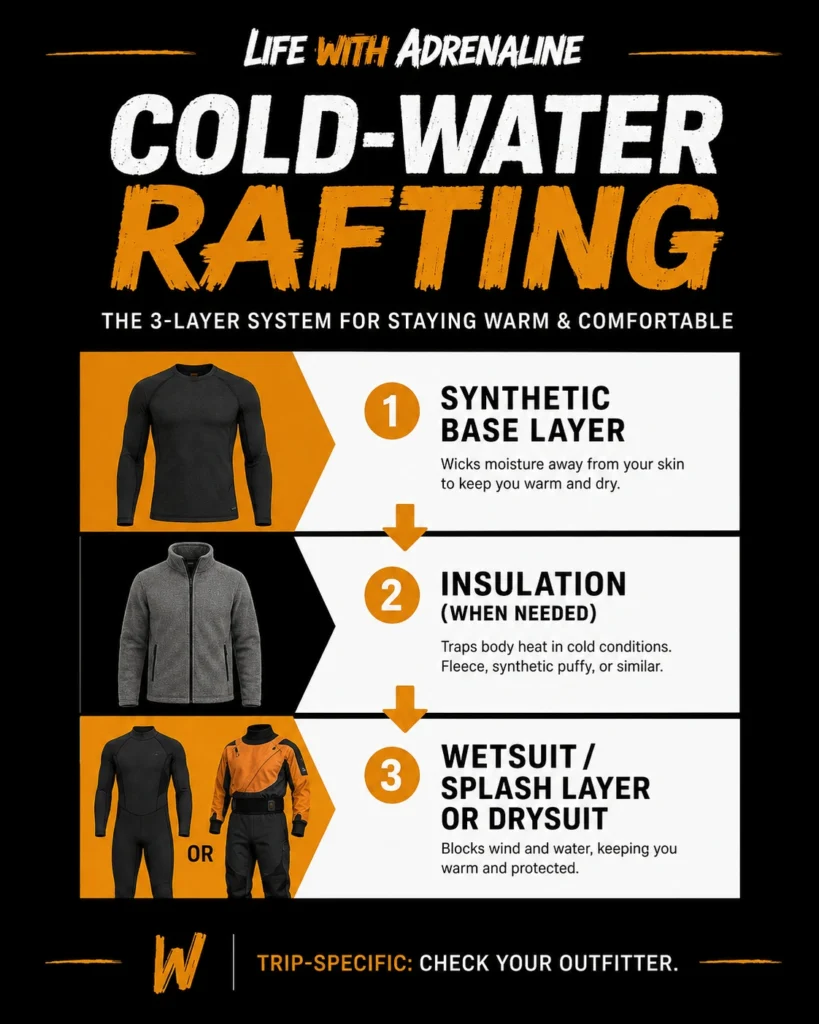
Cold water changes the clothing plan. The goal is no longer just quick drying; it is maintaining useful insulation if you are splashed repeatedly or end up in the river. Synthetic and wool layers are preferred because they retain more useful insulating performance when damp than ordinary cotton clothing. [S1][S2]
A common cold-day system is a synthetic or wool base layer, an insulating layer when conditions call for it, and an outer layer supplied or recommended by the outfitter. Depending on the river and conditions, the technical outer protection may be a wetsuit with a splash jacket, a paddling jacket, or a drysuit. National Park Service guidance for cold-water river environments illustrates why the required protection can become much more serious as water temperatures drop. [S3][S6]
Do not improvise your own technical cold-water system if you are a first-time commercial guest. A too-bulky layer can fit poorly under a PFD or wetsuit, while the wrong fabric can leave you cold once wet. Ask the operator what to wear under the gear they supply.
Should you avoid cotton?
For cool or cold rafting, cotton is a poor choice because it absorbs water, dries slowly, and provides little useful insulation when soaked. That is why REI, NRS, OARS, and many outfitters point beginners toward synthetic or wool layers. [S1][S2][S4]
In very hot, low-consequence settings, individual operators may allow cotton, but a synthetic quick-dry shirt is the more versatile default for a first-timer because it works better across changing spray, shade, wind, and temperature. Your operator’s packing list should override any generic rule.
Best shoes for whitewater rafting
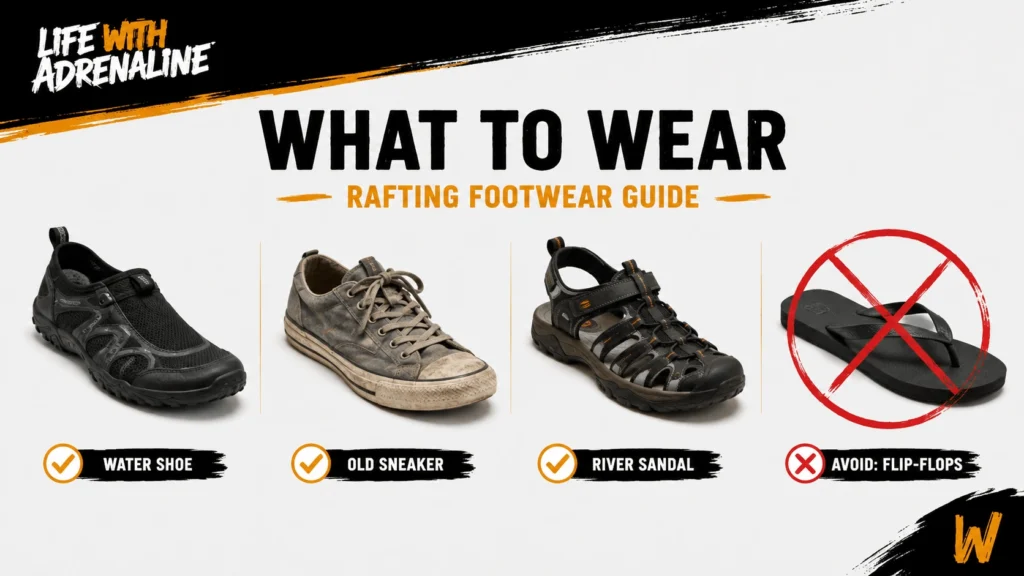
Rafting footwear has one job that matters more than style: it must stay securely on your feet. Good options include purpose-built water shoes, old lace-up sneakers you are willing to soak, or sturdy river sandals with a heel or ankle strap. REI and OARS both recommend footwear that can get wet and remains secured. [S1][S4]
Many operators do not allow loose flip-flops, slides, or bare feet. Local rules vary, but the reason is straightforward: loose footwear can disappear in moving water, and bare feet are exposed to rocks and other hazards. The National Park Service specifically recommends closed-toe footwear in whitewater settings such as the Obed. [S3]
Do you need neoprene socks or booties?
They can be useful in cold water, but do not assume you need to buy them. Some outfitters provide booties, some rent them, and some expect you to bring your own secure footwear. Ask before purchasing. If the outfitter recommends wool or neoprene socks, make sure your shoes still fit securely without becoming painfully tight. [S7][S8]
What your rafting outfitter usually provides
On a commercial whitewater trip, core river equipment normally comes from the operator rather than from you. The exact package varies, but it often includes the raft, paddle, PFD, and a helmet when the trip or operator calls for one. Cold-weather extras such as wetsuits, splash jackets, or booties are much less consistent. [S4][S7][S8]
Before you shop, check the confirmation email or operator FAQ and ask four questions: Is a wetsuit included? Is a splash jacket included? Are booties or river shoes included? Is there a dry bag for personal items? Those answers can save you money and prevent you from showing up with incompatible gear.
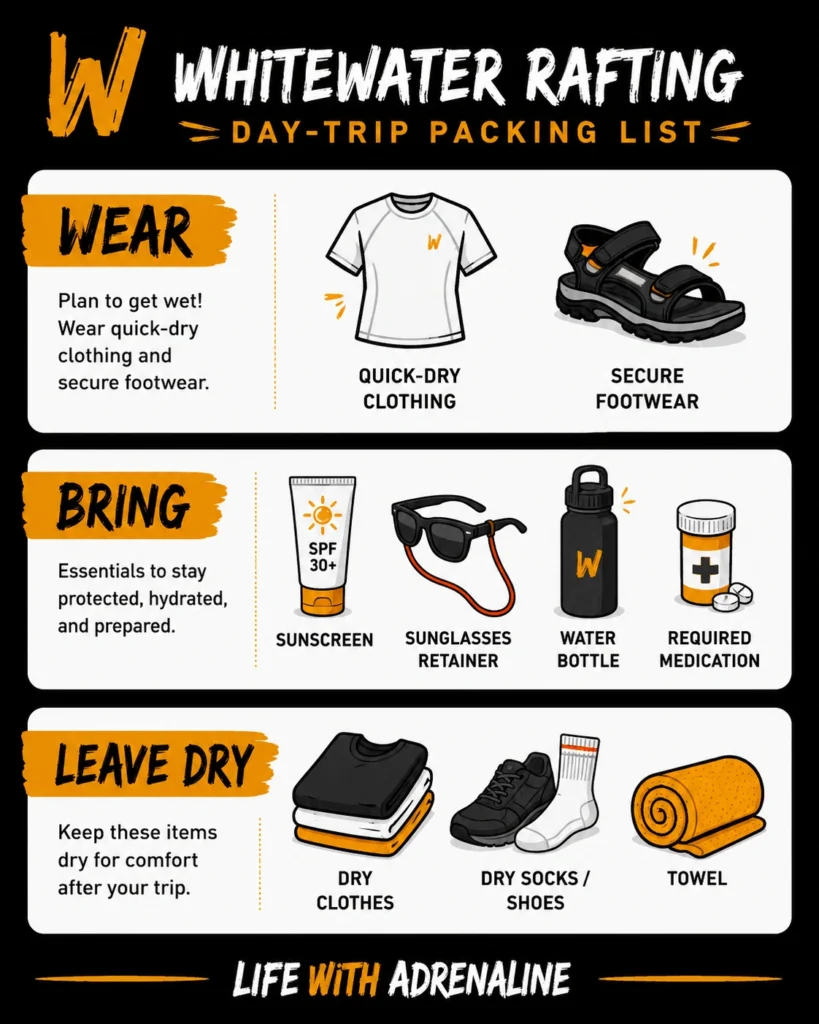
Complete whitewater rafting packing list for a day trip
| Where | Item | Notes |
| Wear on the river | Swimsuit or quick-dry base layer | Choose something comfortable under a PFD or wetsuit |
| Wear on the river | Quick-dry top | Synthetic, wool, rash guard, or UPF sun shirt |
| Wear on the river | Quick-dry shorts, leggings, or light pants | Avoid restrictive clothing |
| Wear on the river | Secure wettable footwear | Water shoes, old sneakers, or strapped river sandals |
| Bring | Water-resistant broad-spectrum SPF 30+ sunscreen | Apply before launch and follow label reapplication directions |
| Bring | Sunglasses with retainer | Do not rely on loose sunglasses |
| Bring | Reusable water bottle if operator allows/recommends | No glass |
| Bring | Required personal medications | Tell the guide about relevant emergency medication per operator instructions |
| Leave dry | Complete change of clothes | Shirt, underwear, bottoms |
| Leave dry | Dry socks and shoes | A major comfort upgrade after the take-out |
| Leave dry | Towel | Usually not needed in the raft itself |
| Ask operator | Wetsuit / splash jacket / booties | Availability varies by river and season |
| Ask operator | Dry bag policy | Some provide group storage; others limit personal items |
What not to wear whitewater rafting
- Loose flip-flops or slides that can come off easily.
- Heavy denim or sweatshirts for cool/cold water conditions.
- Bulky clothing that interferes with a properly fitted PFD.
- Expensive jewelry, watches, or unsecured accessories you would hate to lose.
- Anything with loose straps or dangling pieces that the operator tells you to remove.
- A brand-new expensive shoe you do not want soaked, scraped, or muddy.
Also be conservative with electronics. A phone in a waterproof case can still be lost if it is not secured, and many guided trips discourage guests from handling phones while paddling. Ask what the operator allows and whether they already provide professional trip photos.
Do you need a dry bag?
Not necessarily for a commercial day trip. A small dry bag sounds useful, but space on a raft is limited and some outfitters already have a shared dry-storage system. Others may ask you to leave almost everything at the outpost. Before buying a bag, ask what personal items are allowed in the raft and how they are stored.
If a personal dry bag is allowed, use it for genuinely useful small items such as an extra approved layer, medication, or a compact waterproofed essential. Do not treat a dry bag as permission to bring valuables you do not need.
What changes on a multi-day rafting trip?
Multi-day river trips are a different packing problem. You will need river clothes plus dry camp clothes, warmer evening layers, sleep gear, toiletries, and other trip-specific items. The outfitter may supply large dry bags, tents, sleeping equipment, or meals, but the included gear differs dramatically from company to company.
Follow the operator’s expedition packing list rather than expanding a generic day-trip checklist. Overpacking creates its own problem because dry-bag space and weight are limited.
Safety: clothing helps, but it is not your safety system
Proper clothing can reduce cold stress and make you more comfortable, but it does not make whitewater risk disappear. In moving water, the PFD, helmet where required, guide instructions, route choice, water conditions, and operator procedures matter more than a perfect shirt-and-shoe combination. National Park Service whitewater guidance emphasizes cold water, foot entrapment, strainers, hydraulics, changing flows, and other river hazards. [S3]
Do not modify, loosen, or place bulky clothing under safety equipment in a way that changes the fit. Let the guide fit your PFD and helmet, and tell the operator in advance about mobility issues, medical concerns, or equipment-fit questions. This article is general preparation guidance, not individualized medical or river-safety instruction.
Before-you-book and before-you-go checklist
☐ Read the outfitter’s current packing list for your exact river, date, and trip.
☐ Ask what technical gear is included: PFD, helmet, wetsuit, splash jacket, booties, and dry storage.
☐ Check both air temperature and the operator’s cold-water guidance.
☐ Choose quick-dry clothing that remains comfortable when soaked.
☐ Choose shoes that stay securely on your feet.
☐ Pack sun protection for exposed skin.
☐ Keep a complete dry outfit and dry shoes for after the trip.
☐ Secure or leave behind valuables and electronics.
☐ Bring required personal medication exactly as your operator instructs.
☐ Do not buy a wetsuit, drysuit, or specialty dry bag until you know it is actually needed.
Frequently asked questions
Can I wear leggings whitewater rafting?
Yes, if they are comfortable, quick-drying, and appropriate for the temperature. Synthetic athletic leggings can work well under splash gear or as a warm-weather bottom. Avoid heavy cotton leggings in cold conditions.
Can I wear Crocs rafting?
Do not assume so. Some operators prohibit loose clogs or footwear without secure retention. Choose shoes that stay firmly attached and follow the operator’s specific footwear rule.
Are sneakers okay for rafting?
Often, yes. Old lace-up sneakers that stay securely on your feet can be a practical first-trip option, though they will get completely wet. [S1][S4]
Should I wear a swimsuit under a wetsuit?
A swimsuit or thin synthetic base layer is commonly used, but follow the outfitter’s instructions because wetsuit style and layering needs vary. [S7]
Do I need a waterproof jacket?
Maybe. For cold, windy, or rainy trips, an outer splash or paddling layer can be important, but many commercial operators supply or rent one. Check before buying. [S4][S7]
Can I bring my phone rafting?
Only if the operator allows it and you have a secure waterproof system. For a first trip, leaving the phone behind is often simpler than worrying about losing it.
What should I wear after rafting?
Dry underwear, a dry shirt, comfortable bottoms, dry socks, and dry shoes. Add a warm layer if the day is cool.
Final recommendation
For your first guided whitewater rafting trip, do not overcomplicate the outfit. Start with quick-dry layers and secure footwear, then let the river temperature and the outfitter’s current instructions determine whether you need wetsuit or splash protection. Spend money only after you know what is not included. That approach is cheaper, simpler, and more likely to leave you appropriately dressed for the actual conditions rather than the forecast in the parking lot.
Sources
[S1] REI — What to Wear Whitewater Rafting
https://www.rei.com/learn/expert-advice/what-to-wear-whitewater-rafting.html
[S2] NRS — Cold-Water Boating Safety: How to Dress and Prepare
https://www.nrs.com/learn/proper-paddling-headwear-heatloss
[S3] National Park Service — Obed Wild & Scenic River: River Safety
https://www.nps.gov/obed/planyourvisit/river-safety.htm
[S4] OARS — 1-Day Rafting Trips FAQs
https://www.oars.com/one-day-rafting-trip-faqs/
[S5] American Academy of Dermatology — How to Apply Sunscreen
https://www.aad.org/public/everyday-care/sun-protection/shade-clothing-sunscreen/how-to-apply-sunscreen
[S6] National Park Service — Canyonlands National Park: River Safety
https://www.nps.gov/cany/planyourvisit/riversafety.htm
[S7] New Mexico River Adventures — What to Wear and Bring White Water Rafting
https://www.newmexicoriveradventures.com/what-to-bring/
[S8] Whitewater Voyages — What To Bring
https://www.whitewatervoyages.com/rafting-essentials