
Direct answer: For a first waterfall-rappelling trip, Rappel Maui is one of the easiest formats to understand because it starts with a dry practice rappel before two waterfall descents. Little Bradley Falls in North Carolina is a strong lower-cost choice if a 100-foot waterfall is the main goal. Angel Creek in Ouray is the gentlest true-canyon introduction in this comparison, while Portland Creek adds more direct water contact. French Broad Adventures and Wild Sky are better fits if you want a longer canyon journey rather than a single dramatic rappel. There is no universal “best” trip: the right choice depends on how much height, water, hiking, and technical commitment you actually want.
Waterfall rappelling looks simple in photos: clip into a rope and descend beside rushing water. In practice, U.S. guided trips range from short, structured waterfall experiences to full aquatic canyon descents involving hiking, scrambling, cold water, multiple rappels, and long periods in terrain with limited exits. That difference matters more than the marketing label. This guide compares current beginner-accessible trips by what you actually do, how high you rappel, how wet you get, how long you are committed, what the operator currently charges, and who can participate. Prices and restrictions below were checked on August 27, 2026 and should be verified again before booking.
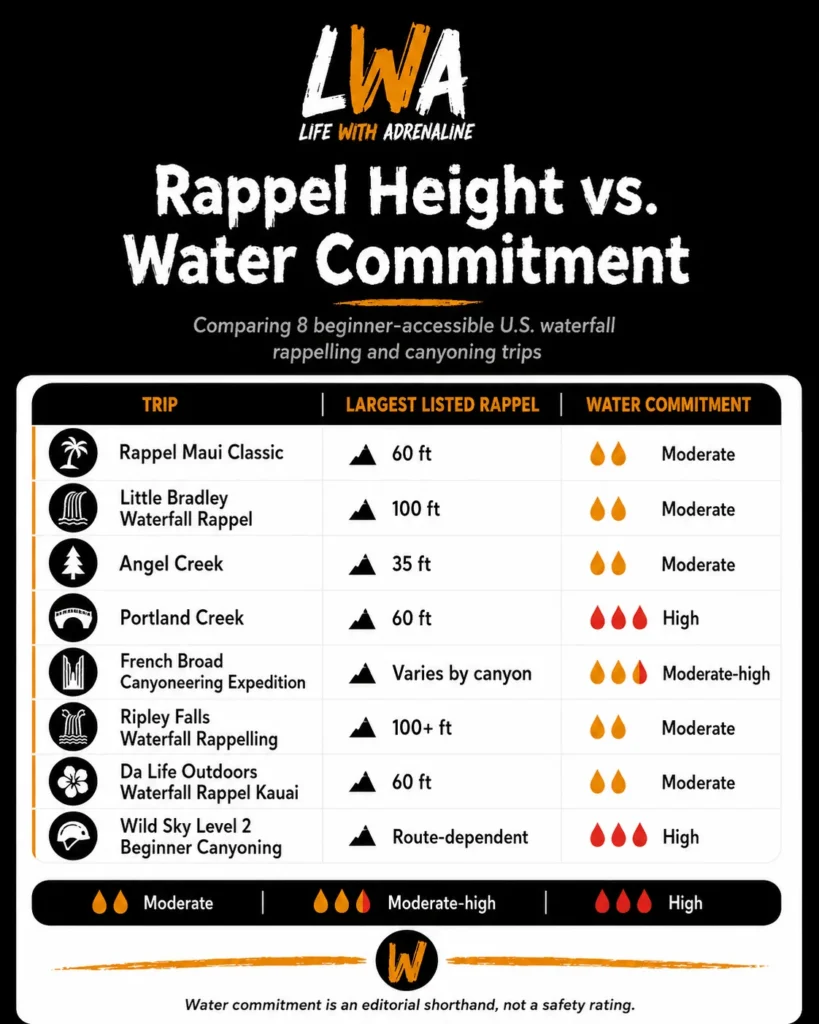
Best Waterfall Rappelling Trips in the USA at a Glance
| Trip | Location | Best for | Listed price* | Key limit | Time | Largest listed rappel | Water commitment** |
| Rappel Maui Classic | Maui, HI | First waterfall rappel | $240.84 incl. tax | 10+ / 70–250 lb | Up to 3 hr | 60-ft waterfall | Moderate |
| Little Bradley Waterfall Rappel | Saluda, NC | 100-ft rappel at lower cost | From $119 | 12+ / 70–275 lb | 4 hr | 100 ft | Moderate |
| Angel Creek | Ouray, CO | Gentle true-canyon intro | $145 | 10+ | 1–2.5 hr | 35 ft | Moderate |
| Portland Creek | Ouray, CO | Beginner wet canyoning | $150 | 10+ | 2–3.5 hr | 60 ft | High |
| French Broad Canyoneering Expedition | Western NC | Full wilderness canyon day | $162.99 | 12+ | 5–6 hr | Varies by canyon | Moderate–high |
| Ripley Falls Waterfall Rappelling | New Hampshire | New England waterfall focus | $150–$275 pp by party size | 10+ / >85–250 lb | 5 hr | 100+ ft | Moderate |
| Da Life Outdoors Waterfall Rappel | Kauai, HI | Kauai waterfall experience | $247.35 | 12+ / 70–250 lb | 4 hr | 60 ft | Moderate |
| Wild Sky Level 2 Beginner Canyoning | Washington | Full-day aquatic canyoning | $269 | 12+ | 6–8+ hr | Route-dependent | High |
*Operator-listed prices checked August 27, 2026. Taxes, gratuities, booking fees, rentals, or other costs may apply unless the operator explicitly says they are included. Northeast Mountaineering uses party-size pricing. **“Water commitment” is an editorial shorthand based on the operator’s route description; it is not a safety rating.
Waterfall Rappelling vs. Canyoning: Know What You Are Booking
A waterfall-rappelling tour may be built around the rappel itself. You learn the basic braking position, practice on easier terrain, then descend one or more waterfall faces. A canyoneering or canyoning trip uses rappelling as only one tool. You may also hike, scramble, wade, swim, slide, downclimb, and move through a canyon where turning around is not always simple.
That distinction explains why two “beginner” products can feel completely different. Rappel Maui gives first-timers a three-rappel progression that includes a 50-foot dry practice station, a 60-foot waterfall, and a 30-foot waterfall when conditions permit. Wild Sky’s Level 2 trip, by contrast, runs six to eight hours or more and describes water immersion and trip length as the main challenge. [S3][S4][S12]
If you have never worn a harness, start by deciding whether your goal is one memorable vertical challenge or a full day of moving through a wet canyon. Then compare height, water, fitness, and time.
1. Rappel Maui Classic — Best Overall First Waterfall Rappel
Rappel Maui is the cleanest fit in this list for someone who wants the waterfall experience without committing to a full wilderness canyon day. The Classic tour is listed at $240.84 per person including tax, lasts up to three hours, requires no previous climbing or rappelling experience, and typically runs with four to eight guests. The current minimum age is 10, with a required weight range of 70 to 250 pounds. [S3]
The progression is beginner-friendly in a practical sense: a 50-foot dry rappel comes first, followed by a 60-foot waterfall and a 30-foot waterfall when water conditions allow. If heavy water makes the normal watercourse inappropriate, the operator says it can move the group to alternate jungle descents away from the water. Footwear, harness, life jacket, helmet, backpack, and a dry container are provided. [S4]
What first-timers may underestimate is the finish. After the descents, the route includes roughly 300 vertical feet of hiking back up through the forest. You also need your own vehicle: the operator does not provide transportation, and it says rideshare and taxi service are not practical at the remote meeting area on the Hana Highway. [S3]
Choose it if: you want a structured, tropical waterfall-rappelling experience where the technical learning is concentrated into a short half-day format. Skip it if: a 60-foot waterfall already feels beyond your comfort level, you do not meet the strict weight range, or you want a long, exploratory canyon journey rather than a rappel-focused tour.
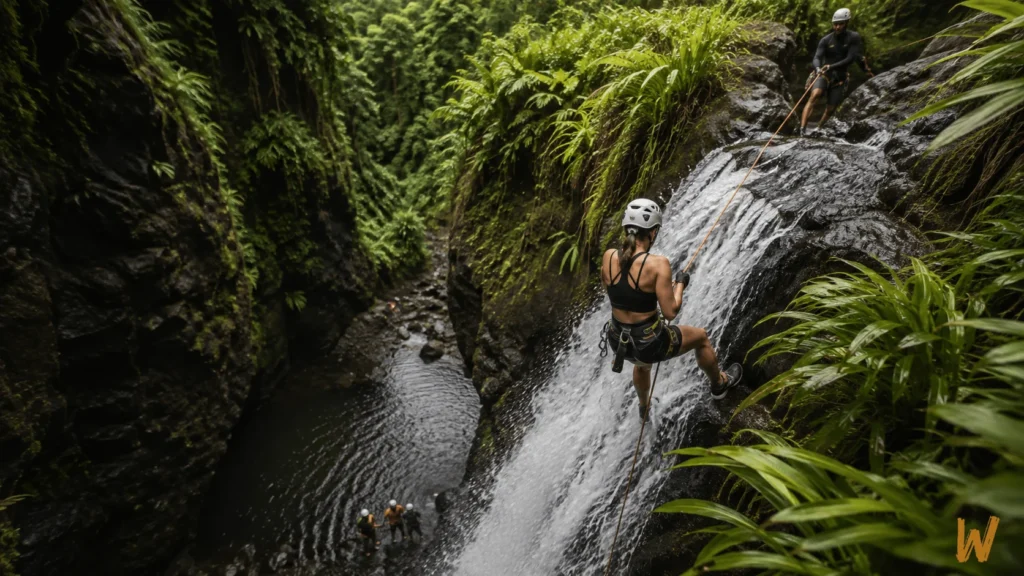
2. Little Bradley Falls, North Carolina — Best Value for a 100-Foot Waterfall Rappel
Green River Adventures’ Little Bradley Waterfall Rappel is one of the clearest value propositions in the current comparison. The operator lists it from $119 for ages 12 and up, with a 70-to-275-pound weight range. The trip runs about four hours and centers on instruction plus a 100-foot waterfall descent. No previous experience is required. [S6]
The big decision here is psychological rather than technical history: are you comfortable making a first major rappel that is already 100 feet tall? The operator describes the trip as beginner/intermediate and provides a ground-school style introduction before the main waterfall. It also involves about two miles of hiking, so this is not a walk-up roadside attraction. [S6]
For active travelers, the combination is compelling: a meaningful hike, a large single rappel, and a price well below many destination-market waterfall tours. It is also a useful midpoint between a short introductory canyon such as Angel Creek and a much longer aquatic canyon day.
Choose it if: the big waterfall is the reason you are booking and you are comfortable trading a resort-style experience for a more active mountain outing. If you later want a much bigger version, Green River Adventures also lists Big Bradley: a 200-foot waterfall rappel, age 15+, four hours, and $129. That is an upgrade, not our default first-timer recommendation. [S7]
3. Angel Creek, Ouray — Best Gentle Introduction to True Canyoning
Angel Creek is the trip to look at when the words “technical canyon” appeal to you but a 100-foot first rappel does not. Canyoning Colorado lists the half-day trip at $145 per person, with a minimum age of 10, a May-to-September season, a largest drop of 35 feet, and an estimated total duration of about one to two and a half hours. [S10]
The low maximum rappel height is only part of the appeal. The operator describes very short approach and return times, which means more of the outing is spent in the canyon rather than on a long hike. It is explicitly graded as a beginner trip. You still encounter waterfalls, rappels, uneven terrain, fixed-rope movement, and the normal exposure of being in a canyon, so “beginner” should not be read as “casual sightseeing.” [S10]
Ouray is also useful because you can see a logical progression inside one destination. If Angel Creek feels like the right first step, Portland Creek adds a longer waterfall descent and more direct water. That makes Ouray unusually easy to understand for a first-time traveler who wants to choose a level instead of choosing an operator first.
Choose it if: you want to learn what moving through a canyon feels like with lower rappel height and relatively light approach logistics. Skip it if: your main goal is a huge waterfall photo or you specifically want a full day of swimming and aquatic obstacles.
4. Portland Creek, Ouray — Best Beginner Wet-Canyon Step Up
Portland Creek is still labeled beginner by Canyoning Colorado, but it raises the commitment in exactly the ways that matter. The operator lists the trip at $150 per person, age 10+, from May through September, with a two-to-three-and-a-half-hour total duration and a maximum listed drop of 60 feet. No previous experience is required, and swimming experience is not required. [S11]
The route starts with scrambling and a practice rappel, then moves into a 55-foot waterfall directly under the flow and two more rappels deeper in the canyon. There is also a small steep climb out on fixed lines near the end. [S11]
That makes Portland Creek a better representation of “canyoning” than a simple one-waterfall descent. You are not only trusting the rope; you are moving through narrow terrain, dealing with water, changing body positions, and continuing through a route. The operator recommends morning departures when possible because afternoon thunderstorms occur regularly in the area. [S11]
Choose it if: you want a first wet canyon with real route progression and you are comfortable being directly in waterfall flow. Choose Angel Creek instead if your priority is keeping the vertical and water commitment lower.
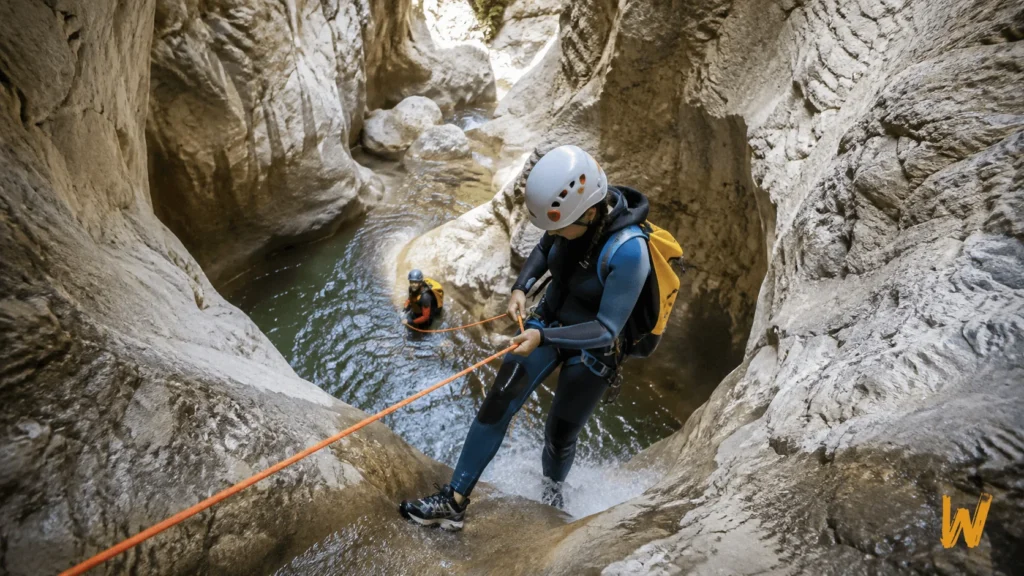
5. French Broad Adventures Canyoneering Expedition — Best Full Wilderness Day Near Asheville
French Broad Adventures offers a different kind of beginner comparison point: less about one signature waterfall and more about spending most of a day in a canyon environment. The current Canyoneering Expedition is listed at $162.99 per person, with a minimum age of 12, a March 1 to November 1 season, and a typical duration of five to six hours. The operator requires a minimum of two participants. [S8]
The participation standards are more demanding than a short waterfall tour. The operator says guests should be comfortable with rappelling and able to walk about three miles unassisted with a light pack, handle uphill and downhill terrain, climb or descend five flights of stairs, climb a ladder, and tolerate heights. Harness fit also matters: the published range is an 18-to-45-inch waist and 10-to-28-inch leg measurement rather than a simple body-weight cutoff. [S8]
Water shoes, rappel gloves, a small backpack, and technical safety equipment are supplied. The itinerary can include hiking, boulder movement, waterfalls, water, and natural slides depending on canyon and river conditions. [S8]
Choose it if: you want the day to feel like an expedition and you have enough fitness for hours of movement. It is not the best choice for someone who only wants to test rappelling for the first time with minimal hiking or commitment.
6. Ripley Falls, New Hampshire — Best New England Waterfall-Rappelling Experience
Northeast Mountaineering’s Ripley Falls program brings the concept to the White Mountains. The operator describes a 100-plus-foot waterfall, a five-hour program, up to three rappels per person, and a beginner difficulty rating. Waterfall outings are currently scheduled Friday through Sunday from Memorial Day through September 30. [S9]
Pricing depends on party size rather than one public per-person rate: $275 for one participant, $200 each for two, $175 each for three, and $150 each for four; groups of five or more are told to call. Current participation criteria include age 10+, more than 85 pounds and no more than 250 pounds, a maximum 45-inch waist, and the ability to hike about one mile on rough terrain. [S9]
The hike to Ripley Falls is only about half a mile each way, but the operator is unusually clear that the trail has roots, rocks, mud, loose footing, a steep final section, and a river crossing. That is useful information for a first-timer because “short hike” does not necessarily mean easy footing. [S9]
Choose it if: you want a substantial waterfall rappel without flying to Hawaii and you like the idea of a mountain-day format. Check the cancellation terms carefully: current New England policy changes from a cash refund to credit as the date gets closer and becomes non-refundable inside 72 hours. [S9]
7. Da Life Outdoors, Kauai — Best Kauai Waterfall-Rappelling Tour
Da Life Outdoors runs a four-hour waterfall-rappelling tour on private property in Kauai. The current listed price is $247.35, the minimum age is 12, and the participant weight range is 70 to 250 pounds. After a safety lesson and dry-wall practice, the route uses two waterfalls: 30-foot Bamboo Falls and 60-foot Papakolea Falls. [S5]
This is a good comparison with Rappel Maui because the headline experience is similar but the rules are not identical. Kauai has the higher minimum age, a published 22-to-48-inch waist range, and the operator describes the tour as intended for physically fit participants who enjoy rugged activities. It also publishes health-related exclusions and says the experience is not recommended for people over 65. [S5]
A spectator option is currently listed at $95.50 with a minimum age of six, but spectators must be connected to a rappel booking. That can matter for a family or couple where one person wants the experience and another does not. [S5]
Choose it if: Kauai is already your destination and you want a dedicated waterfall-rappelling activity rather than building a whole trip around canyoneering. Do not assume Hawaii operators share the same limits; compare the exact age, weight, health, transport, and cancellation rules before paying.
8. Wild Sky Level 2, Washington — Best Full-Day Pacific Northwest Aquatic Canyon
Wild Sky Adventure Guides’ Level 2 Beginner Canyoning Adventure is for travelers who want water immersion to be part of the challenge rather than just the scenery. The 2026 season is listed from June 8 through September 8, with Electric Boogie near Packwood in June and Sapphire Pools near Roslyn in July and August. The published price is $269 per person, minimum age is 12 with a note to call about younger adventurers, and the day runs six to eight hours or more. [S12]
The operator calls the route beginner-friendly but makes the physical reality clear: participants need to sustain a full day of moderate activity, and the challenge comes from water immersion and the length of the canyon. The trip description includes hiking, sliding, jumping, rappelling, and moving through waterfalls. [S12]
This is the most important reminder in the entire comparison: “no previous canyoning experience” does not mean “low commitment.” A six-to-eight-hour wet-canyon day can be much harder than a shorter 100-foot rappel because you are repeatedly moving, getting wet, dealing with temperature, and continuing through the route.
Choose it if: you already know you enjoy long active days and want the canyon itself to be the experience. Choose a shorter rappel-focused trip first if you are still unsure how you react to exposure, cold water, or being committed to technical terrain for most of a day.
Which Trip Fits You Best?
| Your priority | Best starting point | Why |
| “I want the easiest format to understand.” | Rappel Maui Classic | Dry practice first, short total duration, then two waterfall descents when conditions allow. |
| “I want a big waterfall without the highest price.” | Little Bradley | 100-ft main rappel and listed starting price of $119. |
| “I want true canyoning but lower rappel height.” | Angel Creek | 35-ft largest drop and short approach/return. |
| “I want direct waterfall flow and canyon movement.” | Portland Creek | Multiple rappels including a 55-ft waterfall in the flow. |
| “I want a long expedition-style day.” | French Broad or Wild Sky | More continuous movement, hiking, and route commitment. |
| “I am traveling in New England.” | Ripley Falls | 100+ ft waterfall with a mountain-day format. |
| “Kauai is already my vacation.” | Da Life Outdoors | Dedicated private-property waterfall rappel in a four-hour format. |
What Do Guided Waterfall Rappelling Trips Cost?
The current examples in this guide run from $119 to $269 per person for the standard products shown, with Northeast Mountaineering ranging from $150 to $275 per person depending on party size. Rappel Maui’s $240.84 price explicitly includes tax, while the other operator pages do not all describe taxes and booking fees in the same way. That is why a national “average price” would be misleading. [S3][S5][S6][S8][S9][S10][S11][S12]
Your real trip cost may also include gratuity, rental car or local transportation, parking, lodging, meals, extra clothing, photos, optional gear, and travel insurance. Hawaii experiences can be expensive in total even when the activity price itself looks similar to a mainland tour because lodging and transport are separate travel decisions. Conversely, a lower-priced North Carolina trip still becomes a larger purchase if it requires a flight and hotel.
Before booking, compare the amount of active experience you are buying rather than price alone. A $150 two-hour canyon and a $269 eight-hour canyon are not substitutes. One is a shorter introduction; the other is most of an adventure day.
What to Expect on Your First Guided Canyon or Waterfall Rappel
Most beginner trips follow the same broad logic even though the terrain changes. You check in, sign waivers, confirm eligibility, get fitted with technical equipment, learn the basic rappel position and braking action, practice in a controlled setting, then move to the actual route. The guide controls the sequence, but you still have to listen, move your body correctly, and follow instructions while exposed to height and water.
The biggest surprise for many first-timers is everything between the rappels. Canyon travel can involve slippery rock, uneven hiking, scrambling, wading, standing in moving water, climbing short fixed lines, and carrying a small pack. On a longer trip, fatigue and cold can matter as much as fear of the rappel itself.
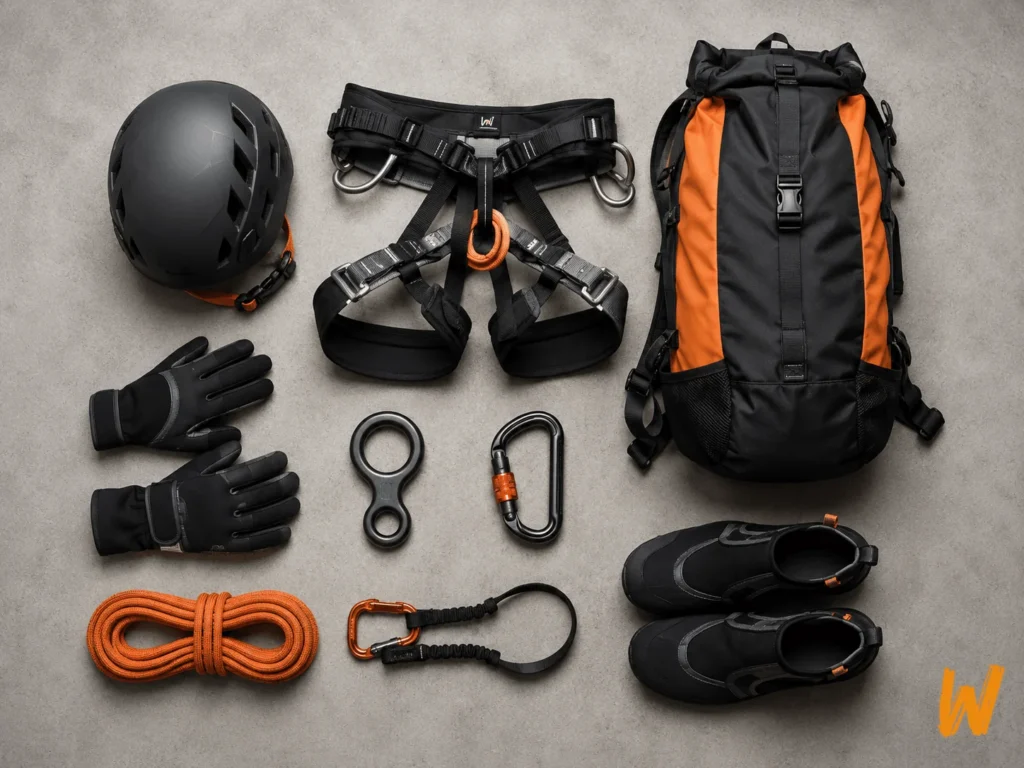
Wear what the operator tells you to wear. Do not assume normal running shoes, hiking boots, sandals, or a cotton T-shirt are appropriate just because another tour allowed them. Several operators in this guide provide specialized water footwear; others tell you what to bring. Check the current gear list for the exact trip you book.
Safety: Beginner-Friendly Does Not Mean Risk-Free
Canyoneering combines hazards that change with terrain and weather. National Park Service guidance describes canyoneering as inherently dangerous and emphasizes researching the route, checking the latest weather, understanding group experience, and recognizing that rescue resources and cell service may be limited. [S1]
Water adds another layer. Flash floods can rapidly change water depth and speed, carry debris, and arrive from storms that are not directly overhead. Zion National Park specifically warns that upstream weather matters and that people in narrow canyons cannot simply assume they can outrun a flood. [S2]
A commercial guided trip changes how responsibilities are managed, but it does not remove inherent risk. The operator selects and rigs the route, supplies or specifies equipment, and makes condition decisions. You are still responsible for meeting the published restrictions, disclosing requested medical information accurately, following instructions, and arriving physically capable of the trip you booked.
Health rules vary substantially. Rappel Maui, Da Life Outdoors, and French Broad Adventures publish different age, body-size, mobility, pregnancy, and medical restrictions. This article cannot decide whether a specific activity is medically appropriate for you. If an operator’s health guidance raises a concern, review it directly and speak with an appropriate healthcare professional before participating. [S3][S5][S8]
Before You Book: First-Timer Checklist
- Is this primarily a waterfall rappel, or a full canyon descent with hiking, scrambling, swimming, slides, or jumps?
- What is the largest rappel, and is the descent beside the water or directly in the flow?
- How long is the total trip, not just the time spent rappelling?
- How much hiking is required, and what does the operator say about footing, stairs, balance, or fitness?
- What are the exact minimum age, weight, waist, harness-fit, and mobility requirements?
- Are there pregnancy, heart, back, neck, seizure, recent-surgery, or other medical restrictions?
- What equipment and footwear are included, and what clothing should you bring?
- Does the operator require swimming ability, or can non-swimmers participate on this specific route?
- What is the current season and departure schedule?
- What happens if water levels, thunderstorms, cold, or other weather changes the route?
- What is the cancellation policy, and does an operator cancellation mean refund or credit?
- Are taxes, booking fees, gratuity, photos, transportation, or parking extra?
- Do you need a minimum group size for the trip to run?
- How early should you reserve during your travel dates?
FAQ
Is waterfall rappelling the same as canyoneering?
Not always. Rappelling is the rope technique used to descend a rock face or waterfall. Canyoneering is a broader journey through canyon terrain and can include hiking, scrambling, rappelling, swimming, wading, slides, and other movement. Some commercial “waterfall rappel” tours use canyoning techniques but keep the day centered on a few rappels.
Can a complete beginner go waterfall rappelling?
Yes, on trips that explicitly accept first-timers and whose restrictions you meet. Rappel Maui, Little Bradley, Angel Creek, and Portland Creek all currently state that previous rappelling or canyoning experience is not required. That does not mean every tour is equally easy; compare height, water, fitness, and duration. [S3][S6][S10][S11]
Do I need to know how to swim?
It depends on the route. Portland Creek specifically says swimming experience is not necessary even though you encounter waterfalls. Other aquatic canyon trips may include deeper pools, jumps, or substantial water immersion. Never generalize one operator’s rule to another trip. [S11][S12]
What is a good first rappel height?
There is no universal number. The better question is how you respond to exposure. Angel Creek tops out at 35 feet, Rappel Maui’s main waterfall is 60 feet, Little Bradley reaches 100 feet, and Ripley Falls is 100-plus feet. If you already know that exposed heights are your main fear trigger, choosing the lower-height route is a sensible way to reduce the psychological jump without pretending the activity is risk-free. [S4][S6][S9][S10]
What should I wear for waterfall rappelling?
Follow the trip-specific gear list. Quick-dry synthetic clothing is common, and many wet trips use specialized footwear, helmets, harnesses, and flotation or thermal layers. Some operators provide water shoes or canyon footwear; others ask you to bring shoes that can get soaked. Bring dry clothes and a towel when the operator recommends them. [S3][S4][S8][S9]
When is the best season for waterfall rappelling in the USA?
There is no single national season. Hawaii operates much of the year, while high-country and northern routes are more seasonal. Canyoning Colorado currently lists Angel Creek and Portland Creek from May through September; Northeast Mountaineering lists Ripley Falls from Memorial Day through September 30; Wild Sky’s Level 2 2026 season runs June 8 through September 8. Conditions can still change within those windows. [S9][S10][S11][S12]
Final Recommendation
If you are booking your first guided waterfall-rappelling trip, choose the format before the destination. Rappel Maui is the strongest all-around introduction in this comparison for travelers who want a short, structured progression. Angel Creek is the most approachable true-canyon step if you want lower rappel height. Little Bradley gives you a much bigger 100-foot waterfall at a comparatively low listed price. Portland Creek is the better choice when you specifically want to feel what wet canyoning is like rather than simply rappel beside a waterfall.
Move to French Broad Adventures, Ripley Falls, Da Life Outdoors, or Wild Sky when the location or longer format is part of the reason you are traveling. The goal is not to book the tallest waterfall you can find. It is to choose the level of height, water, physical effort, and commitment that makes you excited to go — while still respecting the restrictions and hazards that come with technical canyon terrain.
Sources
[S1] Canyoneering — Capitol Reef National Park — National Park Service. https://www.nps.gov/care/planyourvisit/canyoneering.htm
[S2] Flash Floods — Zion National Park — National Park Service. https://home.nps.gov/zion/planyourvisit/flash-flood.htm
[S3] Rappel Maui FAQs — Rappel Maui. https://rappelmaui.com/rappel-maui-faq/
[S4] How the Day Unfolds — Rappel Maui. https://rappelmaui.com/how-the-day-unfolds/
[S5] Waterfall Rappelling in Kauai — Da Life Outdoors. https://www.dalifeoutdoors.com/waterfall-rappel/
[S6] Little Bradley Waterfall Rappel — Green River Adventures. https://greenriveradventures.com/adventure/little-bradley-waterfall/
[S7] Big Bradley Waterfall Rappel — Green River Adventures. https://greenriveradventures.com/adventure/big-bradley-waterfall/
[S8] Canyoneering Expedition — French Broad Adventures. https://www.frenchbroadrafting.com/trip/guided-canyoneering-expedition
[S9] Waterfall Rappelling — Ripley Falls — Northeast Mountaineering. https://www.nemountaineering.com/rappelling/waterfall-rappelling/
[S10] Angel Creek — Canyoning Colorado. https://canyoningcolorado.com/canyoning-tours/angel-creek
[S11] Portland Creek — Canyoning Colorado. https://canyoningcolorado.com/canyoning-tours/portland-creek
[S12] Washington Canyoneering Guides — Level 2 Beginner Adventure — Wild Sky Adventure Guides. https://wildskyguides.com/washington-canyoneering-guides/