Oahu Shark Cage Diving vs. Cage-Free Diving: Which Is Better for First-Timers?
Seeing a shark glide past you in blue water is memorable whether you are looking through the bars of a floating cage or snorkeling outside one. On Oahu, both experiences are sold from the North Shore, but they ask very different things of a first-timer.
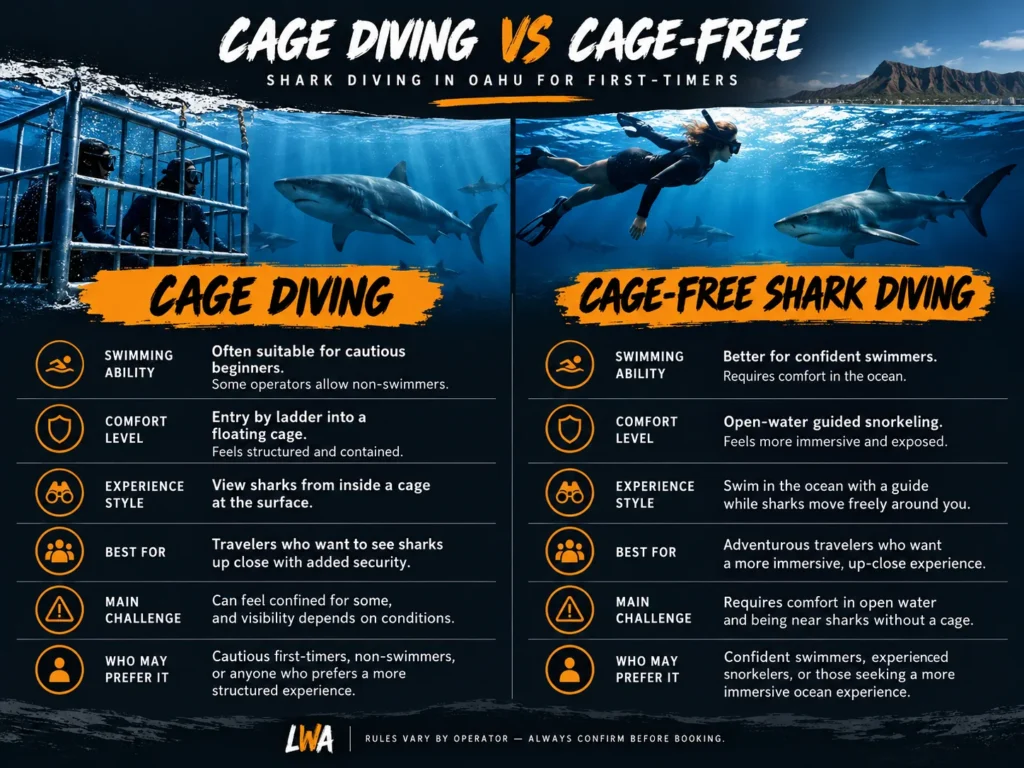
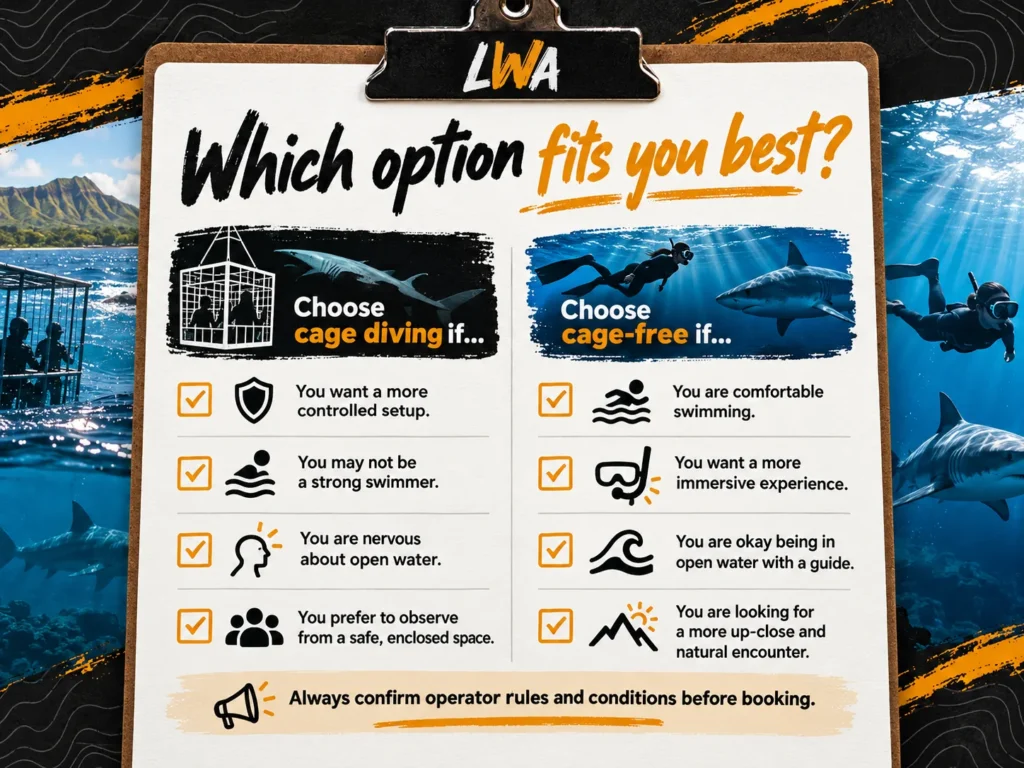
The short answer: choose a surface cage if you cannot swim, want a defined boundary, or are nervous about open water. Consider a guided cage-free snorkel if you can swim confidently, are comfortable following a safety diver’s instructions, and genuinely want to share open water with sharks. Neither option is a universal safety guarantee.
This comparison uses current policies published by Oahu operators, not personal accounts of having taken their tours. Conditions, prices, and participation decisions can change before your booking.
Cage vs. Cage-Free Shark Diving: The Quick Comparison
| Question | Surface cage tour | Cage-free guided snorkel |
| Where you are | Inside a cage alongside the boat | In open water with a guide |
| Swimming | Some operators accept non-swimmers | Swimming ability is needed; specific threshold varies |
| Scuba certification | Not normally required | Not required for surface snorkeling |
| Physical task | Board boat and use cage ladder | Enter water, swim or float under guidance, return to boat |
| Feeling of exposure | A physical barrier between guest and shark | No physical barrier |
| Age rules | Operator specific; cage vs observer matters | Operator and height/weight rules differ |
| Typical fit | Non-swimmers and cautious first-timers | Comfortable swimmers seeking an in-water encounter |
Important: A cage is a boundary, not a promise of zero risk. A guided cage-free swim is a more exposed format, not proof that a particular tour is unsafe. Your swimming ability, medical circumstances, sea conditions and the crew’s decisions matter in both.
What Does an Oahu Shark Cage Tour Actually Feel Like?
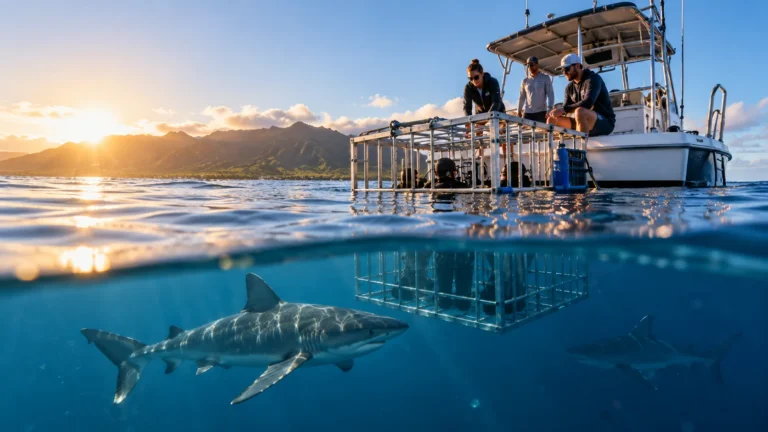
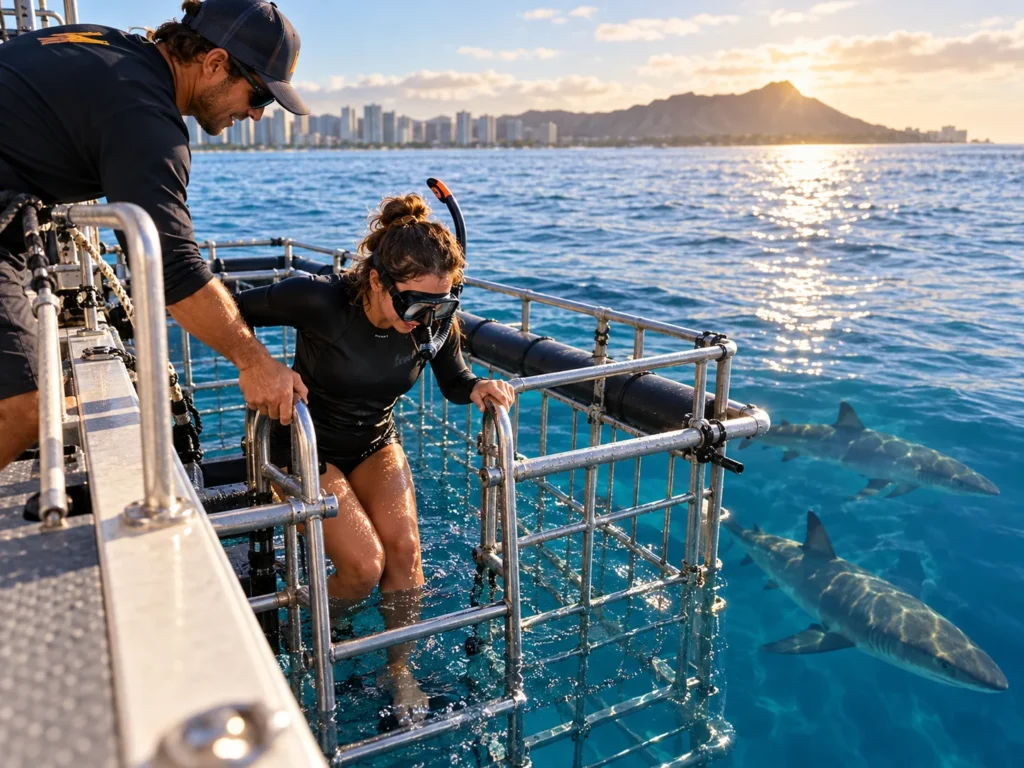
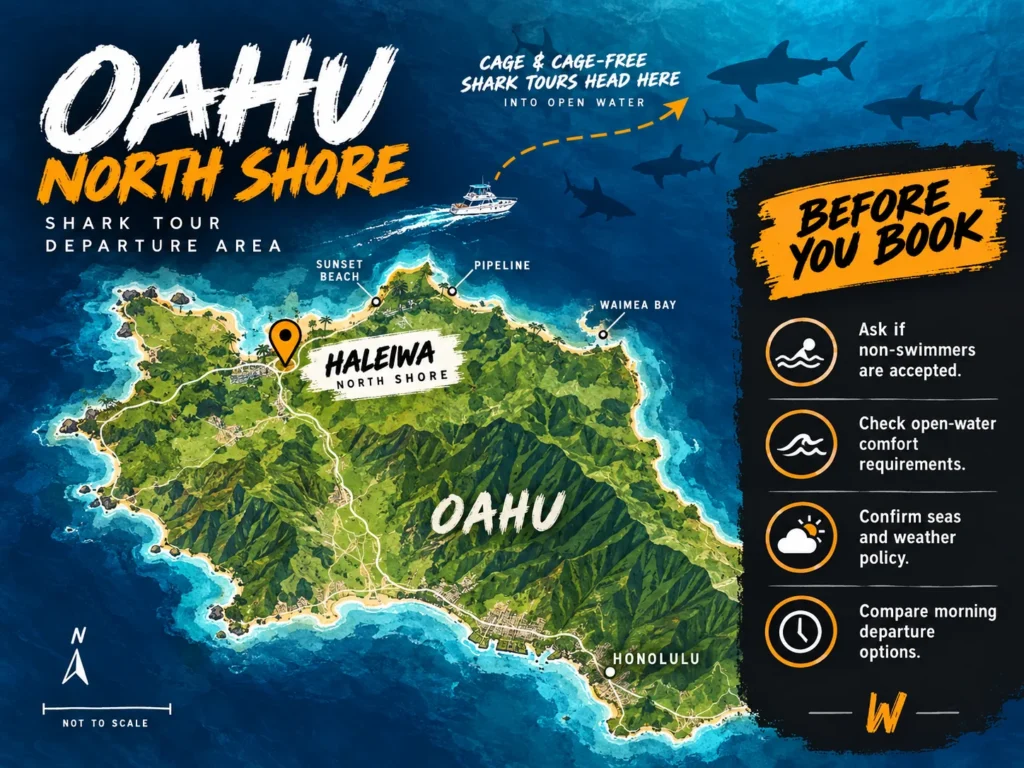
On a typical North Shore surface-cage outing, you board a small boat in Haleiwa, travel offshore, receive instructions and take a turn in a floating cage secured to the boat. You look through a mask and snorkel while staying within the operator’s equipment. You do not need to chase sharks or swim in open water.
North Shore Shark Adventures states that swimming is not required for its cage format. Hawaii Shark Encounters likewise says that even guests who cannot swim may participate, provided they can manage the ladder and follow directions. Hawaii Shark Encounters says guests must be able to pull themselves back up the ladder. [S1][S2]
That physical detail matters more than a reassuring marketing photograph. A person who is comfortable looking into the water but cannot handle a wet ladder should contact the operator before paying. An observer ticket from the boat can sometimes be an alternative.
What if you feel claustrophobic or frightened?
A cage creates a boundary, but it is still a confined space that moves with the sea. Some people like that separation; others dislike the bars, the noise and having water at eye level. Ask about cage size, how many guests are inside at once, and how quickly you can signal that you want to leave. You should not have to pretend you feel comfortable to avoid disappointing a group.
What Changes When You Choose Cage-Free Shark Diving?
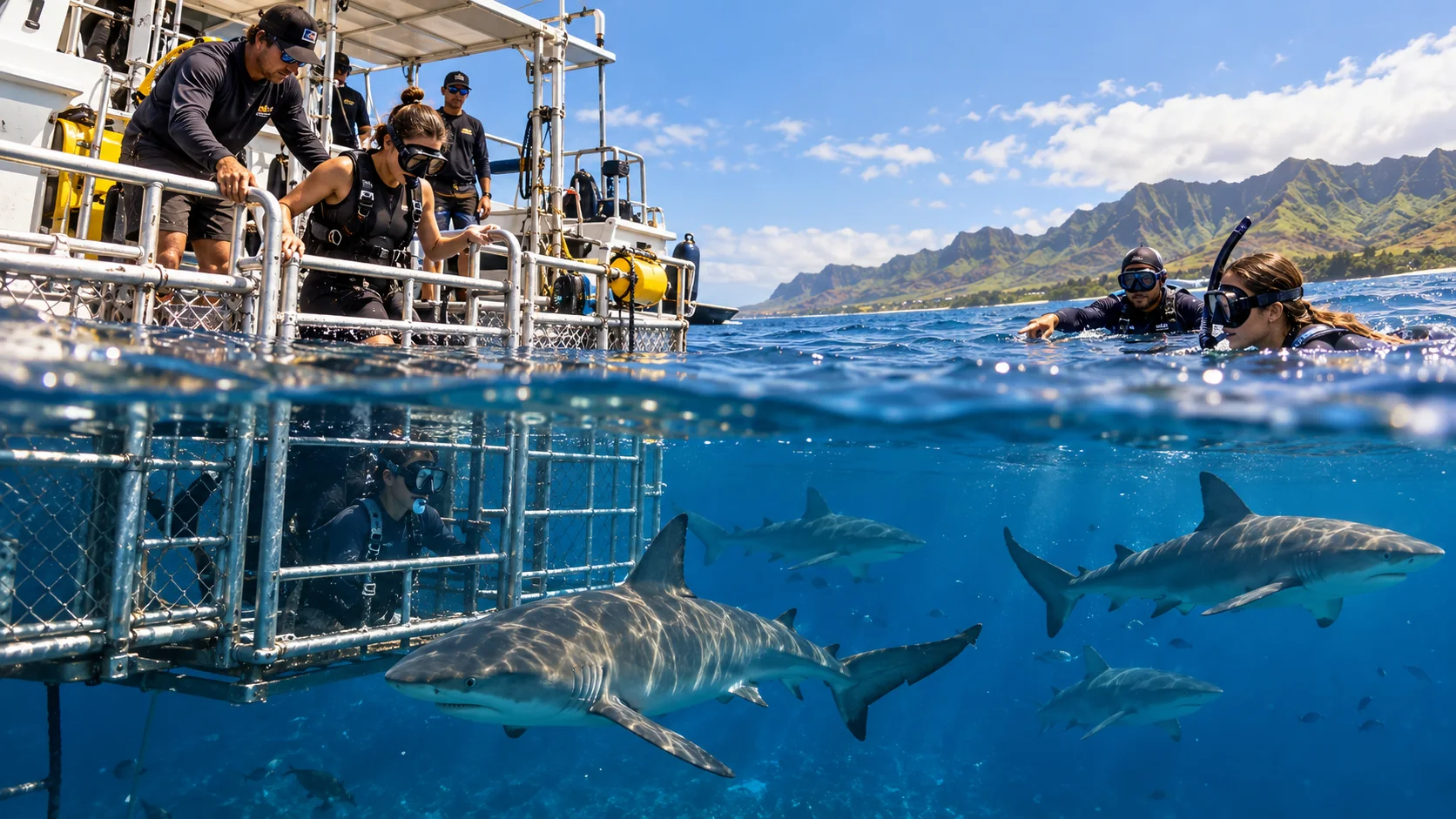
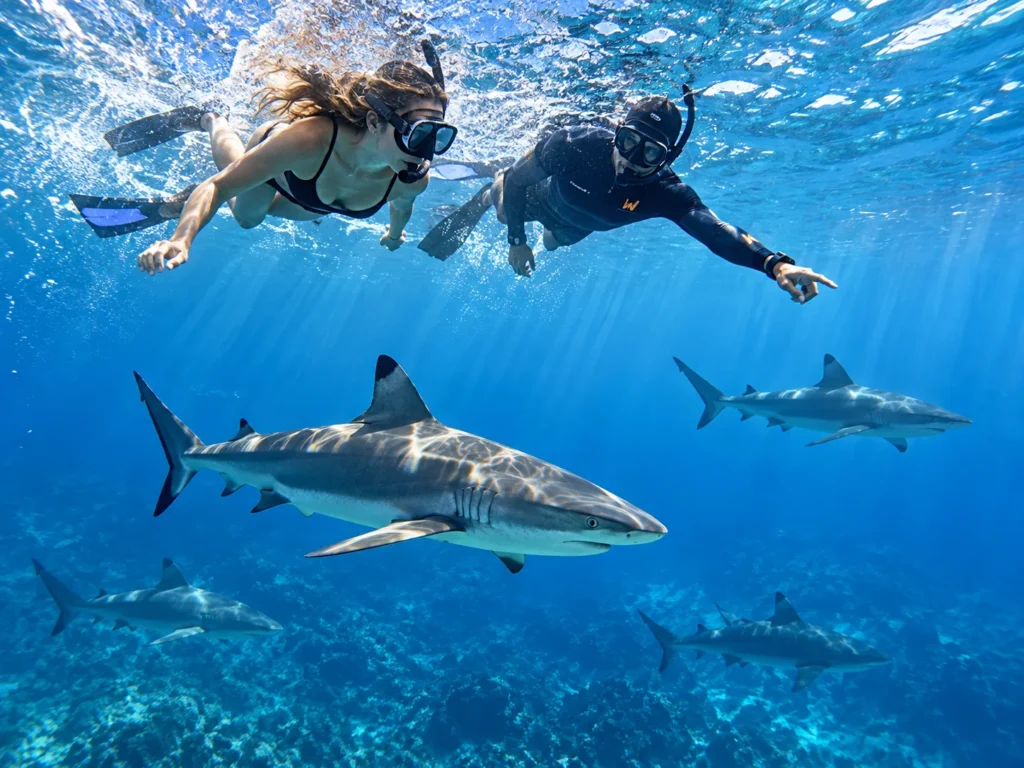
A cage-free shark tour is not the same as scuba diving or an unsupervised swim. Standard North Shore cage-free offerings are guided surface snorkeling experiences. Participants wear a mask, snorkel and often fins, enter the open ocean from the boat, and follow an in-water safety guide’s instructions.
One Ocean Diving describes a six-guests-per-safety-diver operating model and a standard guided surface snorkel. Its current website says participants need to be comfortable swimmers; its more detailed FAQ says guests should at least be physically capable of swimming and able to follow instructions, and it provides a floating line. Do not interpret the presence of a line as a substitute for swimming ability. Confirm your specific case with the operator. [S3][S4]
Being in open water changes the experience: there is no cage between you and the animals, and you are responsible for maintaining your position, listening to the guide and returning to the boat safely. If you would panic in open water, that is a meaningful reason to choose a cage or a boat-only ticket instead.
Do you need scuba training?
Not for the surface-snorkeling tours discussed here. One Ocean Diving says no scuba certification is required. A different operator’s advanced dive, freedive or specialized expedition may set additional requirements, so check the exact product rather than relying on the phrase “shark diving.” [S4]
Swimming Ability: The Most Important First-Timer Decision
If you do not swim, do not book a cage-free in-water slot on the assumption that a guide, life vest or flotation line makes it equivalent to a cage. A genuine swimming requirement is not a box to tick casually.
For a surface-cage tour, being a non-swimmer may be acceptable, but you still need to manage the boat, the entry system, breathing through a snorkel and crew directions. For a cage-free tour, assess whether you can calmly keep yourself afloat, use snorkeling equipment and move with the guide in changing ocean conditions.
Before choosing, read our shark cage diving requirements guide for the ladder, mobility, age and seasickness questions that are easy to overlook.
Age and Family Rules: Can Children Join?
There is no single age rule covering every Oahu shark tour. A company may allow a child aboard but not in the water. North Shore Shark Adventures lists cage-diver age categories and additional infant restrictions for boat tours. Hawaii Shark Encounters does not consider its tour appropriate for children under five. [S1][S2]
For cage-free snorkeling, One Ocean Diving’s detailed FAQ requires participants entering the water to be at least four feet tall, physically capable of swimming and able to follow instructions. It says guests under 80 pounds must bring a properly fitting life vest. Hawaii Adventure Diving separately publishes a minimum participant age of five with parental consent. [S4][S5]
These are examples of current operator policies, not a recommendation that a child is ready. Ask whether the child will be swimming, what the crew-to-guest ratio is, what happens if a child decides not to enter, and who supervises a child staying on the boat.
How Do Fear, Physical Effort and Ocean Conditions Compare?
Fear and perceived control
A cage can make close encounters feel more manageable because there is a visible barrier and less need to swim. But a person with claustrophobia may find the cage more stressful. Cage-free snorkeling offers more freedom of movement, along with the greater responsibility of staying calm in open water. Fear is personal; there is no universal ranking.
Fitness and seasickness
Neither tour requires you to be an athlete, but both involve a boat exposed to ocean motion. Cage tours may emphasize ladder strength; cage-free tours add swimming and position-control demands. Seasickness depends mainly on the boat and conditions, not on which format you booked. Taking the earliest suitable departure can be worth discussing with the operator, but calm seas are never guaranteed.
When the weather changes
An operator may delay, change or cancel a trip for conditions that are unsuitable. Do not assume a cage-free trip can proceed whenever a cage tour can, or the opposite. Policies differ. Keep one flexible day in your itinerary where possible, and verify cancellations and refunds before booking.
Which Oahu Operator Should You Compare?
For a surface cage, start with the official policies of North Shore Shark Adventures and Hawaii Shark Encounters. For cage-free snorkeling, examine the current requirements of One Ocean Diving and Hawaii Adventure Diving. Comparing two products from different operators is not a controlled safety test, and published safety claims are company statements rather than independent certifications. [S1]–[S5]
Read our Oahu shark cage diving guide for a closer look at established cage operators. The best shark cage diving experiences in the USA guide puts this destination in a wider context.
Does Cage-Free Shark Diving Cost More?
Operator-published rates checked in October 2026 provide examples, not a stable market average. North Shore Shark Adventures advertised an online adult cage special at $112 (before applicable taxes or fees), while One Ocean Diving advertised a standard cage-free snorkel at $150 per person plus tax. Different durations, group arrangements, inclusions and refund terms can change the value comparison. [S1][S3]
Do not choose solely by the smaller number. Look at the total checkout price, how long you actually spend in the water, group size, equipment, observer options, photo extras and the operator’s policy for weather cancellations. Our shark cage diving cost guide explains the broader cost considerations.
Six Questions to Ask Before You Pay
- Can everyone entering the water meet the operator’s actual swimming, ladder, height and age requirements?
- What exactly happens during entry, observation and recovery — and can someone choose to remain on the boat?
- Which staff members stay with participants, and what instructions are given for animal behavior and close approaches?
- What is the current trip duration, real water time, included gear and full checkout price?
- What sea conditions trigger postponement and what refund or rescheduling terms apply?
- Are there any medical, pregnancy, medication or accessibility concerns the operator needs to assess in advance?
For a trip later in the year, do not make assumptions from a summer photo. Ask the operator about your date’s likely sea conditions and check the marine forecast nearer departure.
Which Experience Should a First-Timer Choose?
Choose a surface cage if: you are not a swimmer, prefer a physical barrier, or want an introductory encounter while remaining close to the boat. Confirm ladder mobility and any child or observer rules first.
Consider guided cage-free snorkeling if: you can swim, remain comfortable in open water, accept the absence of a barrier and can follow the guide’s instructions even if you feel excited or anxious. Confirm swimming thresholds rather than guessing.
Choose a boat observer place or postpone if: you cannot meet the participation requirements, have unresolved medical questions, are uncomfortable with the day’s conditions, or simply decide the experience is not for you.
The best first shark encounter is not automatically the most exposed one. It is the format you can participate in responsibly, understand before boarding and still feel comfortable choosing when the boat leaves the harbor.
Frequently Asked Questions
Is cage-free shark diving the same as swimming with sharks?
On standard Oahu North Shore tours, cage-free encounters are guided surface snorkeling in open water with sharks. Tour rules and swimming requirements differ, so confirm the product you select.
Can non-swimmers go shark cage diving in Oahu?
Yes, at certain surface-cage operators. North Shore Shark Adventures and Hawaii Shark Encounters describe options that do not require swimming ability, although ladder and other participation rules still apply.
Can a non-swimmer do a cage-free shark swim?
Do not assume so. One Ocean Diving expects in-water guests to be capable of swimming. A boat-only ride-along may be a better alternative.
Will I see great white sharks in Oahu?
Do not book an Oahu tour expecting a great white shark. Operators commonly discuss species such as Galapagos and sandbar sharks, and wildlife sightings and species cannot be guaranteed.
Is cage diving safer than cage-free snorkeling?
The formats have different exposures and participation demands. A physical barrier is a meaningful difference, but no broad independent comparison establishes a universal risk ranking across all operators and sea conditions.
Can I switch from cage-free to cage on the day?
Not automatically. The products are often run by different companies with separate boats, booking terms and capacities. Arrange any changes before departure.
Sources and Verification
[S1] North Shore Shark Adventures — Oahu Shark Diving Tour: https://sharktourshawaii.com/shark-diving-tour/
[S2] Hawaii Shark Encounters — Frequently Asked Questions: https://hawaiisharkencounters.com/faq/
[S3] One Ocean Diving — Tour details and pricing: https://oneoceandiving.com/
[S4] One Ocean Diving — Shark Tour FAQ Oahu: https://oneoceandiving.com/shark-tour-faq-oahu
[S5] Hawaii Adventure Diving — Cage-Free Shark Diving FAQ: https://hawaiiadventurediving.com/shark-diving-tours/hawaii/oahu/north-shore-haleiwa/cage-free-oahu-shark-diving-faq/
[S6] Hawaii Revised Statutes §188-40.6 — Shark feeding restrictions: https://data.capitol.hawaii.gov/hrscurrent/Vol03_Ch0121-0200D/HRS0188/HRS_0188-0040_0006.htm
Sources reviewed October 25, 2026. Operator rates and requirements may change.