New River Gorge Bridge Walk: Cost, Height, and What to Expect
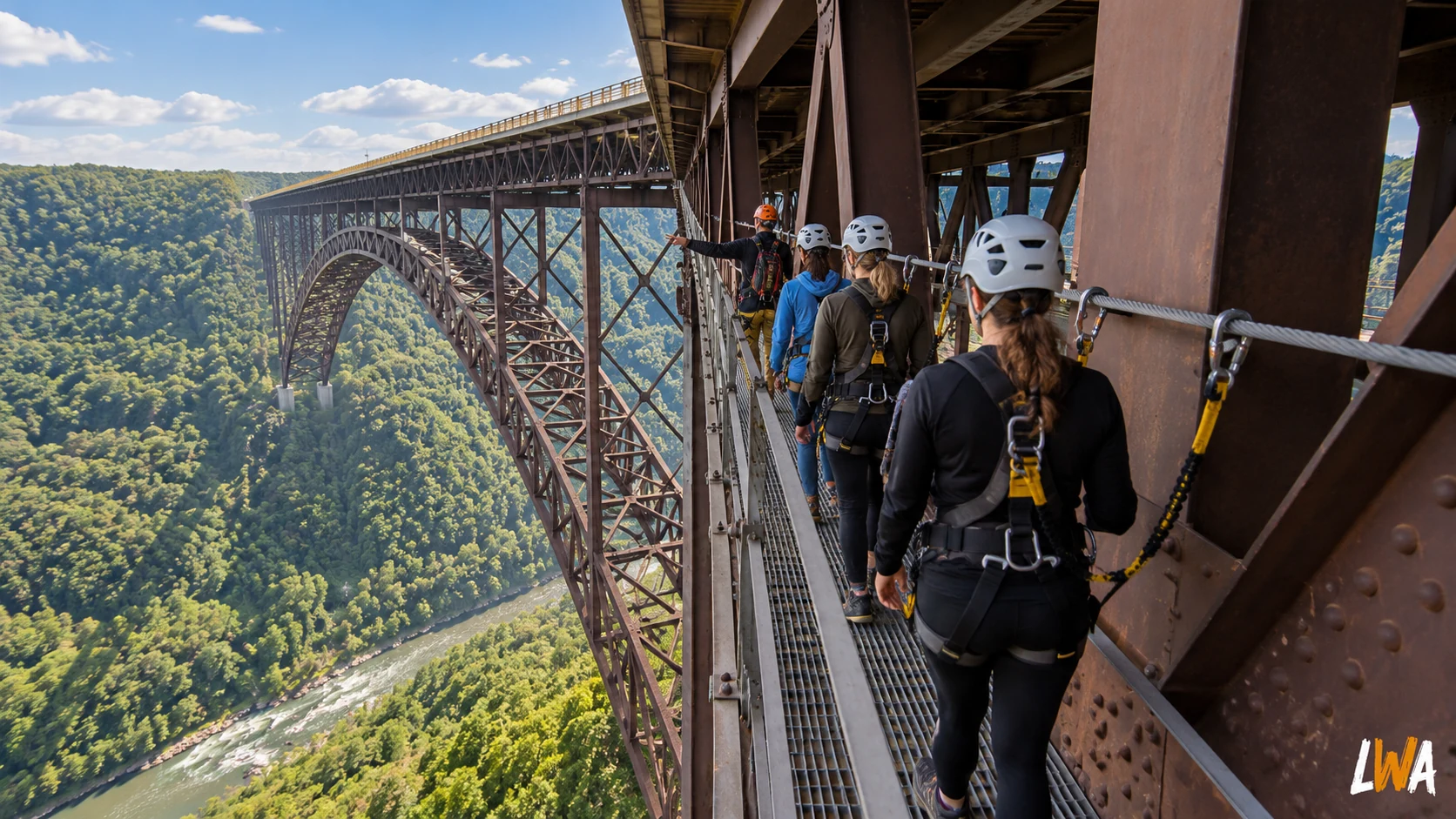
The New River Gorge Bridge Walk isn’t a stroll across the highway bridge. It’s a guided walk on a narrow maintenance catwalk underneath it, with the forested gorge and New River far below. You wear a harness, stay connected to the tour’s safety cable, and follow a guide along the underside of one of West Virginia’s most recognizable landmarks.
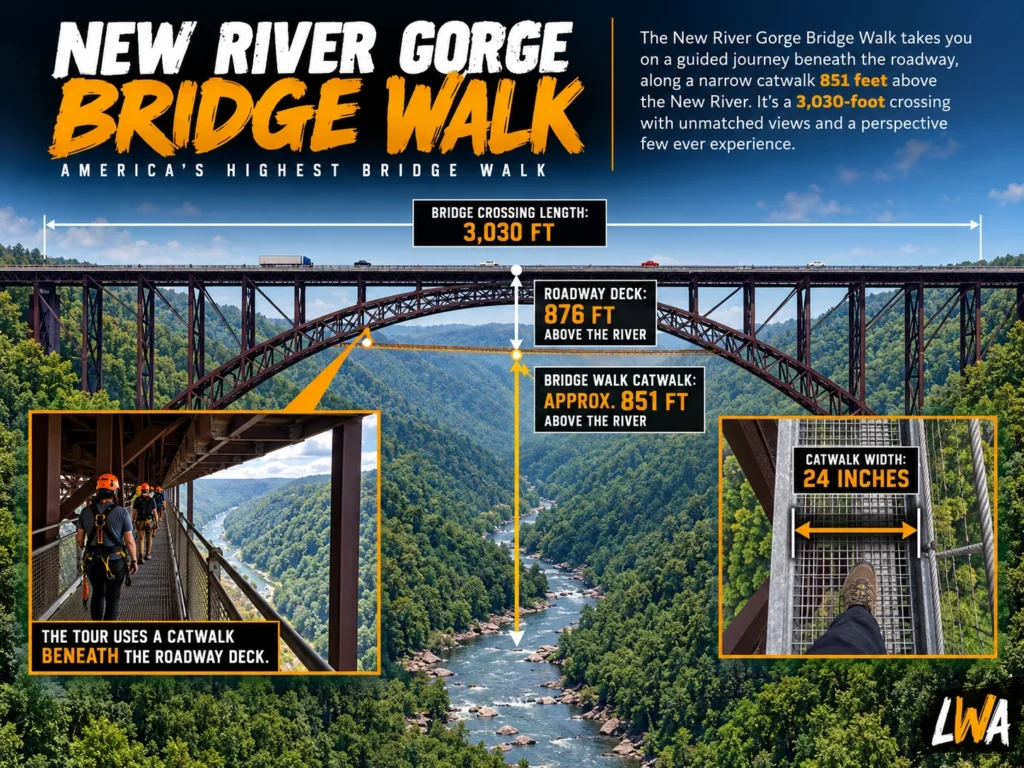
The headline figures are easy to mix up: the bridge deck stands 876 feet above the river, while the catwalk is approximately 851 feet above it. The standard guided tour currently starts at $79 per person and takes at least two hours overall, according to Bridge Walk’s official website. Those details make it an unusually direct way to experience the bridge, but they don’t tell you whether you’ll enjoy the height, narrow walkway, or full trip logistics.
This guide covers the real booking cost, how the tour works, current eligibility rules, what the 24-inch-wide walkway feels like, and what to plan around Fayetteville. It is a local booking guide, not a substitute for your operator’s instructions on the day.
New River Gorge Bridge Walk at a Glance
Here are the practical numbers to check before planning a visit. They describe the standard guided experience, not Bridge Day event access.
| Item | Published detail |
| Standard tour price | Starts at $79 per person |
| Bridge deck above the New River | 876 ft |
| Catwalk above the New River | Approximately 851 ft |
| Catwalk width | 24 inches |
| Bridge crossing length | 3,030 ft |
| Total walking involved | About 1¼ miles, including access paths |
| Overall experience | 2+ hours; allow additional scheduling margin |
| Minimum age and height | 8 years old and at least 48 inches tall |
| Operating season | Year-round, subject to scheduling and conditions |
The tour’s posted price, ages and schedules can change, particularly around special events. Bridge Walk’s published FAQ is the right place for the latest participant rules. The National Park Service confirms that this is a tour on the underside of a vehicle bridge—not public pedestrian access on its roadway.
For a broader comparison with self-guided skywalks and other bridges, see our guide to the best bridge walks in the USA.
How Much Does the New River Gorge Bridge Walk Cost?
The operator currently advertises the standard New River Bridge Walk from $79 per person. That is a starting price, not a guarantee that every time slot, special event or booking will cost exactly $79. Check your actual booking screen for the date, participant count, tax and any extras before paying.
Bridge Walk also lists a special Bridge Day Bridge Walk at $125, an annual pass at $235 and gift certificates starting at $79. Those are different purchases with different use cases. A normal guided Bridge Walk should not be confused with the once-a-year public roadway celebration.
Your total trip cost includes more than the tour ticket. If you’re traveling from outside the area, allow for gas or a rental car, parking or local transfers where relevant, meals, lodging, and any separately purchased photo products or other attractions. The operator allows cameras that are properly secured, so you may not need an extra photography package just to bring your own approved camera.
Before choosing a time, ask whether your preferred date has special-event pricing and read the cancellation terms. Bridge Walk says it operates rain or shine, but may cancel for unsafe conditions such as high wind. If the operator cancels, its FAQ describes options including a reschedule, gift certificate or full refund. Guest-initiated changes have separate deadlines.
How High Is the Bridge Walk? 876 Feet vs. 851 Feet
The New River Gorge Bridge is 876 feet high when measured from its roadway deck to the New River. The maintained catwalk used by Bridge Walk is approximately 25 feet below the roadway, at about 851 feet above the river. Both figures are valid, but they measure different parts of the structure.
The full bridge is 3,030 feet long, and the main arch spans 1,700 feet. These are structural dimensions, not the distance you’ll fall or a description of a climbing route. You walk across a catwalk tucked beneath the road deck; you do not climb over the arch and you do not walk on the highway traffic lanes.
The walking surface is approximately 24 inches wide, with railing and an attached harness system. Some visitors find the overhead steel structure reassuring. Others are more affected by the visible drop and open side views. Height tolerance is personal, so a published measurement alone cannot predict your reaction.
The National Park Service advises visitors that the vehicle bridge is not a normal pedestrian route. Walking on the roadway is associated with the separate Bridge Day event, not ordinary Bridge Walk reservations.
What Happens on a Guided Bridge Walk Tour?
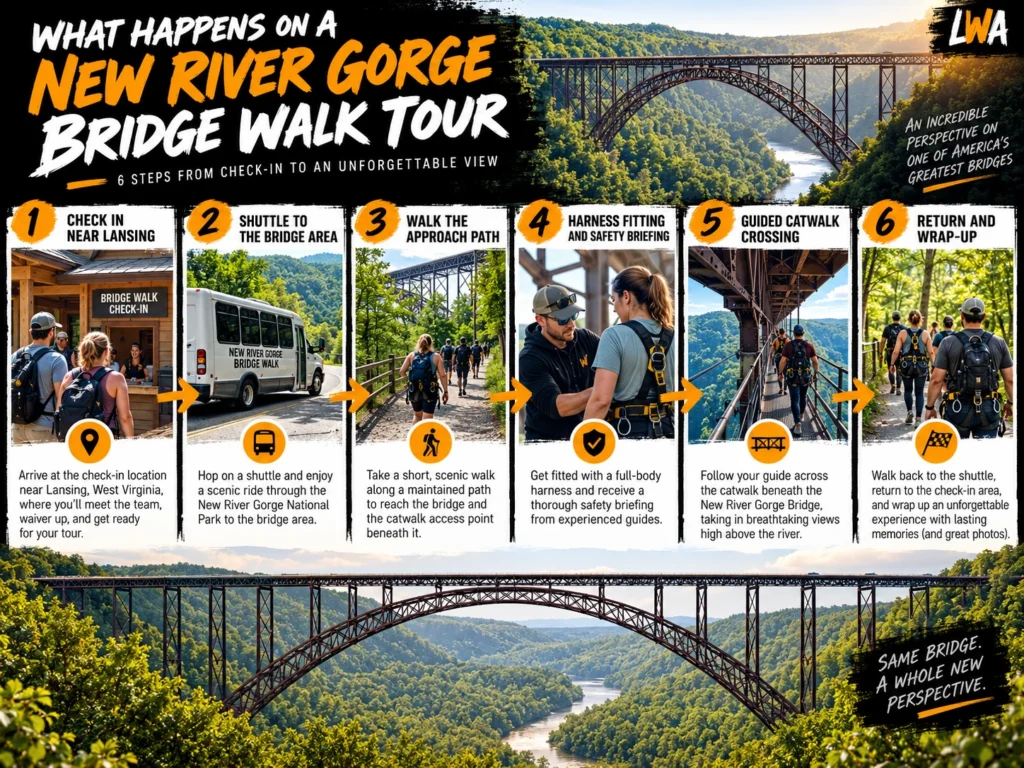
Expect a structured outing rather than independent access. The current operator description includes check-in, a shuttle, an approach trail, harness fitting, the guided catwalk crossing, and the return journey. The exact order and pacing are set by staff and site conditions.
1. Check in near Lansing
The operator lists its headquarters at 57 Fayette Mine Road, Lansing, West Virginia 25862. Arrive at the time instructed in your booking confirmation rather than assuming the bridge itself is your meeting point. Use the official address, check parking information, and ask about accessibility or mobility issues before traveling.
2. Shuttle and approach
After check-in, guests normally take a shuttle toward the Canyon Rim Visitor Center area and walk an approach path to the bridge. This matters if you’re assessing fitness: the outing is not limited to the 3,030-foot catwalk. The operator describes about 1¼ miles of total walking including access and exit paths, with uneven sections and inclines.
3. Harness fitting and safety briefing
Staff fit participants with a full-body harness and connect them to the continuous safety cable. The operator states that only the guides manage attachment and detachment from that system. Follow the briefing exactly and tell staff if anything is uncomfortable, unclear, or incompatible with an injury or mobility limitation.
The cable and guide procedures are central risk controls, but they should not be described as making an outdoor activity universally risk-free. Weather, individual health, equipment fit, and adherence to instructions still matter.
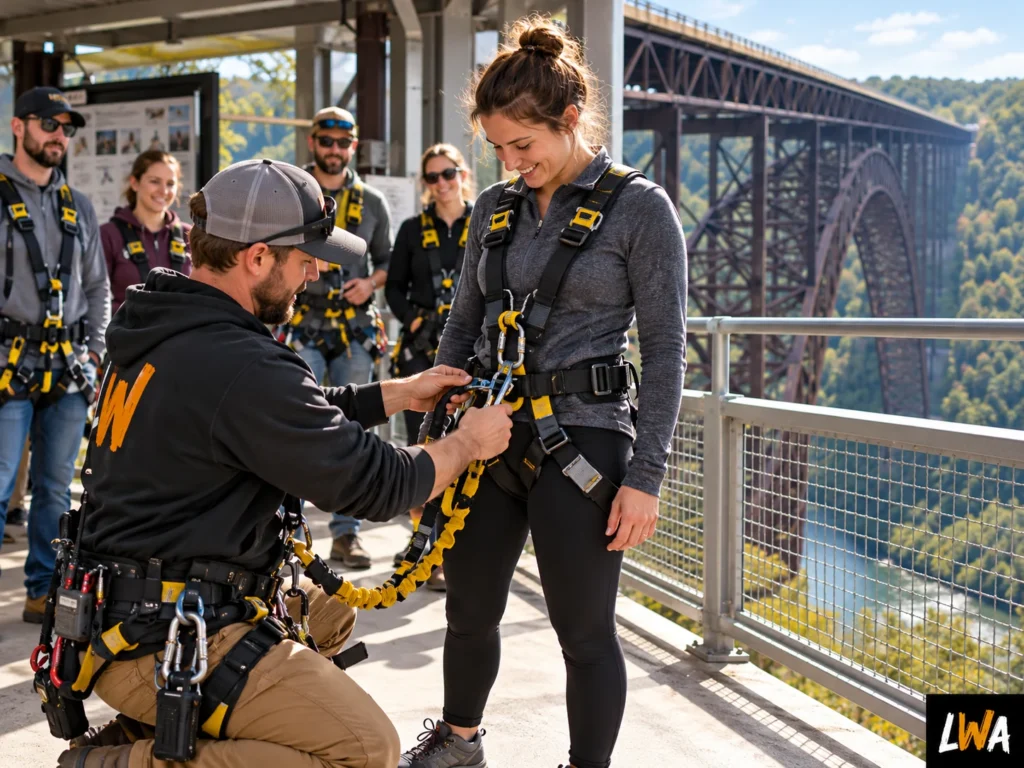
4. The catwalk itself
On the bridge, you’ll walk beneath the roadway through a lattice of steel members, with views through and around the structure. The catwalk spans 3,030 feet and is about two feet wide. A trained guide leads the group and typically allows opportunities for photos and questions.
You won’t have to navigate the crossing alone, but you must be willing to keep moving on a narrow elevated walkway. If you are nervous about heights, mention it before the tour rather than waiting until you’re far out over the gorge.
5. Return and timing
The official sales page estimates 2+ hours from check-in to return. The National Park Service describes tours as three-hour experiences, and local tourism guides sometimes use two to three hours. These are not necessarily contradictory: your actual time can vary with group size, briefing and shuttle timing. Keep a three-hour planning block plus travel buffer rather than scheduling another timed attraction immediately afterward.
Age, Height, Fitness and Harness Requirements
The operator’s current FAQ says participants must be at least eight years old and at least 48 inches tall. It also advises a reasonable level of fitness, enough strength and coordination for independent standing and movement, and the ability to handle about 1¼ miles of walking.
Harness fit is a separate gate. One current Bridge Walk FAQ states a maximum waist of 53 inches and thigh circumference of 35 inches, while its About page states a waist limit under 52 inches. Because these published figures conflict, anyone near either threshold should contact Bridge Walk and obtain confirmation before paying. An older tourism listing also uses a ten-year minimum, so the operator’s current rules take priority over old third-party listings.
Mobility limitations, recent surgery, back or joint issues, dizziness or vertigo, some cardiovascular or respiratory conditions, and seizures may affect participation. The operator says it reviews individual circumstances and may modify or decline participation. Do not use a general online article as medical clearance. If you’re pregnant or have a health concern, consult the operator and your healthcare professional as relevant.
A parent planning for children should verify the age, minimum height, ability to walk independently, and current consent requirements. The fact that a child meets the height requirement does not automatically mean the outing will be enjoyable for them.
What Does Walking 851 Feet Above the River Feel Like?
There isn’t one universal reaction. Some people focus on the bridge’s engineering and the trees below. Others feel the height most strongly when the steel framing opens to a view of the New River. The catwalk’s narrowness can feel more psychologically intense than the amount of physical effort involved.
Unlike a zipline or a jump, the Bridge Walk moves at a controlled walking pace. You’re not being asked to leap, descend on a rope, or balance unaided on the edge of a bridge. The challenge is sustained exposure to a dramatic drop while following a guide on a fixed walkway.
If this is your first height-based adventure, compare your fear response with your practical walking ability. Our guide to choosing your first adrenaline activity offers a useful framework for weighing exposure, effort, instruction, time and total cost before booking.
Don’t promise yourself you will ‘overcome’ a fear of heights in one outing. A guided format may help some people feel more comfortable, but you can still decide that a less exposed viewpoint is the better choice.
What to Wear and Bring
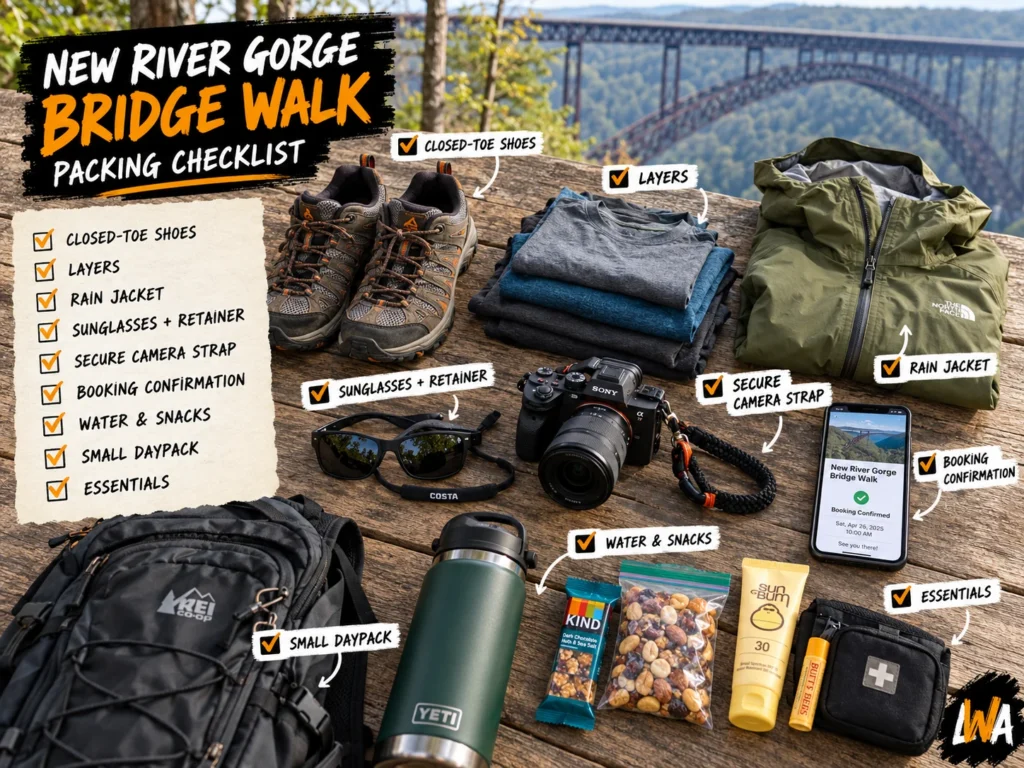
The operator recommends comfortable clothing and secure footwear. Closed-toe walking shoes are sensible; sandals need a heel strap, and flip-flops are not allowed. Avoid anything likely to interfere with your harness or footing.
The catwalk sits under the roadway deck and can be cooler than open areas. Bring an appropriate extra layer and a rain jacket for the approach routes, even when the forecast looks mild. The operator says tours can run in rain because the bridge deck shelters much of the catwalk, but it does not shelter every part of the outing.
Phones, cameras and binoculars must be securely tethered; unsecured handheld items can fall into the gorge. Ask about approved straps, bags and valuables before arrival. Glasses or sunglasses should have a secure retainer when appropriate.
Short packing list: closed-toe shoes, comfortable layers, weather protection, booking confirmation, any required identification, and an approved tether for camera equipment. Bring drinking water for your broader day in the park, but follow operator instructions on what may be carried onto the catwalk.
Best Time to Book: Seasons, Weather and Bridge Day
Bridge Walk markets standard tours year-round. Spring adds green hillsides and changeable weather; summer offers long daylight and lush scenery; autumn brings foliage and demand for scenic dates; winter can mean cold conditions. None of these seasonal descriptions guarantees a particular day’s weather.
Bridge Day is a separate annual event held on the third Saturday in October. The National Park Service explains that pedestrians can use the roadway during that celebration. Special Bridge Day catwalk outings and event access have their own arrangements and may differ from a regular walk.
At the time of this research, the standard tour starting price was $79 and the advertised Bridge Day Bridge Walk price was $125. For an autumn weekend, book transport and lodging around confirmed availability; avoid assuming you can arrive without a reservation.
Whether you’re visiting in July or January, check the official calendar, weather policy, footwear guidance and any schedule changes before departing.
Where to Stay and What Else to Do Near Fayetteville
Fayetteville is a logical base for exploring New River Gorge National Park and Preserve. The Bridge Walk meeting point is in nearby Lansing, so planning around the official check-in address is more useful than guessing from the name of the bridge.
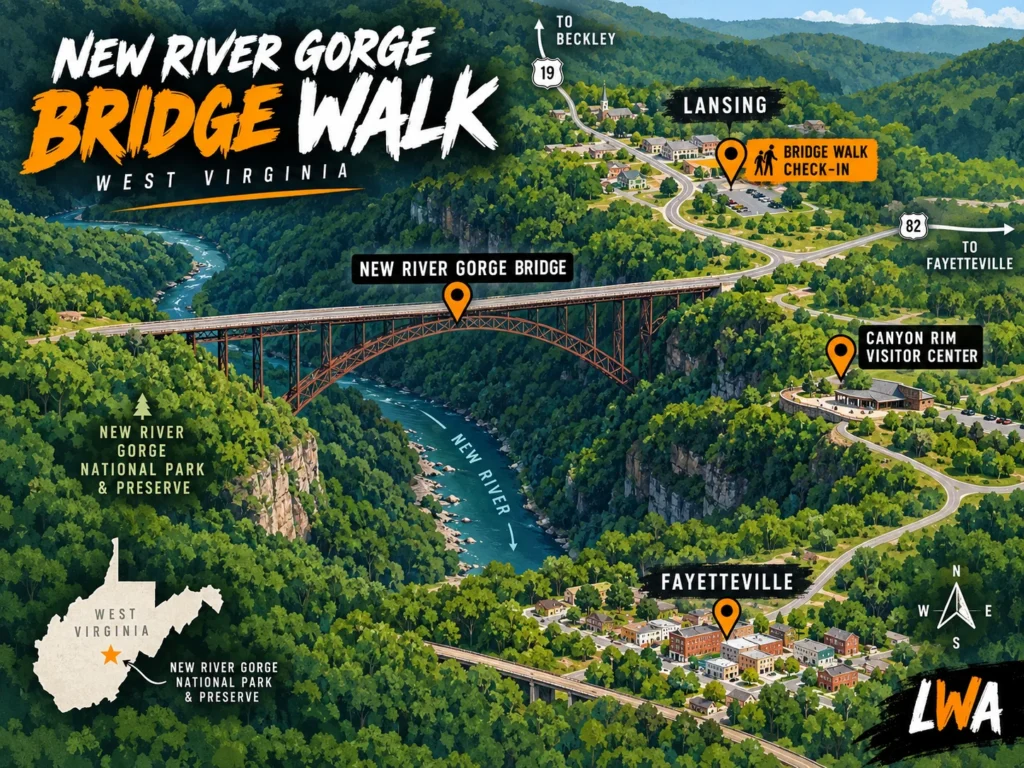
If you have extra time, the National Park Service identifies Canyon Rim Visitor Center overlooks and the Long Point trail as alternative ways to appreciate the bridge. Those viewpoints provide a different experience and don’t replace the guided underside crossing.
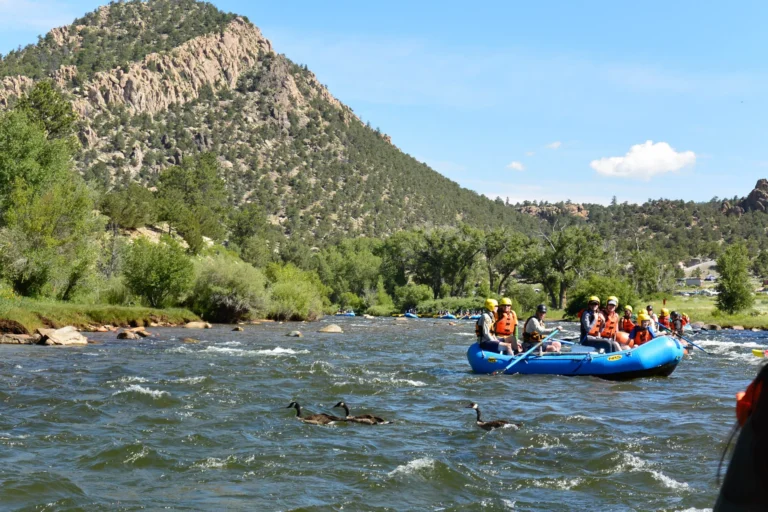
Whitewater rafting makes a natural second adventure, but the Upper and Lower New River are different commitments. Our New River Gorge rafting guide for beginners compares calmer introductory options with more demanding whitewater, so you can choose an appropriate second-day activity.
For a low-pressure itinerary, plan one timed guided adventure and leave the other half of the day for overlooks, meals, or a short hike. Weather changes and tour logistics make overpacked itineraries less enjoyable.
Before You Book: Seven Questions to Ask
1. What is the complete price for my date and number of participants, including any fees?
2. Does everyone in my group meet the current age, height, harness-fit and walking requirements?
3. What exactly is included in the advertised 2+ hours, and when must we check in?
4. Are there stairs, uneven paths or other access conditions that affect someone in my group?
5. Which shoes, layers, cameras and personal items are permitted?
6. What happens if the operator cancels because of high winds or other unsafe conditions?
7. Is this a standard Bridge Walk reservation or a special Bridge Day event product?
If your group has mixed height tolerance or physical ability, ask about alternative local viewpoints rather than trying to pressure everyone into a single activity.
Frequently Asked Questions
Can you walk across the top of the New River Gorge Bridge?
Not on a normal day. It is a U.S. Route 19 vehicle bridge. The guided Bridge Walk uses a catwalk beneath the roadway. Pedestrians can access the roadway during certain Bridge Day arrangements, which are a separate event.
Is the Bridge Walk 876 feet high or 851 feet high?
The bridge deck is 876 feet above the river. The tour’s catwalk runs about 25 feet below it, at approximately 851 feet. Use the second figure when describing where participants actually walk.
How long does Bridge Walk take?
The operator advertises 2+ hours total, while the National Park Service calls it a three-hour tour. Plan roughly two to three hours, plus extra time for arrival and onward travel, and check your booking confirmation.
Can children do the New River Gorge Bridge Walk?
The operator currently lists eight years as the minimum age and 48 inches as the minimum height. Other physical, harness-fit and consent requirements still apply.
Do you need climbing experience?
Not for the standard guided catwalk walk. The relevant requirements are being eligible for the tour, walking its route, wearing the harness correctly and following guide instructions.
Does the Bridge Walk run in rain?
The operator normally runs rain or shine and cancels when conditions are deemed unsafe. Check the forecast, dress for the full itinerary and rely on the operator’s decision for your actual session.
The Bottom Line
Bridge Walk is a distinctive way to experience New River Gorge: 3,030 feet beneath the roadway, around 851 feet above the river, in a guided and harnessed format. Its current published starting price of $79 makes it relatively straightforward to budget for—but the true decision is about your comfort with height, walking demands, group eligibility and weather.
If you want the bridge to be the adventure rather than simply a photo stop, it deserves serious consideration. Confirm the latest participant requirements and book the exact date through the official Bridge Walk site before arranging a tightly scheduled trip.
Sources and Verification
Bridge Walk — official tour, prices and basic requirements: https://bridgewalk.com/
Bridge Walk — detailed FAQ and booking conditions: https://bridgewalk.com/faqs
Bridge Walk — About, safety system and historical details: https://bridgewalk.com/about-bridge-walk
National Park Service — New River Gorge Bridge facts and pedestrian restrictions: https://www.nps.gov/neri/planyourvisit/nrgbridge.htm
National Park Service — Bridge Day information: https://www.nps.gov/neri/planyourvisit/bridgeday.htm