
You do not need marathon-level endurance, advanced outdoor skills, or months of training to experience a serious adrenaline rush.
Some of the most intimidating adventures put most of the technical work on an instructor, guide, vehicle, aircraft, or fixed safety system. That means your heart can be racing while your legs are doing surprisingly little.
The key is knowing the difference between physical effort and perceived intensity. Tandem skydiving, for example, can feel far more extreme than a long hike while requiring much less endurance from the participant.
That does not make these activities risk-free. Height, weight, age, health, weather, mobility, and operator requirements still matter.
Here are 20 adrenaline activities worth considering when you want the thrill without extreme fitness.
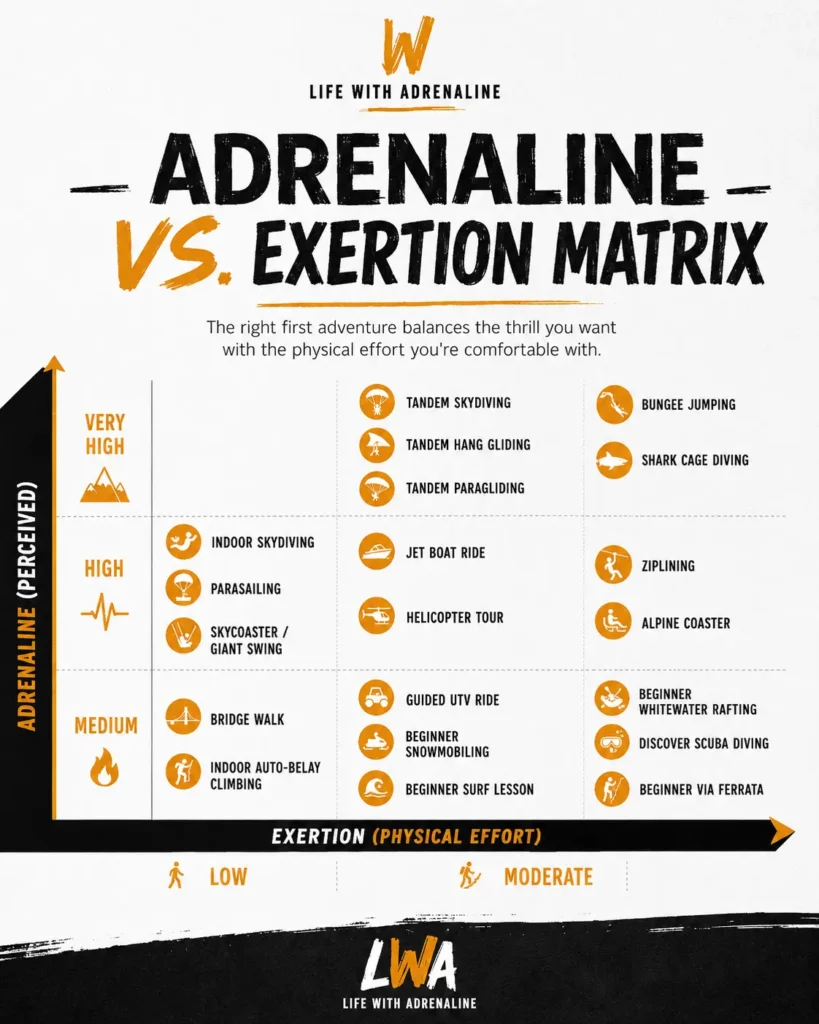
Adrenaline vs. Physical Effort: Quick Comparison
The ratings below are Life With Adrenaline editorial comparisons, not standardized safety or medical ratings.
| Activity | Physical Effort | Adrenaline / Fear |
| Indoor skydiving | Low | Medium |
| Tandem skydiving | Low | Very High |
| Parasailing | Very Low | Medium–High |
| Skycoaster / giant swing | Very Low | Very High |
| Alpine coaster | Very Low | Medium–High |
| Jet boat ride | Very Low | High |
| Helicopter tour | Very Low | Medium |
| Ziplining | Low–Moderate | High |
| Tandem paragliding | Low | High |
| Tandem hang gliding | Low | High |
| Guided UTV ride | Low | Medium–High |
| Bungee jumping | Low* | Very High |
| Shark cage diving | Low | High |
| Bridge walk | Moderate | High |
| Beginner whitewater rafting | Moderate | High |
| Discover Scuba Diving | Low–Moderate | Medium–High |
| Beginner surf lesson | Moderate | Medium |
| Indoor auto-belay climbing | Moderate | Medium |
| Beginner snowmobiling | Low–Moderate | Medium–High |
| Beginner via ferrata | Moderate | High |
*The jump itself requires little endurance, but reaching a particular bungee location may require more physical effort.
What Does “No Extreme Fitness Required” Actually Mean?
This list does not mean every activity is appropriate for everyone.
Instead, it focuses on experiences that generally do not require:
- advanced athletic conditioning;
- months of technical training;
- sustained high-intensity exercise;
- expedition-level endurance;
- previous expertise in the sport.
Some still involve walking, climbing ladders, paddling, balancing, swimming-related comfort, or remaining active for several hours.
Think of the list as a spectrum.
At one end are experiences such as helicopter tours, alpine coasters, jet boats, and parasailing where the equipment or operator does most of the work.
At the other are beginner rafting, surfing, climbing, and via ferrata, which require more movement but can still be realistic for many recreationally active beginners.
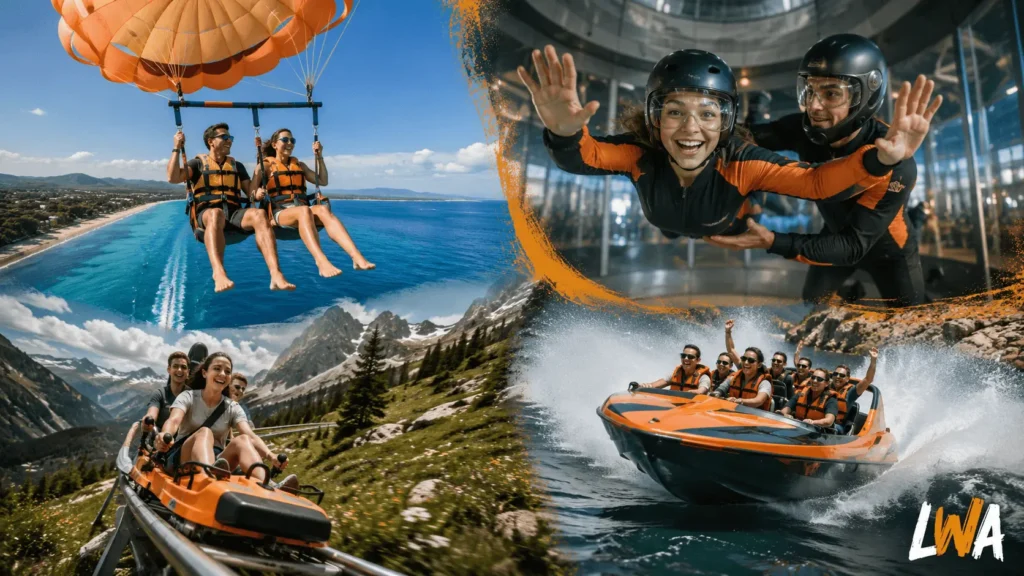
Big Thrills With Very Low Physical Effort
1. Indoor Skydiving
Best for: People who want the sensation of flying without jumping from an airplane.
Indoor skydiving replaces altitude with a vertical wind tunnel. You wear a flight suit and helmet, receive instruction, and enter the airflow with an instructor nearby.
It can feel intense because you are effectively floating on a powerful column of air, but the experience does not require endurance comparable with running, hiking, or climbing.
Current iFLY guidance shows how accessible the format can be: participants can generally start from age 3, although weight limits and medical considerations apply and some participants require additional evaluation. [S2] (iFLY)
Physical effort: Low
Technical experience needed: None for a first flight
Main barrier: Eligibility restrictions and comfort in strong airflow
For nervous beginners, this is one of the easiest ways to discover how you react to a controlled adrenaline experience.
2. Tandem Skydiving
Best for: Maximum fear factor without needing to learn to skydive independently.
Few activities illustrate the difference between fitness and adrenaline better than tandem skydiving.
Your instructor manages the parachute system and the technical sequence, while you follow a short set of body-position and landing instructions.
You still need enough mobility to assume the required position and follow instructions, but you do not need to train like an athlete.
The United States Parachute Association says that, in most cases, participants must be at least 18, although laws and requirements can vary. [S1] (USPA)
Physical effort: Low
Adrenaline: Very high
Technical experience needed: None for a tandem first jump
This is one of the strongest options if fear, rather than physical exhaustion, is what you want to challenge.
3. Parasailing
Best for: A first height experience that feels more scenic than aggressive.
Parasailing is one of the least physically demanding ways to get hundreds of feet of open-air exposure.
You normally take off from and return to the boat rather than running from a cliff or learning to control a wing.
At one current Key West operator, flights last roughly 8–10 minutes, the minimum age is 6, and tandem or triple configurations may be used depending on conditions and participant weight. [S4] (Key West Water Sports)
Physical effort: Very low
Adrenaline: Medium to high
Skill required: None
If you are curious about heights but not ready for skydiving or bungee jumping, parasailing can be a useful intermediate step.
4. Skycoaster or Giant Swing
Best for: People who want the stomach-drop sensation without prolonged exercise.
A Skycoaster or giant swing combines height, anticipation, and sudden acceleration.
Once you are secured into the system, the physical task is minimal. Psychologically, however, pulling a release cord or waiting for the drop can feel far more demanding.
At Royal Gorge Bridge & Park, the current Skycoaster requirement includes a minimum height of 42 inches, and operation is weather dependent. [S7] (Royal Gorge Bridge & Park)
Physical effort: Very low
Adrenaline: Very high
Main challenge: Fear rather than fitness
It is a good example of why an adventure can be extremely intense without being physically exhausting.
5. Alpine Coaster
Best for: Beginners who want speed without giving up control completely.
Alpine coasters run on fixed tracks down mountain terrain. Depending on the system, the rider can usually control braking while gravity supplies much of the speed.
You are seated, so fitness plays almost no role during the ride.
Individual attractions can still impose strict requirements. Glenwood Caverns, for example, currently lists rider and solo-driver height requirements, a maximum combined weight, and restrictions related to certain health conditions and pregnancy. [S8] (Glenwood Caverns)
Physical effort: Very low
Adrenaline: Medium to high
Control: Higher than many aerial activities
If losing control is your biggest fear, an alpine coaster may feel easier psychologically than a freefall experience.
6. High-Speed Jet Boat Ride
Best for: Speed lovers who do not want heights.
A jet boat ride can deliver hard acceleration, rapid turns, spray, and close-to-the-water speed without requiring you to paddle.
That makes it a useful alternative for people who want adrenaline but dislike aircraft or exposed heights.
Current Whirlpool Jet Boat requirements demonstrate how eligibility can vary even between boat configurations, with different minimum heights and, for one format, age and weight requirements. [S9] (Whirlpool Jet Boat Tours)
Physical effort: Very low
Adrenaline: High
Technical skill: None for passengers
Your biggest practical concerns are more likely to be motion tolerance, getting wet on certain boats, and operator restrictions than aerobic fitness.
7. Scenic Helicopter Tour
Best for: Height exposure with almost no physical exertion.
A conventional scenic helicopter flight is one of the least athletic experiences on this list.
You board, remain seated, and let the pilot handle the flying.
The adrenaline comes from altitude, takeoff, turns, terrain views, and simply being in a helicopter rather than from physical exertion.
Operators can use passenger weight procedures for aircraft loading. Maverick Helicopters, for example, publishes location-specific passenger-weight policies and notes that passengers are weighed at check-in. [S20] (Maverick Helicopters)
Physical effort: Very low
Adrenaline: Low to medium for many travelers
Skill: None
Choose this when you want to test your reaction to altitude before committing to a more exposed aerial adventure.
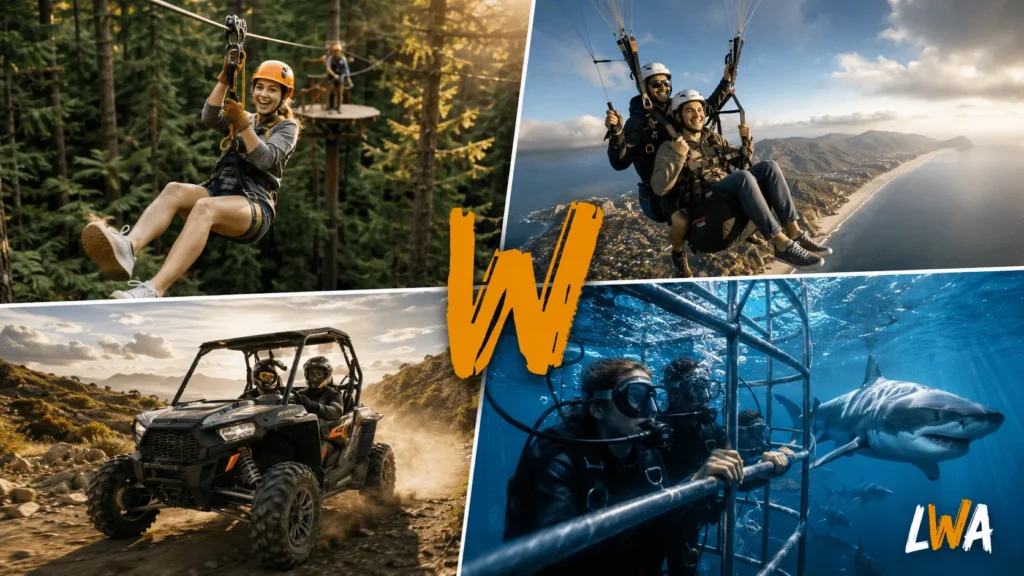
Low-Effort Adventures With More Participation
8. Ziplining
Best for: A first outdoor adventure with a clear progression.
Ziplining can be deceptively accessible.
You get the sensation of speed and height while the cable system does most of the transportation. Depending on the course, however, you may still need to climb stairs, cross obstacles, or walk between platforms.
Go Ape illustrates this difference well: its introductory Treetop Journey format is less involved than its larger Treetop Adventure courses. [S3] (Go Ape)
Physical effort: Low to moderate
Adrenaline: High
Skill: Usually beginner-friendly after instruction
For a first adventure, choose a course based on the entire course design, not simply the length of the biggest zipline.
9. Tandem Paragliding
Best for: People who want real free flight without learning to pilot first.
In tandem paragliding, the instructor controls the wing while you ride in front.
You may need to walk or run briefly during takeoff and landing, so it is not completely passive. But it requires far less conditioning and technical skill than learning to paraglide independently.
Eagle Paragliding currently advertises tandem flights with no previous experience required, while applying participant age and weight requirements. [S5] (Eagle Paragliding)
Physical effort: Low
Adrenaline: High
Skill required: None for the passenger
The major challenge is usually committing to the launch and being comfortable in an open harness high above the ground.
10. Tandem Hang Gliding
Best for: A more aircraft-like version of free flight.
Like tandem paragliding, tandem hang gliding allows a beginner to experience genuine flight while an instructor handles the technical side.
Kitty Hawk Kites currently offers beginner-friendly hang-gliding formats and lists a tandem experience at $199 plus a 6% online booking fee when checked in August 2026. [S6] (Kitty Hawk Kites)
That is an operator-specific price, not a U.S. average.
Physical effort: Low
Adrenaline: High
Technical experience: None for tandem participation
If free flight appeals to you but independent training does not, tandem formats are the logical place to start.
11. Guided UTV Ride
Best for: People who want rough terrain and speed without hiking it.
A UTV lets you cover desert, mountain, or backcountry terrain using an engine rather than your legs.
Passengers have the lowest physical workload. Drivers need more coordination and attention because terrain, steering, braking, and following the guide matter.
A current Moab operator accepts beginners and separates driver eligibility from passenger eligibility, including a driver’s-license requirement for drivers. [S10] (High Point Hummer & ATV)
Physical effort: Low
Adrenaline: Medium to high
Skill: Beginner-friendly on appropriately selected guided tours
If fitness is the limiting factor, ask whether you can ride as a passenger rather than drive.
12. Bungee Jumping
Best for: Maximum mental challenge in a very short experience.
From a fitness perspective, bungee jumping can look almost absurdly simple.
You stand. You commit. You jump.
The physical exertion is tiny compared with the psychological barrier.
That does not mean every bungee trip is low-effort overall. Access to some jump sites may involve walking or difficult terrain, so always check the full itinerary, not just the jump.
Bungee America currently lists a minimum age of 12 and participant-weight criteria for its operation. [S19] (Bungee America)
Physical effort at the jump: Low
Adrenaline: Very high
Main challenge: Commitment and fear
For pure “fear per minute of exercise,” few activities compare.
13. Shark Cage Diving
Best for: Wildlife adrenaline without needing to become a scuba diver.
Shark cage diving sounds highly specialized, but some surface-cage experiences are surprisingly accessible.
At one current Oahu operator, participants do not need previous swimming or scuba-diving experience; access involves using the boat’s ladder and handrail to enter the cage. [S13] (Oahu Shark Cage Diving)
That does not mean every shark-diving experience works this way. Some destinations use scuba equipment or different cage systems.
Physical effort: Low
Adrenaline: High
Technical training: Potentially none for surface-cage experiences
When fitness is a concern, specifically search for surface cage diving, then verify entry, ladder, swimming, and sea-condition requirements.
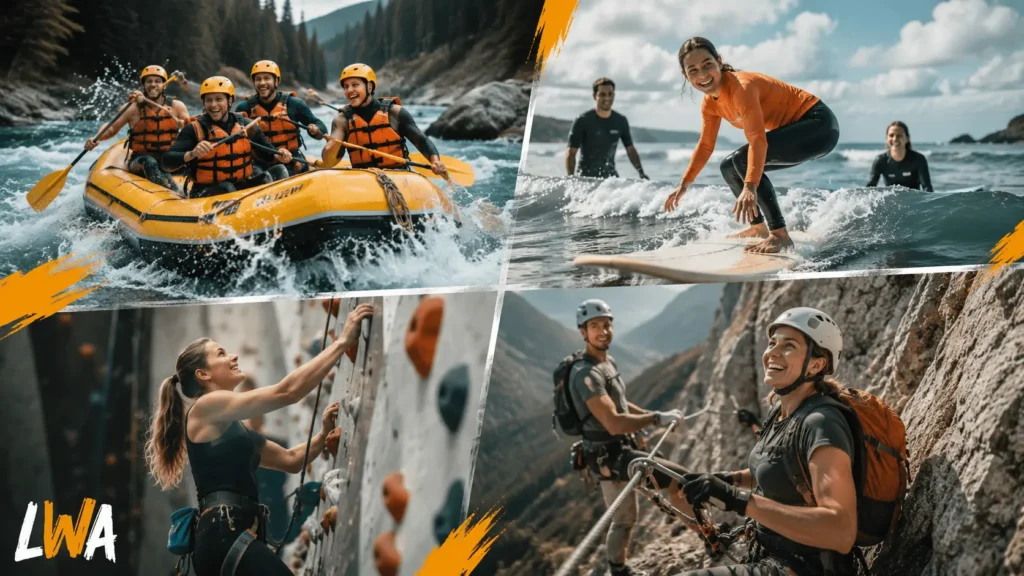
Moderate Effort, But No Extreme Fitness Needed
14. Bridge Walk
Best for: People who prefer steady movement to sudden drops.
A guided catwalk beneath a major bridge creates height exposure without jumping from anything.
Bridge Walk at West Virginia’s New River Gorge currently covers a 3,030-foot catwalk and takes about two or more hours. Guests wear a harness attached to a safety cable and follow a guide. Current pricing starts at $79, and the minimum age is 8. [S11] (Bridge Walk)
Physical effort: Moderate
Adrenaline: High if you fear heights
Technical skill: None
You need to be comfortable walking for an extended period, but this is more about composure at height than athletic ability.
15. Beginner Whitewater Rafting
Best for: Groups who want shared action rather than individual fear.
Whitewater rafting can range from gentle family trips to serious technical rivers.
If fitness is a concern, the key is selecting a guided beginner run, not simply searching for “whitewater rafting.”
Wildwater’s current guided Nantahala trip is rated mild to moderate, requires no previous experience, takes about 3.5 hours overall, and includes the raft, paddle, PFD, and paddling jacket. Its current listed price is $59.95 per person plus taxes and fees. [S12] (Wildwater)
Physical effort: Moderate
Adrenaline: Medium to high
Skill: No prior experience on an appropriate guided beginner trip
You will still paddle and follow commands, so this is not a passive ride.
16. Discover Scuba Diving
Best for: Curious beginners who want an underwater adrenaline experience before full certification.
A Discover Scuba Diving experience is designed as an introduction rather than a complete scuba certification course.
PADI currently sets the minimum age for Discover Scuba Diving at 10 and requires participants to complete a medical questionnaire; some answers may require medical clearance before participation. [S14] (PADI)
Physical effort: Low to moderate
Adrenaline: Medium to high
Technical experience: No previous scuba certification required
Fitness may not be the biggest challenge. Breathing through a regulator, equalizing pressure, being underwater, and remaining calm can matter more psychologically.
17. Beginner Surf Lesson
Best for: People willing to work a little harder for their adrenaline.
Surfing is more physical than tandem flying or a coaster, but a beginner lesson does not require you to arrive as a trained athlete.
A current Waikiki surf-school format includes safety instruction, a land lesson, warm-up, equipment, and instructor guidance. [S16] (Hans Hedemann Surf School)
Physical effort: Moderate
Adrenaline: Medium
Skill: Beginner instruction available
Expect repeated attempts, paddling, standing up, and falling.
If you want zero exertion, choose something else. If you want to finish the experience feeling that you learned a new skill, surfing becomes much more interesting.
18. Indoor Auto-Belay Climbing
Best for: A controlled introduction to climbing.
An indoor climbing gym lets you select very easy routes and stop whenever your arms or legs have had enough.
With an auto-belay, a mechanical system manages the rope while you climb. You still need orientation and must follow the facility’s procedures.
Central Rock Gym describes auto-belays as an option suitable for newcomers and publishes equipment-specific participant weight limits. [S15] (Central Rock Gym)
Physical effort: Moderate
Adrenaline: Medium
Technical barrier: Low after required orientation
This is one of the better options if you want adrenaline and a measurable personal challenge without committing to outdoor rock climbing.
19. Beginner Snowmobiling
Best for: Winter speed and scenery without skiing fitness.
Snowmobiling can cover mountain terrain without requiring you to hike or ski through it.
A beginner tour is very different from high-performance backcountry riding. Nova Guides, for example, currently separates its beginner/family snowmobile experience from its advanced high-performance tour. Its beginner tour includes a helmet, while driver and passenger age requirements apply. [S17] (Nova Guides)
Physical effort: Low to moderate
Adrenaline: Medium to high
Skill: Beginner instruction available
Driving still requires attention, steering input, and the ability to respond to changing terrain.
20. Beginner Via Ferrata
Best for: The most active reader on this list who still does not want technical climbing.
Via ferrata uses fixed cables, metal steps, ladders, bridges, and climbing protection to make steep mountain terrain accessible without traditional rock-climbing skills.
But this is where the phrase “no extreme fitness” needs context.
Basecamp Ouray describes its routes as ranging from beginner-friendly to advanced, but says participants should have a foundational level of fitness and be comfortable climbing a ladder and handling 2–3 hours of sustained activity. It strongly recommends guides for beginners. [S18] (Basecamp Ouray)
Physical effort: Moderate
Adrenaline: High
Technical experience: Beginner routes exist
This is the upper edge of this article’s fitness spectrum. If several hours of climbing and ladder movement sounds difficult, choose another activity.
What Do These Adventures Actually Cost?
There is no useful national “average price” for these activities. Location, season, duration, package level, taxes, fees, and photo packages can change the total dramatically.
These are representative examples verified in August 2026, not universal prices:
| Experience | Current Example |
| Go Ape Treetop Journey — Cleveland | $34.95 |
| Nantahala fully guided rafting | $59.95 + taxes/fees |
| Bridge Walk — New River Gorge | From $79 |
| Kitty Hawk Kites tandem hang gliding | $199 + 6% online fee |
Do not use those numbers to budget for another destination.
Before booking, compare the final checkout price, including taxes, mandatory fees, equipment, transportation, parking, and optional photo/video packages.
How to Choose Based on What Actually Scares You
Fitness is only one part of the decision.
If heights scare you
Start with:
- indoor skydiving;
- jet boating;
- beginner rafting;
- snowmobiling;
- scuba.
Then move toward ziplining or parasailing before considering skydiving or bungee jumping.
If losing control scares you
Consider:
- alpine coasters with rider-controlled braking;
- guided UTV driving;
- climbing;
- surfing.
A tandem skydive or bungee jump may feel much harder psychologically because your options become limited once the experience starts.
If water makes you nervous
Choose:
- indoor skydiving;
- ziplining;
- alpine coasters;
- bridge walks;
- helicopter tours;
- UTV tours.
If physical endurance is the main limitation
Your strongest candidates are:
- helicopter tours;
- parasailing;
- Skycoasters;
- tandem skydiving;
- alpine coasters;
- jet boats;
- indoor skydiving.
Low Fitness Does Not Mean No Restrictions
Before booking, check the operator’s current rules individually.
Requirements can include:
- minimum or maximum age;
- minimum height;
- minimum or maximum weight;
- ability to climb stairs or ladders;
- ability to enter or exit a boat;
- ability to maintain a specific body position;
- weather-related restrictions;
- pregnancy restrictions;
- medical screening;
- waivers;
- footwear or clothing requirements.
For example, the operators reviewed for this article apply very different height, weight, age, and health criteria across indoor skydiving, alpine coasters, bungee jumping, scuba, and aerial activities. (iFLY)
Never assume that being able to participate with one operator means you automatically qualify with another.
If you have a health condition or are unsure whether an activity is appropriate for you, review the operator’s current restrictions and speak with an appropriate healthcare professional.
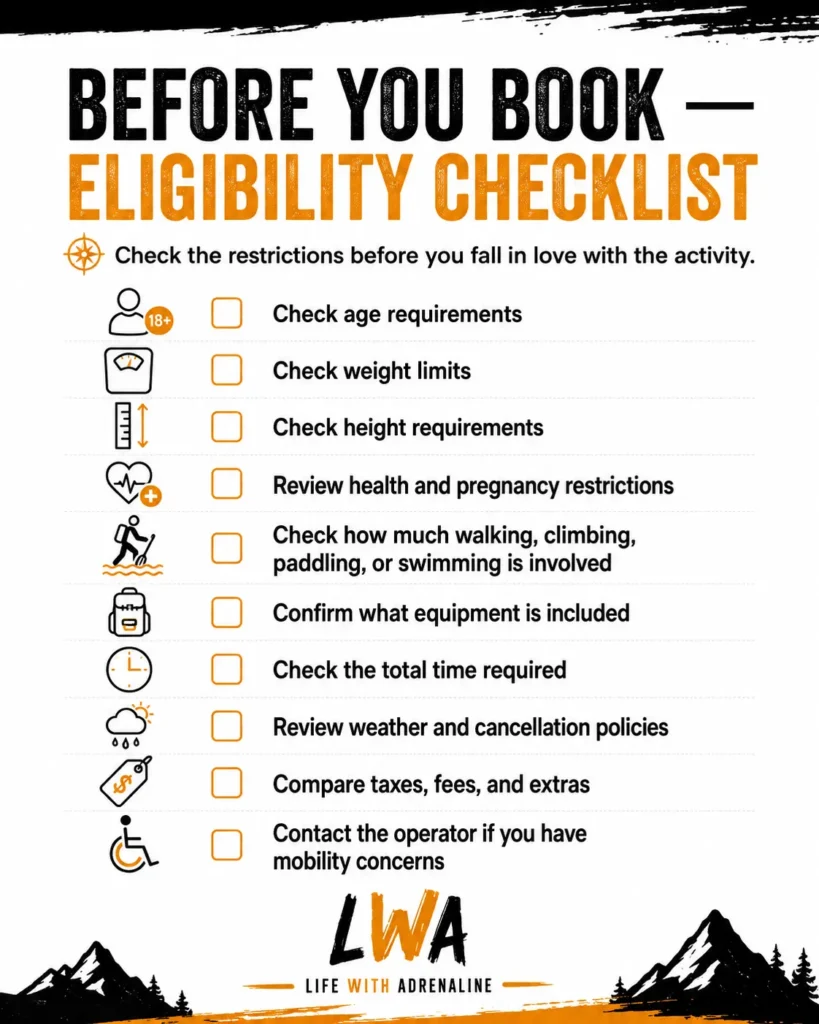
Before You Book
☐ Check the operator’s current minimum and maximum weight rules.
☐ Confirm age and height requirements.
☐ Read medical and pregnancy restrictions.
☐ Find out how much walking, climbing, paddling, or swimming is involved.
☐ Check whether reaching the activity requires a hike or difficult terrain.
☐ Verify whether equipment is included.
☐ Check the full duration, not just the active ride or flight time.
☐ Review the weather and cancellation policy.
☐ Check taxes and mandatory fees before comparing prices.
☐ Choose a beginner or tandem format when available.
☐ Tell the operator about mobility concerns before paying.
☐ Do not choose an activity simply because someone calls it “easy.”
Frequently Asked Questions
Can you do adrenaline activities without extreme fitness?
Yes, depending on the activity and your individual eligibility. Operator-controlled experiences such as parasailing, helicopter tours, indoor skydiving, jet boats, alpine coasters, and tandem aerial activities can require relatively little endurance, but operator restrictions still apply. (iFLY)
Which adrenaline activity gives the biggest thrill for the least physical effort?
For pure intensity with low exertion, tandem skydiving, bungee jumping, and giant-swing/Skycoaster experiences stand out in our editorial comparison.
That is a judgment about fear versus exertion, not a claim that one is objectively more dangerous or exciting than another.
What adrenaline activities are good if I hate heights?
Consider jet boats, whitewater rafting, snowmobiling, indoor climbing at low heights, surfing, or scuba.
Do beginner adventure activities still have weight limits?
Many do. Current examples reviewed for this article show operator-specific weight criteria for indoor skydiving, paragliding, alpine coasters, bungee jumping, helicopter operations, and other activities. (iFLY)
Always check the exact operator.
What is the best first adrenaline activity?
There is no single answer.
For a gentler start, consider:
Indoor skydiving if you are curious about flight.
Ziplining if you want height plus forward movement.
Alpine coasters if you want speed and some control.
Jet boats if you want speed without height.
Parasailing if you want a calmer first aerial experience.
Your best first adventure is the one that challenges one major fear at a time, rather than combining every fear you have into one booking.
Final Recommendation
You do not need extreme fitness to have an experience that feels extreme.
The smartest approach is to stop treating “adrenaline” and “physical difficulty” as the same thing.
A tandem skydive may require less endurance than a beginner surf lesson. A bridge walk may be physically easier than a mountain hike while feeling far more intimidating. An alpine coaster can give you speed without requiring technical ability at all.
Start by identifying what you actually want:
height, speed, freefall, water, wildlife, flight, or personal challenge.
Then choose the lowest physical-demand version that still gives you the experience you are looking for.
You can always move up the intensity ladder later.
The goal of your first adventure is not to prove how fit you are.
It is to find the kind of adrenaline that makes you want to do the next one.
Sources
Research checked August 14, 2026.
[S1] United States Parachute Association — First Skydive.
[S2] iFLY — Frequently Asked Questions.
[S3] Go Ape — Cleveland Adventure Park.
[S4] Key West Water Sports — Parasailing Adventure.
[S5] Eagle Paragliding — Tandem Paragliding.
[S6] Kitty Hawk Kites — Hang Gliding.
[S7] Royal Gorge Bridge & Park — Skycoaster.
[S8] Glenwood Caverns Adventure Park — Alpine Coaster.
[S9] Whirlpool Jet Boat Tours — FAQ.
[S10] High Point Hummer & ATV — UTV Tours.
[S11] Bridge Walk — New River Gorge Bridge.
[S12] Wildwater — Nantahala River Rafting.
[S14] PADI — Discover Scuba Diving.
[S15] Central Rock Gym — Auto Belays.
[S16] Hans Hedemann Surf School — Surf Lessons.
[S17] Nova Guides — Snowmobile Tours.
[S18] Basecamp Ouray — Via Ferrata.
[S19] Bungee America — FAQ.[S20] Maverick Helicopters — Passenger Requirements.