
If your main goal is to experience a real skydive, you do not need to try indoor skydiving first. A tandem skydive is designed to introduce first-timers to the complete experience with an instructor. But if your biggest uncertainty is the feeling of strong airflow, bodyflight, or being physically unstable in freefall, a wind tunnel can be a useful lower-commitment introduction.
The best first choice comes down to one question:
What part of skydiving do you actually want to experience — or make less unfamiliar?
Indoor skydiving can reproduce an important part of freefall: moving and stabilizing your body in powerful vertical airflow. It cannot reproduce the airplane ride, exit, real altitude, parachute deployment, canopy flight, weather, or landing that make a tandem skydive a much broader experience. [S3][S5]
That difference matters more than deciding which one is simply “better.”
Indoor Skydiving vs. Real Skydiving at a Glance
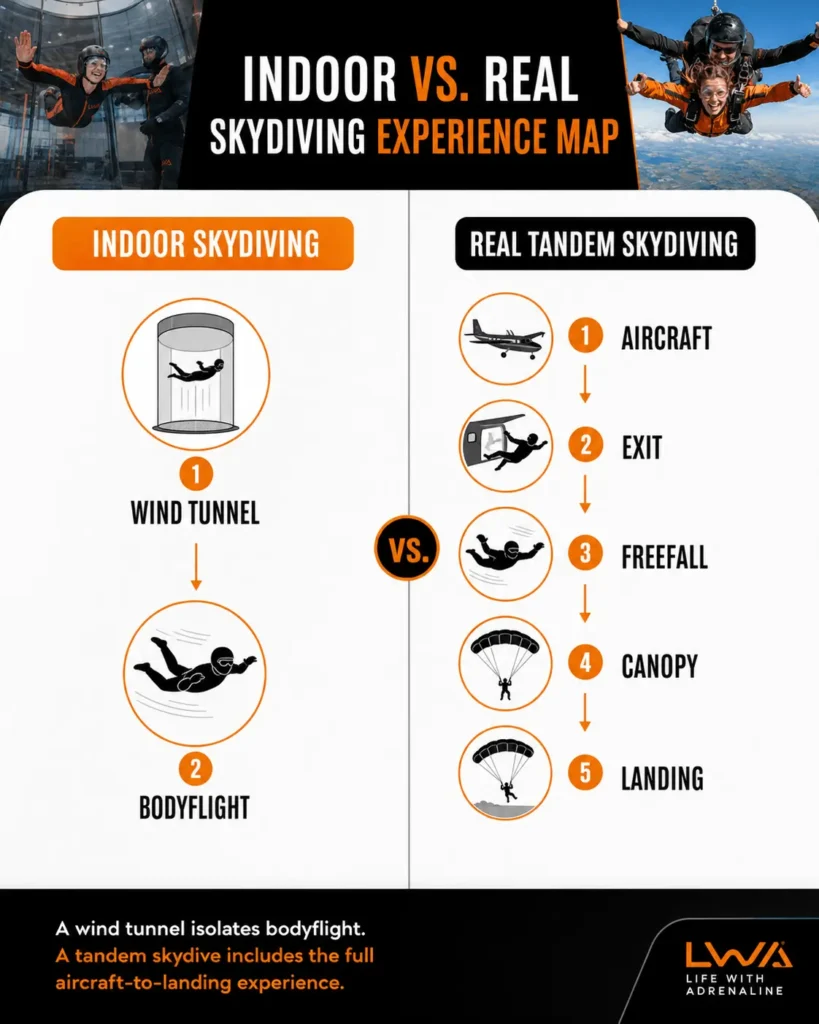
| Indoor Skydiving | Real Tandem Skydiving | |
| Environment | Vertical wind tunnel | Aircraft and open sky |
| Main sensation | Supported bodyflight in strong airflow | Freefall plus the complete parachute jump |
| Aircraft exit | No | Yes |
| Parachute ride | No | Yes |
| Weather dependence | Low | Significant |
| Repeatability | Multiple short flights can be repeated easily | Each jump requires another aircraft ascent |
| Beginner technical demand | Instructor coaches your body position | Tandem instructor manages the parachute system while you follow instructions |
| Best for | Testing bodyflight, repeated practice, lower logistical commitment | Experiencing an actual skydive |
| Typical first choice | Useful but optional preparation | Appropriate for first-time jumpers who meet the operator’s requirements |
There is no universal winner. The right answer depends on why you are interested in skydiving in the first place.
What Does Indoor Skydiving Actually Reproduce?
Indoor skydiving takes place inside a vertical wind tunnel. High-speed air moves upward through the flight chamber and supports your body, allowing you to fly in a position similar to belly-to-earth freefall.
For a beginner, this introduces several sensations that matter outdoors:
- Powerful airflow around your body.
- The need to relax rather than fight the air.
- Basic body position.
- Small movements affecting stability.
- Communicating through hand signals when normal conversation is difficult.
At iFLY, for example, first-time flights are conducted with an instructor, and each flight is typically about 60 seconds. The company says a beginner visit generally includes pre-flight training, equipment and instructor-assisted flying. [S5][S7]
That makes a tunnel particularly useful if your question is:
“What will it feel like to have that much air pushing against my body?”
It is much less useful if your real question is:
“What will it feel like to step out of an airplane several thousand feet above the ground?”
A wind tunnel cannot answer that one.
What Real Skydiving Adds That a Wind Tunnel Cannot
A tandem skydive is not simply indoor skydiving moved outside.
It is a sequence of experiences:
- Checking in and receiving instruction.
- Meeting your tandem instructor and preparing equipment.
- Boarding an aircraft.
- Climbing to jump altitude.
- Approaching and leaving the aircraft door.
- Freefalling while attached to your tandem instructor.
- Experiencing parachute deployment.
- Flying under canopy.
- Approaching the landing area.
- Landing with your instructor.
Federal tandem-skydiving regulations require qualified tandem instructors and require passengers to receive instruction covering areas including aircraft exit, freefall, parachute operation and landing. [S3]
That is why indoor flying should not be described as a complete simulation of a tandem jump.
It reproduces an important bodyflight component, not the entire experience.
If your bucket-list goal is specifically to say, “I jumped from an airplane,” a wind tunnel is not a substitute.
Does Indoor Skydiving Feel Like Real Skydiving?
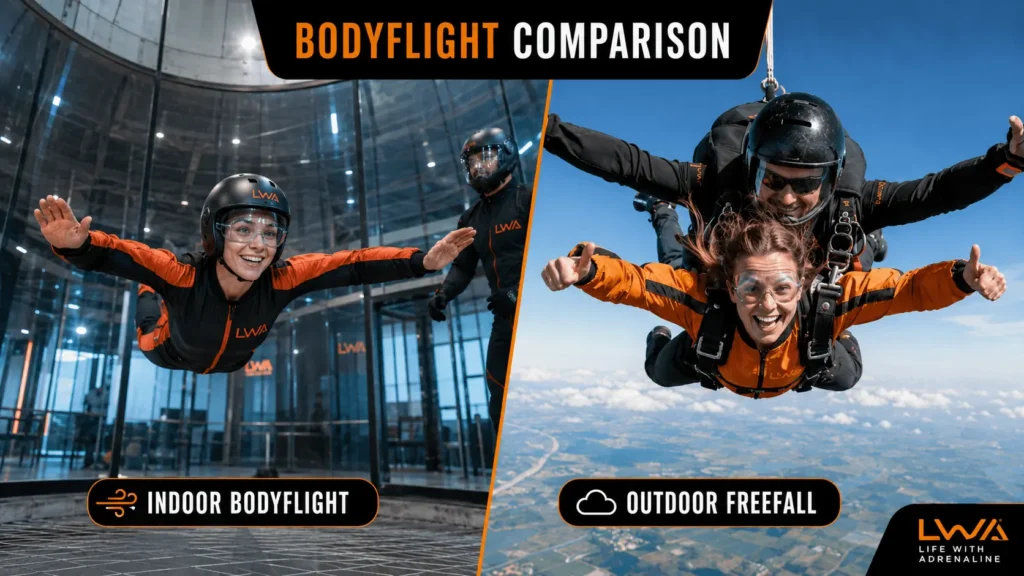
Partly.
The strongest overlap is the airflow and bodyflight.
Both environments involve air interacting with your entire body rather than simply hitting your face like wind from an open car window. Position matters. Relaxation matters. Small changes in your arms, legs and hips change how your body behaves.
But the context is completely different.
In a tunnel:
- You enter a flight chamber.
- You stay close to the floor and instructor.
- The physical environment is controlled.
- You can stop and repeat the experience.
- There is no aircraft, parachute or real altitude.
During a tandem skydive:
- You leave an aircraft.
- You are actually descending through open air.
- Your instructor deploys and operates a parachute system.
- Weather influences operations.
- The freefall is followed by canopy flight and landing.
If you want a deeper explanation of the outdoor sensation itself, see What Does Skydiving Feel Like? A First-Timer’s Guide.
Which One Feels Scarier?
There is no reliable universal answer because people are afraid of different parts of the experience.
Someone who dislikes heights may be comfortable in a wind tunnel but extremely nervous about approaching an aircraft door.
Someone else may be comfortable with the idea of altitude but dislike the feeling of not immediately knowing how to control their body in strong airflow.
This is one of the most useful reasons to separate the experiences.
Indoor skydiving removes several major psychological unknowns
There is:
- no aircraft exit,
- no real altitude exposure,
- no parachute deployment,
- and no outdoor landing.
That can make it easier to focus purely on bodyflight.
Real skydiving adds the entire commitment sequence
The anticipation starts before freefall. You check in, train, board the airplane, climb to altitude and eventually reach the point where the jump begins.
If that complete sequence is exactly what attracts you, doing a tunnel first may not add much value.
Indoor Skydiving vs. Real Skydiving Cost
There is no useful single U.S. price for either activity because prices vary by location, package and operator.
Current examples show the scale of the difference.
As of August 19, 2026, iFLY Oceanside was advertising first-time-flyer options starting at $119, with packages built around multiple short flights. [S8]
For outdoor tandem examples checked the same day:
- Skydive Perris listed a standard tandem skydive from $199. [S11]
- Skydive Arizona listed a tandem skydive at $259. [S9]

These are illustrative operator prices, not national averages.
Indoor skydiving may therefore require a lower initial spend in some markets, but that does not mean wind-tunnel training is always cheaper. Buying additional flight time or coaching can quickly change the comparison.
More importantly, you are purchasing different things.
A $119 tunnel session and a $200-plus tandem jump should not be compared only by minutes in the air. One is primarily a controlled bodyflight experience; the other includes an aircraft flight, outdoor freefall, parachute flight and landing.
For a broader look at tandem pricing, extras and realistic jump-day budgets, see How Much Does Skydiving Cost in the U.S.?.
The Time Commitment Is Different Too
A tunnel session is generally easier to fit into a fixed schedule.
iFLY’s current beginner guidance says first-time visitors should plan for roughly 90 minutes for the overall experience, including training and preparation, even though the actual flights are much shorter. [S7]
Outdoor skydiving can be less predictable.
Skydive Perris tells first-time tandem customers to expect approximately 2–4 hours, with weather and other delays potentially extending the visit. [S11]
Skydive Arizona goes further and recommends planning to spend half the day at the facility. Its FAQ makes clear that a reservation time begins the process rather than guaranteeing a specific aircraft departure time. [S10]
That difference can matter if you are traveling on a tight schedule.
Age, Weight and Health Requirements Are Not the Same
Indoor skydiving can be accessible to people who cannot currently make a tandem jump, but you should never assume one company’s restrictions apply everywhere.
For example, iFLY currently states that participants can fly from age 3, subject to its other participation requirements. It also has specific weight and medical policies, prohibits flying while pregnant and does not permit certain other conditions. [S6]
Outdoor tandem requirements vary by system, operator and participant circumstances.
Current USPA Basic Safety Requirements direct tandem jumps to follow the applicable tandem-system manufacturer’s age requirements, while individual drop zones also publish their own participation rules. [S1]
For example, both Skydive Arizona and Skydive Perris currently state a minimum age of 18 for their tandem operations, while their weight policies differ. [S10][S11]
The practical lesson is simple:
Check the exact rules of the tunnel or drop zone you intend to visit before paying.
Do not rely on a generic age or weight limit found in another article.
For a fuller explanation, see Skydiving Age, Weight, and Health Requirements Explained.
Is Indoor Skydiving Safer Than Real Skydiving?
The two activities have fundamentally different risk profiles, and simplistic numerical comparisons can be misleading.
Real skydiving is an inherently risky aviation and parachuting activity. USPA explicitly describes skydiving as involving inherent risk, even when training, equipment and good judgment are used to reduce it. [S2]
Indoor skydiving removes several major elements of an outdoor jump:
- aircraft operations,
- real-altitude freefall,
- parachute deployment,
- canopy flight,
- and outdoor landing.
But that does not mean indoor flying should be described as risk-free.
Tunnel operators still maintain medical and participation restrictions. iFLY, for example, tells people with relevant health concerns to review its restrictions and seek appropriate medical guidance where necessary. [S5][S6]
Because the activities are fundamentally different and comparable exposure-based incident data are not readily available across the two activities, this article does not assign a simplistic “X times safer” figure.
If you have a medical condition or are unsure whether either activity is suitable for you, review the operator’s current restrictions and discuss your situation with an appropriate healthcare professional.
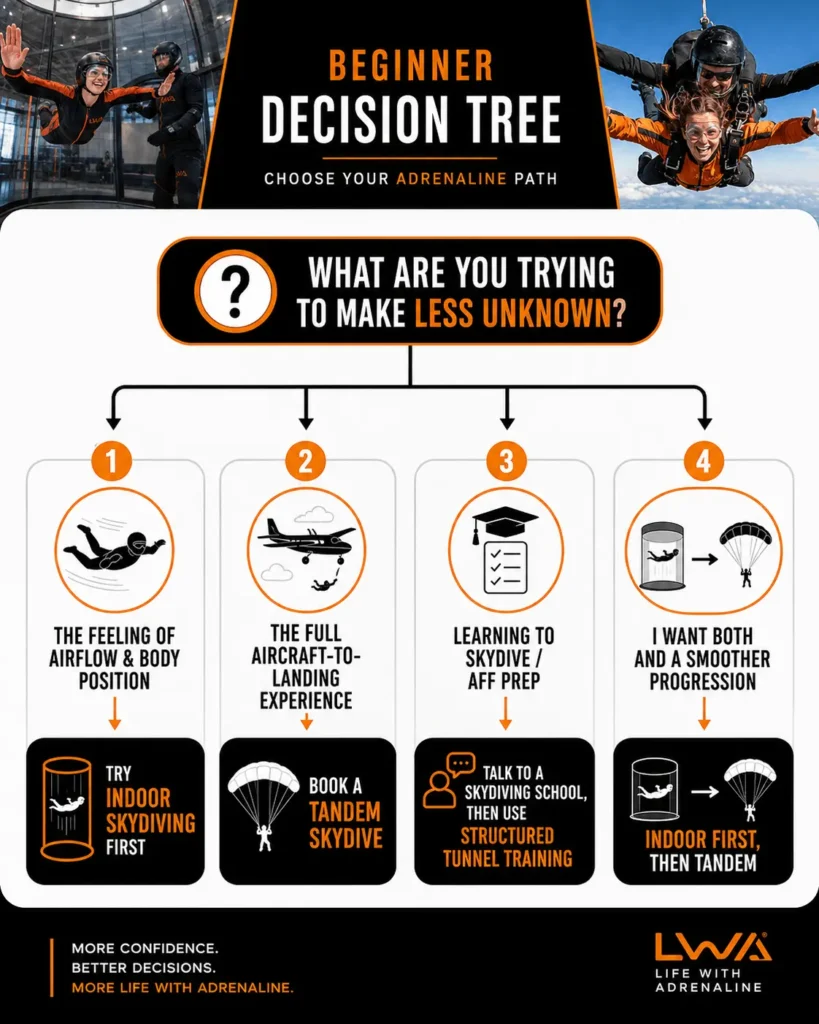
When Indoor Skydiving Is Worth Doing First
1. You are mainly nervous about the feeling of freefall
A tunnel can make the physical sensation of strong airflow less unfamiliar.
You can learn that your body is not simply passive in the air and get used to basic positioning before adding an aircraft exit and real altitude.
2. You want a lower-commitment test
If you are unsure whether you even enjoy bodyflight, an indoor session lets you answer that question without committing to an outdoor parachute jump.
3. You want repeated practice
A tandem skydive is primarily an experience.
A wind tunnel makes repetition much easier. You can fly, receive feedback, adjust and try again without another aircraft ascent.
That distinction becomes increasingly important if you care about developing bodyflight skills rather than simply completing a bucket-list jump.
4. You want to learn to skydive rather than only make one tandem
This is where wind-tunnel time can become much more strategically useful.
USPA’s current Basic Safety Requirements contain a provision under which students with documented wind-tunnel training can progress under specific AFF conditions after demonstrating required skills and meeting the applicable documentation and instructor requirements. [S1]
5. You cannot currently meet the outdoor operator’s requirements
A younger participant, for example, may be eligible for an indoor facility even when the local tandem operator will not accept them.
Again, confirm the exact facility rules rather than relying on general assumptions.
Do not assume a standard recreational indoor-skydiving package automatically counts as formal AFF preparation.
If your goal is to use tunnel time for student progression, speak with the skydiving school first. Ask what skills they want you to practice, what coaching is appropriate and what documentation is required.
When You Should Probably Go Straight to a Tandem Skydive
1. Your goal is the complete experience
If the airplane, exit, freefall, parachute ride and landing are all part of what you want, an indoor session cannot replace them.
2. You are comfortable with the commitment
You know skydiving carries inherent risk, you meet the operator’s requirements and you are comfortable signing up for a real tandem.
There is no general requirement that a first-time tandem passenger complete wind-tunnel training first.
3. You are buying indoor time only because you think you “have to”
You do not.
Tandem skydiving is specifically structured to allow a passenger to jump attached to a qualified tandem instructor after receiving the required briefing and instruction. [S3][S4]
If your sole goal is a recreational first tandem, adding a tunnel session is optional preparation, not a prerequisite.
4. Your budget only allows one experience
Choose based on the experience you actually want.
If saying “I jumped from an airplane” is the goal, spend the budget on the tandem.
If the idea of human flight and body control interests you more than the aircraft jump itself, the tunnel may give you more of what you are looking for.
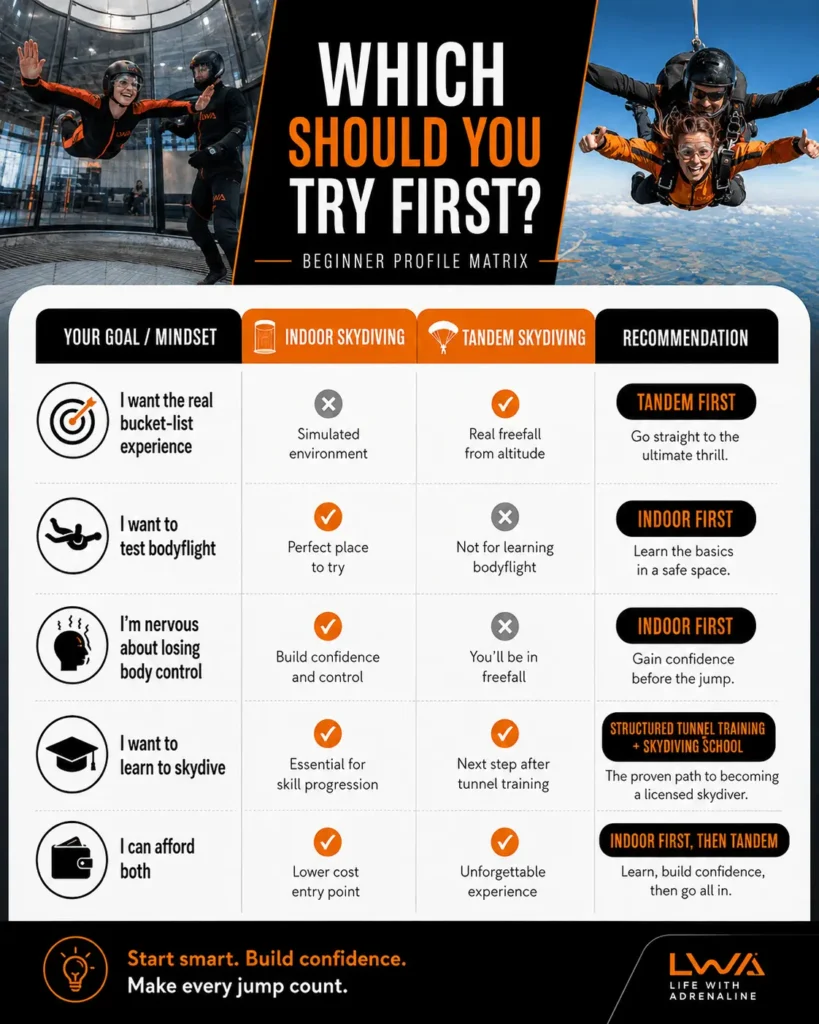
The Best Choice by Beginner Profile
| Your situation | Best first option | Why |
| “I want to skydive, and I’m ready for the real experience.” | Tandem skydive | No tunnel session is required for a standard first tandem |
| “I want to know what freefall airflow feels like before committing.” | Indoor first | Removes the aircraft and parachute while introducing bodyflight |
| “I am very nervous about losing control of my body.” | Indoor first | Allows repeatable instructor-guided practice |
| “My bucket-list goal is jumping from an airplane.” | Tandem skydive | A tunnel cannot reproduce the complete experience |
| “I want to become a licensed skydiver.” | Consider structured tunnel training | Bodyflight training can be useful, but coordinate it with your skydiving school |
| “I am below my local tandem operator’s minimum age.” | Check indoor eligibility | Some tunnel operators accept much younger participants |
| “I have limited time and cannot risk a weather delay.” | Indoor may be easier | Outdoor operations can be delayed by weather |
| “I can afford both and want the transition to feel less unfamiliar.” | Indoor, then tandem | Separates bodyflight practice from the full outdoor experience |
Before You Book Indoor Skydiving
- Check the facility’s current age and weight restrictions.
- Review health and medical restrictions.
- Confirm how many actual flight sessions or minutes the package includes.
- Check how long to allow for the entire visit, not just flight time.
- Find out whether equipment and instruction are included.
- If you are preparing for AFF, speak with your skydiving school before buying tunnel time.
- If you want photos or video, verify the additional price before checkout.
Before You Book a Real Tandem Skydive
- Check the drop zone’s current age, weight and health requirements.
- Confirm the base price and any mandatory charges.
- Decide whether you want a photo or video package.
- Read the cancellation and weather policy.
- Leave enough time in your schedule for weather or operational delays.
- Wear suitable clothing and secure footwear.
- Bring the identification required by the operator.
- Read the waiver and safety information carefully.
- Tell the operator about relevant health or mobility concerns before jump day.
FAQ
Do I need to try indoor skydiving before a tandem skydive?
No.
Indoor skydiving is optional preparation for a recreational tandem jump. Tandem operations are designed for first-time passengers and include the required pre-jump briefing and instruction. [S3][S4]
A tunnel can still be useful if you specifically want to become familiar with airflow and basic body position before your jump.
Does indoor skydiving count as a real skydive?
Not in the normal meaning of making a parachute jump from an aircraft.
It is a genuine bodyflight activity, but there is no aircraft exit, outdoor freefall, parachute deployment, canopy flight or landing.
Will indoor skydiving make my first tandem less scary?
It may make one part of it less unfamiliar: the sensation of strong airflow and maintaining a body position.
It cannot tell you how you will react to the aircraft ride, altitude, exit, parachute deployment or canopy flight.
That is why “less unfamiliar” is a better expectation than “not scary.”
Is indoor skydiving good practice for AFF?
It can be.
Wind tunnels allow repeated bodyflight practice, and current USPA rules recognize wind-tunnel training in a specific AFF progression context when the required skills, instructor involvement and documentation are present. [S1]
If AFF is your goal, coordinate the tunnel session with your skydiving school instead of simply purchasing a general entertainment package.
Which is cheaper: indoor or real skydiving?
A beginner wind-tunnel package can have a lower starting price than a tandem at some locations, but there is no universal price relationship.
As of August 19, 2026, one iFLY location checked for this article started at $119, while outdoor tandem examples checked ranged from $199 at Skydive Perris to $259 at Skydive Arizona. [S8][S9][S11]
Prices vary significantly by operator, location, package and optional extras, so compare the actual experiences available near you.
Final Recommendation
If you already know you want to experience a real skydive and you meet the operator’s current requirements, you can go directly to a tandem. Indoor skydiving is not something you need to complete first.
Choose indoor skydiving first if your biggest unknown is the physical feeling of bodyflight, you want repeatable practice, you want a lower-logistics introduction, or you are seriously considering learning to skydive.
And if you are extremely curious about both?
Doing the tunnel first and the tandem second can be a great progression — not because the first is required, but because you get to experience exactly where the similarities end and the real skydive begins.
The best first step is not automatically the more extreme one.
It is the one that answers the question you actually have.
Sources
[S1] United States Parachute Association — Basic Safety Requirements
https://www.uspa.org/sim/2-1
[S2] United States Parachute Association — How Safe Is Skydiving?
https://www.uspa.org/discover/faqs/safety
[S3] Electronic Code of Federal Regulations — 14 CFR Part 105, Parachute Operations
https://www.ecfr.gov/current/title-14/chapter-I/subchapter-F/part-105
[S4] United States Parachute Association — Category A
https://www.uspa.org/skydiveschool/a
[S5] iFLY — Frequently Asked Questions
https://www.iflyworld.com/discover/faq
[S6] iFLY — Policies
https://www.iflyworld.com/policies
[S7] iFLY — Indoor Skydiving for Beginners
https://www.iflyworld.com/blog/indoor-skydiving-for-beginners
[S8] iFLY — First-Time Flyer Booking — Oceanside
https://www.iflyworld.com/oceanside/booking
[S9] Skydive Arizona — Pricing
https://www.skydiveaz.com/pricing/
[S10] Skydive Arizona — Frequently Asked Questions
https://www.skydiveaz.com/frequentlyaskedquestions/
[S11] Skydive Perris — First Jump / Tandem Pricing
https://skydiveperris.com/prices/first-jump/