
| Direct answer: If you want one all-around pick, Copper Mountain’s Rocky Mountain Coaster is the strongest starting point in this comparison: its operator publishes a 5,800-foot track, a 430-foot vertical descent, speeds up to 25 mph, and a standalone ride option rather than forcing you into a full attraction-park day. [S2] But there is no universal winner. Smoky Mountain Alpine Coaster is better if you want a long, classic standalone ride in Pigeon Forge; Snow King’s Cowboy Coaster is the scenery pick; Anakeesta is the most interesting two-coaster comparison; and Jiminy Peak is one of the easiest places in this list to buy a relatively inexpensive single ride. |
Mountain coasters are a useful middle ground for travelers who want speed and exposure without the physical demands of hiking, climbing, or mountain biking. You ride a cart attached to a fixed track, gravity provides the descent, and a brake lever lets you manage your pace within the system’s limits. [S1] That self-control is also why the “best” alpine coaster is not automatically the fastest or the longest. Ticket structure, scenery, child rules, weather, and whether you are visiting a destination anyway can matter more than a few hundred extra feet of track. This guide compares nine U.S. options using current official information checked in August 2026, and it calls out where operators do not publish a simple static price.
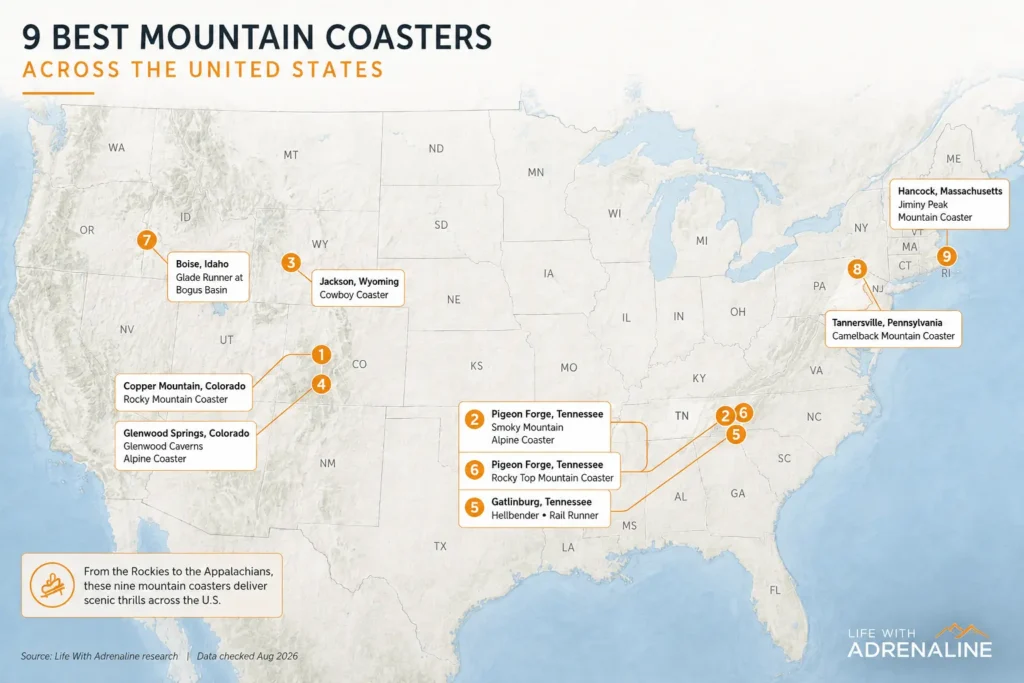
Best alpine coasters in the USA at a glance
| Rank | Coaster | Best for | Ride snapshot | 2026 price snapshot |
| 1 | Rocky Mountain Coaster — Copper Mountain, CO | Best overall balance | 5,800 ft; 430 vertical ft; up to 25 mph | 2026 single ride: $30; new Copper Card may add $5 [S2] |
| 2 | Smoky Mountain Alpine Coaster — Pigeon Forge, TN | Best classic standalone long ride | More than 1 mile; about 7–8 min | Current static price not verified on official page; check direct [S3] |
| 3 | Cowboy Coaster — Jackson, WY | Best scenery | Nearly 1 mile; 456-ft ascent | Driver $35; passenger $20 [S9] |
| 4 | Glenwood Caverns Alpine Coaster — Glenwood Springs, CO | Best history + full park day | About 3,400 ft; first U.S. Alpine Coaster claim | Summer Funday $79.99 online + $1.50 fee; coaster included [S11][S12] |
| 5 | Hellbender + Rail Runner — Anakeesta, TN | Best two-coaster comparison | 3,350 ft + 1,600 ft; both up to 25 mph | Coaster Pass add-on $16.99 May–Dec 2026; general admission required [S7][S8] |
| 6 | Rocky Top Mountain Coaster — Pigeon Forge, TN | Best long ride time / night ride | Over 9 min; four uplifts; up to 30 mph | Adult $18.99 + tax; eligible kids $9.99 + tax [S5][S6] |
| 7 | Glade Runner — Bogus Basin, ID | Best Northwest mountain-resort option | 4,330 ft / 0.9 mi; up to 27 mph | Sold through current Bogus Basin ticket products; verify at checkout [S13] |
| 8 | Camelback Mountain Coaster — Tannersville, PA | Best Poconos option | Up to 25 mph; Pennsylvania’s only mountain coaster claim | Advance online purchase required; price can vary by product/date [S14] |
| 9 | Jiminy Peak Mountain Coaster — Hancock, MA | Best straightforward single-ride value in New England | Thousands of feet; up to 23 mph | 2026 window single ride: $19 (54+ in.) / $14 (38–53 in.) [S15][S16] |
Price note: “check direct” or “verify at checkout” is intentional where an official public page did not expose a stable, current single-ride price. Prices and hours can change without notice.
How we chose the best alpine coasters in the USA
This is not a laboratory ranking. There is no independent national database that scores every U.S. mountain coaster on the same measurement standard, and operators do not all publish the same fields. We therefore weighted six practical questions: how substantial the ride is, how much control the rider has, scenery, ticket friction, family eligibility, and whether the attraction is currently presented as operating. We also favored official operator or manufacturer information over recycled listicles.
That last point matters. A current Destination Deals roundup still lists Wisp Resort’s Mountain Coaster as open year-round, while Wisp’s own 2026 page says the coaster is closed until further notice because of maintenance. [S17][S19] Wisp is therefore not ranked as a current recommendation here. This is exactly why operating status belongs in a 2026 buyer’s guide rather than in a generic ‘best coasters’ list.
Alpine coaster vs. mountain coaster vs. alpine slide
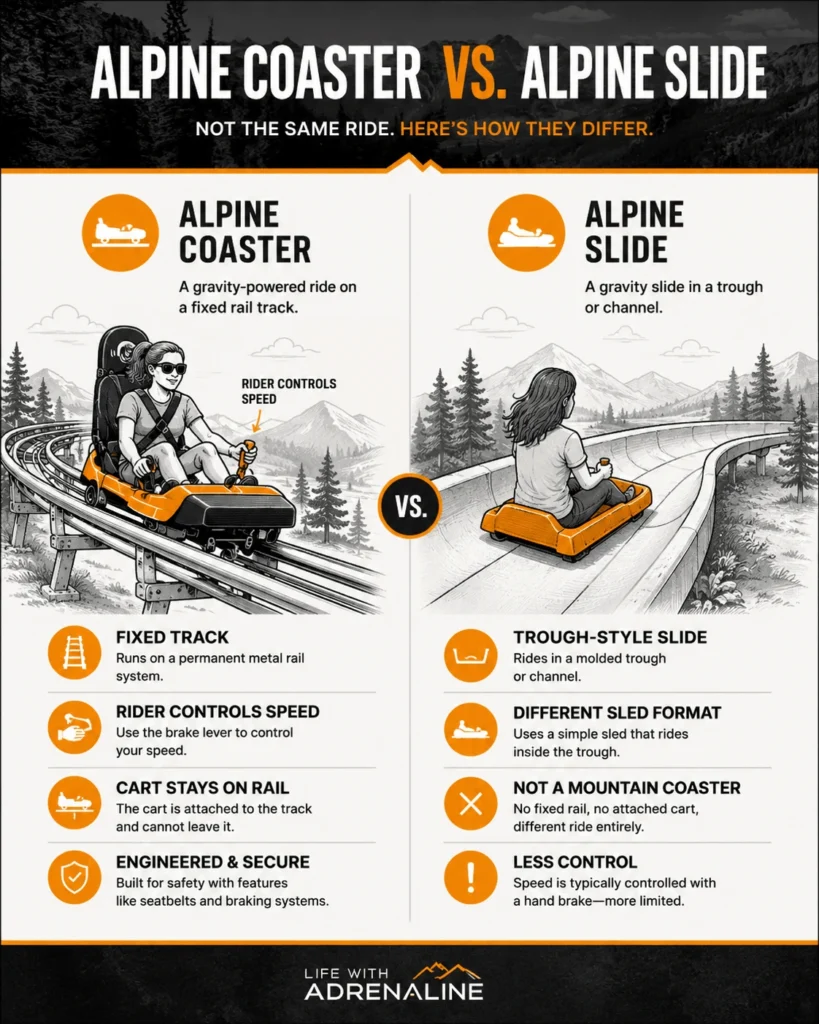
In U.S. travel marketing, “alpine coaster” and “mountain coaster” are often used for the same general experience: a gravity-driven cart attached to a fixed rail system, with the rider controlling speed using a brake. Wiegand, one of the best-known manufacturers, describes its Alpine Coaster as track-guided and all-weather, with independent speed control. [S1] You are controlling speed, not steering the cart off the track.
An alpine slide is different. The sled runs in a trough rather than being fixed to a rail. Wiegand explicitly separates its track-guided Alpine Coaster from its summer toboggan-run concept. [S1] That distinction matters when you compare weather tolerance, rider instructions, and the feel of the ride. For example, Jiminy Peak has both a mountain coaster and an alpine slide; its 2026 park page warns that any moisture can close the alpine slide, while the coaster is a separate attraction. [S16]
1. Rocky Mountain Coaster at Copper Mountain, Colorado — best overall
Copper Mountain publishes one of the clearest spec-and-price combinations in this group. The Rocky Mountain Coaster is 5,800 feet long, drops 430 vertical feet, can reach 25 mph, and is promoted for both summer and winter operation. [S2] That makes it a strong destination coaster without requiring the reader to rely on an old third-party measurement.
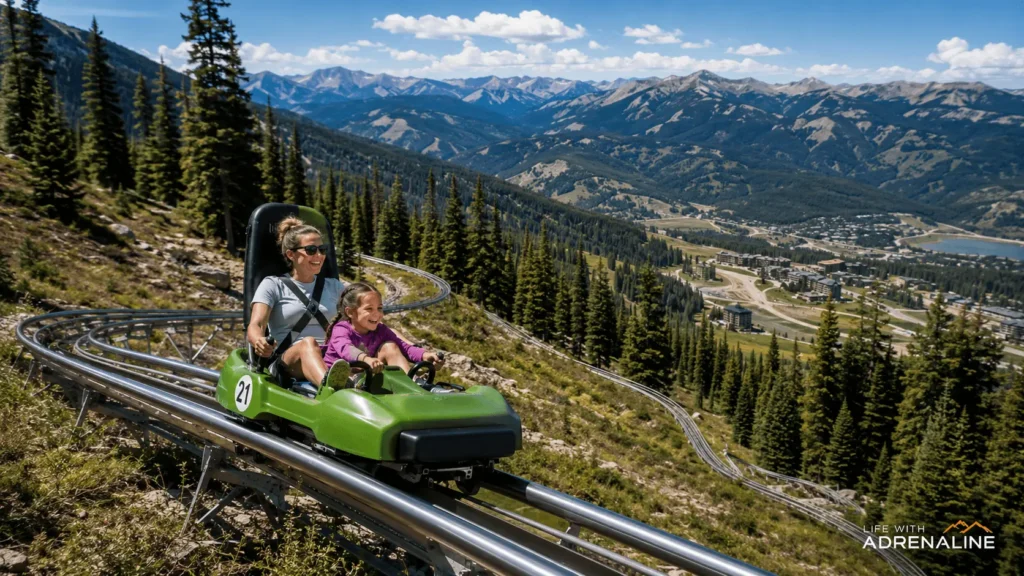
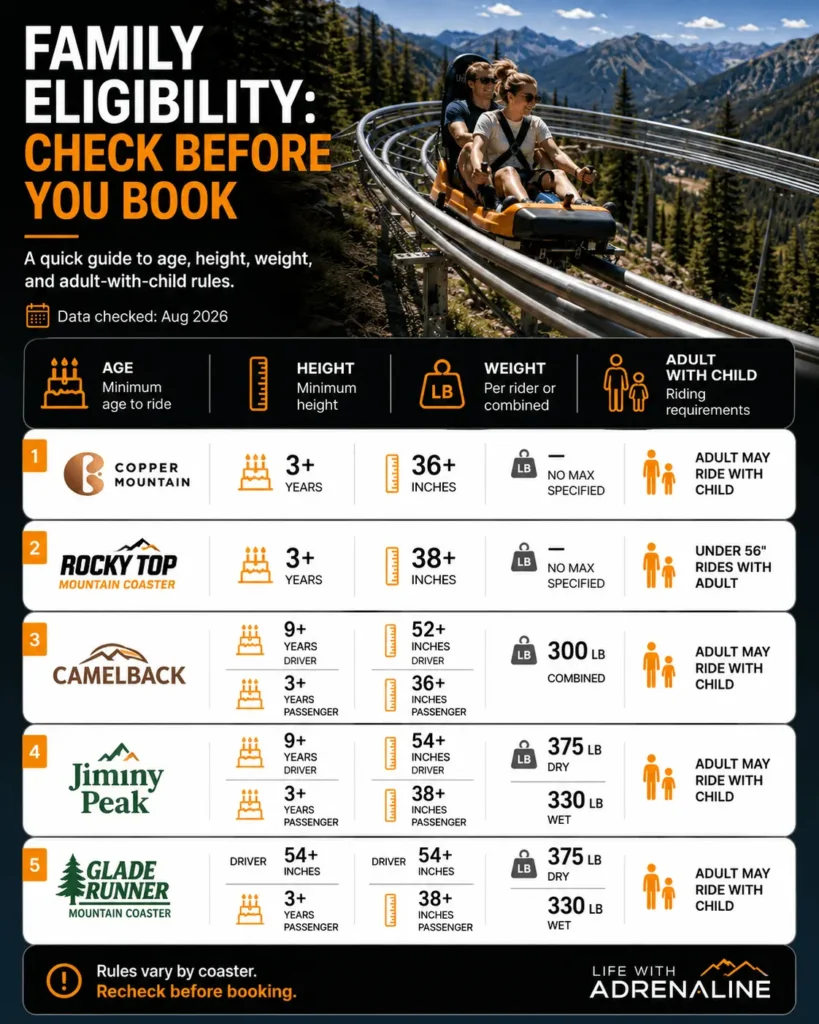
It also works well for travelers who want one ride rather than an entire adventure-park package. Copper’s 2026 single-ride price is $30, with a $5 Copper Card charge for guests who need a new card. A paying adult can take an eligible child passenger, and the operator currently lists a minimum passenger age of 3 and height of 36 inches. Tickets are limited and weather dependent. [S2]
Who should choose it: couples, older kids, ski-trip add-ons, and first-time coaster riders who want a substantial track but still control their pace. The main limitation is destination cost: Copper Mountain is a resort, so transportation and lodging can easily matter more than the coaster ticket itself.
2. Smoky Mountain Alpine Coaster, Tennessee — best classic standalone long ride
Pigeon Forge has enough mountain coasters to make a full comparison trip possible, but Smoky Mountain Alpine Coaster remains one of the most straightforward choices. Its official FAQ describes a ride of more than a mile that lasts about seven to eight minutes, with riders controlling their own speed. [S3] Because the lift and descent are part of one continuous attraction, the experience feels longer than a short resort add-on.
Family rules are typical of this category but still need checking before you arrive. The operator states that solo riders must reach the published height threshold, while younger passengers can ride with a qualified driver; wet and dry combined weight limits also apply. [S3] Its guidelines exclude some riders for medical or pregnancy-related reasons and stress that riders must be able to control their bodies and follow instructions. [S4]
The pricing caveat is important: the official pages we checked did not expose a current static dollar price that could be verified reliably. Rather than copy an older blog price into a 2026 guide, this article treats the price as ‘check direct.’ That is less convenient, but more useful than false precision.
3. Cowboy Coaster at Snow King Mountain, Wyoming — best scenery
Snow King sits directly above Jackson, and the Cowboy Coaster uses that location well. Its current store describes nearly a mile of loops, curves, and drops, a 456-foot ride up the mountain, and views toward the Tetons. [S9] If your priority is a coaster that feels integrated into a major Western destination rather than a roadside attraction, this is one of the strongest options in the list.
The 2026 store currently lists a single-ride driver ticket at $35 and a passenger ticket at $20. [S9] That is easy to understand, but it is not necessarily the lowest-cost family choice once multiple riders are involved. Snow King also sells broader summer activity products, so compare the single ride with any pass you were already considering.
Who should choose it: Jackson visitors, couples who value scenery, and travelers building a Grand Teton or Yellowstone-area itinerary. Its biggest advantage is location; its biggest drawback is that Jackson can be an expensive destination, so the total trip budget is very different from a quick Pigeon Forge stop.
4. Glenwood Caverns Alpine Coaster, Colorado — best for history and a full park day
Glenwood Caverns says its Alpine Coaster was the first Alpine Coaster in the United States and traces the ride to 2005. Operator materials describe about 3,400 feet of track through the mountain setting. [S12] That history gives it a legitimate reason to make a national list even though it is not the longest option here.
The value calculation is different from a standalone coaster. In summer 2026, the park’s online Summer Funday ticket is $79.99, with an $84.99 gate price and a $1.50 online processing fee per item. The ticket includes the Alpine Coaster along with other thrill and family rides. [S11] If you only want one coaster run, that is expensive. If you want the gondola, caves, and multiple rides, the bundled format becomes much easier to justify.
This is a good example of why ‘alpine coaster prices’ cannot be compared as if every attraction sells the same product. Glenwood is best treated as a mountain adventure-park day with a coaster inside it, not as a $20 roadside ride.
5. Hellbender and Rail Runner at Anakeesta, Tennessee — best two-coaster comparison
Anakeesta is the most interesting choice if you want to feel two different coaster formats in one destination. Hellbender has 3,350 feet of track, seven major turns totaling a 240-foot drop, and speeds above 25 mph according to the operator. [S7] Rail Runner is a single-rail design with 1,600 feet of downhill track, more than 400 feet of elevation change, and speeds up to 25 mph. [S8]
The catch is ticket structure. Anakeesta does not sell individual coaster tickets. Its Coaster Pass lets you ride each coaster once or one coaster twice. The operator states that the pass was included with general admission from March through May 2026 and is a $16.99 add-on from May through December 2026; general admission is still required. [S7]
That makes the ride cost attractive only if Anakeesta itself is part of your plan. For a Gatlinburg visitor who wants a mountaintop day, the two-coaster contrast is hard to replicate. For someone driving in only for a coaster, a standalone Pigeon Forge attraction may be simpler and cheaper overall.
6. Rocky Top Mountain Coaster, Tennessee — best for long ride time and night rides
Rocky Top’s appeal is not a record claim; it is the amount of time and variation packed into one ride. The operator describes an experience lasting more than nine minutes, spread across more than 20 acres, with four uplifts, tunnels, 360-degree turns, and sled speeds up to 30 mph. [S6] It also actively promotes night rides, which can make a repeat run feel different from the daytime version.
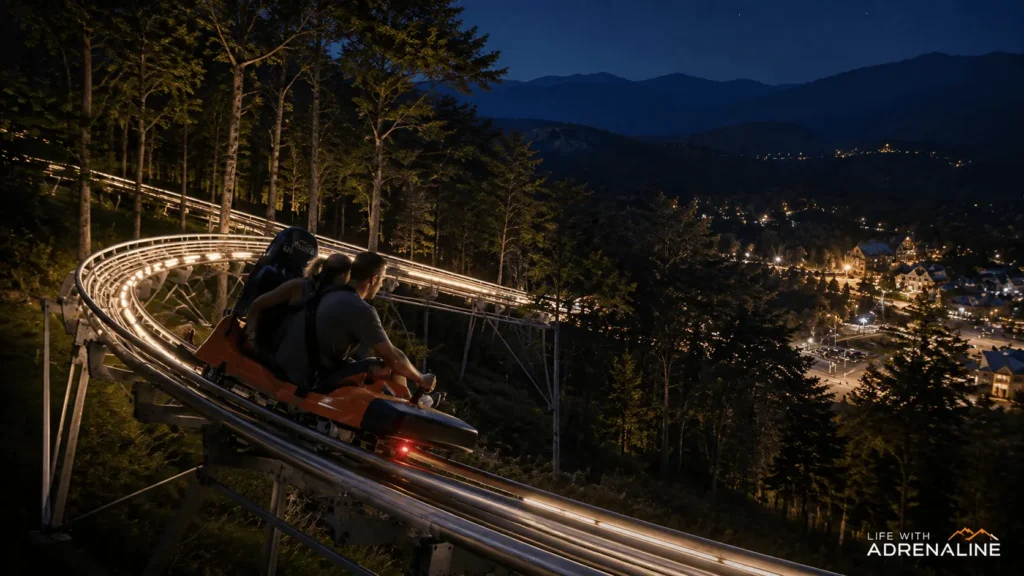
Current pricing is unusually transparent. The posted ticket page lists $18.99 plus tax per person, $9.99 plus tax for eligible kids ages 3–9 who are at least 38 inches tall, and a $9.99 second ride. [S5] Current posted hours extend later on Friday and Saturday, but hours can change seasonally.
For families, check the exact pairing rules before buying. The home page says riders must be at least 3 years old and 38 inches tall, and riders under 56 inches must ride with an adult. [S6] Weather can also interrupt coaster operations, especially thunderstorms or heavy rain.
7. Glade Runner at Bogus Basin, Idaho — best Northwest mountain-resort option
Bogus Basin’s Glade Runner is an easy coaster to overlook in national roundups, but its official numbers are competitive. The operator publishes 4,330 feet of track, a 0.9-mile track distance, and a top speed of 27 mph. [S13] It is also promoted as Idaho’s only mountain coaster.
The rider rules are clearly stated: solo riders must be at least 54 inches tall; children at least 3 years old and 38–54 inches tall can ride with a qualified driver; and the sled’s maximum weight is 375 pounds in dry conditions or 330 pounds when wet. Pregnancy, alcohol use, and casts are among the restrictions. A liability waiver is required. [S13]
Bogus Basin sells the coaster through its current activity-ticket system rather than presenting a stable single dollar figure on the public informational page we verified. Treat the checkout price as the current source of truth. This is a particularly good option for Boise-area travelers who already want a summer mountain day rather than a coaster-only detour.
8. Camelback Mountain Coaster, Pennsylvania — best Poconos option
Camelback markets its ride as Pennsylvania’s only mountain coaster. The current operator page says riders control their own speed and can reach up to 25 mph. [S14] Its location in the Poconos makes it one of the more practical options for travelers coming from the New York City or Philadelphia regions.
The important planning detail is that Camelback requires Mountain Adventures tickets to be purchased online in advance. The operator also requires a waiver and closed-toe shoes with a secured back strap. Current driver rules include a minimum age of 9, a minimum height of 52 inches, and a 300-pound combined cart limit; passengers can be as young as 3 and at least 36 inches tall. [S14]
Camelback’s online ticket products can vary by date and package, so we are not freezing a single price into this guide. That is a case where a live checkout is more accurate than a static article. Buy only after confirming the date, activity package, and weather policy that apply to your visit.
9. Jiminy Peak Mountain Coaster, Massachusetts — best simple single-ride value in New England
Jiminy Peak describes its coaster as the first of its kind on the East Coast, with thousands of feet of fixed track and rider-controlled speeds up to 23 mph. The resort says the coaster operates year-round. [S15] Its Berkshires setting makes it a natural add-on to a New England weekend rather than a destination that requires a major Western mountain trip.
The 2026 pricing is a major reason it earns a place here. A single ride purchased at the ticket window is $19 for riders 54 inches and taller and $14 for riders 38–53 inches. The resort also sells a six-ride book and a full Mountain Adventure Park ticket. [S16] If your goal is simply to try a mountain coaster once, that single-ride option is unusually easy to understand.
Solo riders must be at least 9 years old and 54 inches tall. Passengers must be at least 3 years old, 38 inches tall, and 45 pounds, with a qualified ticketed driver; dry and wet sled weight limits are 375 and 330 pounds. [S15]
What alpine coaster prices really mean in 2026
The cheapest number on a website does not always equal the cheapest experience. In this list, Rocky Top and Jiminy Peak sell clear single rides; Copper also sells a single ride but may require a new reusable card; Snow King separates driver and passenger prices; Anakeesta makes the coaster an add-on to general admission; and Glenwood bundles the coaster into a much broader park ticket. [S2][S5][S7][S9][S11][S16]
Before you compare prices, ask what the ticket actually buys. Does it include one person or a tandem cart? Is general admission mandatory? Do you need a gondola or park pass to reach the ride? Is parking extra? Does the ticket include repeat rides? Is a processing or RFID/card fee added? A $16.99 coaster add-on can cost more in total than a $30 standalone ride when admission is required first.
For a family of four, total attraction cost can also change depending on which children qualify as passengers versus independent drivers. Always run the exact family combination through the operator’s current rules and checkout rather than multiplying an adult headline price by four.
Which coaster is best for families and first-timers?
For nervous first-timers, the key feature is not the posted maximum speed. It is the ability to brake and choose a slower pace, combined with a track system that keeps the cart on the route. [S1] A confident rider may allow the cart to run close to the system’s limit; a cautious rider can usually brake more, subject to the operator’s instructions about spacing and minimum movement.
For families, height and age rules are the real filter. Many attractions in this guide allow passengers around age 3 once they meet a minimum height, but the required age and height for the driver vary. Camelback, for example, uses a 9-year/52-inch minimum for drivers, while Jiminy Peak uses 9 years/54 inches. [S14][S15] The person driving a younger passenger often has a higher age requirement as well.
Do not assume that a child who rode one mountain coaster will automatically qualify for another. Wet-weather weight limits, passenger height, driver age, and combined-cart limits differ by attraction. Check the operator page again shortly before the trip.
Safety and medical considerations
Mountain coasters are controlled attractions, but they are still moving rides on mountain terrain. Braking responsibility, following distance, seating position, restraints, weather, and the rider’s ability to follow instructions all matter. The category should not be described as risk-free. Wiegand’s system includes track guidance and multiple safety components, while individual operators add their own procedures and restrictions. [S1]
Common restrictions in the official pages reviewed include pregnancy, some back or neck problems, certain heart conditions, intoxication, casts, inability to control the body or braking lever, and weight limits that can be lower in wet conditions. [S4][S13][S14][S15] These are not universal rules; they are examples of why you must read the specific attraction’s current requirements.
If you have a medical condition, recent injury, mobility limitation, or concern about whether you can safely use the brake and remain seated in the required posture, review the operator’s current restrictions and discuss the activity with an appropriate healthcare professional. This article cannot determine individual medical suitability.
A current closure that shows why status checks matter
Wisp Resort in Maryland is a good case study in stale travel content. Its official 2026 Mountain Adventures page currently states that the Mountain Coaster is closed until further notice because of maintenance. The same page still publishes the ride’s specifications — 1,300 feet uphill, 3,500 feet downhill, 350 vertical feet, and an approximately 25 mph governed speed — but the operating-status notice controls the planning decision. [S17]
At least one current-looking national roundup still describes Wisp as a year-round active coaster. [S19] We are therefore leaving Wisp out of the ranked recommendations until the operator removes the closure notice. If it reopens, it should be reassessed rather than automatically restored to a list based on its old specifications.
Before you book: 10-point checklist
- Confirm the coaster is operating on your exact date, not just ‘open year-round’ in general.
- Check whether the ride requires general admission, a gondola, an RFID card, or an activity pass.
- Verify the current 2026 price at checkout and look for taxes or processing fees.
- Match every child to the current age and height rule for passenger or solo-rider status.
- Check combined cart weight limits, including lower limits that may apply in wet conditions.
- Read the operator’s medical, pregnancy, mobility, footwear, and loose-item restrictions.
- Check weather and closure policies on the morning of your visit.
- Decide whether one ride is enough or a repeat-ride/pass product is better value.
- For resort coasters, compare parking, lodging, and transportation costs with the ride ticket.
- If a ‘longest’ or ‘fastest’ claim matters to you, verify what the operator is actually measuring before booking.
FAQ
What is the longest alpine coaster in the USA? There is no clean answer that should be stated as an uncontested national record from the sources reviewed. Copper Mountain publishes 5,800 feet and calls its ride the second-longest alpine coaster in North America, while Smoky Mountain Alpine Coaster uses its own ‘longest downhill ride’ language and publishes a ride of more than a mile. [S2][S3] Different operators may count total rail, downhill rail, uplifts, or historical rides differently. Compare published measurements rather than relying on one slogan.
Do mountain coasters let you control the speed? Yes, rider-controlled braking is a defining feature of the standard alpine-coaster format. The manufacturer and the operators in this guide repeatedly describe manual braking or rider-controlled speed. [S1] You still have to follow the operator’s instructions and any system limits.
Are alpine coasters open in winter? Some are designed or marketed for year-round or winter operation, including Jiminy Peak and Copper Mountain, but actual operating days depend on weather, maintenance, and the resort calendar. [S2][S15] Always check the date-specific status.
Can a 3-year-old ride a mountain coaster? At several attractions, yes, if the child also meets the minimum height and rides with a qualified driver. Examples include Rocky Top, Bogus Basin, Camelback, and Jiminy Peak. [S6][S13][S14][S15] The exact pairing rules vary, so age alone is not enough.
Is an alpine coaster the same as an alpine slide? No. A typical Alpine Coaster uses a cart guided by a fixed track, while an alpine slide/summer toboggan run uses a different sled-and-trough setup. [S1] Some resorts offer both, so check the attraction name before buying.
Which destination has the most useful coaster variety for one trip? The Gatlinburg/Pigeon Forge area is the strongest choice in this guide if the goal is to compare several coasters without major drives between them. Anakeesta alone offers two distinct rides, while Smoky Mountain Alpine Coaster and Rocky Top add different standalone formats nearby. [S3][S6][S7][S8]
Final recommendation
Choose Copper Mountain if you want the best all-around mix of substantial track, transparent current specs, rider control, and a standalone ticket. Choose Smoky Mountain Alpine Coaster for a classic long standalone ride; Snow King for the Jackson/Teton setting; Glenwood Caverns for a full adventure-park day; Anakeesta for two different coaster formats in one destination; Rocky Top for a long, varied ride and night option; Glade Runner for Boise-area mountain access; Camelback for a Poconos trip; and Jiminy Peak for an easy single-ride option in New England.
The practical rule is simple: book the coaster that fits the trip you are already taking, not the one with the loudest record claim. A self-controlled mountain coaster is usually a short part of a larger destination day. The right choice balances the ride itself with admission structure, child eligibility, weather, and the real total cost.
Sources
[S1] Alpine Coaster — product information and FAQ — Josef Wiegand GmbH & Co. KG. https://www.wiegandslide.com/en/products/alpine-coaster.html
[S2] Rocky Mountain Coaster — Copper Mountain. https://www.coppercolorado.com/events-activities/summer-activities/coaster/
[S3] Frequently Asked Questions — Smoky Mountain Alpine Coaster. https://www.smokymountainalpinecoaster.com/faq.html
[S4] Guidelines — Smoky Mountain Alpine Coaster. https://www.smokymountainalpinecoaster.com/guidelines.html
[S5] Tickets — Rocky Top Mountain Coaster. https://www.rockytopcoaster.com/tickets
[S6] Rocky Top Mountain Coaster — Home — Rocky Top Mountain Coaster. https://www.rockytopcoaster.com/
[S7] Hellbender Mountain Coaster — Anakeesta. https://anakeesta.com/hellbender/
[S8] Rail Runner — Anakeesta. https://anakeesta.com/rail-runner/
[S9] Cowboy Coaster — Snow King Mountain. https://store.snowkingmountain.com/en/catalogue/category/210-summer-activities/240-cowboy-coaster_390/
[S10] Alpine Coaster — Glenwood Caverns Adventure Park. https://www.glenwoodcaverns.com/thrill-rides/alpine-coaster/
[S11] Tickets, Annual Passes & Park Info — Glenwood Caverns Adventure Park. https://www.glenwoodcaverns.com/park-info/tickets/
[S12] Alpine Coaster facts / media information — Glenwood Caverns Adventure Park. https://www.glenwoodcaverns.com/media/
[S13] Glade Runner Mountain Coaster — Bogus Basin Mountain Recreation Area. https://bogusbasin.org/your-mountain/things-to-do/mountain-coaster/
[S14] Mountain Coaster — Camelback Resort. https://www.camelbackresort.com/mountain-adventure-park/mountain-coaster
[S15] Mountain Coaster — Jiminy Peak Mountain Resort. https://www.jiminypeak.com/summer/attractions/mountain-coaster/
[S16] Mountain Adventure Park — Summer 2026 Pricing — Jiminy Peak Mountain Resort. https://www.jiminypeak.com/summer/attractions/mountain-adventure-park/
[S17] Mountain Adventures — Wisp Resort. https://www.wispresort.com/activity/mountain-adventures/
Editorial note: Source IDs in the article refer to the official sources above. Operator record claims are attributed rather than treated as independently verified national records.