What Does Bungee Jumping Feel Like? A First-Timer’s Guide
If you are considering your first bungee jump, the hardest part to imagine may not be the height. It is what happens in the few moments after your feet leave the platform. Will your stomach drop? Will the cord suddenly yank you? Will you feel frightened the whole time?
A bungee jump can feel like a quick switch from anticipation to falling, followed by the growing resistance of the elastic cord, an upward rebound, and a series of smaller movements before recovery. But there is no single sensation everyone experiences. Your position, jump style, equipment, setting, and response to fear all affect how those moments feel.
This guide walks through the experience in order, separates the physics from personal impressions, and helps you decide whether you actually want to try it.
The Short Answer: What Does Bungee Jumping Feel Like?
The first moment can feel strangely unsupported: the solid platform is gone and you begin moving downward. Some jumpers describe a stomach-drop sensation similar to a roller coaster; others notice the rushing air or the sight of the landscape moving first. As the bungee cord stretches, it progressively resists the fall. You slow, reverse direction, rebound upward, then descend into smaller oscillations.
The psychological part may be just as memorable as the movement. Waiting at the edge can feel intense. The fall may be over before you have time to put the sensation into words. Afterwards, you might feel excited, relieved, shaky, quiet, or some combination of those feelings. None of those outcomes is guaranteed.
What It Feels Like, Stage by Stage
1. Before the jump: the anticipation
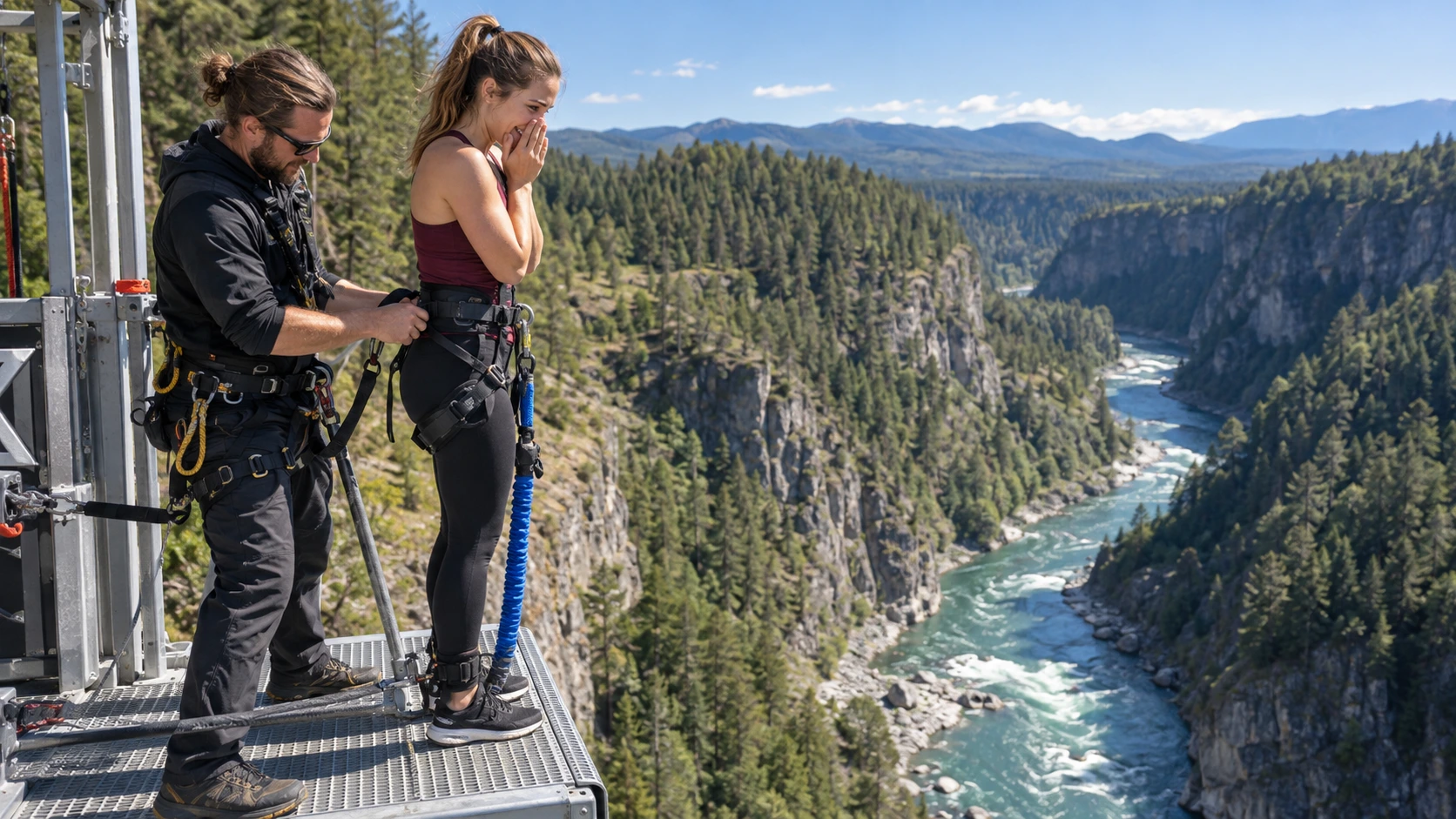
The experience starts before you leave the platform. You may notice the height more clearly as you approach the edge, hear staff instructions, and become very aware that you are about to step into open space. Some people feel eager. Others hesitate. There is no reliable way to predict your reaction from how confident you normally feel.
Before this point, a commercial operator should have explained its procedure and checked your eligibility and equipment. For example, Great Bungee describes a group briefing covering jump instructions, retrieval and jump options, followed by harnessing. Bungee America describes a more extended Jump School as part of its Bridge to Nowhere day.
If your fear makes it difficult to follow instructions, tell the staff. You do not have to prove anything by jumping. Ask how the operator handles someone who decides not to proceed and what its cancellation policy means for your booking.
2. Leaving the platform: the missing support
A distinctive part of the jump is the transition from standing on a solid surface to moving through the air. As you step or jump off using the technique staff have approved, the platform stops supporting your body. For some people, that creates the familiar stomach-drop feeling associated with a sudden descent.
It is reasonable to expect a powerful change in perspective, but not a universal dramatic scream or a specific feeling of weightlessness. The exact sensation depends on the beginning of the jump and the participant. You may be more focused on breathing, sound, or the scenery than on your stomach.
3. The fall: speed, air and changing perspective
During the initial descent, gravity accelerates you downward while air moves past your body. Wind noise and rapidly changing visual distance can make the movement feel intense. A taller jump is not automatically a better first jump: the cord system and jump design affect the experience as much as the height does.
Avoid taking a precise claim such as “every jump has four seconds of freefall” at face value. The time before the cord significantly stretches depends on the operation, jump height, cord arrangement, the participant, and the approved technique. Ask your chosen operator what its jump actually involves.
4. The cord stretches: slowing instead of continuing to fall
A bungee jump is not simply freefall followed by an abrupt stop. The elastic cord develops increasing tension as it stretches, slowing your downward movement. At the lowest point of that motion, your direction changes. The resulting forces can feel firm or surprising; they should not be described as painless or gentle for every participant.
The term “jerk” often appears in casual descriptions, but it can be misleading. The experience depends on the cord and harness configuration, the operating setup and the participant. If you have a relevant neck, back, cardiovascular or other medical concern, do not use reassuring descriptions of the rebound as a substitute for the operator’s restrictions or medical advice.
5. The rebound: going back up
As the stretched cord releases some stored energy, it draws you upward again. This is what separates a conventional elastic-cord bungee jump from a single uninterrupted fall. You may feel another change in direction, then a smaller descent and another rebound. The movement diminishes rather than continuing at the original amplitude.
The International Bungee Association distinguishes bungee jumping from rope jumping partly by this rebound: bungee jumping generally uses an elastic rubber cord, whereas rope jumping often involves a swinging path and different rope systems. Do not assume videos of both activities show the same sensation.
6. Hanging and recovery: the movement settles
When the main bouncing has settled, you remain attached to the operator’s retrieval system until staff recover you according to the site procedure. Depending on the approved setup, recovery may involve lowering you to a landing area or bringing you back toward a platform.
You may still feel unsteady or unusually alert when you return. Give yourself time to regain your bearings. If you experience persistent dizziness, visual changes, notable pain or other worrying symptoms, tell the staff and seek appropriate medical assessment rather than dismissing them as “just adrenaline.”
Does Bungee Jumping Make Your Stomach Drop?
It can. The sensation people call “stomach drop” is commonly associated with rapid changes in movement and the temporary loss of ordinary support. It is similar in broad terms to the feeling some people get on a roller coaster drop, but a bungee jump adds an open-air setting, a different body position and an elastic rebound.
Not everyone experiences it equally. Some jumpers report a strong stomach sensation, while others mainly notice the rush of air or the visual impression of falling. Treat other people’s descriptions as examples, not a promise of what you will feel.
Is the Bungee Cord Pull Painful?
It would be misleading to promise that a bungee jump never hurts. Properly supervised operations use an equipment system and defined procedures, but a jump still places loads on the body. Harness pressure or discomfort may occur, and medical conditions or injuries can change the level of risk.
An older published survey of 100 professionally supervised ankle-harness jumpers documented short-term complaints including dizziness, headache and musculoskeletal pain. That small, specific study does not establish the current injury rate of every commercial operation, but it is a useful reason to avoid blanket claims that all jumps feel comfortable.
Ask the operator which harness options are actually offered, what the recovery position is, and whether any health restrictions apply to you. Do not request an unfamiliar jump style simply because it looks more dramatic in a video.
Is Bungee Jumping Scarier Than Skydiving?
There is no objective winner. Bungee jumping involves deliberately leaving a visible platform and then rebounding beneath it. Tandem skydiving usually involves exiting an aircraft with an instructor and transitioning from freefall to parachute flight. The physical sequence, height, duration and sense of control differ.
Someone who dislikes stepping into open space may find the edge of a bungee platform especially challenging. Someone else may be more intimidated by an aircraft exit or a longer experience. For a decision based on the formats rather than hype, see our bungee jumping vs. skydiving guide.
What Can Change the Feeling of Your First Jump?
Jump style and body position
Body position changes how you see the ground and feel the movement. Great Bungee describes both ankle-attachment and body-harness options, while Bungee America lists multiple techniques as part of its program. These are operator-specific offerings—not a menu of moves to try independently.
The location and the approach
A visit to a fixed-location platform can feel very different from the full-day Bridge to Nowhere experience in California. Bungee America describes a five-mile hike each way, river crossings and a briefing before jumping. That approach can affect energy levels and anticipation long before the actual leap.
Your expectations
You may have watched edited clips showing screaming, dramatic rebounds and smiling participants. Those clips do not show every feeling, and they often compress the time spent waiting or getting ready. Expect a structured process, not a guaranteed transformation or a specific emotional high.
How to Prepare If You Are Nervous
You do not need to eliminate fear to make a thoughtful decision. You need reliable information and a chance to make a voluntary choice.
- Read the operator’s current rules for age, weight, health, clothing and personal items before paying.
- Ask what the platform, approved jump style, harness arrangement and recovery procedure are like.
- Allow enough time for check-in and the briefing; do not arrive rushed.
- Listen to the complete instructions and ask for clarification rather than copying moves from online videos.
- Tell the staff about worries or relevant health concerns. Do not hide medical information.
- Find out what happens financially and practically if you decide not to jump.
Our detailed bungee jumping requirements guide covers age, weight, health restrictions and what to wear. Read it before committing to a particular operator.
Frequently Asked Questions
Does bungee jumping feel like a roller coaster?
The initial falling sensation may remind some people of a roller coaster drop. The open-air setting, orientation, cord tension and rebound make it a different experience, so the comparison is only approximate.
Do you feel weightless during a bungee jump?
You may briefly experience a sensation of reduced support during the falling phase. It is more accurate to describe the possible feeling than to promise an identical “zero-gravity” experience for everyone.
Do you bounce more than once?
In a conventional elastic-cord bungee jump, the first rebound is typically followed by smaller movements as the system loses energy. The number and size of rebounds depend on the setup and conditions.
Will I be upside down?
That depends on the jump format and harness arrangement. Some experiences can involve an inverted position; others use a different orientation. Confirm exactly what your operator offers.
What if I freeze at the edge?
Tell the crew rather than forcing yourself to act. The operator should explain its procedure for a participant who no longer wants to jump. Check refund and rescheduling rules before booking.
How long does the adrenaline feeling last?
There is no dependable universal duration. Some people feel energetic or shaky after recovery; others settle more quickly. Persistent or concerning symptoms deserve attention rather than an assumption that they are normal.
The Bottom Line
Bungee jumping can combine a strong build-up of anticipation, a brief downward rush, the resistance of a stretching cord and several rebounds before you are recovered. The sequence is predictable in broad terms; your personal sensations are not.
If that sounds appealing, the next step is not to chase the biggest drop. Choose an operator whose requirements you meet, understand its procedure and decide whether you are comfortable taking part. For practical U.S. options, compare our guide to the best bungee jumping places in the USA.
Sources
International Bungee Association — Rope Jump or Bungee Jump? https://www.bungeeassociation.org/ropejumps
Central Oregon Bungee Adventures — What Does Bungee Jumping Feel Like? https://oregonbungee.com/what-does-bungee-jumping-feel-like/
The Great Bungee Company — FAQs. https://greatbungee.com/faqs
Bungee America — Details About Your Day. https://www.bungeeamerica.com/day-details/
Young et al. — After the fall: symptoms in bungee jumpers (1998), PubMed. https://pubmed.ncbi.nlm.nih.gov/20086815/