
Direct answer: Short answer: bungee jumping is often the more concentrated fear test, while tandem skydiving is the bigger overall commitment. Choose bungee if you want a shorter, usually cheaper burst of adrenaline and can handle stepping off a visible edge. Choose tandem skydiving if you prefer being attached to an instructor and want a longer, more immersive experience even though it costs more and takes more time.
If you are choosing between bungee jumping and skydiving, the scarier one usually depends on what your brain dislikes most. Bungee jumping concentrates the fear into one exposed moment: you stand at an edge, see the drop, and deliberately step off. Tandem skydiving builds more anticipation and starts from a much greater altitude, but you leave the aircraft attached to an instructor and the experience unfolds in phases: exit, freefall, parachute flight, and landing. For many beginners, bungee feels more immediately frightening; for people who are more disturbed by aircraft exits, extreme altitude, or a longer buildup, skydiving can feel scarier. There is no honest universal winner.
| Factor | Bungee jumping | Tandem skydiving |
| Typical fear trigger | Visible edge; deliberate solo step | Aircraft exit; extreme altitude; longer buildup |
| Experience pattern | Short fall + cord deceleration + rebounds | Plane ride + 30–60 sec freefall + canopy flight |
| Current price examples | Great Bungee: $141.51 + tax | Perris: from $199; Orange: $259–$322 examples |
| Total time example | Great Bungee: ~45 min–2 hr | Perris: ~2–4 hr; delays possible |
| Availability | Limited and site-specific | Widely available at most drop zones [S1] |
| Best fit | Short, concentrated fear challenge | Longer, guided aerial experience |
Bungee Jumping vs. Skydiving at a Glance
The fastest way to decide is to separate fear from intensity. A shorter experience can feel scarier in the moment, while a longer experience can feel more significant overall.
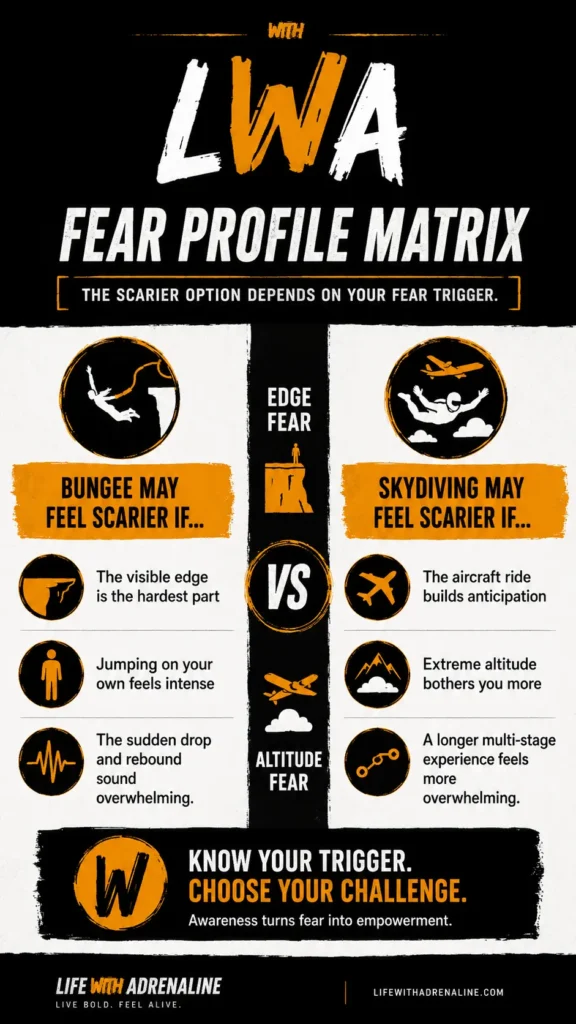
Which Is Actually Scarier?
There is no objective fear score that makes bungee jumping or skydiving scarier for everyone. Fear of heights varies widely, and research on visual height intolerance shows that height exposure can change anxiety, balance behavior, and even perceived height in susceptible people. That matters because the two activities present height very differently. [S10]
Bungee puts you close enough to the structure, water, canyon, bridge, or ground to read the drop as a familiar physical space. At Great Bungee in Harpers Ferry, for example, the jump platform is 150 feet above the water. The participant jumps alone, although staff manage the system and briefing. [S5][S6]
Tandem skydiving does the opposite. You climb thousands of feet in an aircraft and exit while physically connected to an instructor. USPA says tandem students generally receive less than 30 minutes of training and experience about 30 to 60 seconds of freefall before parachute flight. [S1]
That is why a useful answer is not ‘bungee is scarier’ or ‘skydiving is scarier.’ The better question is: which fear trigger sounds worse to you?
Why Bungee Jumping Can Feel Scarier
Bungee jumping compresses almost everything into the edge. You can usually see the platform, the void below it, and the exact point where you have to commit. There is no aircraft carrying you through the final decision and no tandem instructor physically attached to you for the leap itself. At Great Bungee, tandem bungee jumps are not allowed; each participant jumps individually. [S5]
For a beginner who is especially sensitive to visible height, that setup can be powerful. Research on height fear has found that anxiety at height is associated with altered visual exploration and with perceptual biases that can make a height seem greater than it is. That does not prove bungee is scarier than skydiving, but it helps explain why standing at a clearly readable edge may be a stronger trigger for some people. [S10]
The jump is also concentrated. The cord begins to stretch after the initial fall, slows the descent, and sends the jumper into rebounds. Great Bungee describes its 150-foot jump as using a gradual deceleration and says its setup can rebound a jumper to roughly 80% of the original jump height. Those are operator-specific characteristics, not universal bungee specifications. [S6]
If your worst moment on a roller coaster is the instant before the first drop, bungee is likely to target that same kind of anticipatory fear more directly.
Why Skydiving Can Feel Scarier
Skydiving gives anxiety more time to build. You check in, train, gear up, board the aircraft, climb to altitude, move toward the door, and then exit. At Skydive Perris, first-time tandem guests are told to expect roughly two to four hours on site, and delays can extend that window. Skydive Orange offers an early-morning weekend option designed to keep the start-to-finish visit to two hours or less, which shows how much total timing can vary by operator and conditions. [S8][S9]
The altitude is also far greater. Skydive Perris currently advertises a standard tandem from 14,000 feet MSL, with around 60 seconds of freefall and a five- to ten-minute parachute ride. [S9]
If your fear is not the edge but the idea of leaving an aircraft thousands of feet above the ground, the larger scale of skydiving may dominate everything else. The aircraft ride can also create a long runway for ‘what if’ thoughts before you ever reach the door.
The difference is that tandem skydiving gives the beginner a partner throughout the jump. USPA describes tandem as the most convenient way to experience freefall: the student is harnessed to an instructor and shares the parachute system. [S1] That can reduce the feeling that you personally have to manage the entire event, even though the activity still involves inherent risk.
What Do They Feel Like Physically?
Both activities involve a period when your body is no longer supported in the ordinary way, but the sensations are not identical. Bungee starts from a fixed platform and transitions quickly from falling to elastic deceleration and rebound. Skydiving transitions from aircraft exit into sustained high-speed airflow, then into a much slower parachute descent.
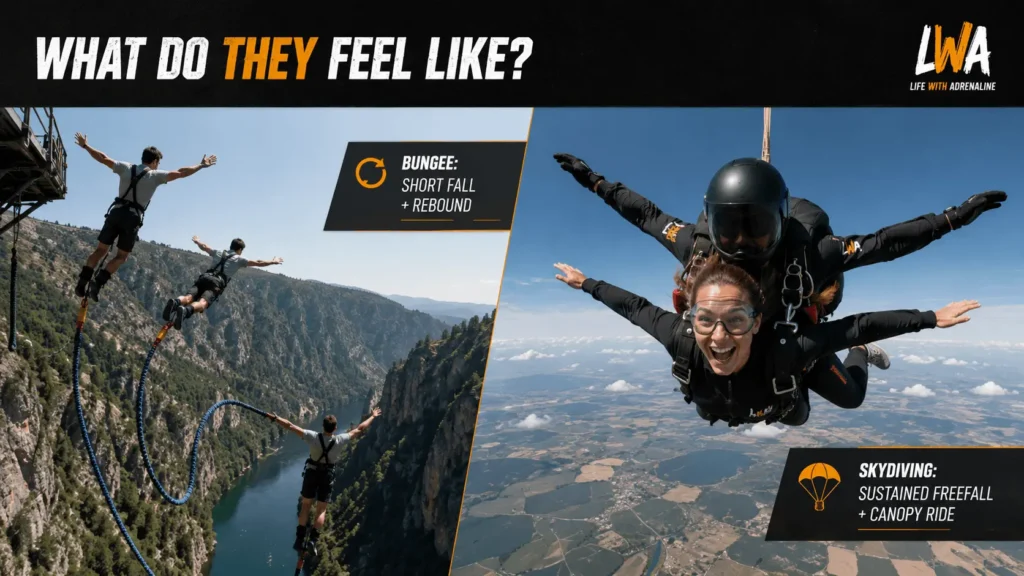
For bungee, the most distinctive physical feature is the reversal: fall, cord stretch, deceleration, rebound, and smaller oscillations. The exact forces depend on the jump system, cord selection, jumper weight, and operator design. Great Bungee, for example, describes its own setup as a gradual deceleration and offers either an ankle-harness or body-harness configuration with a backup waist harness for ankle jumps. [S5][S6]
For tandem skydiving, the freefall phase lasts much longer. USPA gives a general first-timer range of 30 to 60 seconds. After deployment, the experience changes into parachute flight. [S1] Skydive Perris advertises about 60 seconds of freefall from its standard 14,000-foot MSL tandem and a five- to ten-minute canopy ride. [S9]
Do not rely too heavily on claims such as ‘skydiving has no stomach drop’ or ‘bungee always gives a huge stomach drop.’ Individual sensation varies, and operator marketing often turns subjective experiences into universal rules. A better expectation is that bungee feels shorter and more abrupt, while skydiving gives you more time in sustained airflow before the parachute phase.
Bungee vs. Skydive Cost: Which Is Cheaper?
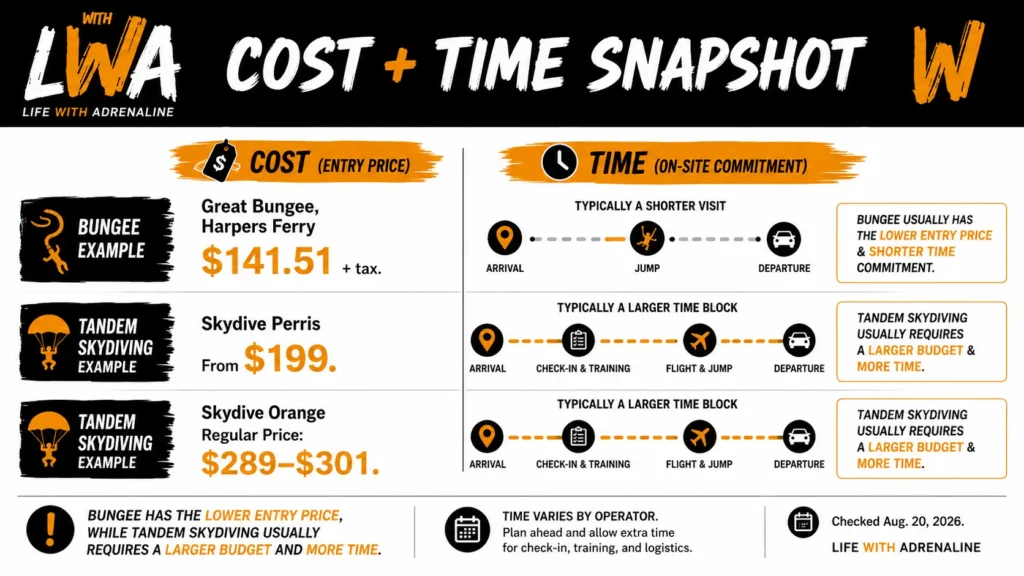
Bungee is usually the cheaper first purchase in the current examples we checked, but there is no single U.S. national price for either activity. Prices change by operator, day, altitude, media package, and local taxes, so compare like-for-like bookings rather than using a vague national average.
As of August 20, 2026, Great Bungee in Harpers Ferry lists a first jump at $141.51 plus tax. An HD jump video is $37.74 plus tax, and a jump/video/T-shirt package is $188.68 plus tax. [S4]
For tandem skydiving, Skydive Perris lists its standard tandem from $199, while Skydive Orange currently lists prices ranging from $259 cash on discounted Wednesdays and Thursdays to $322 by credit for its 8:00 a.m. weekend ‘Top of the Morning’ slot. Skydive Orange lists video or photos separately, with combined video and photos at $150 cash or $156 credit. [S8][S9]
That makes bungee easier on the budget in these examples, but the comparison is not perfectly symmetrical: a tandem skydive includes an aircraft ride, instructor, freefall, parachute flight, and landing, while a bungee booking is a shorter fixed-site experience.
Which Takes More Time?
Skydiving normally requires the larger time block. The jump itself is only part of the visit; aircraft operations, weather, training, manifest order, equipment, and landing logistics all matter.
USPA says tandem training is generally under 30 minutes, but that is training time, not total visit time. [S1] Skydive Perris tells guests to expect two to four hours, while weather or other delays can make the visit longer. [S9]
Great Bungee says its Harpers Ferry process usually takes about 45 minutes to two hours from arrival through registration, briefing, and the jump cycle for the booked group. It asks participants to arrive 45 minutes before their scheduled time. [S5]
If you are fitting an adrenaline activity into a tight day trip, bungee can be easier to schedule. If you want the activity itself to be a major part of the day, skydiving offers a more extended experience.
Which Is Easier to Find in the United States?
Tandem skydiving is generally easier to find. USPA describes tandem as widely available at most drop zones and maintains a network of affiliated drop zones around the country. [S1]
Commercial bungee jumping is much more location-dependent. Rules and oversight can also be state-specific. West Virginia, for example, has a Commercial Bungee Jumping Safety Act requiring a permit and at least annual inspection of commercial bungee sites; it also requires reporting of fatalities and serious injuries to the state Division of Labor. [S7]
For a beginner, availability can therefore decide the question before fear or price does. You may have several tandem skydiving options within driving distance but only one practical commercial bungee option, or none.
Is Bungee Jumping Safer Than Skydiving?
There is not enough comparable national data in the sources reviewed to give a responsible ‘bungee is safer’ or ‘skydiving is safer’ verdict. This is one of the most important places to resist oversimplified internet statistics.
USPA publishes nationwide skydiving data. For 2025, it reports an estimated 3.47 million U.S. skydives and 16 civilian skydiving fatalities, equal to 0.46 fatalities per 100,000 jumps. Those figures cover civilian skydiving broadly; they should not be presented as a tandem-only fatality rate. [S2]
USPA also states that parachute systems include a main and reserve parachute and that student systems include an automatic activation device. FAA guidance requires reserve parachutes made from modern rot-resistant materials to be packed by an appropriately certificated rigger within 180 days before use. [S2][S3]
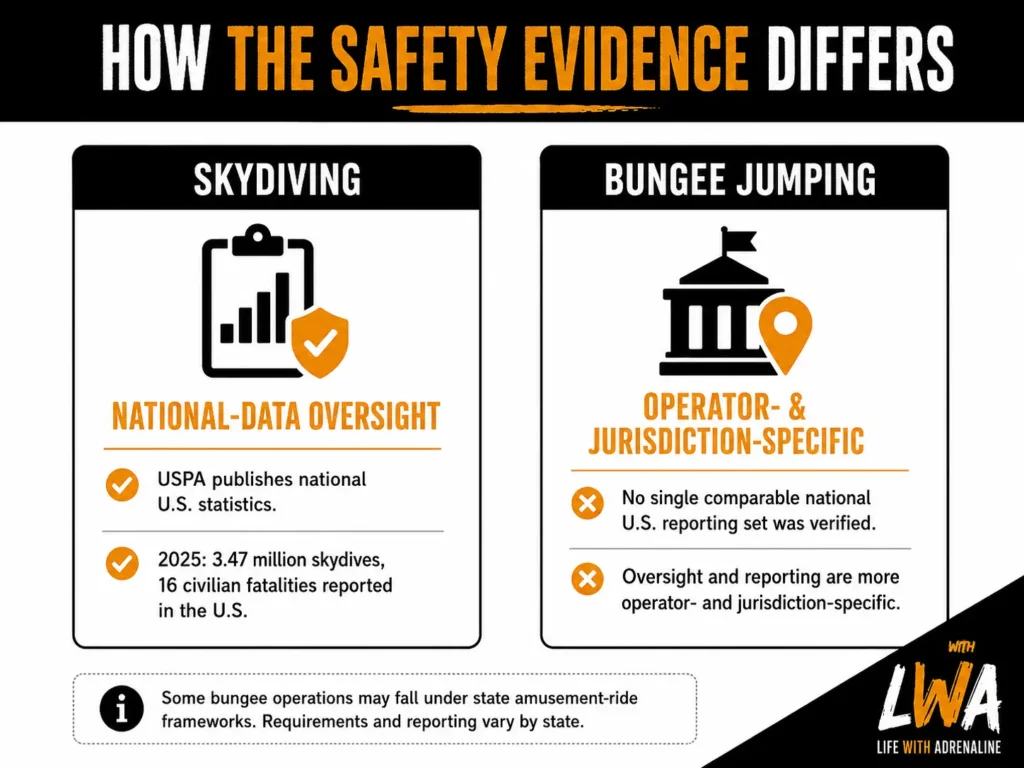
Bungee oversight is different. In West Virginia, commercial sites are subject to permitting, inspection, accident-reporting, and insurance requirements under state law. Great Bungee also states that its equipment and operation meet or exceed the requirements it identifies under ASTM F3785 and the West Virginia law. [S6][S7]
These are different systems with different data structures. The absence of a national bungee fatality database comparable to USPA’s dataset means a clean numerical risk comparison would be misleading. The practical takeaway is simpler: use a legitimate operator, read the current participant restrictions, follow instructions, and understand that neither activity is risk-free.
Age, Weight, and Health Restrictions
Restrictions can make the decision for you, and they should always be checked on the operator’s own website shortly before booking.
USPA says that in most cases you must be at least 18 to skydive, although the legal requirement can depend on the jurisdiction. Individual drop zones also set their own weight and health policies. [S1] Skydive Perris, for example, currently requires tandem participants to be at least 18, caps weight at 240 pounds, and asks guests with health concerns to consult a doctor. [S9]
Great Bungee’s Harpers Ferry FAQ currently states a minimum age of 16 under West Virginia law, with parental or guardian consent and presence requirements for participants under 18. It lists an 80-pound minimum and 320-pound maximum and names restrictions including pregnancy, intoxication, extreme asthma or respiratory disorders, epilepsy, hypertension, and certain skeletal, joint, or ligament problems. [S5]
Those numbers are examples, not universal rules for all U.S. bungee or skydiving operators.
Which Should You Try First?
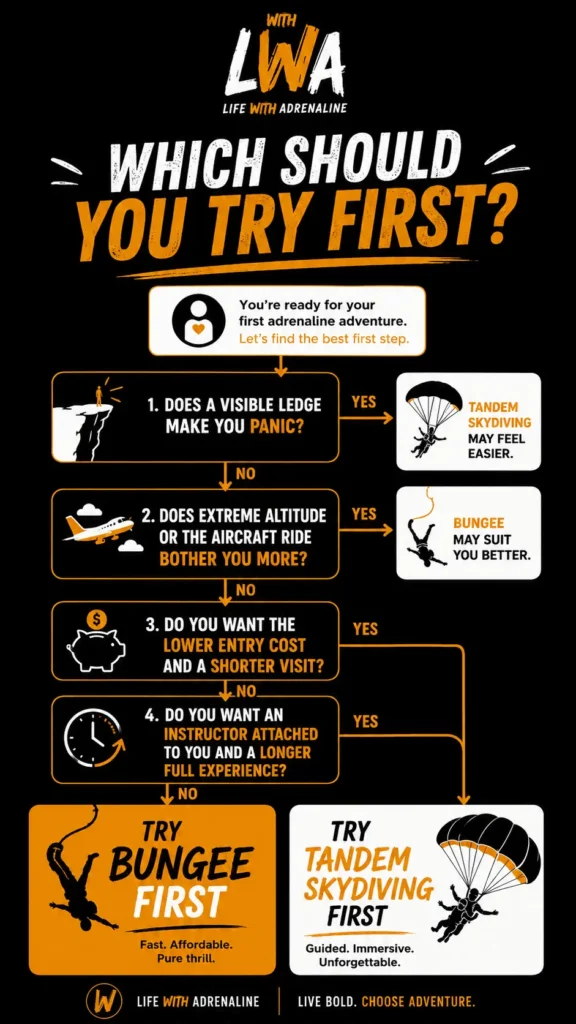
Pick bungee first if your main goal is to test your nerve in the shortest possible format. It is a strong choice if you want a single, concentrated commitment moment, a lower current entry price, and less total time on site. You should also be comfortable jumping alone from a visible edge.
Pick tandem skydiving first if you want the more complete aerial experience and like the reassurance of being physically attached to an instructor. It costs more and takes longer, but the experience includes several distinct phases rather than one short plunge.
If you already know that visible ledges make you freeze, bungee may feel like the harder psychological challenge. If aircraft, extreme altitude, or a long buildup are your biggest triggers, skydiving may be harder. Neither choice proves anything about courage. The better first adventure is the one whose fear profile you understand and are genuinely willing to manage.
Before You Book: Quick Checklist
- Check the operator’s current age, weight, health, clothing, and footwear restrictions.
- Confirm the exact price for your date, including taxes, card fees, media, and any weight-related or premium-time charges.
- Ask how much total time to allow, not just how long the jump lasts.
- Review weather and cancellation or rescheduling rules.
- For skydiving, consider a USPA Group Member drop zone and read the drop zone’s current tandem requirements. [S1]
- For bungee, check the operator’s permit/inspection information where applicable and follow the operator’s briefing and harness instructions.
- Do not participate while intoxicated, and do not hide a medical condition or restriction from the operator.
- If you have a significant medical concern or severe anxiety related to heights, get appropriate professional advice rather than relying on a blog comparison.
FAQ
Is bungee jumping more terrifying than skydiving? For many people, the exposed edge and solo commitment make bungee feel more immediately terrifying. Others find the aircraft exit and altitude of skydiving worse. Fear is personal, so the useful comparison is your trigger profile rather than a universal ranking.
Which gives a bigger adrenaline rush? Both can produce a major adrenaline response, but they deliver it differently. Bungee is short and concentrated; skydiving is longer and has several phases, from aircraft climb to freefall to canopy flight.
Which is cheaper, bungee or skydiving? In the current U.S. examples checked for this article, bungee costs less: Great Bungee lists $141.51 plus tax for a first jump, while tandem skydiving examples range from $199 at Skydive Perris to higher prices at Skydive Orange depending on timing and payment method. [S4][S8][S9]
Which is better if I am afraid of heights? There is no universal answer. If visible edges trigger you, bungee may be harder. If aircraft exits and extreme altitude trigger you, skydiving may be harder. Research on height fear shows that reactions to height exposure vary substantially between people. [S10]
Can I do both on the same trip? Sometimes, but availability is the limiting factor. Tandem skydiving is widely available at U.S. drop zones, while commercial bungee sites are much less common. [S1]
Final Recommendation
For most first-timers, the best distinction is simple: bungee jumping is the sharper fear test; tandem skydiving is the bigger experience. If you want the cheaper, faster option and can tolerate a deliberate step from a visible edge, start with bungee. If you want a longer bucket-list event and prefer being attached to an instructor, start with a tandem skydive. Whichever you choose, judge the operator and the current rules separately from the thrill itself, and do not let unsupported ‘which is safer’ statistics make the decision for you.
Sources
[S1] Your First Skydive — United States Parachute Association. https://www.uspa.org/students/your-first-skydive/tandem
[S2] How Safe is Skydiving? — United States Parachute Association. https://www.uspa.org/discover/faqs/safety
[S3] Advisory Circular AC 105-2E — Federal Aviation Administration. https://www.faa.gov/documentLibrary/media/Advisory_Circular/AC_105-2E_Ed_Upd_2.pdf
[S4] Pricing — The Great Bungee Company. https://greatbungee.com/pricing
[S5] FAQs — The Great Bungee Company. https://greatbungee.com/faqs
[S6] The Jump — The Great Bungee Company. https://greatbungee.com/the-jump
[S7] Commercial Bungee Jumping Safety Act, Chapter 21, Article 12 — West Virginia Legislature. https://code.wvlegislature.gov/email/21-12/
[S8] Tandem Skydiving / Skydiving Prices — Skydive Orange. https://www.skydiveorange.com/first-time-skydiving/tandem-skydiving/
[S9] First Jump / Tandem Prices — Skydive Perris. https://skydiveperris.com/prices/first-jump/