
For a typical tandem skydive in the United States, plan on being at least 18 years old, but do not assume there is one nationwide weight limit. Weight policies vary by drop zone, and your height, body shape, harness fit, mobility, health, and ability to follow instructions may also affect whether an instructor can take you. [S1][S2][S4][S5]
If you are close to a published weight limit, are an older adult, have limited mobility, are pregnant, take medication that may affect your ability to participate, or have a medical condition that could matter during a jump, contact the actual skydiving center before you book or travel.
That simple step is more useful than relying on a generic number found online.
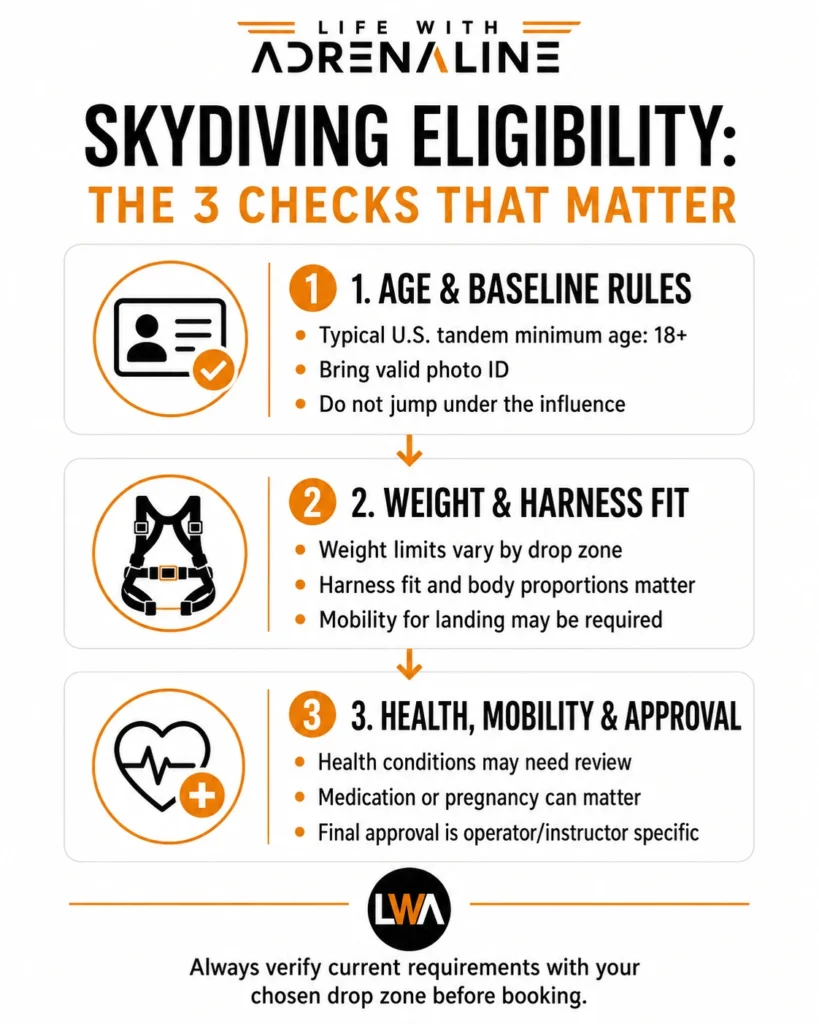
Skydiving age and weight Requirements at a Glance
| Requirement | What First-Time Tandem Customers Should Know |
| Minimum age | 18 is the practical minimum for ordinary U.S. tandem skydiving under current USPA/manufacturer requirements. [S1][S2] |
| Maximum weight | There is no single operator-wide U.S. number. Current examples reviewed range from 240 to 260 lb. [S4][S5][S8][S9] |
| BMI | No universal tandem passenger BMI cutoff was found in the current USPA BSR reviewed for this guide. Some operators consider BMI, body shape or height-to-weight proportion. [S1][S7][S11] |
| Maximum age | Policies vary. Some operators publish no maximum if physical requirements are met, while others have local age limits. [S4][S6][S10] |
| Health | You need to be medically and functionally able to participate. Some conditions may require discussion with the operator and your healthcare professional. [S1][S3] |
| Mobility | Harness fit, aircraft access, body position and the ability to raise your legs for landing can matter. [S6][S8] |
| Identification | Expect to show valid government-issued photo ID at many U.S. drop zones. [S4][S5][S8] |
The Three Checks That Determine Whether You Can Skydive
Skydiving eligibility makes more sense when you stop looking for one universal checklist.
Think of it as three separate gates.
1. Age and baseline participation requirements
For a normal U.S. tandem jump, age is the simplest part: 18 is the practical minimum under current tandem manufacturer requirements referenced by USPA. [S1][S2]
2. Your drop zone’s weight and harness policy
This is where requirements begin to vary substantially.
One skydiving center may publish 240 pounds, another 250, and another 260. Some also assess height-to-weight proportion or body shape rather than relying exclusively on scale weight. [S4][S5][S7][S9]
3. Your individual health, mobility and day-of assessment
A published weight limit is not a guarantee that you can jump.
The tandem harness must fit appropriately, and you need to be able to participate in the required body positions and landing procedure. Operators may make the final determination after seeing you in person. [S5][S7][S8]
That is why eligibility should be confirmed before booking whenever you are unsure.
What Is the Minimum Age to Skydive in the United States?
For an ordinary tandem skydive in the U.S., 18 is the number first-time customers should plan around.
USPA’s Basic Safety Requirements say tandem jumps must comply with the age requirements of the specific tandem equipment manufacturer. USPA’s minimum-age guidance states that the U.S. tandem manufacturers use 18 as their minimum age. [S1][S2]
This is why you should not assume that a parent can simply sign a consent form for a 16- or 17-year-old at a normal U.S. tandem operation.
USPA’s requirements do contain a narrowly defined provision involving terminally ill minors and manufacturer approval, but that is an exceptional circumstance, not a normal tourist tandem option. [S1]
Do You Need ID?
Expect it.
Skydive Perris, Skydive Chicago and Skydive Cross Keys are among the operators currently requiring adult tandem customers to show valid government-issued photo identification. [S4][S5][S8]
If you are traveling for your jump, check the operator’s accepted ID requirements before leaving home.
Is There a Maximum Age for Skydiving?
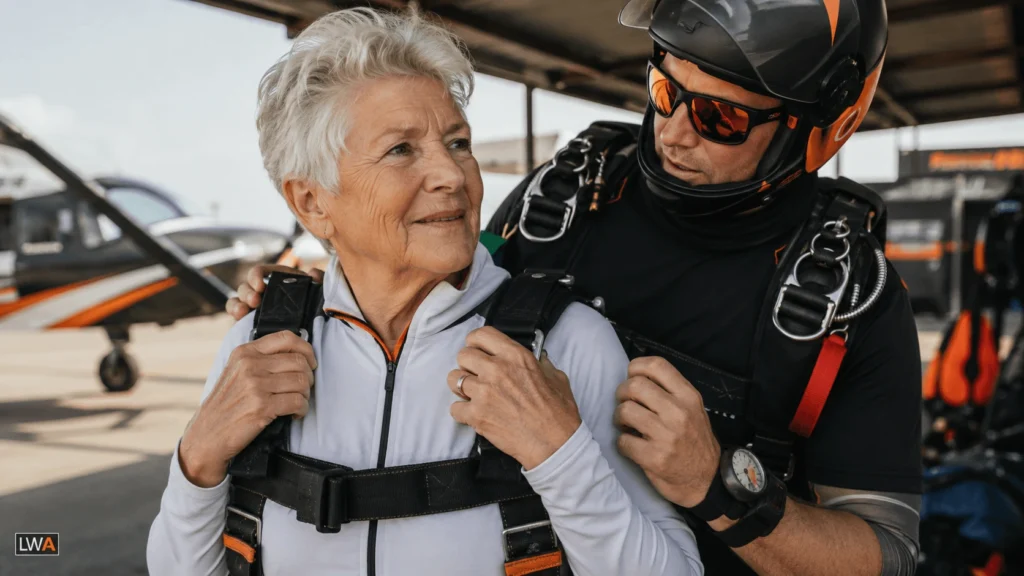
There is no simple nationwide maximum-age number you can rely on.
Some current operators explicitly state that they have no maximum age as long as the participant meets their physical and health requirements. Skydive Perris and Skydive Chicago are examples. [S4][S6]
But that does not mean every drop zone follows the same policy.
Skydive Newport, for example, currently publishes a maximum age of 75 for its operation. [S10]
Can Seniors Skydive?
Potentially, yes.
The more useful question is not simply “How old are you?” but whether you can satisfy the particular operator’s health and mobility requirements.
Skydive Chicago, for example, says older participants need to meet minimum physical requirements that include being able to lift their legs for landing. [S6]
If you are an older first-time jumper, calling the drop zone before paying is especially worthwhile. Tell them your age and ask whether they have any additional mobility or medical requirements.
What Is the Weight Limit for Tandem Skydiving?
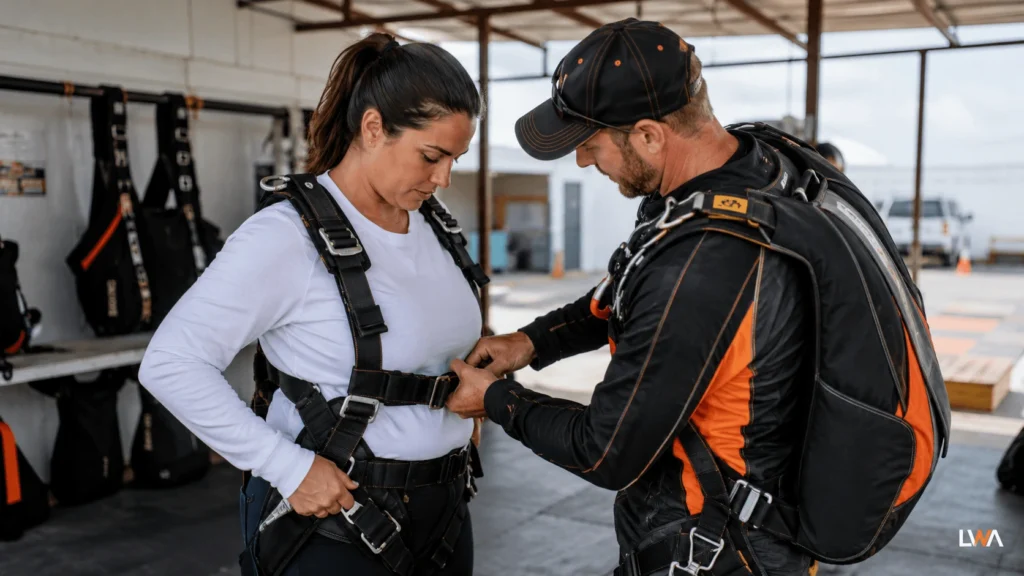
There is no single number that works for every U.S. drop zone.
Here are examples of published tandem policies checked on August 16, 2026:
| Skydiving Center | Published Tandem Policy |
| Skydive Perris, CA | Maximum 240 lb; currently lists an additional $25 fee above 220 lb. [S4] |
| Skydive Chicago, IL | Under 250 lb, with body shape and harness fit also evaluated. [S5] |
| Skydive Cross Keys, NJ | Maximum 250 lb including clothing and shoes; proportion and harness fit matter. [S8] |
| Wisconsin Skydiving Center, WI | Maximum 260 lb; currently publishes additional charges in higher weight ranges. [S9] |
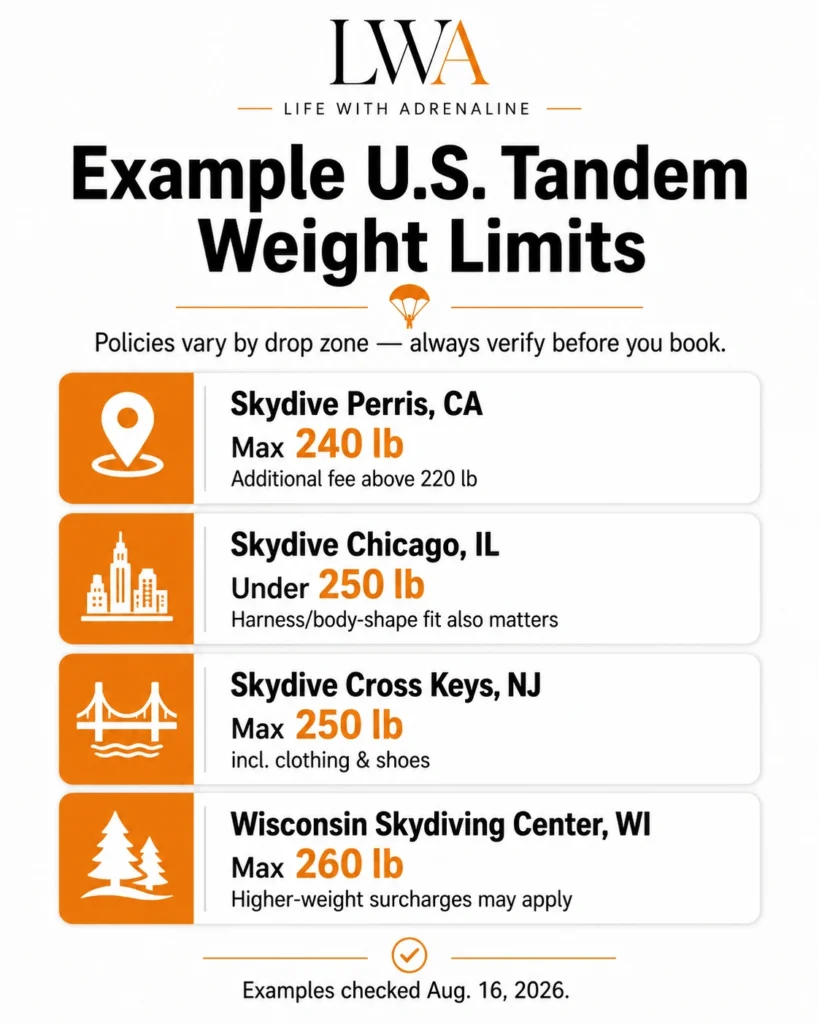
These numbers are examples, not national standards.
Your chosen operator’s current policy is the one that matters.
Why Do Skydiving Weight Limits Vary?
Scale weight is only part of the decision.
Tandem equipment has operating limits, but the practical decision can also involve:
- how the harness fits your body;
- your height-to-weight proportion;
- range of motion;
- the combined equipment and participant configuration;
- the instructor’s ability to manage the jump appropriately;
- current operating conditions and operator procedures.
Current policies from Skydive Phoenix, Skydive Chicago and Skydive Cross Keys specifically show that body composition, harness fit, mobility or an instructor’s individual assessment may matter in addition to weight. [S5][S7][S8]
Can You Be Under the Weight Limit and Still Be Refused?
Yes.
Skydive Chicago states that tandem participants must both meet its weight requirement and fit safely into the harness, with the instructor making the final determination. [S5]
That means a website number should be treated as a screening threshold, not a guaranteed reservation acceptance.
If you are close to the limit, provide your actual weight and height when contacting the drop zone. Do not intentionally underestimate your weight to secure a reservation.
Is There a BMI Limit for Skydiving?
There is no universal tandem passenger BMI cutoff published in the current USPA Basic Safety Requirements reviewed for this article. [S1]
That does not mean body proportions are irrelevant.
Individual operators may evaluate height-to-weight proportion, body composition, body shape or BMI because the tandem harness needs to fit appropriately. Skydive Phoenix discusses height and body composition in its assessment, while Skydive City states that BMI and body shape may affect acceptance. [S7][S11]
So searching for a single “skydiving BMI limit” can give you the wrong impression.
Your actual drop zone’s policy matters more than a universal BMI number found online.
What Health Conditions Can Affect Skydiving Eligibility?
There is no responsible one-line list that can tell every person with a medical condition whether they should or should not skydive.
USPA’s medical requirements are framed around fitness to participate safely and the absence of conditions or impairments that would interfere with the jump. USPA also notes that some situations may warrant medical documentation or discussion with a physician. [S1][S3]
Individual operators identify a range of conditions that should be discussed before booking.
Examples appearing in current operator guidance include:
- heart disease or a recent heart event;
- uncontrolled high blood pressure;
- serious respiratory conditions;
- epilepsy or seizure history;
- diabetes;
- fainting history;
- significant ear or sinus problems;
- recent major surgery;
- neck or back problems;
- previous shoulder dislocation;
- significant joint injuries. [S4][S6]
These examples are not a diagnosis or universal disqualification list.
Having a condition does not automatically tell you whether a tandem skydive is appropriate. The correct next step is to review the operator’s current requirements and, when appropriate, discuss your circumstances with a qualified healthcare professional.
What About Prescription Medication?
Medication matters when it could affect your judgment, alertness, physical coordination or ability to participate appropriately.
USPA’s student guidance states that medications or substances should not impair a person’s ability to skydive. [S3]
Do not stop or change prescription medication just to meet a skydiving requirement without medical guidance.
If you take medication and are uncertain whether its effects could matter during a jump, ask both your healthcare professional and the drop zone before booking.
Can You Skydive While Pregnant?
Do not assume a drop zone will accept a pregnant tandem participant.
Skydive Perris and Skydive Chicago currently state that pregnant customers cannot participate in tandem skydiving at their operations. [S4][S6]
Policies should be verified directly with the operator, and pregnancy-related medical decisions should be discussed with an appropriate healthcare professional.
What If You Have Limited Mobility or a Disability?
A disability does not automatically mean every tandem skydive is impossible.
The practical issue is whether the operator can accommodate your individual needs while meeting its equipment and operational requirements.
Skydive Perris states that it has accommodated some guests with congenital disabilities, visual or hearing impairment, amputation and paraplegia, but asks customers to discuss those needs in advance. [S4]
Other operators emphasize specific functional abilities. Skydive Cross Keys says tandem customers need sufficient mobility to board and exit the aircraft, maintain required body positions and raise their legs for landing. [S8]
This makes advance communication particularly important.
Do not arrive expecting every drop zone, aircraft, harness configuration or instructor to provide the same accommodation.
Other Eligibility Rules First-Timers Often Miss
Alcohol and Recreational Drugs
USPA’s Basic Safety Requirements prohibit skydiving while under the influence of alcohol or drugs that affect the participant, and they require at least eight hours between alcohol consumption and skydiving. [S1]
Treat that as a minimum operational requirement, not a target drinking schedule before your jump.
Scuba Diving
USPA’s student guidance advises people who have been scuba diving not to skydive for at least 24 hours afterward. [S3]
If your adventure trip combines scuba and skydiving, schedule them accordingly.
Temporary Injuries and Recent Procedures
A short-term injury can matter even if you are normally healthy.
USPA guidance specifically tells students to consider issues such as recent joint dislocations and other circumstances that could interfere with participation. [S3]
Recent surgery, orthopedic injuries or significant neck and back problems also appear in current operator guidance as reasons to speak with the drop zone and potentially a healthcare professional before booking. [S4][S6]
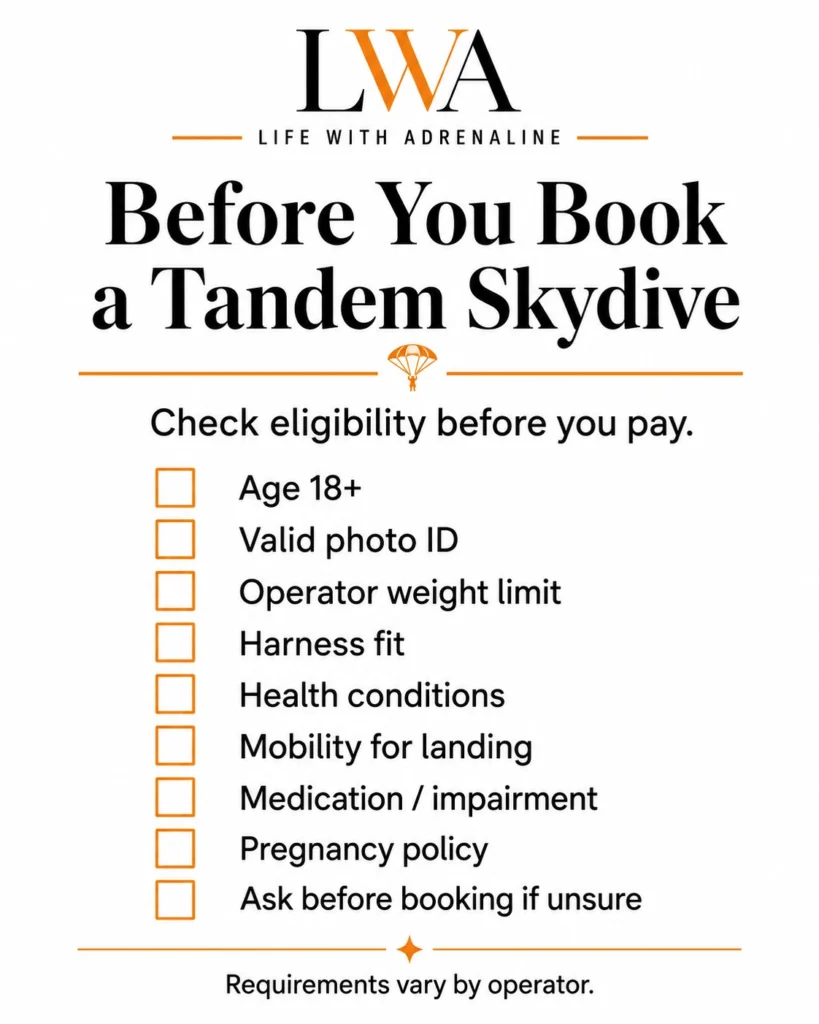
Before You Book: Tandem Skydiving Eligibility Checklist
Before paying for your first jump, confirm:
☐ You meet the drop zone’s current minimum-age requirement.
☐ You have the required government-issued photo ID.
☐ You meet its current tandem weight limit.
☐ You have asked about any height-to-weight, BMI or harness-fit rules if you are near the limit.
☐ You have disclosed any mobility issue that could affect boarding, body position or landing.
☐ You have reviewed any relevant health condition with the operator.
☐ You have sought professional medical guidance where appropriate.
☐ You have checked whether your medication could impair participation.
☐ You understand the operator’s alcohol and drug policy.
☐ You have allowed appropriate time after scuba diving.
☐ You have asked about any special accommodation before arriving.
☐ You have reconfirmed requirements if your booking is several months away.
Requirements can change, so check the operator’s official website again shortly before your jump.
Frequently Asked Questions
Can a 16- or 17-year-old go tandem skydiving with parental consent?
For a standard U.S. tandem skydive, you should plan on 18 as the minimum age. USPA requires tandem jumps to follow the equipment manufacturer’s age rules, and USPA states that the U.S. tandem manufacturers use 18 as their minimum. [S1][S2]
Is 250 pounds too heavy for tandem skydiving?
Not automatically everywhere, but it can be at some drop zones.
Skydive Chicago requires tandem students to be under 250 pounds, Cross Keys publishes a 250-pound maximum including clothing and shoes, while Wisconsin Skydiving Center currently publishes a 260-pound maximum. [S5][S8][S9]
Always check the specific operator.
Will I be weighed before skydiving?
You may be.
Skydive Perris and Skydive Chicago both state that tandem participants are weighed as part of their check-in or eligibility process. [S4][S5]
Is there a maximum age for tandem skydiving?
Not one that applies uniformly to every U.S. drop zone.
Some operators publish no maximum age provided their health and mobility requirements are met, while others impose local limits. [S4][S6][S10]
Can someone with high blood pressure, diabetes or another medical condition skydive?
That cannot be answered responsibly for an individual without considering the person’s condition and the operator’s requirements.
Current operator guidance identifies conditions such as uncontrolled high blood pressure, diabetes and various cardiovascular or neurological issues as reasons to discuss eligibility in advance. [S4][S6]
Seek appropriate medical guidance if your condition could affect participation.
Do I need a doctor’s note to skydive?
Not every tandem customer needs one.
However, USPA guidance and individual operators indicate that medical documentation or physician input may be appropriate in some circumstances. [S1][S3][S4]
Ask your operator before booking if you are unsure.
Can a person with a disability tandem skydive?
Sometimes.
Some operators can make accommodations for particular disabilities, but the answer depends on the person’s needs, harness fit, aircraft, mobility requirements and the operator’s capabilities. Skydive Perris specifically asks customers requiring accommodation to contact the operation in advance. [S4]
Final Recommendation
The biggest mistake you can make when checking skydiving eligibility is looking for one universal weight, BMI or maximum-age number.
For a normal U.S. tandem jump, the minimum-age question is relatively straightforward: plan on 18. [S1][S2]
Everything else becomes more operator-specific.
Your best sequence is:
Check the drop zone’s published requirements → contact the operator if anything is close or unclear → obtain appropriate medical guidance if your health could affect participation → book only after your eligibility is reasonably clear.
That can save you from paying for a jump you cannot make, traveling to a drop zone only to be turned away, or relying on a rule that belongs to a completely different skydiving center.
Once you know you are eligible, our First-Time Skydiving: What to Expect guide can walk you through what happens from check-in to landing.
Sources
[S1] U.S. Parachute Association — Basic Safety Requirements: https://www.uspa.org/sim/2-1
[S2] U.S. Parachute Association — Minimum Age to Skydive: https://www.uspa.org/minimum-age-to-skydive
[S3] U.S. Parachute Association — Skydiver School: Regulations Pertaining to You: https://www.uspa.org/skydiveschool/1
[S4] Skydive Perris — Tandem FAQs: https://skydiveperris.com/skydiving/tandem/faqs
[S5] Skydive Chicago — First Time Skydive: https://skydivechicago.com/first-time-skydive
[S6] Skydive Chicago — Age & Health Requirements for Skydiving in the U.S.: https://skydivechicago.com/health-age-requirements-for-skydiving-in-us
[S7] Skydive Phoenix — Tandem Skydiving:
https://www.skydivephoenix.com/tandem-skydiving
[S8] Skydive Cross Keys — Requirements for Tandem Skydiving: https://www.skydivecrosskeys.com/requirements-for-tandem-skydiving/
[S9] Wisconsin Skydiving Center — Skydiving Requirements: https://wisconsinskydivingcenter.com/blog/skydiving-requirements-weight-limits-height-age/
[S10] Skydive Newport — Physical Requirements: https://www.skydivenewport.com/first-time/physical-requirements/
[S11] Skydive City — Skydiving Weight & Age Limits: https://www.skydivecity.com/skydiving-weight-age-limits/