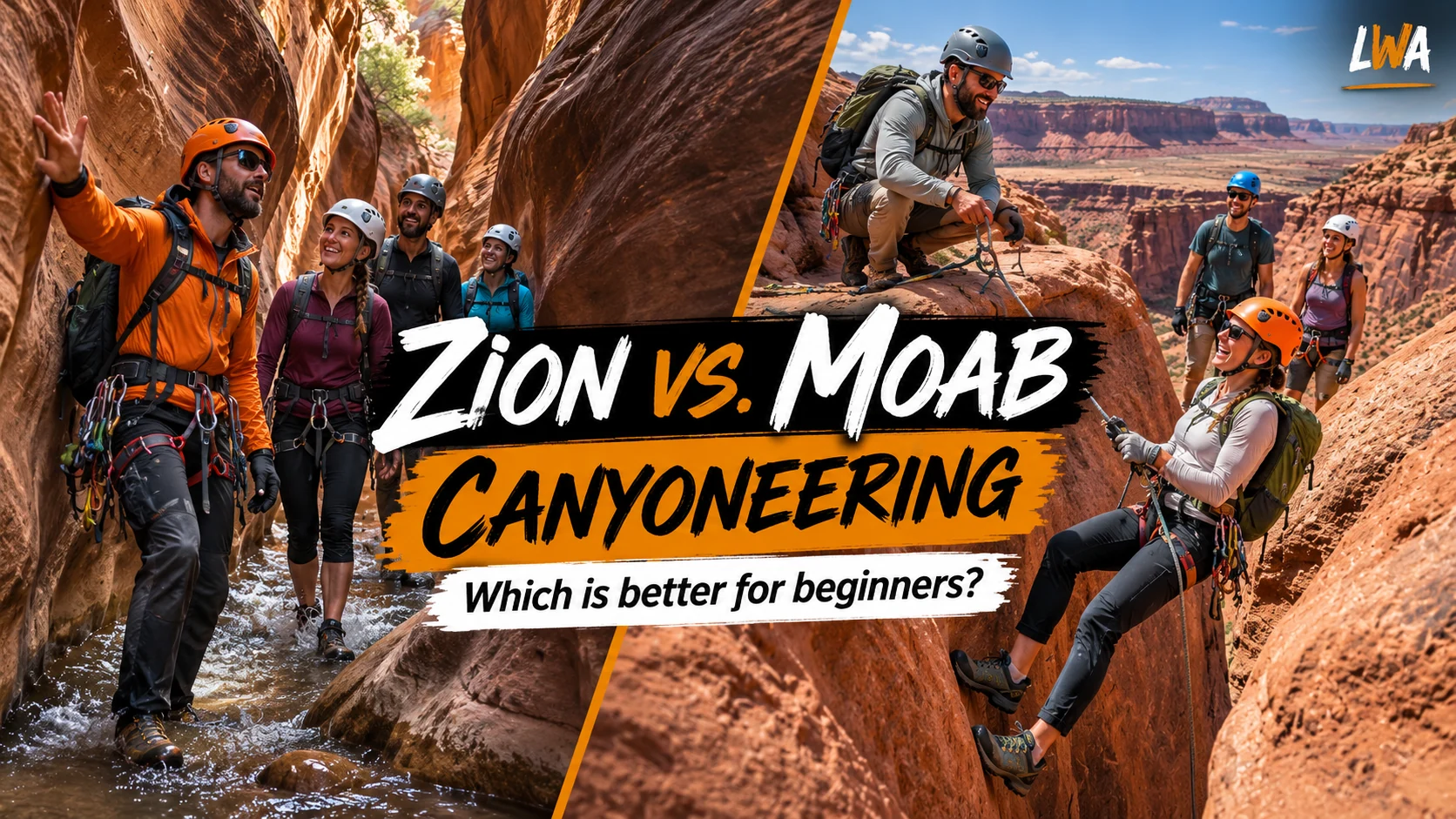
Zion vs. Moab Canyoneering: Which Is Better for Beginners?
The Short Answer: Choose the Trip, Not Just the Destination
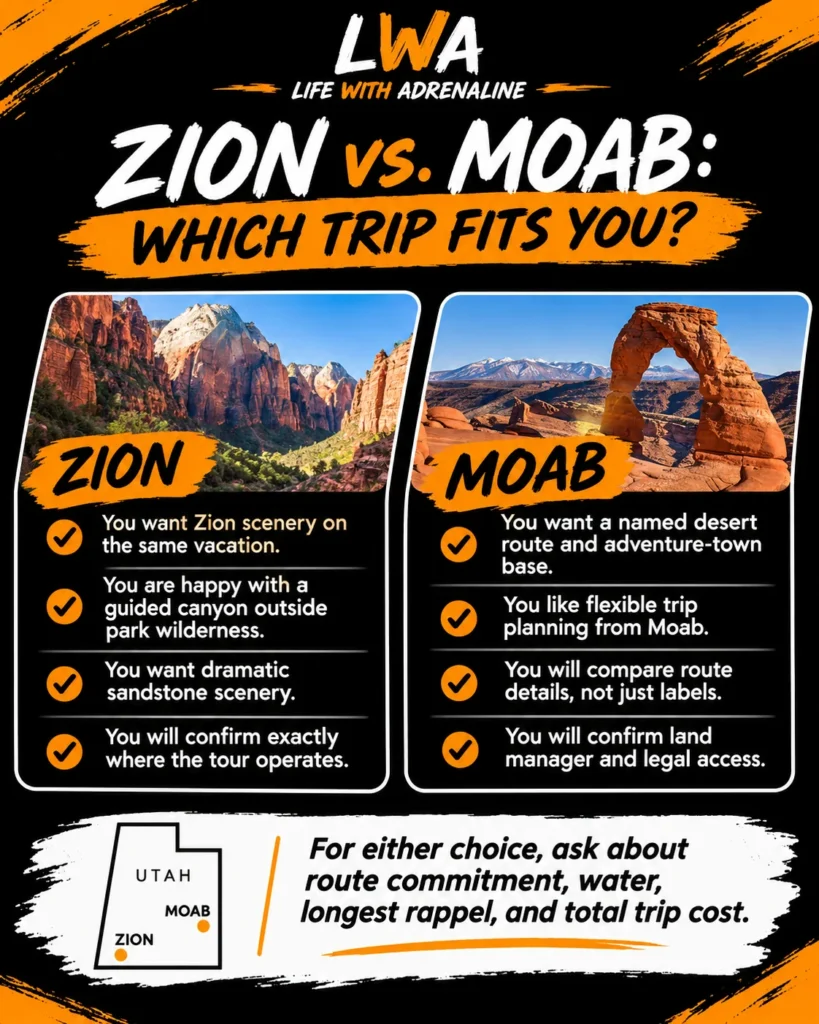
For a first guided rappel in Utah, Moab is a practical choice if you want to compare several recognizable desert routes and build the rest of your trip around a compact adventure town. The Zion area is a strong choice if towering sandstone scenery is the priority and you are happy to book a commercial canyon outside Zion National Park’s designated wilderness. Neither destination is automatically safer, easier, wetter, or cheaper. The exact route and operator matter more than the destination name.
Here is the distinction that changes the whole comparison: a company advertising a “Zion canyoneering tour” generally means a trip on suitable land near the national park, not a guided technical descent inside Zion Wilderness. The National Park Service prohibits commercially guided technical canyoneering within Zion Wilderness and requires a Wilderness permit for independent technical canyoneering there. Meanwhile, Moab is a gateway to multiple land-management areas; guided canyoneering is prohibited in Arches National Park, even though operators offer trips elsewhere around Moab. Never infer the permitted activity or access rules from a city or park name on a booking listing. [S1][S2][S3]
If you are deciding where to take a beginner trip rather than researching a specific canyon already, use the criteria below to narrow the question. You can then compare actual booking pages by approach hike, mandatory rappels, water exposure, price, and cancellation rules.
Zion vs. Moab Canyoneering at a Glance
| Decision factor | Zion area | Moab area |
| Typical guided-trip setting | Sandstone slots and rock formations on land outside Zion Wilderness | Desert sandstone canyons and grotto or arch approaches on authorized nearby lands |
| First-timer experience | Introductory rappels, canyon walks, sometimes vehicle-assisted access | Introductory rappels, rocky approaches, route-specific exposed sections |
| Water exposure | Varies by route; do not assume dry | Varies by route; some tours enter pools or water-carved narrows |
| Technical permit issue | Independent technical trips inside Zion Wilderness require permits; commercial technical guiding there prohibited | Rules depend on exact land unit; guided canyoneering within Arches prohibited |
| Traveler base | Springdale, East Zion / Mount Carmel, Hurricane / La Verkin | Moab and neighboring trailheads |
| Trip planning question | “Where exactly is this tour outside the park?” | “Which land unit and route does this trip use?” |
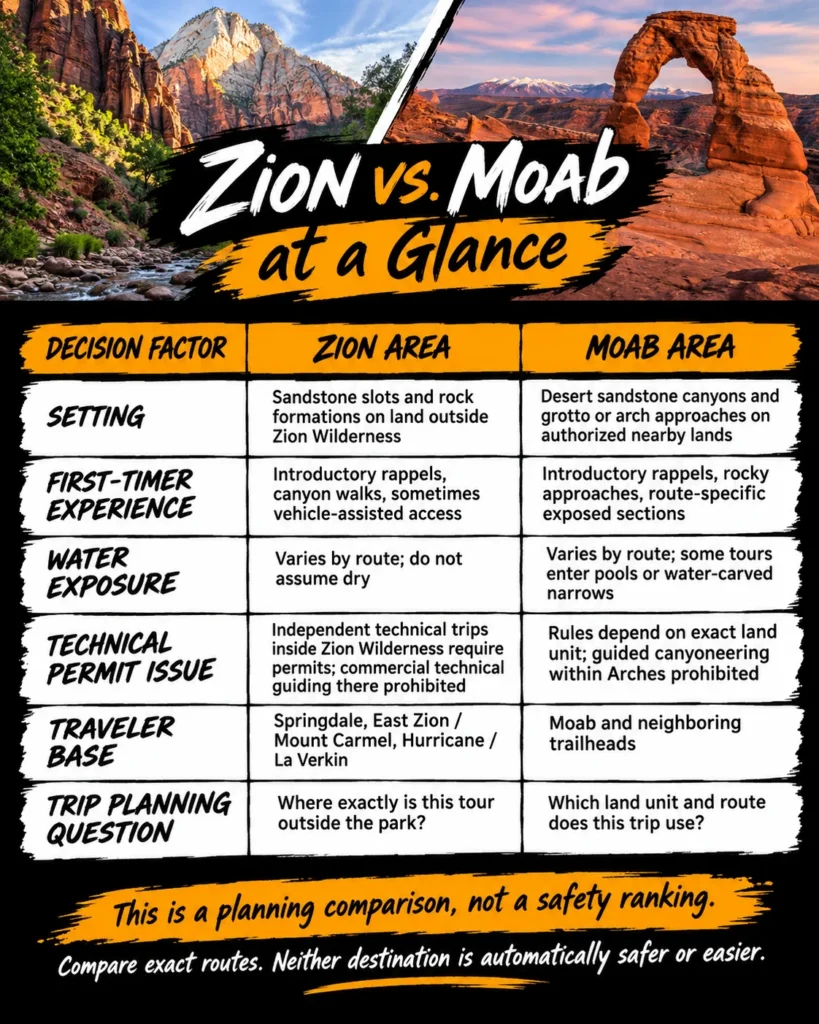
This is a planning comparison, not a safety ranking. Both regions contain routes that are unsuitable for an unprepared beginner. When a seller says “family-friendly,” ask what that means in rappel height, walking distance, exposure, minimum age, and ability to turn around.
1. What Counts as “Zion Canyoneering”?
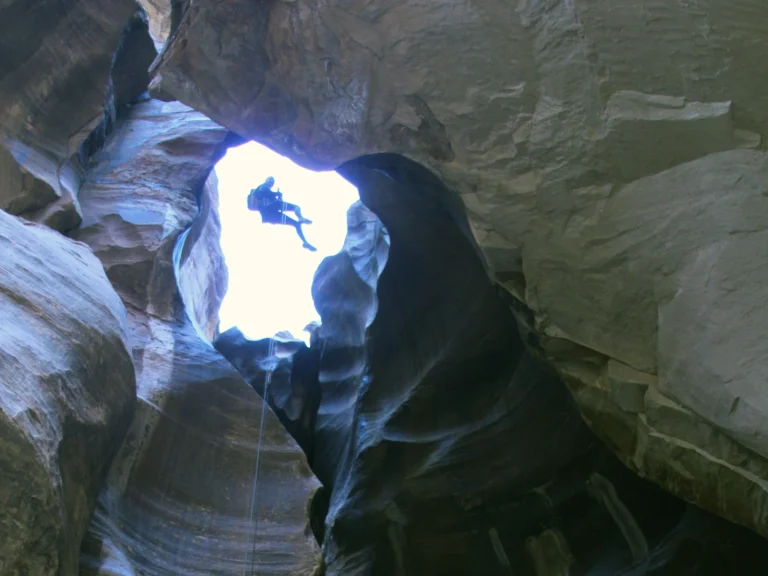
The Zion landscape has made technical slot-canyon travel famous, but the park’s reputation can produce a misleading booking shortcut. A commercial tour marketed as “Zion” is not permission to descend Pine Creek, Keyhole, the Subway, or any other technical route inside Zion Wilderness with a paid guide. NPS describes canyoneering as a combination of route finding, rappelling, scrambling, swimming, and hiking, and applies specific permits and group limits to technical trips inside the park. [S1][S2]
Guided introductions are available on suitable nearby terrain, with departure points around Springdale, the east side, and other surrounding areas. East Zion Adventures, for example, advertises a guided Hidden Creek Canyon outing near Zion Ponderosa Resort, outside the park wilderness, and describes a four-hour experience. That is an operator’s specific product—not an assurance that every Zion-area canyon has the same difficulty or conditions. [S4]
If you want a first experience with rope work, let the guide handle the technical setup and ask for an itinerary that spells out what you personally must do. If instead you want the scale of Zion’s canyon scenery without mandatory rappelling, a bottom-up visit to The Narrows is a different kind of excursion. It involves river walking, current conditions, and potential flash-flood risk, not a substitute for a technical canyon tour. Our Zion canyoneering guide for beginners explains these boundaries in more detail.
Zion-area beginner advantages—and compromises
The attraction is the variety of canyon scenery near one of the country’s most recognizable national parks. A guided half-day can sit alongside a national-park visit, a scenic drive, and a relaxed evening in Springdale. Some operators offer easier introductory formats or trips with short rappels; others sell longer or more physically demanding days. Ask for the actual meeting point, whether transportation is supplied, and how long you spend in the canyon versus the vehicle.
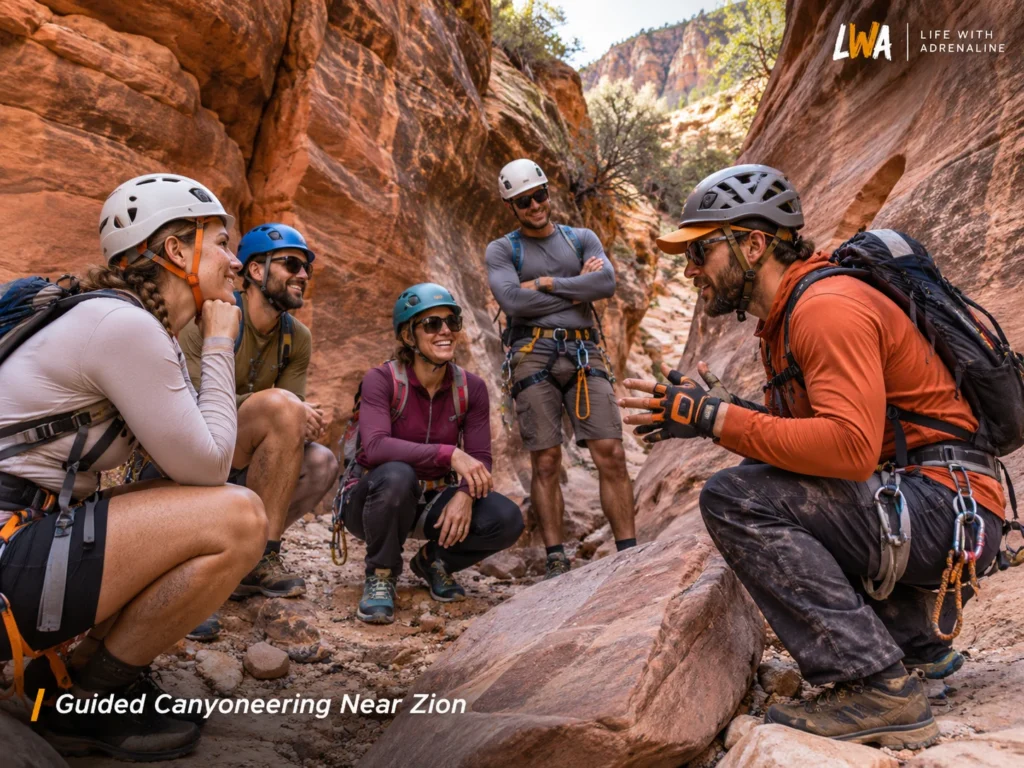
The tradeoff is that the famous park and the commercial tour may be two separate excursions with separate rules, driving logistics, and costs. Do not pay for a “Zion National Park rappel” on the assumption that the national-park branding means the descent happens inside the park. Check the operator’s land-access description and confirm it in writing.
2. What Makes Moab Different for a First-Timer?
Moab is known for red-rock desert activities, and its guided canyoneering market often explains outings by named route rather than one broad park label. A listing might mention Morning Glory / Medieval Chamber, Ephedra’s Grotto, Entrajo, or Bow & Arrow. The names are useful only after you know the route’s real commitment: walking and scrambling, rappel number and height, water possibilities, exit hike, and physical requirements.
Moab’s landscape is not one uniformly dry playground. Water can collect in certain canyons; slickrock, sand, loose footing, and exposed approaches matter even when no swimming is expected. Trail conditions change with weather, and desert flash flooding is a concern in slots and drainages. At the same time, an itinerary near town may be simpler to combine with an afternoon activity or food stop than a longer remote transfer. These are general planning considerations, not promises about any single departure.
If a listing refers to Arches National Park, be particularly careful: NPS explicitly states that guided canyoneering services are prohibited in Arches. Independent canyoneering there has its own permit rules. Moab operators can offer legal commercial experiences elsewhere, but you should never assume that a photographed arch or a park entrance means your tour uses that site. [S3]
Our Moab canyoneering guide for beginners compares specific route formats and explains the questions that make a “beginner” label meaningful. Read it if Moab is your likely destination and you want more detailed itinerary comparisons.
Moab-area beginner advantages—and compromises
Moab gives a first-time traveler several plausible tour styles to investigate while also offering non-canyoning alternatives. This is useful when one person in a group wants to rappel and another would rather hike, visit viewpoints, or book a different guided experience. Our best adrenaline activities in Moab guide helps with that wider day-planning decision.
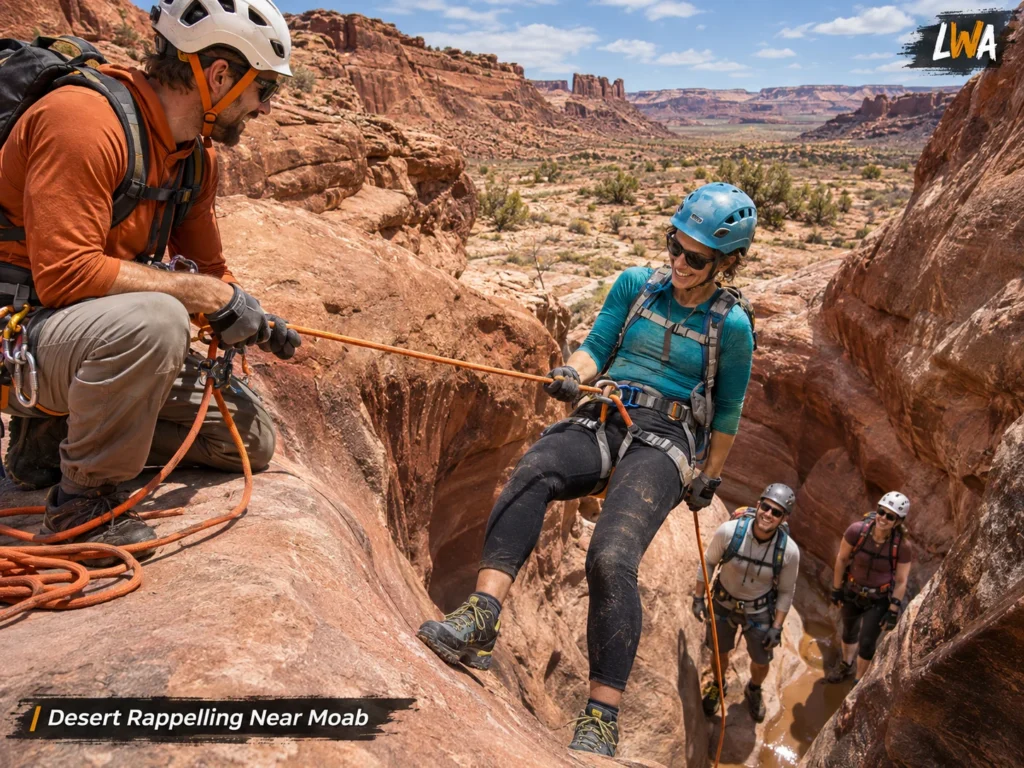
The compromise is route variability. A “half-day Moab canyon” is not a standardized product: one operator may build a gentle skills-oriented introduction, while another includes a bigger rappel, longer scramble, or different terrain. Ask for specifics instead of assuming that a shorter tour or a lower price means lower commitment.
3. Scenery, Rappels, and Water: What Will the Day Feel Like?
Scenery: Zion-area guided trips can deliver narrow sandstone corridors, sculpted rock, and the larger Zion region’s dramatic cliffs. Moab experiences may emphasize open slickrock approaches, enclosed desert passages, grotto settings, and views across different red-rock formations. Your actual route matters more than Instagram’s most recognizable photograph. An operator may use a permitted canyon that looks very different from the nearby national park.
Rappels: Both regions offer beginner-oriented trips with an instructor, but the number, height, and mandatory nature of descents differ. Ask whether the first rappel is the largest, whether there is practice on the ground, whether a participant can opt out before entering a committed section, and what happens if someone freezes midway through the route. None of those details can be inferred from destination alone.
Water: Do not assume that “Utah desert” means zero water. Some canyons have pools, wading, or seasonal flow, and cold water may alter footwear and thermal requirements. A dry-canyon tour may avoid immersion, but conditions still change. Ask your guide whether swimming is required, whether neoprene equipment is provided when needed, and whether weather can force a different route.
Physical demand: A technically simple descent can still require several miles of uneven walking, scrambling, sun exposure, or a steep return hike. Conversely, a trip with an eye-catching rope photo might include relatively little approach mileage. Compare both movement and exposure: “How far will I walk, what sections are mandatory, and what is the longest rappel?”
4. Permits, Park Boundaries, and Guided Access
This is where first-time visitors most often mix up two very different products: an independent technical canyon and a commercial guided introduction. For Zion, NPS says technical canyoneering within the park requires a Wilderness Permit, while structured commercially guided activities are prohibited in Wilderness. A permit for independent visitors does not authorize a private company to guide that technical descent. [S1][S2]
For Moab, route-specific rules change with the land manager. In Arches National Park, NPS requires free canyoneering permits for independent use and prohibits guided canyoneering services. Outside Arches, permits and commercial authorizations depend on the agency and specific site; some routes may be on other public lands or managed properties. Ask the operator to identify the land manager and confirm that the planned route is an authorized commercial operation. [S3]
You do not need to memorize every land-management rule to book a first guided trip. You do need a clear answer to one simple question: “Where exactly is the tour, and are you authorized to guide there?” If the description is vague, request the route or permitted operating area before paying.
5. Guided-Tour Prices: Compare Real Products, Not Average Destinations
A Zion-area tour does not have a universal premium over Moab, and Moab is not universally the cheap option. Trip length, group size, transport, private versus shared booking, and what equipment is included affect the final price. The apparent cost difference can disappear when one itinerary requires an extra hotel night or rental-car drive.
For a sense of scale, our canyoneering cost guide documented a November 2026 operator-page example of East Zion Adventures’ Hidden Creek starting at $89 and a Moab Desert Adventures half-day at $90 per person for groups of four or more, versus $185 for one person. They are different offers, not matched routes, guarantees, or regional averages. Those published examples are time-sensitive: verify today’s checkout prices, taxes, trip requirements, and seasonal availability. [S5]
The right calculation is: tour subtotal + taxes and booking fees + transportation + any required personal gear + meals + optional gratuity + lodging attributable to the outing. Compare similar group sizes and durations; do not compare a private couple’s booking with a large shared-group seat as though the price bought the same service.
| Before paying, compare | What to ask |
| Route commitment | Which descents, pools, and return hike are mandatory? |
| Tour format | Shared seats, private booking, or minimum group charge? |
| Equipment | Helmet, harness, shoes, wetsuit, dry bag, and food included? |
| Timing | How much is actual canyon time versus travel and instruction? |
| Total checkout | Taxes, park/access charges, photos, gratuity policy? |
| Cancellation | Weather changes, deposits, minimum notice, alternatives? |
Some Utah providers quote a “Zion” location that is farther from your lodging than the park entrance. Similarly, Moab canyon trips may meet outside town or require a transfer. A map preview is not the operator’s verified meeting instructions: ask for the real address and actual departure time.
6. Which Destination Fits Your Traveler Profile?
You want a first rappel but are nervous about heights
Choose an operator who describes the training sequence, rappel sizes, and what support is available—not the place with the most reassuring promotional adjective. Either region can work if the individual itinerary begins with suitable practice and every mandatory section matches your comfort and ability. Ask how the guide handles a participant who decides not to continue, and whether there is a safe way to leave before committing to a descent.
You are traveling with children or mixed fitness levels
Look for the written age, minimum size, swimming, mobility, and walking requirements. A route that accepts children is not automatically suitable for all families. Some trips require every participant to finish the full canyon once started; others have alternative experiences nearby. Pick the route for the least experienced participant, not the most enthusiastic one. Check whether nonparticipants can join a separate outing or wait somewhere practical.
The national park is the main reason for your vacation
Choose the Zion region if you specifically want to combine a guided canyon experience outside Zion Wilderness with independent visits to Zion National Park. Understand that these are usually separate activities and plan separate transport and permit/entry checks. Our broader Zion adventure guide for first-timers provides ideas beyond technical canyoneering.
You want multiple activities from one adventure base
Moab may fit if you want a canyon day plus other red-rock adventures from the same town. You can compare nearby scenic hikes, rafting or other guided experiences, and a flexible rest day if conditions affect the canyoneering booking. But do not confuse compact town logistics with short trailhead distances; the operator’s meeting location still determines the day.
You are trying to keep the trip economical
Choose whichever destination you can reach with fewer flights, nights, and transfers—then compare suitable guided routes. If you are already visiting Zion, a well-matched outside-park canyon may cost less overall than adding Moab solely for a discounted half-day. If you already have Moab lodging, the reverse can be true. Total-trip cost matters more than the smallest per-person tour price.
7. A Realistic Two-Day Plan in Each Area
Zion-area version: On day one, arrive, confirm your guided-trip meeting location, check park alerts, and enjoy a scenic nontechnical outing compatible with the weather. On day two, take your guided canyon trip on the operator’s designated outside-park route, allowing buffer time after the scheduled end. Avoid stacking a timed, permit-dependent independent wilderness adventure immediately after the guided outing.
Moab version: On day one, travel to Moab and choose an easy scenic activity without exhausting yourself before the canyon. On day two, follow the outfitter’s exact meeting directions, arrive early for gear and the briefing, and leave the afternoon flexible. If a route changes due to weather, do not assume the alternative has identical rappels or exposure—ask before accepting the replacement.
Neither plan is a promise that the route is operating on a given date. Summer heat, thunderstorms, cold water, winter conditions, road access, and operator schedules can change the practical window. Both destinations warrant monitoring weather forecasts and local advisories just before departure.
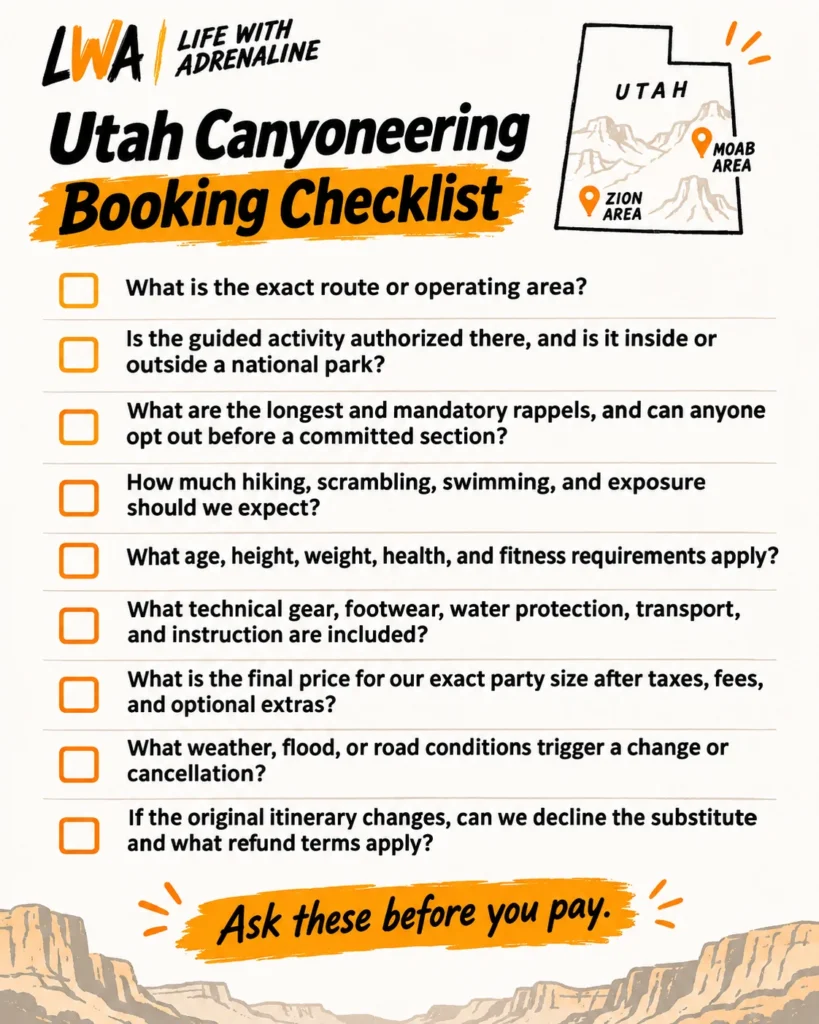
8. Nine Booking Questions That Matter More Than “Zion or Moab?”
- What is the exact route or operating area, and who manages the land?
- Is the guided activity authorized there, and is it inside or outside a national park?
- What are the longest and mandatory rappels, and can anyone opt out before a committed section?
- How much hiking, scrambling, swimming, and exposure should we expect?
- What age, height, weight, health, and fitness requirements apply?
- What technical gear, footwear, water protection, transport, and instruction are included?
- What is the final price for our exact party size after taxes, fees, and optional extras?
- What weather, flood, or road conditions trigger a change or cancellation?
- If the original itinerary changes, can we decline the substitute and what refund terms apply?
If the operator cannot answer these questions clearly, do not treat a beautiful photo or broad “beginner-friendly” label as a substitute for specifics. First-time canyoneers do not need to own a rope system to participate in a guided outing, but they do need to understand what they are agreeing to attempt.
Frequently Asked Questions
Is Zion or Moab better for a complete canyoneering beginner?
Both can work. The stronger first choice is the operator and specific route whose physical and technical demands fit you. Moab is appealing for named desert-route options around an adventure town; the Zion area makes sense when you want to pair a guided outing near the park with Zion scenery. Always verify the route and access rules.
Can a guide take me canyoneering inside Zion National Park?
Commercially guided technical canyoneering in Zion Wilderness is prohibited. Tours marketed as Zion canyoneering generally use appropriate land outside the designated wilderness. Independent technical routes inside the park require Wilderness permits and competence; a tourist tour booking does not replace those requirements. [S1][S2]
Can I book a guided canyon inside Arches National Park near Moab?
NPS says guided canyoneering services are prohibited within Arches National Park. Independent canyoneering there requires the park’s free permit. Guided trips sold in Moab may operate in other authorized areas, so verify where the tour actually goes. [S3]
Which region has more water or easier rappels?
Neither generalization is reliable. Conditions differ by named route, season, and weather. Ask about expected standing water, mandatory swims, rappel height, and whether a participant can leave before entering a committed section.
Is a half-day guided tour enough for a first trip?
Often, if it provides a suitable introductory route, enough time for instruction, and a manageable hike. “Half-day” is a booking label rather than a guarantee about rappel count or difficulty. Confirm how much of the scheduled period is spent traveling, practicing, and moving through the canyon.
Final Take: Zion or Moab?
Pick Zion-area canyoneering when its nearby guided route fits your group and the park visit is a meaningful part of the same vacation. Pick Moab when a specific named desert route and a multi-activity stay there sound better. Neither choice wins by default on safety, value, or technical ease. A clear route description, lawful access, appropriate guidance, and an honest total budget are worth more than a destination label.
If you still need to identify a suitable first outing anywhere in the country, start with our best canyoneering trips in the USA for beginners and return to this comparison after you know what kind of rappel experience you want.
Sources and Verification
The sources below were checked on November 21, 2026. Park rules, operator routes, prices, and conditions can change; recheck them before booking. No first-hand route testing is claimed.
[S1] National Park Service — Zion Wilderness Regulations: https://www.nps.gov/zion/planyourvisit/wilderness-regulations.htm
[S2] National Park Service — Zion Canyoneering and Wilderness Permits: https://www.nps.gov/zion/planyourvisit/canyoneering.htm
[S3] National Park Service — Canyoneering at Arches: https://www.nps.gov/thingstodo/canyoneering-at-arches.htm
[S4] East Zion Adventures — Hidden Creek Canyon: https://eastzionadventures.com/hiking-tours/hidden-creek-canyon/
[S5] Life With Adrenaline — How Much Does Canyoneering Cost? (operator price examples checked November 17, 2026): https://www.lifewithadrenaline.com/how-much-does-canyoneering-cost/