Zion Adventure Guide for First-Timers: Canyoneering, Climbing, and More
Quick Answer: What Is the Best Zion Adventure Activities for a First-Timer?
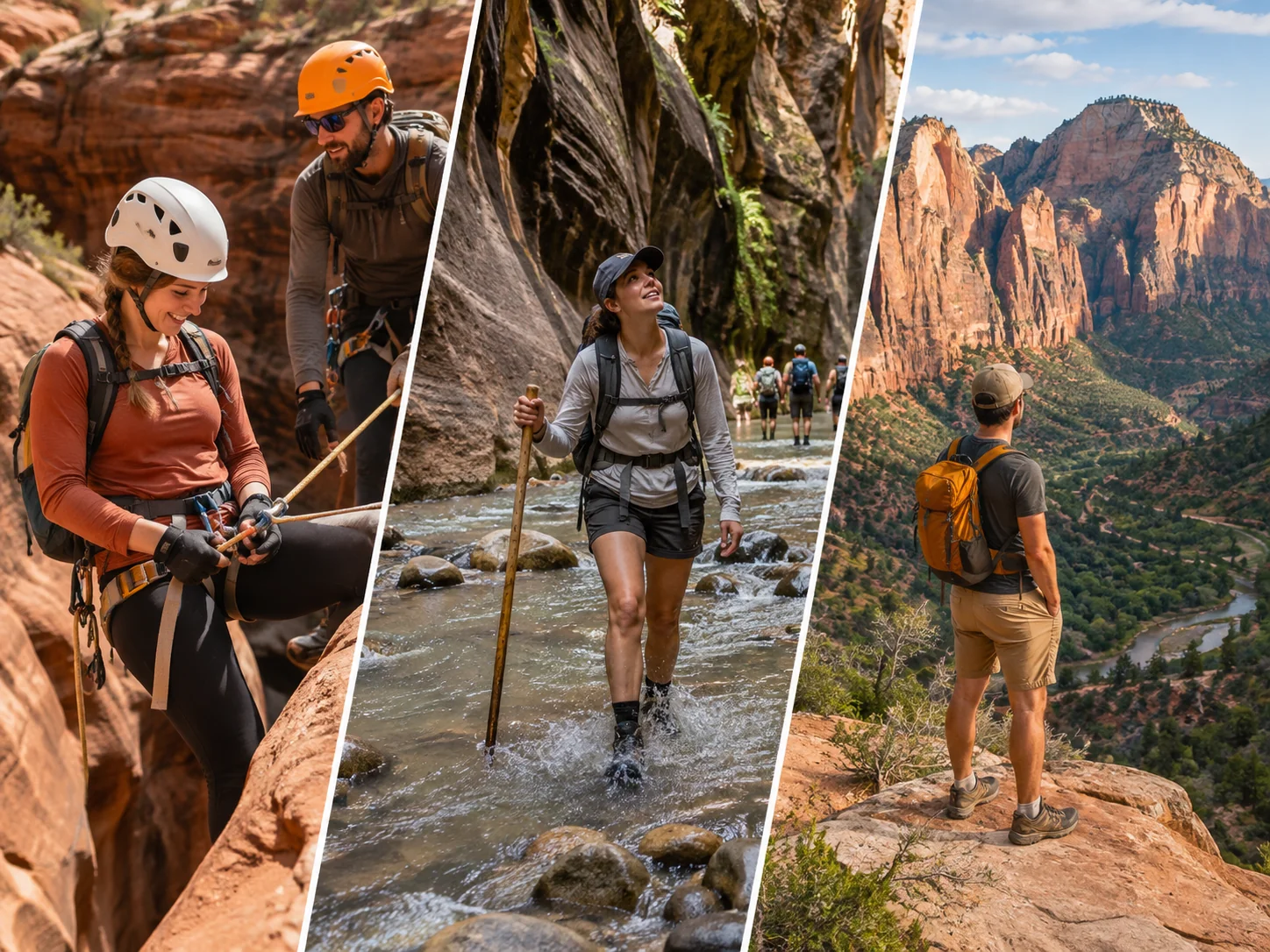
If you want one adventure that feels genuinely different from an ordinary hike, a guided beginner canyoneering trip on land outside Zion National Park is a compelling first choice. You can learn the basics of rappelling with an instructor, explore narrow sandstone terrain, and select a tour with a realistic physical commitment. Inside the national park, a short bottom-up visit to The Narrows offers dramatic slot-canyon scenery without technical ropes—but river conditions can make even a short outing demanding. [S2][S6][S7]
The important distinction is geographical and legal. Commercial guiding for technical canyoneering and climbing is not permitted in Zion Wilderness. Guided tours advertised as “Zion canyoneering” normally take place on nearby land, while technical routes inside the park require independent competence and, in most cases, a Wilderness permit. Never assume that a bookable canyon tour enters the national park itself. [S3][S8]
For a gentler starting point, choose an established canyon hike or a regulated bicycle ride. For greater exposure, consider Angels Landing only if you obtain the required chains-section permit and are comfortable with its genuine consequences. A first Zion vacation does not have to include every famous route.
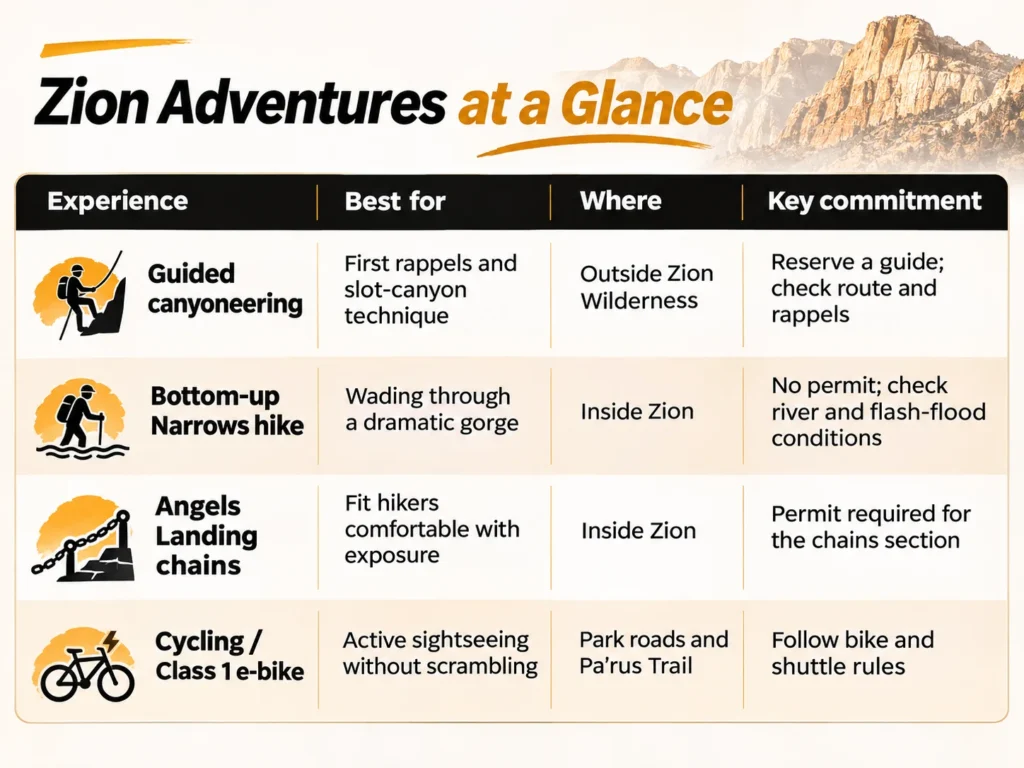
Zion Adventures at a Glance: Match the Format to Your Comfort
This comparison is a decision aid, not a ranking of accident risk. Conditions and participant requirements vary from day to day. “Beginner” is useful only when the exact route, guide, equipment and physical demands are defined.
| Experience | Where | Best fit | Key commitment / permission |
| Guided beginner canyoneering | Outside Zion Wilderness | First rappels and slot-canyon technique | Reserve a guide; check route, ages and rappels |
| Bottom-up Narrows hike | Inside Zion | Wading through a dramatic gorge | No permit; river and flash-flood conditions govern access |
| Angels Landing chains | Inside Zion | Fit, height-comfortable hikers | Permit required for chains; narrow exposure |
| Guided beginner climbing | Usually outside Zion Wilderness | Learn rope skills with an instructor | Ask for top-rope and exact location |
| Cycling / Class 1 e-bike | Park roads and Pa’rus Trail | Active sightseeing without scrambling | Traffic and shuttle rules; approved bike type |
| Scenic hikes / viewpoints | Inside Zion | Flexible first-day acclimation | Closures, heat, trail conditions and shuttles |
1. Guided Canyoneering Near Zion: Best for a First Rappel
Canyoneering involves much more than stepping backward over a cliff. On a typical guided introductory outing, participants hike into sandstone terrain, learn how a harness and rope system feel, descend short or longer drops under instruction, and move over uneven rock. Different tours may include tight passages, hands-on scrambling, water, or extended desert approaches. The best first tour is not necessarily the one with the tallest rappel.
Start by asking the operator three concrete questions: What canyon will we enter? Which part of the route is mandatory? And what physical movement is expected before and after the rope sections? Some trips can be customized for hesitant participants; others have a fixed technical sequence and no simple exit. A short description that says “all levels” does not answer those questions.
The legal boundary matters. Zion prohibits structured commercial guiding in its designated Wilderness; an advertised guided slot-canyon trip around Springdale or East Zion is generally held outside those areas. That can be an excellent way to learn without claiming to have descended a famous technical canyon inside the park. For exact differences between guided trips, park permits and independent descents, read our Zion canyoneering guide for beginners. [S3]
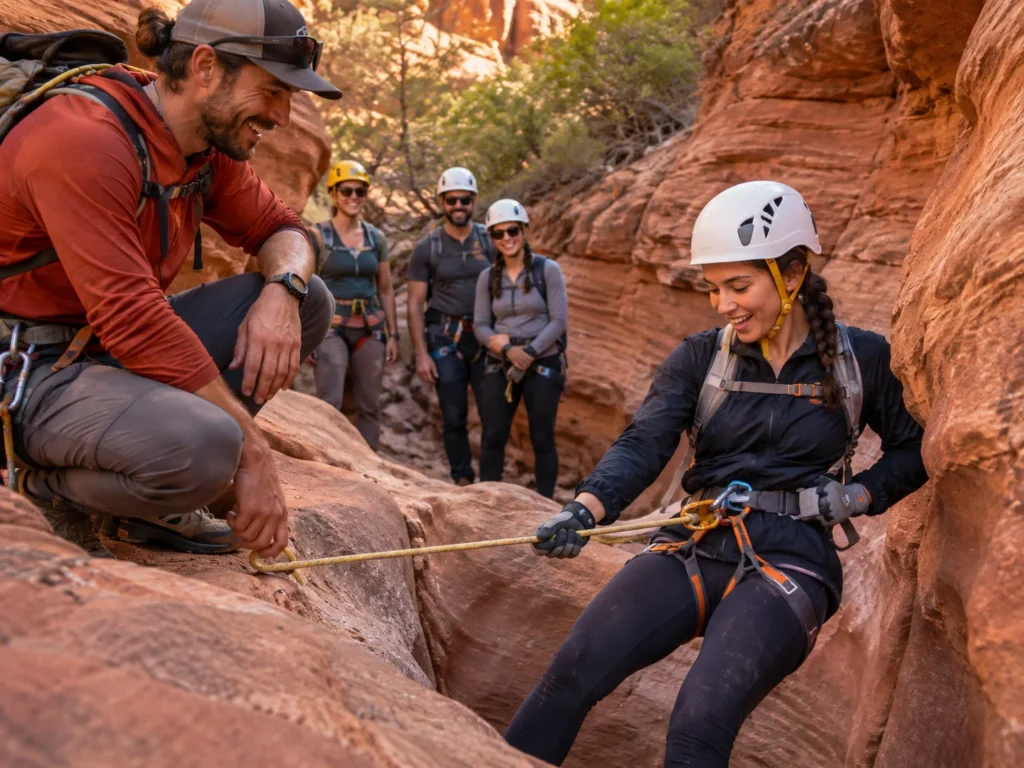
Gear is another reason to book a credible introductory product. Instead of buying a rope, descender, lanyard and helmet for one holiday, verify which technical items the guide supplies, what shoes and clothing you need, and whether transportation from the meeting point is included. Ask what the operator does when storm forecasts or road conditions make the planned route unsuitable. “We operate rain or shine” should not be interpreted as a promise to enter narrow terrain during dangerous runoff.
If this sport might become a recurring hobby, compare the best canyoneering trips in the USA for beginners before deciding whether Zion, Moab or another region suits the experience you want. A dry descent focusing on height can feel very different from a wet canyon with slippery movement and cold pools.
2. Technical Canyoneering Inside Zion Is a Different Commitment
Technical routes inside Zion require a different level of responsibility. The National Park Service requires a Wilderness permit for technical canyoneering using descending gear or ropes, as well as certain specific routes including the Subway and top-down Narrows. An online reservation is not itself the permit; the park issues the actual Wilderness permit under its current procedures. [S2][S4]
A party that intends to descend a technical canyon independently must be able to manage route finding, rope systems, water conditions and contingencies. A beautiful photograph does not tell you whether the canyon has cold swims, difficult anchors or an exit that becomes dangerous in afternoon heat. Do not treat a two-hour-looking route as a beginner route without verifying its entire approach, descent and exit.
The Subway is a good example of why naming matters. A bottom-up or top-down trip is not interchangeable, and permits apply to both. The route is not a last-minute guided family tour simply because it is famous on social media. If your group has never rappelled or practiced canyon rescue, the sensible first step is a class or guided introductory day on appropriate land outside Zion Wilderness. [S4]
This distinction also protects the authenticity of a booking recommendation. It would be misleading to place an affiliate button beside the words “guided trip inside Zion’s technical canyons” when the actual paid product runs elsewhere. In every activity description, specify the real meeting area and whether the canyon is in or outside the national park.
3. The Narrows: A Canyon Adventure Without Technical Rappelling
For visitors who want the sensation of being dwarfed by canyon walls without learning to rappel, the bottom-up Narrows is the classic alternative. Start at the Temple of Sinawava, use the Riverside Walk approach and continue upstream in the Virgin River for as little or as much time as conditions, ability and daylight allow. This bottom-up format does not require a Wilderness permit; a top-down through-hike does. [S1][S6]
What photographs hide is the footing. Much of the route is in flowing water over rounded, slippery rocks, with changing depths and uneven steps. The NPS recommends sturdy, closed-toe shoes and a walking stick; sandals and bare feet are inappropriate. Cold exposure can be significant even when the canyon outside feels hot. If you have limited balance, a short paved canyon walk may be a better choice. [S7][S12]
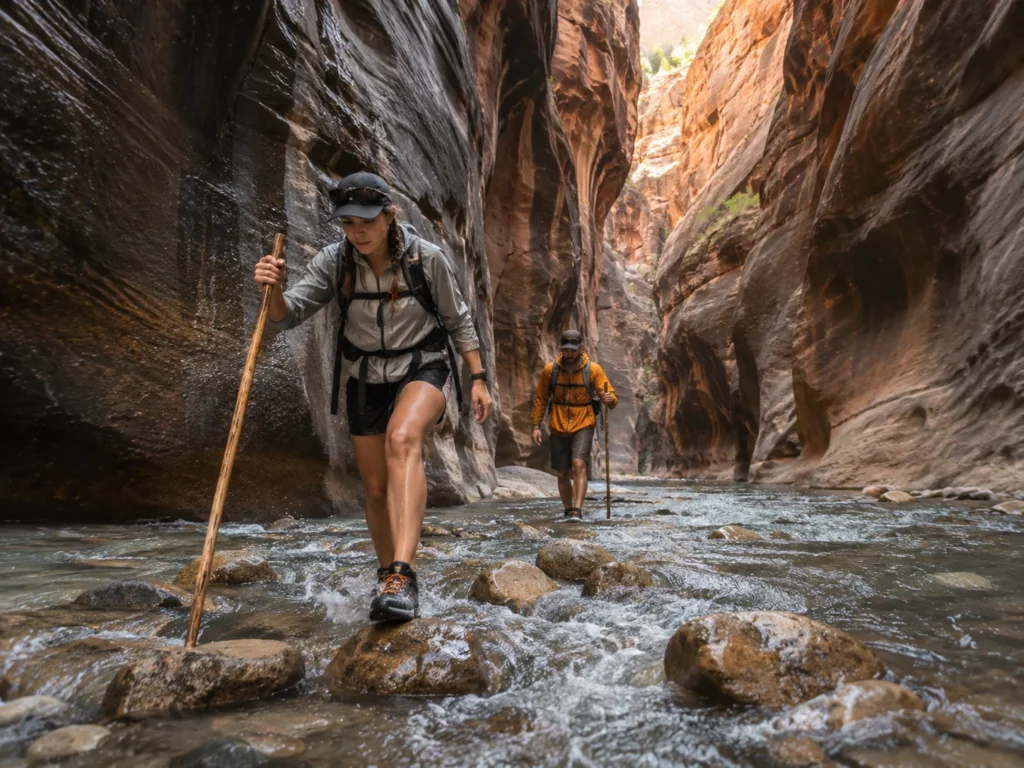
Flash floods are not an abstract disclaimer. Rain far upstream can send dangerous water into a narrow canyon even when the sky above you looks clear. The park closes the Narrows at flow greater than 150 cubic feet per second and during National Weather Service flash-flood warnings. Visitors also need to account for cyanobacteria-related water hazards. Never rely on a fixed blog itinerary to decide whether to enter the river that day. [S7][S11][S12]
A useful first-visit test is to reach the river entrance, assess the day’s current official conditions and turn around if the water, footing, forecast or crowd makes you uneasy. Visiting the canyon entrance is not a failure; it is a good way to learn how the environment feels before attempting a longer river hike.
4. Angels Landing: Iconic Exposure, Not an Automatic First Hike
Angels Landing is best treated as an optional advanced-feeling height experience, not a compulsory stop on a first Zion trip. A permit is required for the final chains section. The exposed ridge is narrow, two-way traffic can create bottlenecks, and a fall can have severe consequences. The NPS emphasizes remaining on the trail, cooperating with other hikers and taking special care along the chains. [S5]
Before entering the lottery, assess your honest response to exposure. Do you freeze on narrow paths? Are you comfortable making decisions while other hikers approach? Do heat, fatigue or a heavy backpack make your balance worse? Having climbed stairs or visited a viewing platform is not the same as hiking along a narrow ridgeline. A permit grants permission, not an assurance that conditions suit you.
For an alternative, consider an established non-chain hike with canyon views after checking its current status and physical demand. Do not use outdated itineraries that route visitors through closed trails. The NPS currently lists Hidden Canyon closed and says Observation Point is accessible only from the east rather than from Zion Canyon. [S11]
If what appeals to you is protected exposure rather than a permit-controlled narrow hike, read our via ferrata for beginners guide. A via ferrata is not the same activity as Angels Landing, and the existence of guided routes elsewhere does not authorize commercial guided climbing in Zion Wilderness. Choosing a different kind of height adventure can be a better fit than pushing through discomfort for a famous summit.
5. Beginner Rock Climbing: Choose Instruction Before a Famous Wall
Zion’s towering sandstone faces are impressive, but they are not a sensible place to improvise a first belay. Inside the park, commercial climbing guiding in Zion Wilderness is prohibited. The NPS does not inspect or maintain fixed climbing hardware and requires permits for overnight bivouacs, though not for ordinary day climbs. [S8]
A complete beginner seeking hands-on instruction should instead look for a legitimate climbing class or guided top-rope introduction on appropriate land outside Zion Wilderness. Ask the provider to describe its site, how it teaches harness fitting, commands, checks, belaying and lowering, and whether the outing is suitable for people who have never touched rock. Technical safety is not established by an Instagram photo of someone wearing a helmet.
Another question is whether you want a one-day vacation memory or a skill to practice afterward. A climbing gym orientation in your home city can make an outdoor trip much more enjoyable; you will arrive knowing how unfamiliar the equipment feels and what a controlled first ascent involves. If you are nervous about cliff exposure, pick a beginner session where the instructor can scale difficulty and duration.
Via ferrata is a separate category from traditional roped climbing, with fixed cables and specialized energy-absorbing equipment on authorized routes. Our best via ferrata routes in the USA guide compares actual venues; it should not be read as a list of in-park Zion climbs. Distinguishing these sports helps travelers avoid buying the wrong experience.
6. Bike Zion Canyon: Big Scenery, Different Type of Focus
Bicycling is an appealing alternative for travelers who want movement and striking canyon scenery without ropes. Bikes are permitted on park roadways and the Pa’rus Trail, not on Zion’s other hiking trails. The park allows Class 1 pedal-assist e-bikes under its published definition, while other e-bike categories are restricted. The Zion-Mt. Carmel Tunnel is not open for bicycling through on a bike. [S9]
The key safety issue is interacting with park shuttle traffic. Riders must travel single file, keep groups to six or fewer, and pull over to a complete stop when a shuttle approaches from behind. The road may look idyllic in a wide scenic photograph, but it is still shared with very large vehicles. An e-bike does not remove the need for alert braking, balance, stamina and awareness of pedestrians. [S9]
For a first ride, ask your rental provider about frame fit, battery range, allowable routes, helmets, roadside support and what happens if you tire before returning. Do not assume you can load an e-bike onto the free shuttle: the park says e-bikes cannot ride on the shuttle bike racks. The Pa’rus Trail is a useful lower-commitment introduction, but it is shared with pedestrians, with a 15 mph limit. [S9]
If your group includes someone who does not ride confidently, choosing a shuttle-and-hike day may be better than an ambitious bicycle schedule. The entire trip can still be an adventure without turning basic transportation into a stressful challenge.
Where to Stay and How to Get Around Zion
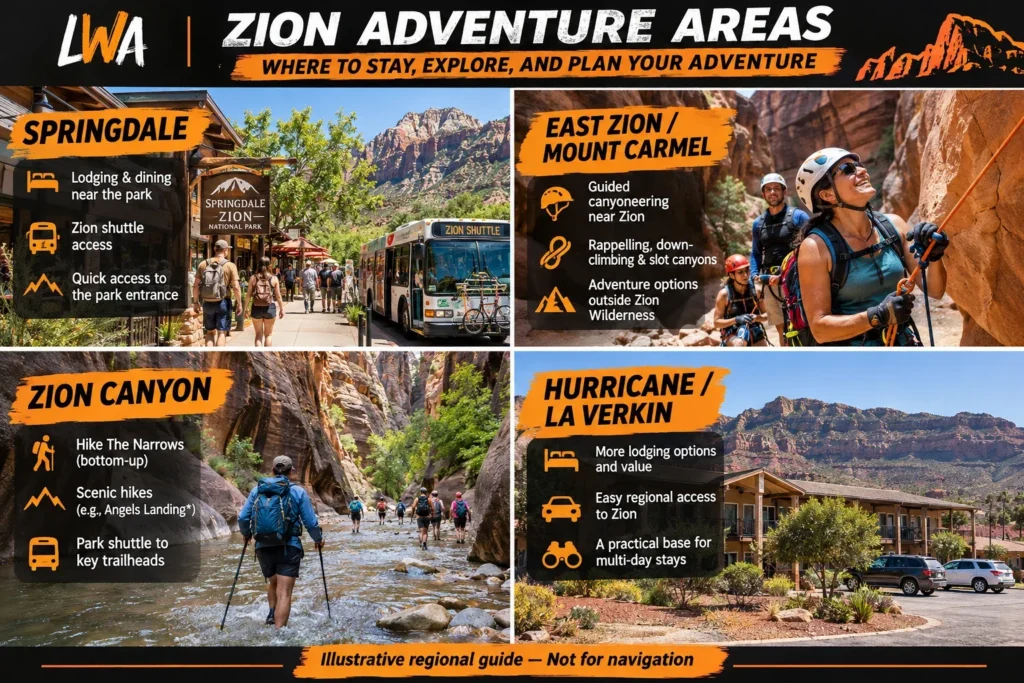
Springdale is the most practical base for many first-time travelers focused on the main Zion Canyon. It provides access to the pedestrian entrance, lodging, food and the seasonal town shuttle. Staying here can simplify early starts and reduce the need to drive between meals, trailheads and the visitor center. The tradeoff is that rooms near the entrance can sell out or become expensive during popular periods.
East Zion and the Mount Carmel area may make sense when the main paid activity is a canyon tour on nearby land, but confirm its actual departure point before booking. A tour marketed as “Zion” may start far from the pedestrian entrance. Hurricane or La Verkin can be an alternative lodging base for travelers with a car, at the cost of more driving and less spontaneous canyon access.
During shuttle season, private vehicles generally cannot use Zion Canyon Scenic Drive. For 2026, the NPS published shuttle operations from March 7 with a seasonal schedule and a gap from November 29 to December 25. Shuttles are free and do not require their own ticket, but the park entrance fee still applies. Check the current schedule instead of relying on an old timetable screenshot. [S10]
Allow extra time for lines, parking and the ride itself. A trip that appears 20 minutes away on a map can take far longer when it involves walking to the shuttle stop, waiting, riding up-canyon and getting ready at the trailhead. Planning one central activity per half-day tends to work better than stacking the Narrows, Angels Landing and a paid canyon trip into a single morning.
| Base | Best when | Planning tradeoff |
| Springdale | Main Zion Canyon hiking, shuttle, car-light stay | Busy lodging and entrance-area parking |
| East Zion / Mount Carmel | Guided canyoneering nearby and east-side access | Confirm each operator meeting site |
| Hurricane / La Verkin | Car-based budget flexibility | More driving for main-canyon days |
| In-park Zion Lodge / campground | Prioritize dawn access and park immersion | Reservation availability and specific access rules |
Two-, Three-, and Four-Day Zion Adventure Itineraries
Two days: one iconic canyon, one guided skill
Day 1: settle into Springdale, use the park shuttle, walk an established frontcountry trail and choose a viewpoint or a short Riverside Walk visit after checking conditions. Day 2: book a verified guided beginner canyoneering session outside Zion Wilderness. Keep a generous buffer for the operator’s meeting time and a low-effort dinner. If storms threaten narrow canyons, use the operator’s cancellation or alternative plan rather than improvising another canyon.
Three days: add a controlled height or river challenge
Keep the two-day framework and use Day 3 for either a bottom-up Narrows outing when official conditions permit or a permit-backed Angels Landing attempt if you genuinely want ridge exposure. These are alternatives, not interchangeable attractions. They require different preparation, fitness and tolerance for uncertainty. If neither fits, a bicycle outing or lower-exposure scenic hike gives you a rewarding additional day.
Four days: make room for weather and learning
Add a fourth day for climbing instruction outside the park, a slower scenic ride, or a new area of the region. This extra time makes the itinerary more resilient. It allows you to postpone a water-dependent activity instead of feeling compelled to proceed during a questionable forecast. Do not schedule a demanding technical day immediately after an exhausting drive or a long prior hike.
All three itineraries are frameworks, not guarantees of access. Permit outcomes, river flow, shuttle operations, heat, seasonal closures and actual tour meeting locations should determine the final order. Start with the scarce permit or guide reservation, then build the flexible scenic portions around it.
When to Visit: Heat, Water and Seasonal Tradeoffs
Spring can offer pleasant hiking temperatures but may bring higher snowmelt-driven flows that affect the Narrows. Summer creates long daylight and popular guided-tour inventory, alongside extreme canyon heat and monsoon-season flash-flood potential. Fall can be appealing for walking and photography but shorter daylight and variable temperatures still matter. Winter offers quieter conditions on some trails, yet ice, cold water and changed shuttle operations can sharply limit certain objectives. [S11][S12]
This is why “best month” is less helpful than matching your primary activity to the conditions it needs. If a Narrows river day is your nonnegotiable goal, check the NPS history and current flow guidance. If rappelling is the priority, ask the operator what weather limits it uses and how it handles rescheduling. For cycling, account for road conditions and the length of the return ride.
No seasonal prediction in a destination article should override the park’s current conditions notices, a ranger’s guidance or the guide’s actual day-of-trip decision. The right Zion itinerary keeps one enjoyable activity available even when the signature slot canyon is not viable.
How to Compare Guided Tours Without Inventing a Safety Ranking
When two canyon tours use similar photographs, a meaningful comparison begins with the actual trip format. Ask whether the outing is shared or private, how many participants accompany each guide, what terrain is covered before the first rappel, and how the operator teaches an unfamiliar client to use the equipment. Verify what happens if someone decides not to complete a drop after arriving at the canyon. The answer may vary by route; there is no universal right to step aside once a group has passed a committing point.
Ask about vehicle access as carefully as the outdoor activity itself. Some excursions begin at an in-town storefront but require a separate drive to the canyon, sometimes on rough roads. Others require you to arrive at a remote meeting point with your own transport. A start time is not always the same as the time you enter the canyon, and a listed duration may include gearing up, transfers and return travel. This is a practical reason to avoid stacking a second timed reservation immediately after a guided trip.
Finally, check the guide’s current operating terms and whether the company is clear about its land access. A professional-looking website and attractive testimonials do not prove the suitability of a specific route for your health, age, balance or fear of heights. It is more useful to receive a direct written answer to your concerns than to rely on a generic “great for anyone” description. Your goal is not to find the company promising the most excitement, but to book a defined day your whole group understands.
Budgeting and Booking Without Confusing the Fees
A Zion adventure budget usually contains at least four layers: lodging, park entry or pass, the guided activity fee, and transportation or gear. A guided canyoneering trip outside the park does not automatically include the park entrance fee, and a park entrance ticket does not include commercial rappelling instruction. Likewise, an Angels Landing lottery application, an awarded permit, and an outfitter reservation are separate items with different rules.
Rather than publish an invented “average Zion adventure price,” compare real checkout totals from two or three tour providers for your exact date and party size. Ask what is included: helmet, harness, rope systems, guide, vehicle transport, private-group upgrades, taxes, photo packages or gratuities. Also ask whether refunds differ when the operator cancels for weather versus when a customer changes plans.
Budget some flexibility for parking, meals, a rental vehicle and unexpected gear needs. The least expensive headline product can become a more costly day if its location requires an extra rental-car day or a long drive. Conversely, spending more on a Springdale base can reduce transfers when your itinerary centers on the main canyon and park shuttles.
Affiliate links, if added later, should take readers directly to a specific verified product and be clearly disclosed. Do not promote a technical in-park wilderness descent as a commercial beginner tour. The correct offer is the one that matches the reader’s real location, ability, permit requirements and time budget.
Safety and Eligibility: Nine Questions Before You Pay
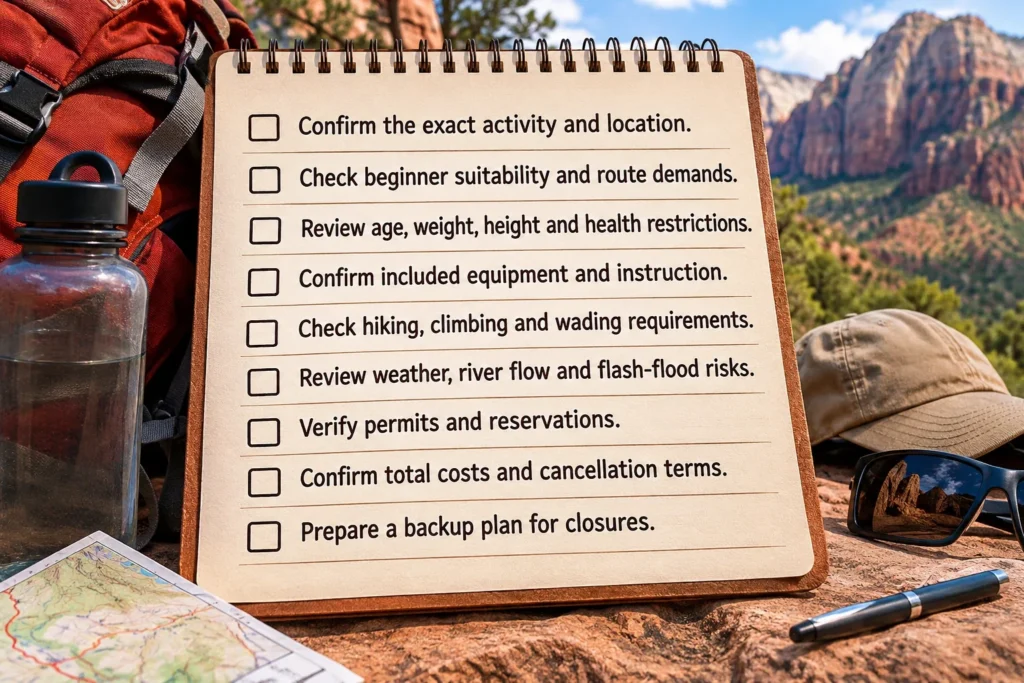
Start with the exact location, because “Zion area” may refer to the national park, Springdale, East Zion or another outdoor site. Then verify the route and the technical requirements. The questions below are more useful than accepting the marketing label “beginner friendly” at face value.
• Where does the activity actually take place, and how do we get to the start?
• Is it intended for people with no prior rappelling, climbing or river-wading experience?
• What age, weight, height, reach or medical requirements apply to every participant?
• Which equipment and instruction are provided, and what must we bring ourselves?
• How much time is spent hiking, scrambling, wading, climbing or waiting—not just on the advertised highlight?
• What weather, flash-flood or river conditions trigger cancellation or a route change?
• Are NPS permits required, and is the reservation separate from the permit?
• What is the complete price and what refund or rescheduling terms apply?
• What is the backup activity if the chosen canyon, trail or road is closed?
Do not treat a blog’s illustrations as equipment instructions, a conceptual region guide as a navigation map or a previously published access rule as today’s permission. Check current NPS notices and operator requirements immediately before departure. [S1][S7][S11]
Frequently Asked Questions
Can first-timers go canyoneering in Zion?
A guided introductory canyon tour near Zion can be appropriate for complete beginners when the operator explicitly accepts them. Technical descents inside Zion Wilderness are not the same product: they require independent skills and permits, and commercial guiding there is prohibited. [S2][S3][S4]
Do I need a permit for The Narrows?
The bottom-up hike from the Temple of Sinawava does not require a Wilderness permit. The top-down through-hike does. Current flow, weather and park closures still determine whether entering the river is appropriate. [S1][S6][S12]
Do I need a permit for Angels Landing?
Yes, for the final chains section. Obtaining a permit does not remove the need to assess exposure, weather, fitness and trail conditions for yourself. [S5]
Can I hire a climbing guide inside Zion?
Commercial guiding is prohibited on Zion Wilderness climbs. Look for a legitimate instructional outing at an approved site outside those Wilderness areas and verify the meeting location before paying. [S8]
Can I ride an e-bike in Zion Canyon?
Class 1 pedal-assist e-bikes are permitted on designated bike routes under NPS rules. They cannot ride through the Zion-Mt. Carmel Tunnel, and e-bikes cannot be loaded onto the park shuttles. [S9]
Where should I stay for a first visit?
Springdale is usually the simplest base for shuttle-served Zion Canyon days; East Zion or Mount Carmel can fit nearby guided canyoneering; Hurricane and La Verkin give car-based lodging alternatives. Confirm exact meeting points rather than choosing a hotel from a generic “near Zion” label.
Final Recommendation
For a first Zion adventure, choose an experience that teaches you something without forcing you into the most technical terrain. A professionally guided canyon outside Zion Wilderness offers a memorable introduction to rappelling. A short Narrows visit provides striking no-rope canyon scenery when conditions allow. Scenic cycling and frontcountry trails leave more room to control effort. Angels Landing, independent technical canyons and serious rock climbs are different commitments that should follow preparation rather than social-media pressure.
Choose one main objective each day, confirm permits and route access, leave a realistic weather backup and be specific about what is actually inside Zion National Park. The best first-timer itinerary is the one you can confidently enjoy from check-in through the return—not just the few seconds captured in a dramatic photograph.
Sources and verification notes
Official National Park Service references checked November 16, 2026. Availability, restrictions and closures can change. The source links below are the starting point for day-of-trip verification.
[S1] NPS — Zion Permits and Reservations: https://www.nps.gov/zion/planyourvisit/permitsandreservations.htm
[S2] NPS — Zion Canyoneering: https://www.nps.gov/zion/planyourvisit/canyoneering.htm
[S3] NPS — Wilderness Regulations: https://www.nps.gov/zion/planyourvisit/wilderness-regulations.htm
[S4] NPS — Zion Canyoneering Permits: https://home.nps.gov/zion/planyourvisit/canyoneeringpermits.htm
[S5] NPS — Angels Landing Permits: https://www.nps.gov/zion/planyourvisit/angels-landing-hiking-permits.htm
[S6] NPS — The Narrows Bottom-Up: https://home.nps.gov/zion/planyourvisit/narrowsbottomup.htm
[S7] NPS — Narrows Safety: https://www.nps.gov/zion/planyourvisit/narrowssafety.htm
[S8] NPS — Climbing Regulations: https://home.nps.gov/zion/planyourvisit/climbingregulations.htm
[S9] NPS — Bicycling: https://www.nps.gov/zion/planyourvisit/bicycling.htm
[S10] NPS — Zion Shuttle 2026: https://www.nps.gov/zion/learn/news/2026-02-06-shuttle-schedule.htm
[S11] NPS — Current Conditions: https://www.nps.gov/zion/planyourvisit/conditions.htm
[S12] NPS — Zion Narrows: https://www.nps.gov/zion/planyourvisit/thenarrows.htm
[S13] NPS — Zion Current Operating Hours: https://www.nps.gov/zion/planyourvisit/hours.htm