How Much Does Canyoneering Cost? Guided Trip Prices and Total Budget
Quick Answer: What Does a Guided Canyoneering Trip Cost?
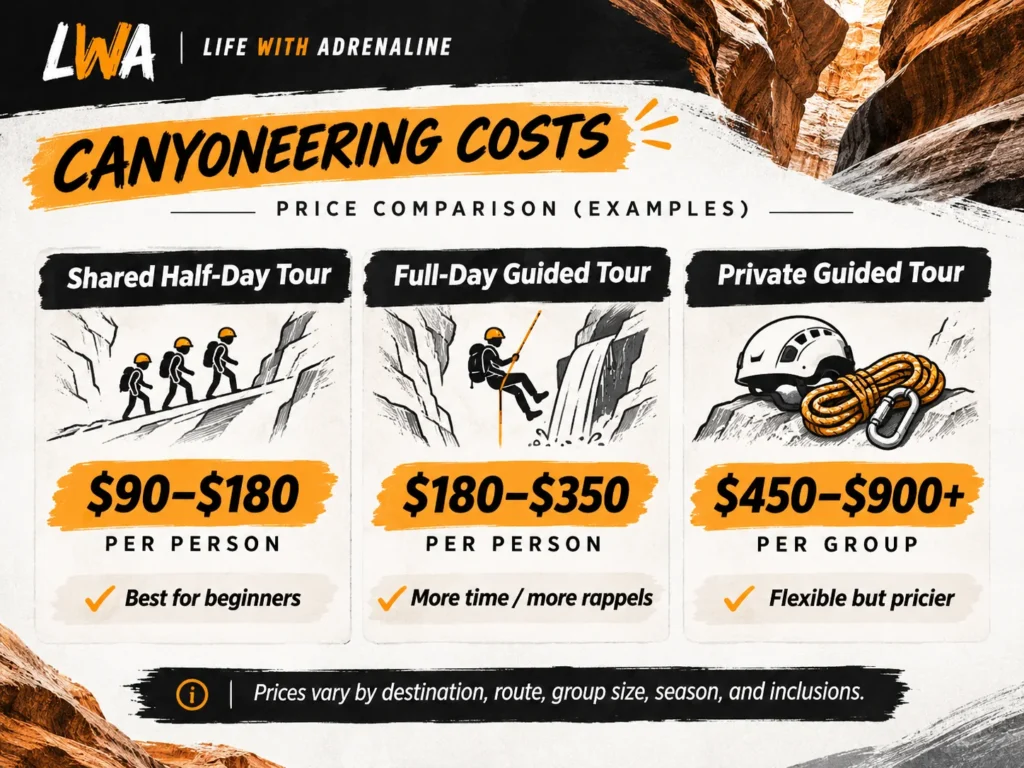
For a first canyoneering outing in the United States, a useful planning starting point is roughly $100–$250 per person for a conventional shared or small-group guided day, but this is an editorial budgeting range—not a measured national average or a quote for any specific trip. Short introductory trips can advertise less, while small private bookings, long wet-canyon days, and trips involving more logistics can cost considerably more. The price you see first is rarely the full cost of getting to the canyon and back.
In the operator pages checked on November 17, 2026, East Zion Adventures lists Hidden Creek from $89 for four hours and Rock Drop Canyon from $149. Moab Desert Adventures shows a basic half-day rate of $90 per person when four or more people join, but $185 for one participant. Zion Guru lists a half-day at $223 per person for two people or $159 each for eight. Rappel Maui lists its roughly three-hour Classic waterfall-rappelling tour at $240.84 including tax. The activities, destinations, booking conditions, and inclusions differ, so none of these figures should be used as an apples-to-apples quality ranking. [S1][S2][S3][S4]
A more useful question than “What is the cheapest canyon?” is “What will I pay for the exact experience I can actually complete?” Keep route difficulty, guide-to-guest ratio, swimming and hiking requirements, mandatory rappels, transport, taxes and cancellations next to the number on the booking page.
Real Published Canyoneering Prices: Four Different Booking Models
| Operator / region | Example offer | Displayed rate | Important context |
| East Zion Adventures — Utah | Hidden Creek, 4 hr | From $89 | Starting price; beginner listing; verify date and checkout total |
| Moab Desert Adventures — Utah | Basic half-day, 4+ guests | $90/person | Same company lists $185 for a single person |
| Zion Guru — Utah | Half-day, 2 guests | $223/person | 2026 pricing, plus state sales tax and fees |
| Zion Guru — Utah | Half-day, 8 guests | $159/person | Group-size-dependent pricing |
| Rappel Maui — Hawaii | Classic group, ~3 hr | $240.84/person | Price explicitly includes tax; wet waterfall setting |
These figures are snapshots from public operator pages, checked November 17, 2026. “From” pricing can change with date, route, age group, party size and add-ons. A half-day often includes travel to and from the activity site, so the number of hours on the listing is not necessarily the number of hours spent rappelling. Confirm the exact reservation screen before payment. [S1][S2][S3][S4]
What Actually Drives the Price Up or Down?
1. Group size changes the price—even before the canyon does
Guiding is staff-intensive. A company still needs a qualified guide, gear and travel time when one visitor books instead of six. That is why “$90 per person” and “$185 solo” can appear on the same Moab rate card. Zion Guru makes the relationship unusually clear: a half-day booked one-on-one is listed at $432 total, while an eight-person group is $159 per person. The cost per participant can fall as the group grows, even though the group total rises. [S2][S3]
Do not assume all operators assemble strangers into a shared departure. Some trips are private by default, some sell individual seats, and some require a minimum group size. Ask whether the quoted amount is per person, per guide, per group or for an entire vehicle; whether other guests can be added; and whether taxes are calculated on the group total.
2. A “half day” is a format, not a universal duration
Zion Guru labels a 3.5–4-hour trip as a half-day, including transportation, and a 6.5–7.5-hour product as full-day. Another company may use a shorter slot for a beginner rappel or spend much of the booked time driving to the approach. Compare actual movement: approach mileage, scramble difficulty, number of rappels, and return hike. A longer, less technical day is not automatically better value than a shorter, well-paced introduction. [S3]
For a first outing, a controlled half-day can be a better purchase than paying for extra hours you are not yet sure you enjoy. If your goal is practicing more advanced movement, a long day or an instructional course can be worth more—but only when that activity is explicitly offered.
3. Wet canyons and specialized routes involve different logistics
A dry desert slot often centers on approach hiking, rock movement and rappel exposure. A wet-canyon or waterfall experience may involve specialized footwear, cold water, swimming and different retreat options. Rappel Maui’s Classic group experience lists a practice rappel followed by two waterfall descents when conditions allow, with water conditions affecting the plan. This is a different product from a dry desert intro, not a higher-priced version of the same ride. [S4]
Terrain alone does not produce a reliable price formula. Land access, instructor staffing, vehicles, season and local operating costs also matter. Avoid choosing a destination solely because a viral video shows a spectacular drop that seems “worth the money.”
Shared Tour vs. Private Guide: Which Is Better Value?
A shared tour usually makes the most sense for a solo traveler or couple comfortable joining others. You buy seats rather than paying for an entire dedicated booking. The tradeoff is less control over pace, stops and possible participant mix. A private trip can be helpful when your group has a wide fitness range or wants additional instruction, but “private” is not a substitute for matching the route to every participant.
| Party type | Pricing question | Potential benefit | Main caution |
| Solo | Is there a shared seat, or a solo minimum? | Lower group-seat price if available | Solo private cost can rise sharply |
| Couple | Is it per person or a private two-person price? | Choice of shared or dedicated format | Two seats may not be half a private booking |
| Family / friends | Is there a group price, child rate or minimum? | Cost shared across a known group | Check age, size and route commitment |
| Private instruction | Is training included or only guiding? | Ability to discuss specific learning goals | Do not equate more money with automatic safety |
For a numerical example, at Zion Guru’s listed half-day rates, two participants paying $223 each have a $446 activity subtotal, while four participants at $188 each have a $752 group subtotal. The second group spends less per head, but more in total; the figures exclude stated state taxes and fees. This comparison says nothing about whether one departure is more appropriate for your needs. [S3]
What Is Usually Included in the Guided-Tour Price?
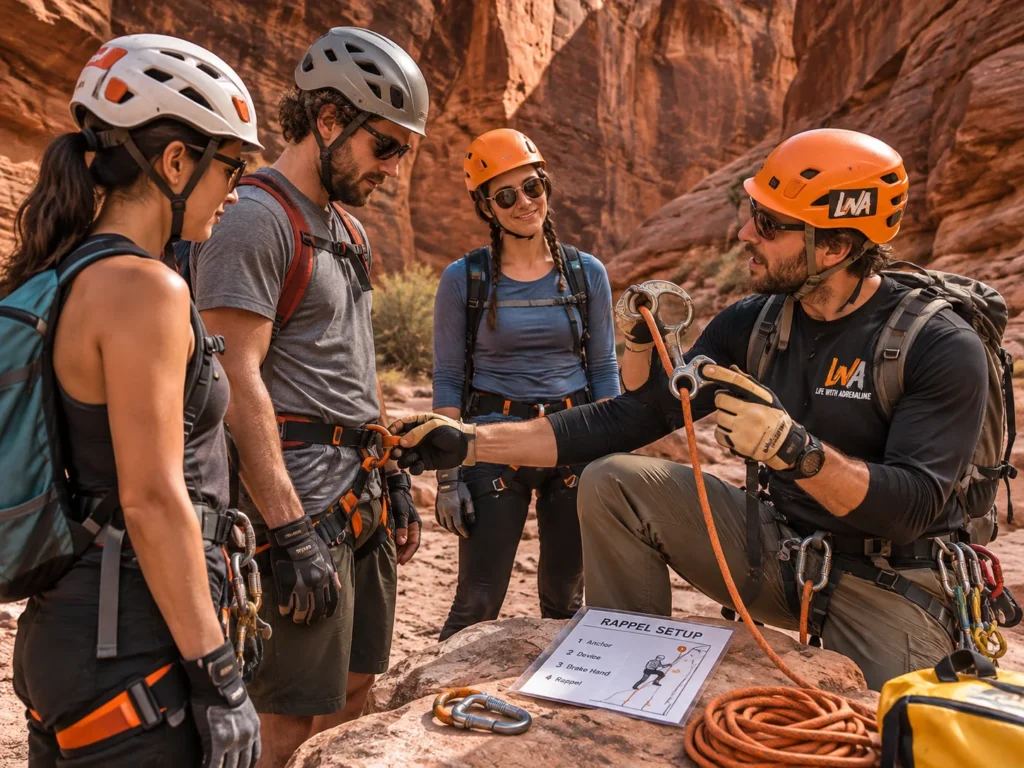
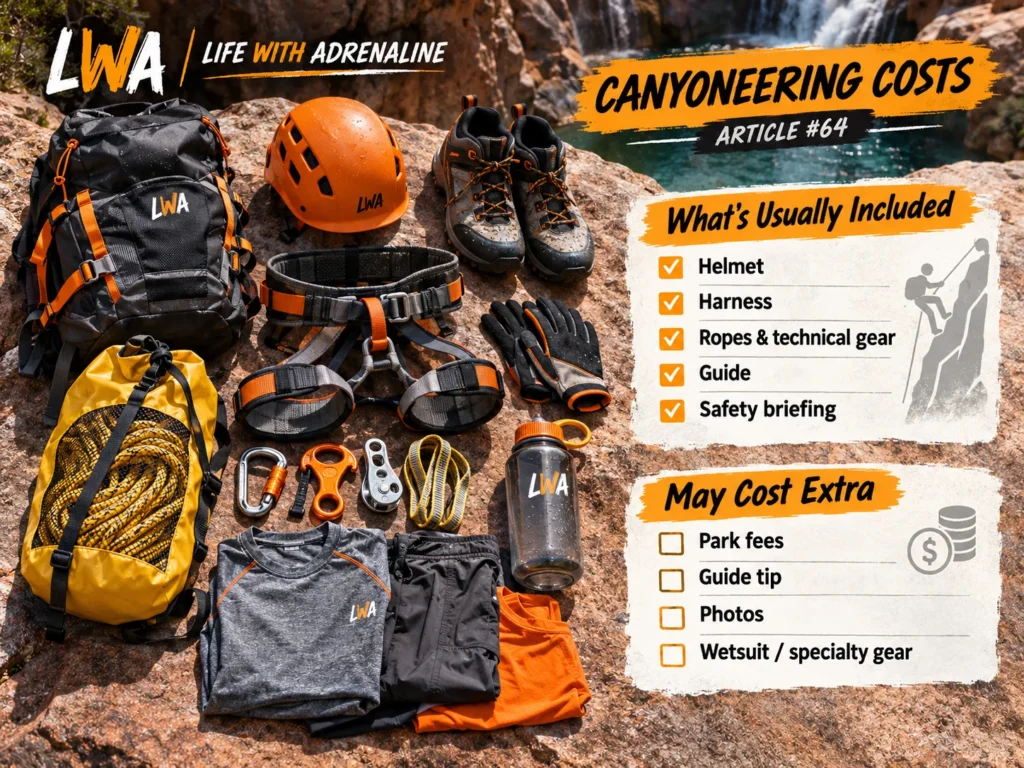
Many professional trips include the guide, helmet, harness, descender and other technical systems. They may also include a safety briefing, instruction on how to move on rope, and transfers from a designated meeting point. But the inclusion list is not universal. For example, Magnum Expeditions says its Moab trips provide technical gear and professional instruction, while clients supply food, snacks and water; taxes and guide gratuity are not included. Rappel Maui lists specialized footwear, bottled water and snacks in its Classic package. [S4][S5]
- Usually worth checking: guide services, helmet, harness, descender, ropes and any wetsuit or specialized canyon footwear.
- Transportation: exact pickup location, vehicle transfers and whether parking or off-road transfers cost extra.
- Food and water: meals, snacks, bottles or hydration packs, especially for full-day departures.
- Photos and digital extras: included files, optional photo packages or restrictions on personal cameras.
- Insurance, waivers and rescue arrangements: ask what the company provides and what personal coverage you may need.
Equipment being “included” does not remove the need to meet size limits, wear appropriate shoes and follow the guide’s instructions. A quote that lacks the route name, mandatory rappels or participant requirements is incomplete even if the gear list looks generous.
The Hidden Costs: A Real Total-Budget Checklist
The guide fee is only one line of the budget. Most price surprises come from travel, taxes, tips, route-specific clothing and the fact that a remote canyon rarely sits next to your lodging. Put these items in one place before comparing two operators.
- Checkout charges: state and local sales tax, booking or processing fees, and optional add-ons.
- Gratuity: some operators explicitly exclude guide gratuity; do not present a universal percentage as required.
- Ground transport: rental car, fuel, rideshare availability, parking and shuttle costs.
- Lodging: one extra night can outweigh a small difference between trip prices.
- Personal kit: appropriate footwear, layers, sun protection, water and a dry change of clothes.
- Meals and timing: breakfast before an early departure, food after the trip and a possible recovery day.
- Cancellation exposure: non-refundable deposits, minimum notice, weather rescheduling and travel bookings.
In the Zion area, check the operator’s actual meeting point. A guided canyon sold with the word “Zion” in its title may be on permitted land outside Zion National Park Wilderness; the National Park Service does not authorize commercial guiding for technical canyoneering in Zion Wilderness. Park entry and a commercial canyon booking are separate matters. For location and permit distinctions, see our Zion canyoneering guide for beginners. [S6]
Three Worked Budgets: What You Might Actually Spend
The following are planning examples, not quotes from tour providers. Every non-tour allowance is an illustrative assumption, and tax or fee treatment follows the cited operator description only where specified. Substitute your actual itinerary and checkout price.
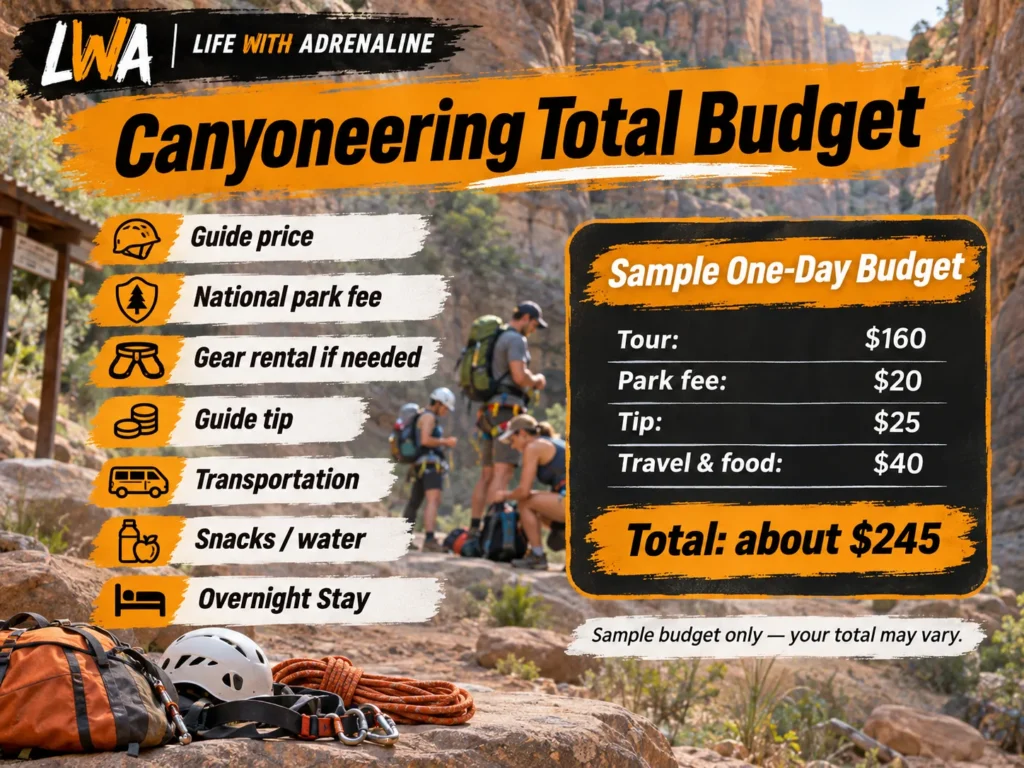
| Budget scenario | Tour subtotal | Other assumed costs | Illustrative total |
| One person, East Zion starter | From $89 | Transport $35 + food $20 + fees/tips buffer $25 | $169+ |
| Two people, Zion Guru half-day | $446 (2 × $223) | Travel $60 + meals $45 + taxes/fees/tips budget $85 | $636 |
| Four people, Moab basic half-day | $360 (4 × $90) | Transport $75 + meals $70 + fees/tips budget $75 | $580 |
The first line uses a starting price and should not be treated as a guaranteed bookable total. The second line is a two-person activity subtotal built from Zion Guru’s published 2026 price; its stated taxes and fees are additional, so the $85 is simply a provisional planning allowance. The third line uses Moab Desert Adventures’ four-person entry-tier half-day price; the trip’s final taxes, private-request rules, and actual suitability must be reconfirmed. Lodging and flights are deliberately excluded from this activity-day table because they vary too widely to hide in a generic total. [S1][S2][S3]
For a destination trip, calculate the larger decision separately: two hotel nights plus transport plus the guided activity. If one canyon is the only reason for flying, the lodging and transportation may dominate the bill. If the tour fits a trip you already planned to Moab, East Zion or Maui, the added cost of the experience may be much lower.
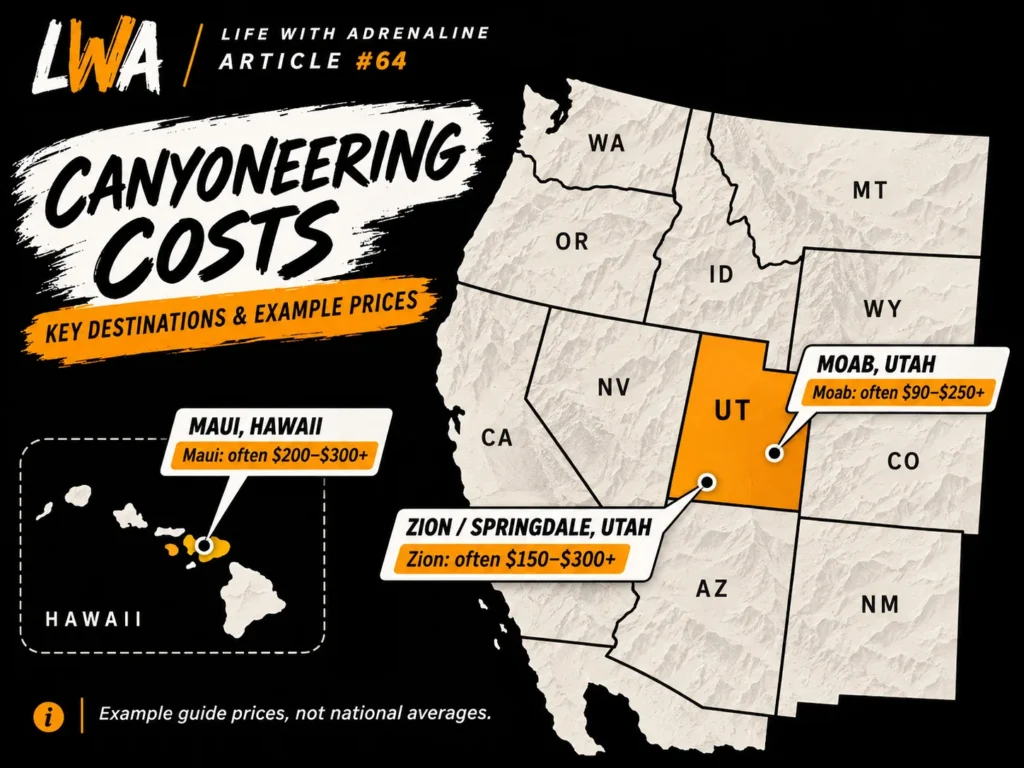
How Costs Compare by Destination
Moab, Utah: strong choice for a dry-leaning introductory trip
Moab has multiple guided canyon products, from compact introductions to longer descents. For a first-timer, the best comparison is not simply “half-day for $90 versus half-day for $150.” Ask which route is used, whether the fee reflects an existing group, how much walking is involved and whether every rappel is mandatory. Our Moab canyoneering guide for beginners explains route categories and why the canyon itinerary matters at least as much as the sticker price.
Near Zion, Utah: pay attention to the park boundary
East Zion operators advertise beginner canyons and mixed UTV-and-canyon formats, while Springdale-based providers may offer half- and full-day options on suitable lands outside the park’s wilderness. A price difference can reflect the vehicle component, trip duration, group size or land access rather than a superior or inferior adventure. Check exactly what the “Zion” product includes and where it meets. [S1][S3][S6]
Maui, Hawaii: compare waterfall rappelling separately
Maui’s forested-waterfall setting introduces a different kind of day from Utah’s dry-rock terrain. Rappel Maui’s published $240.84 tax-inclusive Classic group price includes guided instruction and technical gear, but getting to the Road to Hana meeting point is still part of your personal logistics. If waterfalls are the main attraction, compare our waterfall rappelling trips in the USA rather than treating all canyoneering prices as equivalent. [S4]
Arizona and other regions: request the exact trip quote
Arizona canyon trips range from short dry approaches to wet, demanding canyon days. Published prices may vary by season, participant minimum and route conditions. If an operator has a quote-only itinerary, do not substitute a third-party listing price without checking its date, inclusions and cancellation rules. A transparent written quote is more valuable than an unverified “typical regional average.”
When Is Paying More Worth It?
Paying more may be rational when the additional amount buys something you actually need: a route matched to your group, more instructional time, a smaller departure, specialized footwear, a clearly included transfer or an alternative plan for unsuitable conditions. It is less compelling when the difference buys only a bigger adjective on the booking page. “Extreme,” “premium” and “VIP” do not disclose the descent technique, difficulty or risk.
For many beginners, the best value is a trip they can realistically complete and enjoy, with explicit mandatory rappel heights and enough time for the group to learn the basics. If you are still deciding between places and canyon styles, our best canyoneering trips in the USA for beginners provides a route-centered starting point.
Nine Questions to Ask Before You Pay
- 1. What is the exact route and where does it take place?
- 2. How many hours are on site versus driving or hiking?
- 3. Which rappels and swims are mandatory, and how tall or long are they?
- 4. Is the price per person, per private group or a minimum charge?
- 5. What gear, footwear, transportation, food and water are included?
- 6. What is the final checkout total with taxes, fees and add-ons?
- 7. What age, size, health and fitness restrictions apply?
- 8. What happens when weather or road access changes the plan?
- 9. When can we cancel or reschedule, and what will we lose?
Save the answers alongside the reservation confirmation. Ask the guide about route commitment before handing over non-refundable travel money. Weather or water conditions can change the plan; a clearly defined alternative is more reassuring than an absolute guarantee.
Frequently Asked Questions
Is canyoneering expensive for a first-timer?
It can be, but the guide fee alone does not tell the full story. Lower advertised introductory prices exist, and shared departures can reduce the per-person cost. A distant destination, a solo private booking or extra hotel nights can make the same activity much more expensive. Budget both the booking subtotal and the travel needed to reach it.
Does a guided canyoneering tour include equipment?
Many include technical rope equipment and a helmet, but footwear, wetsuits, food, transport and photos vary. Read the actual operator’s inclusion list. Do not buy specialized canyoneering hardware for a one-off trip unless the provider specifically requires it and you know how it must be used.
Is private canyoneering always safer than a group tour?
No. Private guiding can offer more individual attention or a personalized pace, but risk depends on the route, current conditions, guide practices, participant decisions and many other factors. Paying more does not guarantee safety. Compare relevant qualifications, procedures, fit and clarity of the itinerary instead.
Can I save money by skipping the guide?
An unguided technical canyon is not a budget substitute for an introductory commercial outing. It requires independent knowledge of route finding, ropes, anchors, changing water and permits. A beginner should not take a technical route simply to avoid the guide fee; choose a nontechnical scenic hike if the guided cost does not fit your budget.
Do I need to tip my canyoneering guide?
Policies vary, and gratuities may be optional or explicitly excluded from the posted price. Check the operator’s wording before travel, then decide what fits your circumstances. The important budget point is not to discover the issue only at the end of a long canyon day.
Final Take: Buy the Right Canyon Day, Not the Lowest Number
Canyoneering cost is best understood in layers: the quoted guide fee, what that fee buys, and the transport and travel needed to make the day happen. Start with a route you can complete, ask for a written total and check the cancellation terms. A manageable half-day can be a better introduction than an ambitious all-day booking with a vague itinerary.
Compare the best canyoneering trips in the USA for beginners if you need to choose a destination first, or explore our best adrenaline activities in the USA if you are not sure canyoneering is the right first adventure at all. The goal is a trip that feels worth its total cost—not merely a transaction with the smallest advertised price.
Sources and Verification
Prices and terms checked November 17, 2026. Tour rates and rules may change; verify current checkout pricing, availability, insurance requirements, land access and conditions. Examples are not endorsements or first-hand tests.
[S1] East Zion Adventures — Adventure Pricing
[S2] Moab Desert Adventures — Rates
[S3] Zion Guru — Canyoneering Tours
[S4] Rappel Maui — Classic Group Tour
[S5] Magnum Expeditions — Canyoneering FAQs
[S6] National Park Service — Zion Wilderness Canyoneering
[S7] Life With Adrenaline — 7 Best Beginner Canyoneering Trips