
For a first tandem skydive, wear comfortable athletic clothes that let you move freely, closed-toe shoes that stay securely on your feet, and weather-appropriate layers. Avoid loose accessories, heels, sandals and clothing with obvious snag hazards. Bring an extra layer even on a warm day, and always check your drop zone’s current clothing and footwear rules before leaving home. [S1][S2][S3][S4]
The good news is that you probably do not need a special skydiving wardrobe.
For most first-time tandem jumps, the best outfit looks more like something you would wear for an easy workout than specialized extreme-sports gear. Comfortable pants or leggings, a T-shirt or long-sleeve athletic top and secure sneakers are usually a better choice than heavy outdoor clothing.
But weather is only part of the decision.
Your clothes also need to work with a tandem harness, stay secure in fast-moving air and comply with the rules of the drop zone where you are jumping. Those rules can differ from one operator to another. [S1][S2]
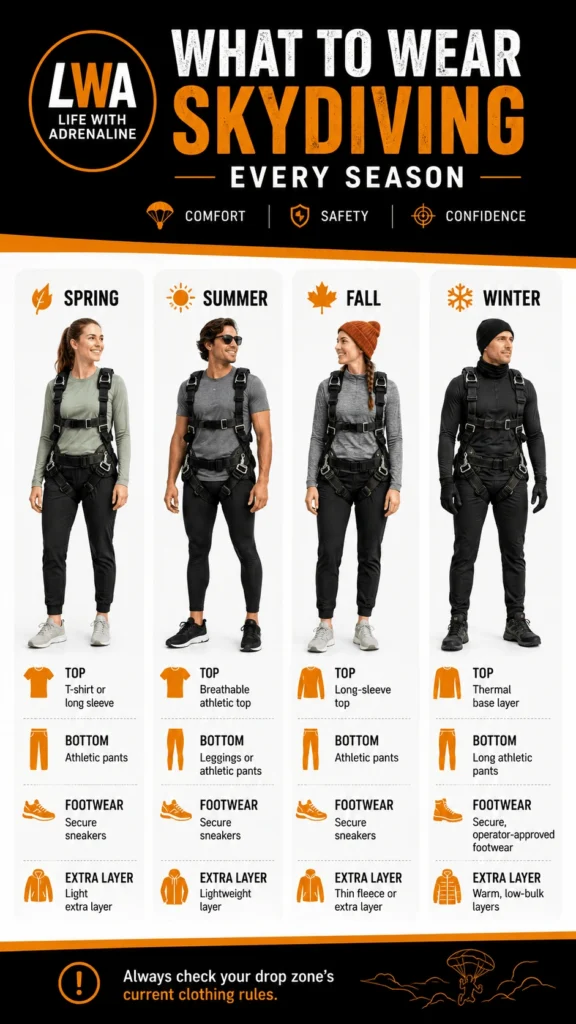
What to Wear Skydiving at a Glance
| Season | Good Starting Outfit | Bring With You | Common Mistake |
| Spring | Athletic pants + T-shirt or long sleeve | Light extra layer | Trusting the ground temperature alone |
| Summer | Breathable athletic top + leggings, athletic pants or appropriate shorts | Lightweight layer | Sandals or extremely short shorts |
| Fall | Athletic pants + long-sleeve top | Light fleece or low-bulk layer | Wearing a bulky hoodie |
| Winter | Thermal base layer + athletic pants + warm low-bulk layers | Extra warm layer; ask DZ about gloves/footwear | Assuming winter boots are automatically allowed |
This table is a starting point, not a universal dress code. Your drop zone’s instructions take priority.
The Four Tests Every Skydiving Outfit Should Pass
Instead of asking whether an outfit “looks like skydiving clothes,” ask whether it passes four practical tests.
1. Can You Move Freely?
You will need to walk around the drop zone, climb into an aircraft, move into the exit position and follow your instructor’s body-position instructions.
Stretchy athletic clothing works well because it allows a good range of motion without adding unnecessary bulk. Paraclete XP recommends athletic-style clothing, while Perris specifically favors close-fitting athletic clothes. [S2][S3]
Try this before leaving home:
Squat, sit, raise your knees and arch your back slightly.
If the outfit feels restrictive on the ground, choose something else.
2. Will It Work Comfortably With a Tandem Harness?
A tandem harness fits around your legs and torso.
That makes extremely short shorts, stiff pants and bulky layers less appealing than they might seem on the ground. WNY Skydiving specifically warns that very short shorts may be uncomfortable because of the harness. [S4]
Leggings, joggers, flexible athletic pants and comfortable jeans are generally easier choices.
3. Does It Have Loose or Snag-Prone Parts?
Keep the outfit simple.
Paraclete XP advises avoiding clothing and accessories with potential snag hazards, while Cross Keys warns against loose accessories such as hats and scarves as well as jewelry and belts that may create snag concerns. [S3][S5]
That does not mean every zipper, button or belt is automatically forbidden at every drop zone. It means your safest planning strategy is to minimize unnecessary loose hardware and let the instructor make the final call.
4. Is It Appropriate for Both the Weather and Your Drop Zone?
Conditions at altitude can feel much colder than the temperature you experience while waiting on the ground. Perris recommends bringing an additional layer, and several operators emphasize dressing for current weather conditions rather than the calendar alone. [S2][S4]
The smart strategy is simple:
Dress comfortably for the ground and bring one adaptable extra layer.
What Are the Best Clothes for Skydiving?
For most first-time tandem jumpers, start with:
- Leggings or athletic pants
- Joggers or flexible sweatpants
- Comfortable jeans that allow good movement
- T-shirt
- Long-sleeve athletic shirt
- Thin base layer in colder weather
- Lightweight, non-bulky outer layer if your drop zone approves it
- Secure athletic shoes
You do not need to look like a professional skydiver.
In fact, specialized clothing may provide little benefit for a person making one tandem jump.
Some drop zones also provide a jumpsuit, but you should not assume yours will. Perris, for example, says it can provide a jumpsuit when a guest’s clothing does not adequately cover the shoulders or shins, or when the customer simply wants one. [S2]
Check your own operator’s policy before deciding what to wear underneath.
What Shoes Should You Wear Skydiving?
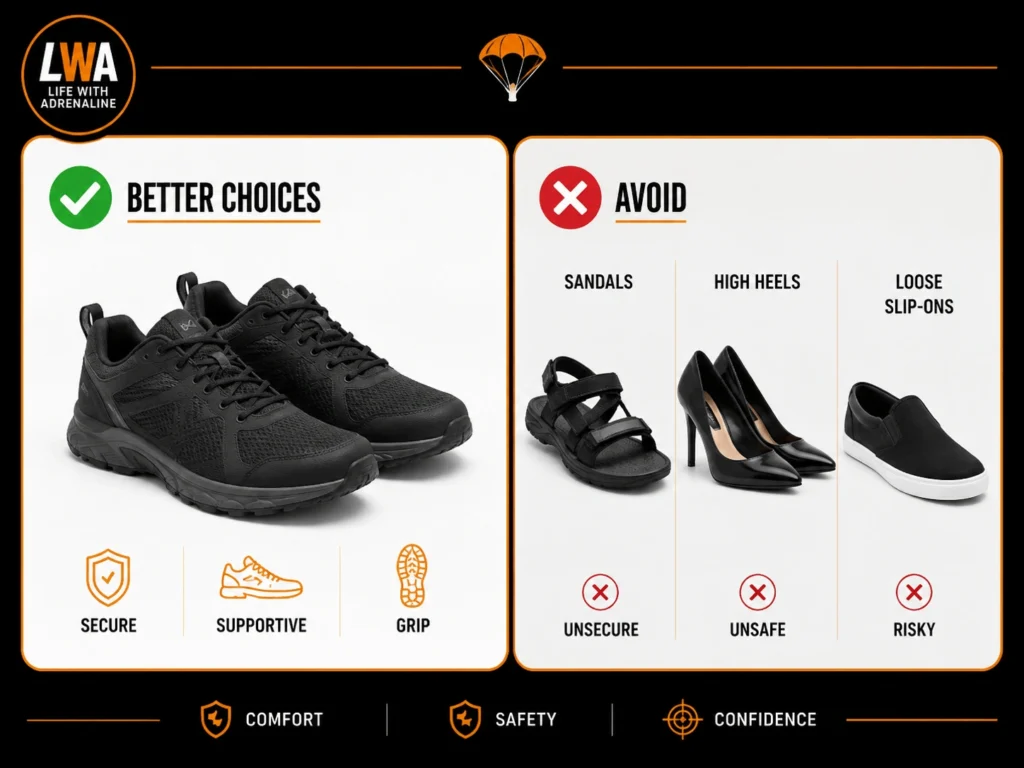
Footwear deserves more attention than most first-timers give it.
A simple pair of secure athletic shoes is usually the easiest choice.
Perris requires closed-toe footwear and identifies lace-up tennis, running and skate shoes as suitable options. It prohibits heels, boots, sandals and footwear with hooks for its tandem customers. WNY Skydiving similarly requires sneakers rather than sandals, open-toed shoes, boots or heels. [S2][S4]
USPA’s safety material also notes that unstable footwear such as flip-flops or Crocs can increase ankle-injury risk compared with sneakers or well-fitted laced shoes. [S6]
A Good First-Time Skydiving Shoe
Look for:
- Closed toes
- Secure laces
- Flat or relatively low-profile soles
- A snug fit
- Enough comfort for walking and waiting around the drop zone
Avoid
- Flip-flops
- Sandals
- High heels
- Loose slip-on footwear
- Shoes that can easily come off
- Shoes with obvious hooks or snag points
What About Boots in Winter?
This is where universal advice becomes risky.
USPA’s general winter-jumping guidance discusses winter boots or shoes but specifically warns against hooks and other snag points. Perris and WNY, however, prohibit boots for their tandem customers. [S2][S4][S7]
So do not assume that your normal winter boots are acceptable.
Ask the drop zone what footwear it allows before your jump.
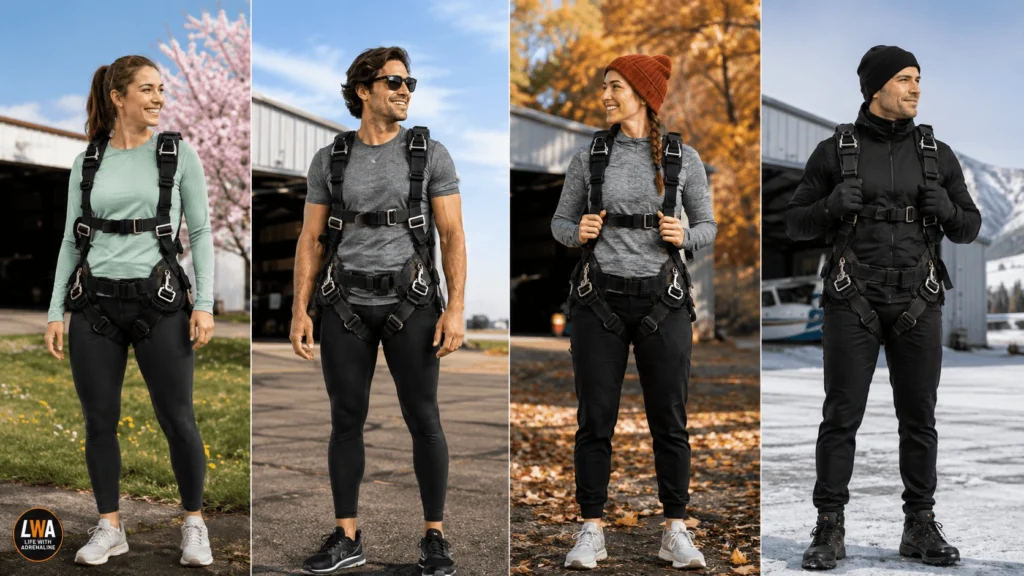
What to Wear Skydiving in Spring
Spring weather can change quickly, so flexibility matters more than dressing for a specific month.
A good starting combination is:
- Athletic pants or leggings
- T-shirt or lightweight long-sleeve top
- Secure sneakers
- One extra light layer in your bag
Avoid building your outfit around a heavy jacket that cannot easily be removed.
If the day warms up while you wait, you want the option to shed a layer before gearing up.
What to Wear Skydiving in Summer
On a hot summer day, breathable athletic clothing makes sense.
Consider:
- Lightweight athletic shirt
- Leggings or breathable athletic pants
- Appropriate shorts if your drop zone allows them
- Closed-toe lace-up sneakers
- A thin extra layer for altitude
Shorts are not universally prohibited. WNY Skydiving, for example, says shorts can work in warm weather, while warning that very short shorts may be uncomfortable under the harness. Perris may provide a jumpsuit if clothing does not cover the shins or shoulders. [S2][S4]
That is another reason to check the exact operator policy.
And no matter how hot it is at the drop zone, sandals are not a good substitute for secure athletic shoes. [S2][S4][S6]
What to Wear Skydiving in Fall
Fall may be the easiest season to underestimate.
A comfortable combination is:
- Athletic pants
- T-shirt or long-sleeve athletic top
- Lightweight base layer if needed
- Secure sneakers
- Thin fleece or another low-bulk layer available for colder conditions
Avoid a complicated outfit with several bulky pieces.
The goal is adaptable warmth without restricting movement or creating unnecessary loose material around the harness.
What to Wear Skydiving in Winter
Cold-weather jumps require more planning.
USPA’s winter-jumping guidance emphasizes proper cold-weather clothing and protecting exposed skin. It also highlights the need to maintain visibility, mobility and dexterity while wearing winter gear. [S7]
For a tandem first-timer, a reasonable starting point is:
- Thermal or moisture-wicking base layer
- Long athletic pants
- Long-sleeve top
- Low-bulk insulating layer
- Secure footwear approved by your drop zone
Do not simply pile on the thickest clothes you own.
Your instructor needs to fit the harness correctly, and some drop zones may have specific clothing or footwear restrictions.
Ask whether gloves are recommended or provided rather than assuming you should bring your normal winter pair.
Can You Wear Jeans Skydiving?
Usually, comfortable jeans are possible, but they are not necessarily the best choice.
If your jeans are stretchy enough to sit, squat and move comfortably, they may work fine.
If they are tight, stiff or restrictive, athletic pants are a better option.
WNY Skydiving allows jeans in warm weather, while Skydive Front Royal notes that jeans may be less comfortable than athletic wear. [S4]
Can You Wear Glasses or Contact Lenses Skydiving?
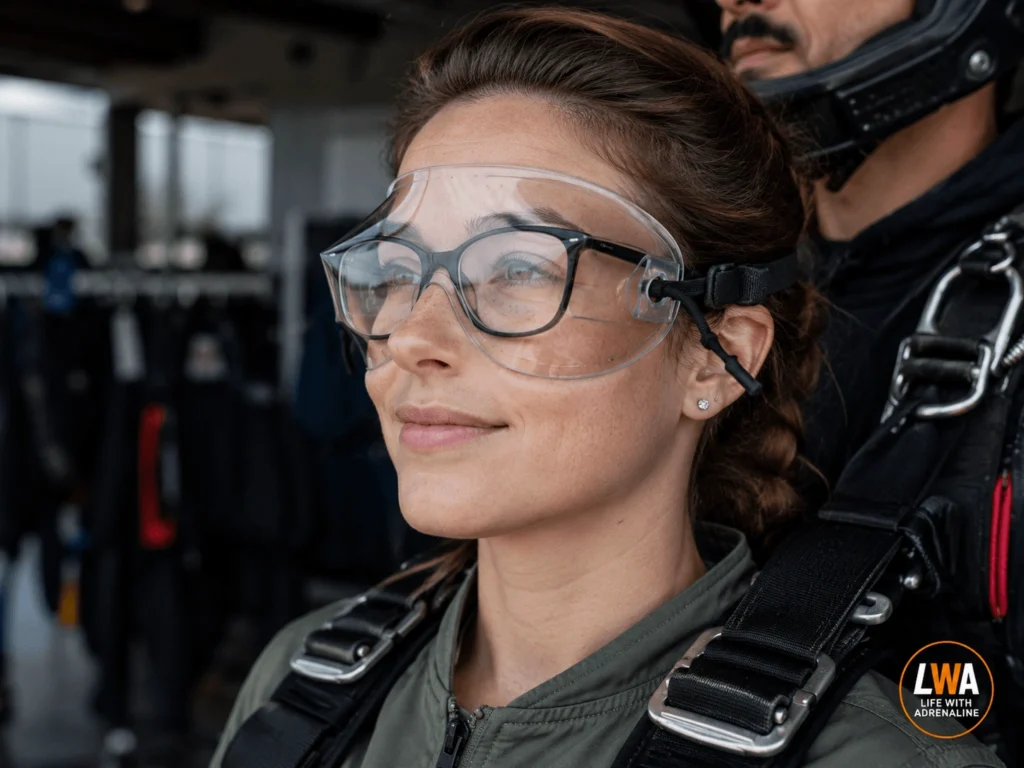
For many tandem jumps, yes.
Skydive Perris allows both prescription glasses and contact lenses and provides appropriate protective goggles. It recommends wearing a relatively low-profile pair of glasses when possible so the goggles can fit securely over them. [S2]
Because goggle systems and operator policies vary, tell your drop zone in advance if you wear prescription glasses.
If you own several pairs, bring the pair that fits most securely and ask the instructor which option works best with their equipment.
What About Long Hair?
Secure it before gearing up.
Cross Keys specifically recommends bringing extra hair ties for hair that needs to be restrained. [S5]
A braid or secure low ponytail may be practical depending on your hair length and the instructor’s preference, but ask your instructor how they want it secured before putting on your equipment.
Jewelry, Hats, Scarves and Hoodies
The simplest rule is:
Leave unnecessary loose accessories on the ground.
Cross Keys advises against loose hats and scarves and identifies jewelry and belts as potential snag hazards. Paraclete XP similarly recommends avoiding jewelry and accessories and lists hooded sweatshirts and jackets among items it advises against. [S3][S5]
If you need a warm layer, a simple non-hooded top is therefore an easier default than a bulky hoodie.
Do You Need a Skydiving Jumpsuit?
Not necessarily.
Jumpsuit policies vary between operators.
Some drop zones provide them routinely or under certain conditions; others may allow you to jump in suitable street or athletic clothing.
At Perris, a jumpsuit can be provided when clothing does not cover the shoulders or shins, or simply when the customer wants one. [S2]
Do not buy your own skydiving jumpsuit for a first tandem jump.
Check what your operator provides and wear comfortable clothing underneath.
Can You Take Your Phone or GoPro on the Jump?
Do not plan to attach a phone, action camera or other recording device to yourself for your first tandem skydive.
USPA’s current camera-flying guidance recommends that skydivers be licensed and have completed at least 200 jumps before jumping with a camera. Camera equipment also introduces additional snag, distraction and equipment-interaction considerations. [S8]
If you want photos or video, check the professional media options offered by the drop zone.
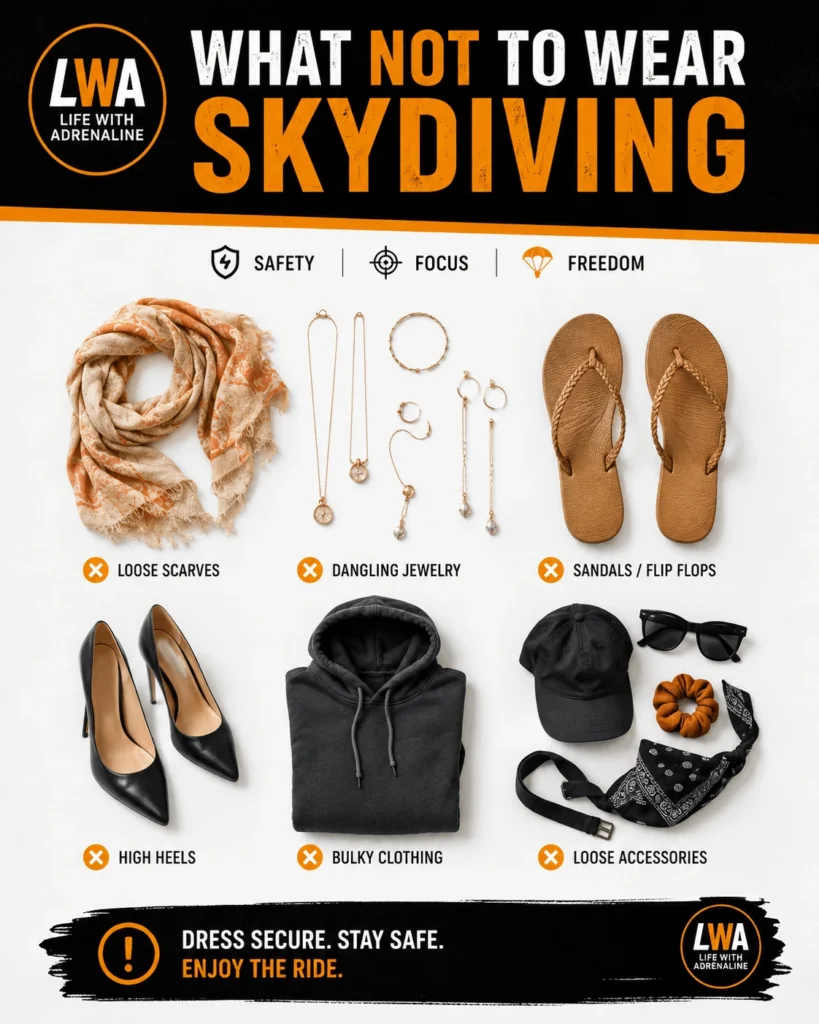
What Not to Wear Skydiving
Unless your drop zone specifically approves otherwise, avoid arriving with your jump dependent on any of these:
- Flip-flops
- Sandals
- High heels
- Loose slip-on shoes
- Boots with hooks or snag points
- Bulky clothing
- Loose scarves
- Unsecured hats
- Dangling jewelry
- Clothing with excessive loose cords or hardware
- Extremely short shorts
- Your own camera setup
Operator rules can be stricter than this list, so your confirmation email and drop-zone instructions take priority. [S1][S2][S3][S4][S5]
Before-You-Book and Jump-Day Clothing Checklist
Before your skydive:
☐ Check the drop zone’s current clothing requirements.
☐ Confirm its footwear policy.
☐ Ask whether a jumpsuit is provided.
☐ Ask about glasses if you need prescription eyewear.
☐ Choose clothes that allow a full range of motion.
☐ Avoid loose or unnecessary accessories.
☐ Bring an extra weather-appropriate layer.
☐ Pack a hair tie if you have long hair.
☐ Leave your GoPro or personal camera setup on the ground.
☐ Recheck the forecast and the operator’s instructions on jump day.
Frequently Asked Questions
Do I need special clothes for my first skydive?
Usually not. Comfortable athletic clothing is a practical starting point, and some operators provide jumpsuits. Check the exact policy of your drop zone. [S2][S3]
Should I wear shorts or pants?
Either may be possible depending on the operator and weather. Pants provide more coverage, while very short shorts can be uncomfortable under a tandem harness. [S2][S4]
What are the best shoes for skydiving?
Secure, closed-toe lace-up athletic shoes are the safest default for planning purposes. Many tandem operators specifically prohibit sandals, heels and boots. [S2][S4]
Can I wear contacts while skydiving?
Many operators allow contacts and provide protective goggles. Tell the instructor that you wear contacts or glasses so the appropriate eyewear can be fitted. [S2]
Should I buy a special skydiving outfit?
For one tandem jump, probably not. Start with comfortable clothing you already own and spend money only if you genuinely lack suitable footwear or weather layers.
Final Recommendation
For your first tandem skydive, keep the outfit boring in the best possible way:
comfortable athletic clothes, secure lace-up shoes and simple layers.
The biggest mistake is not choosing the “wrong color” or failing to buy technical gear. It is assuming that a clothing rule you saw online applies to every drop zone.
Choose an outfit that lets you move easily, minimizes loose items and works with the weather. Then check your operator’s current rules before jump day.
That final check matters more than any universal skydiving packing list.
Sources
[S1] United States Parachute Association — Your First Skydive: https://www.uspa.org/students/your-first-skydive
[S2] Skydive Perris — Tandem Skydiving FAQs: https://skydiveperris.com/skydiving/tandem/faqs/
[S3] Skydive Paraclete XP — Guidelines on What to Wear Skydiving:
https://skydiveparacletexp.com/2023/04/18/guidelines-what-to-wear-skydiving/
[S4] WNY Skydiving — Planning Your Day: https://wnyskydiving.com/tandem-skydiving/planning-your-day/
[S5] Skydive Cross Keys — First Time Skydiving Tips: https://www.skydivecrosskeys.com/first-time-skydiving-tips/
[S6] United States Parachute Association — That’s How We Roll: Ankle Injuries in Skydiving:
https://www.uspa.org/thats-how-we-roll-ankle-injuries-in-skydiving
[S7] United States Parachute Association — Staying Warm and Safe on the Winter Jumps:
https://www.uspa.org/staying-warm-and-safe-on-the-winter-jumps
[S8] United States Parachute Association — Skydiver’s Information Manual 5-7: Camera Flying:
https://www.uspa.org/SIM/5-7