
Choosing your first adrenaline activity is not about finding the least scary option. It is about finding the experience where the fear feels exciting, the physical demands are realistic, the logistics fit your day, and the level of instruction gives you enough confidence to participate.
A good first adventure does not need to be your biggest one.
Before booking, compare five things: fear, fitness, guidance, time, and total cost. That simple framework can help you separate an activity that genuinely fits you from one that only looks impressive on social media.
The Five-Factor First-Adventure Fit Test
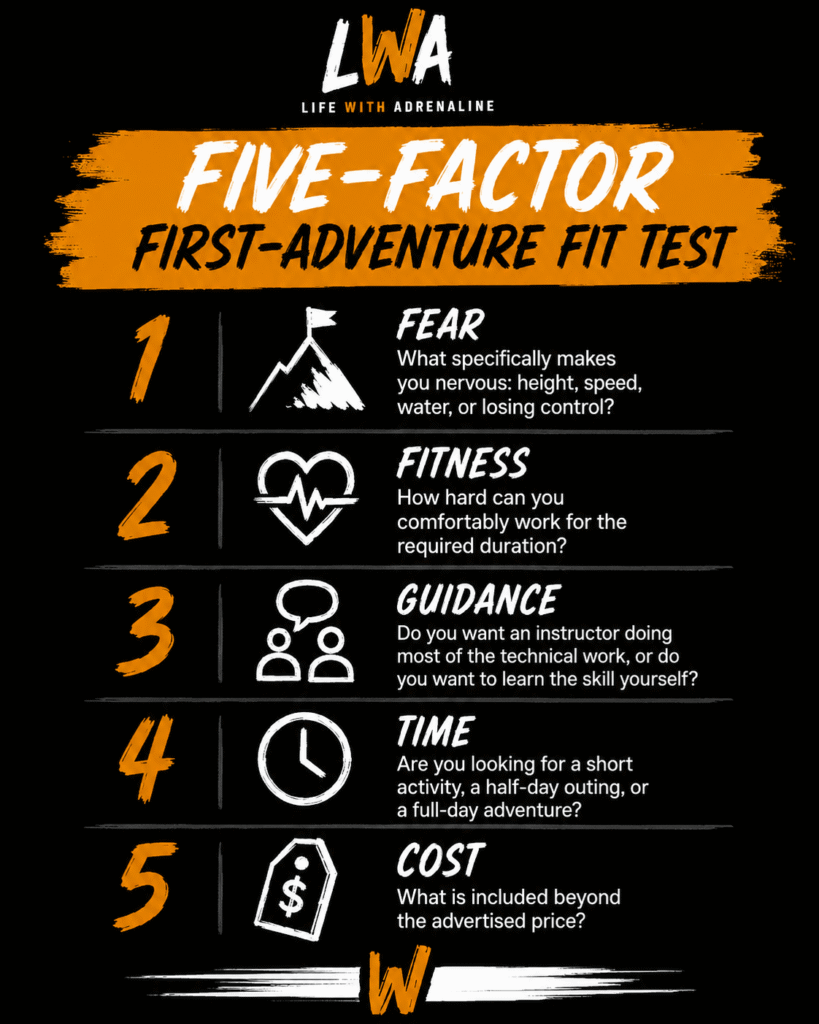
Use these questions before you compare operators or destinations.
| Factor | Ask Yourself |
| Fear | What specific sensation makes me nervous: height, speed, water, exposure, falling, or losing control? |
| Fitness | How hard can I comfortably work for the required duration? |
| Guidance | Do I want an instructor controlling most of the technical work, or do I want to actively learn the skill? |
| Time | Am I looking for a two-hour experience, a half-day outing, or an entire adventure trip? |
| Cost | What is included beyond the advertised activity price? |
The National Park Service uses a similar logic for outdoor recreation: evaluate your skills, experience, physical fitness, activity difficulty, duration, equipment and environmental conditions before deciding whether an activity fits you. [S1] (nps.gov)
The important part is to judge each factor separately.
A huge mental challenge can require surprisingly little sustained physical effort. A quieter-looking activity can demand far more endurance or technical involvement.
1. Choose the Kind of Fear You Actually Want
“Scary” is too broad to be useful.
Two people can look at the same adventure and have completely different reactions.
You may be comfortable with speed but hate heights. You may love heights but dislike deep water. You might be fine with both but become uncomfortable when you feel that you are not in control.
So start by identifying your main fear trigger.
Common examples include:
- height and exposure;
- falling;
- speed;
- moving water;
- deep or open water;
- confined spaces;
- loss of control;
- technical failure;
- or simply doing something unfamiliar.
Then avoid stacking several major fears into your first experience.
If deep water already makes you nervous, for example, your first adventure probably does not need to combine water, difficult swimming, remoteness and technical equipment.
Pick one main challenge and keep the rest of the experience reasonably manageable.
That gives you room to enjoy the adventure instead of spending the entire day managing multiple sources of stress.
Fear is not the same as difficulty
This distinction matters.
Tandem skydiving may create an enormous psychological barrier because of the aircraft ride, altitude and exit. Yet the tandem format places much of the technical operation with the instructor. USPA describes tandem as the most convenient way to experience freefall and notes that the student and instructor are harnessed together. [S4] (uspa.org)
By contrast, activities such as mountain biking, surfing or climbing may involve less dramatic single moments but demand more repeated movement, coordination and decision-making.
So do not ask only:
“How scary is it?”
Ask:
“What exactly am I responsible for doing?”
2. Separate Adrenaline From Physical Effort
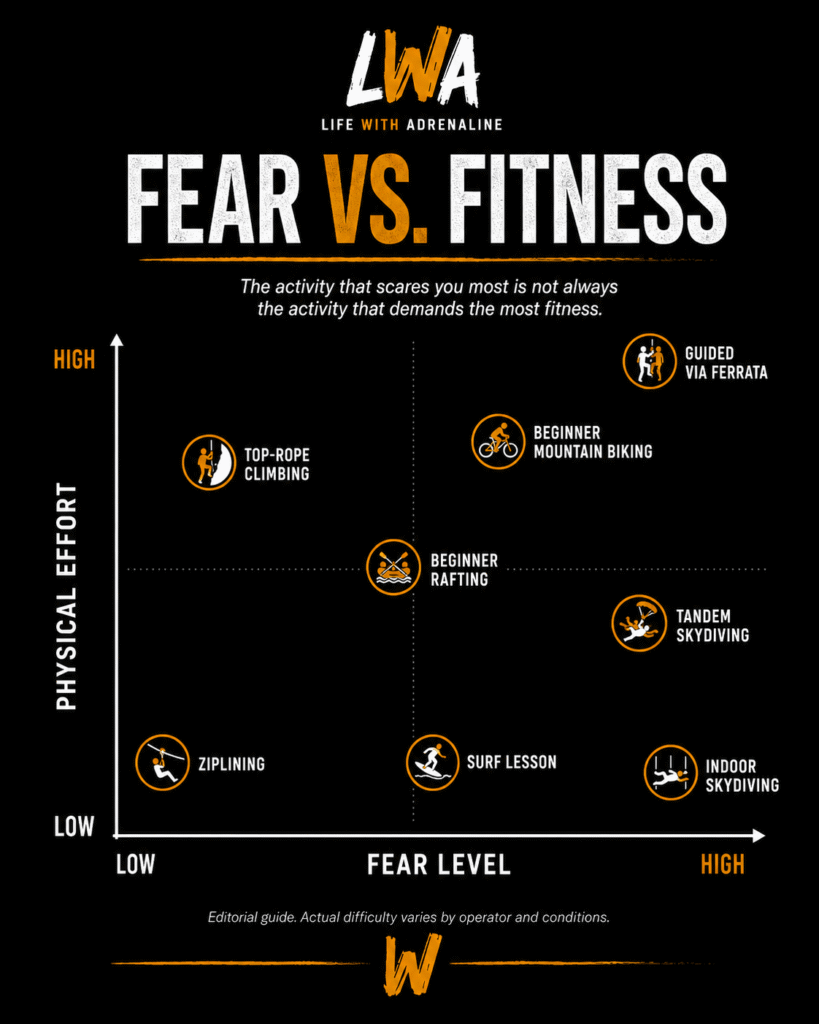
Your fitness level should be treated separately from your courage.
The CDC defines exercise intensity relative to the individual: an activity that feels vigorous to one person may feel moderate to someone fitter. The CDC suggests a 0–10 effort scale, with moderate activity around 5–6 and vigorous activity beginning around 7–8. [S2] (cdc.gov)
A practical self-check is the talk test.
During moderate aerobic activity, you can usually talk but not comfortably sing. During vigorous activity, saying more than a few words without stopping for breath becomes difficult. [S2] (cdc.gov)
You can use that concept when reading an adventure description.
Ask the operator:
- How long am I actively moving?
- Is the activity continuous or broken into short sections?
- Will I climb stairs, hike, paddle, swim or carry equipment?
- Is upper-body strength important?
- How much balance or mobility is required?
- Are there easier beginner routes or formats?
High adrenaline does not automatically mean high fitness
Some experiences are primarily mental challenges.
Others are genuine workouts.
For example, a guided zipline or tandem jump may put more emphasis on managing height and anticipation than on sustained cardiovascular effort.
A surf lesson, mountain-bike session, climbing course or longer rafting trip can involve substantially more repeated physical work.
Neither category is “better.”
The goal is simply to avoid choosing an adventure where your fitness becomes the limiting factor before the fun begins.
If you have a medical condition or are unsure whether an activity’s altitude, exertion or environment is appropriate for you, review the operator’s current requirements and discuss the activity with an appropriate healthcare professional. NPS specifically recommends considering medical conditions that may be affected by altitude, weather or physical exertion. [S1] (nps.gov)
3. Decide How Much Control You Want
Beginners often focus on the activity but overlook the format.
That can completely change the experience.
Think of beginner adventures in three broad groups.
Passenger-style adventures
The professional handles most of the technical work while you participate.
Tandem skydiving is an obvious example. USPA says tandem students are harnessed to an instructor, with initial training generally taking less than 30 minutes. [S4] (uspa.org)
This type of format can be attractive when you want a big sensation without first learning an entire sport.
Guided participation
You still have an active job, but a guide organizes the technical environment.
Beginner rafting and many guided via ferrata, canyoning or climbing experiences can fit this general model depending on the specific trip.
You may paddle, climb or move through the route yourself, but you are not independently planning the entire outing.
Skill-building experiences
Activities such as surfing, climbing or mountain biking can also be approached as lessons.
Here the goal is not only to experience adrenaline. You are starting to develop a repeatable skill.
That may be the better choice if you want your first adventure to become a new hobby rather than a one-time bucket-list experience.
4. Compare Total Time, Not Just Activity Time
A “one-hour activity” does not necessarily take only one hour out of your day.
You may need to account for:
- check-in;
- paperwork;
- equipment fitting;
- training;
- transport to the activity area;
- waiting;
- weather holds;
- the activity itself;
- return transport;
- and changing afterward.
This matters especially when weather affects operations.
NPS recommends evaluating weather, duration, difficulty, skills and equipment before choosing an activity and advises having a backup plan when conditions change. [S1] (nps.gov)
For your first adventure, avoid building a travel schedule that leaves no flexibility.
If the experience is weather-dependent, give yourself enough room that a delay does not destroy the rest of your trip.
5. Compare the Real Cost, Not the Headline Price
There is no useful nationwide price that applies to “adrenaline activities.”
Location, season, activity format, equipment and operator can change the total substantially.
Instead of asking which activity is cheapest, compare the complete cost structure.
Check for:
| Cost Item | What to Verify |
| Activity | Base booking price |
| Equipment | Included, mandatory rental, or bring your own |
| Fees | Facility, park, permit or other mandatory charges |
| Transportation | Shuttle, parking or separate transfer |
| Media | Photo or video package |
| Clothing | Wetsuit, footwear or weather-specific gear |
| Travel | Gas, rental car, hotel or flight if relevant |
| Cancellation | Refund, rebooking and weather policy |
A lower advertised price can become a more expensive day once mandatory equipment and logistics are added.
Conversely, a more expensive guided package may include equipment, instruction or transportation that you would otherwise arrange separately.
Compare the same package level, not two unrelated headline prices.
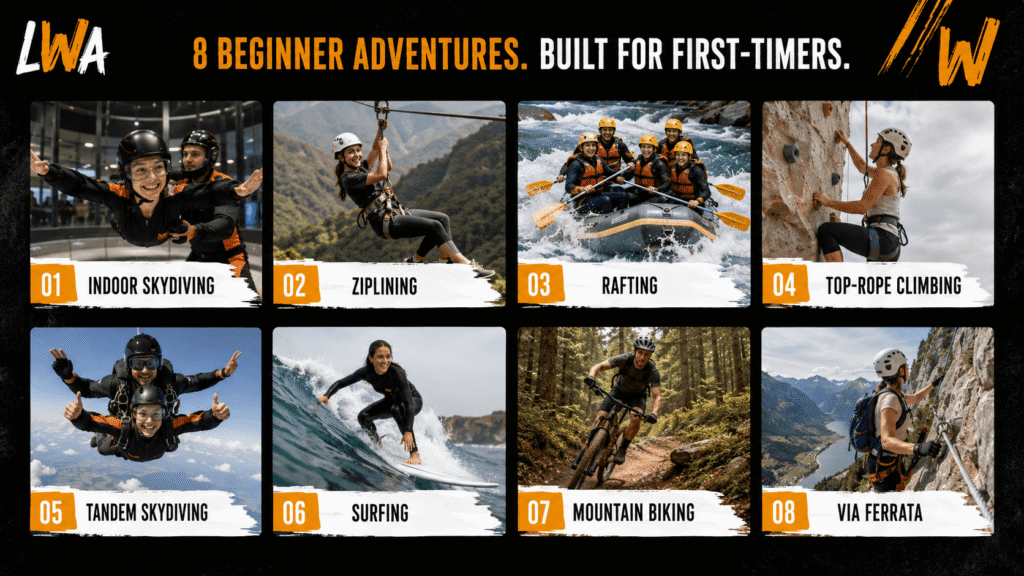
A Beginner Activity Fit Matrix
The following is an editorial decision guide, not a safety ranking. Actual difficulty, requirements and conditions vary by location and operator.
| Activity | Main Challenge | Effort Profile | Beginner Format | Cost Drivers |
| Indoor skydiving | Unfamiliar body sensation | Low to moderate | Instructor-led | Number of flights, media |
| Ziplining | Height and exposure | Usually low | Guided | Tour length, photos, transport |
| Top-rope climbing | Height + physical problem solving | Moderate | Lesson + belay | Entry, lesson, gear rental |
| Beginner rafting | Moving water + teamwork | Moderate | Guided | Trip length, equipment, transport, photos |
| Tandem skydiving | Height + exit + loss of control | Low to moderate physical effort, very high mental commitment for many beginners | Instructor attached | Jump, media, local fees, travel |
| Surf lesson | Waves + balance | Moderate to high | Coached | Lesson, board, wetsuit |
| Beginner mountain biking | Speed + balance + terrain | Moderate to high | Coached | Bike rental, protective equipment, lesson |
| Guided via ferrata | Height + sustained exposure | Moderate to high | Guided | Guide, equipment, access or transport |
Do not use this table to choose an operator or assume one activity is inherently safer than another.
Use it to identify which type of challenge sounds most compatible with you.
Guided or Self-Guided: Which Is Better for a First Adventure?
For an unfamiliar activity with technical equipment, environmental hazards or skills you do not yet have, a structured beginner lesson or guided format is usually the more sensible starting point.
But “guided” should never be translated as “risk-free.”
You still need to understand:
- what the activity involves;
- what your responsibilities are;
- what conditions can stop the activity;
- what equipment you will use;
- and whether you meet the current participant requirements.
NPS specifically advises choosing activities within your abilities, learning required skills, obtaining appropriate gear and checking current regulations and conditions. [S1] (nps.gov)
For something more independent, start well below your maximum perceived capability.
There is no prize for making your first day unnecessarily difficult.
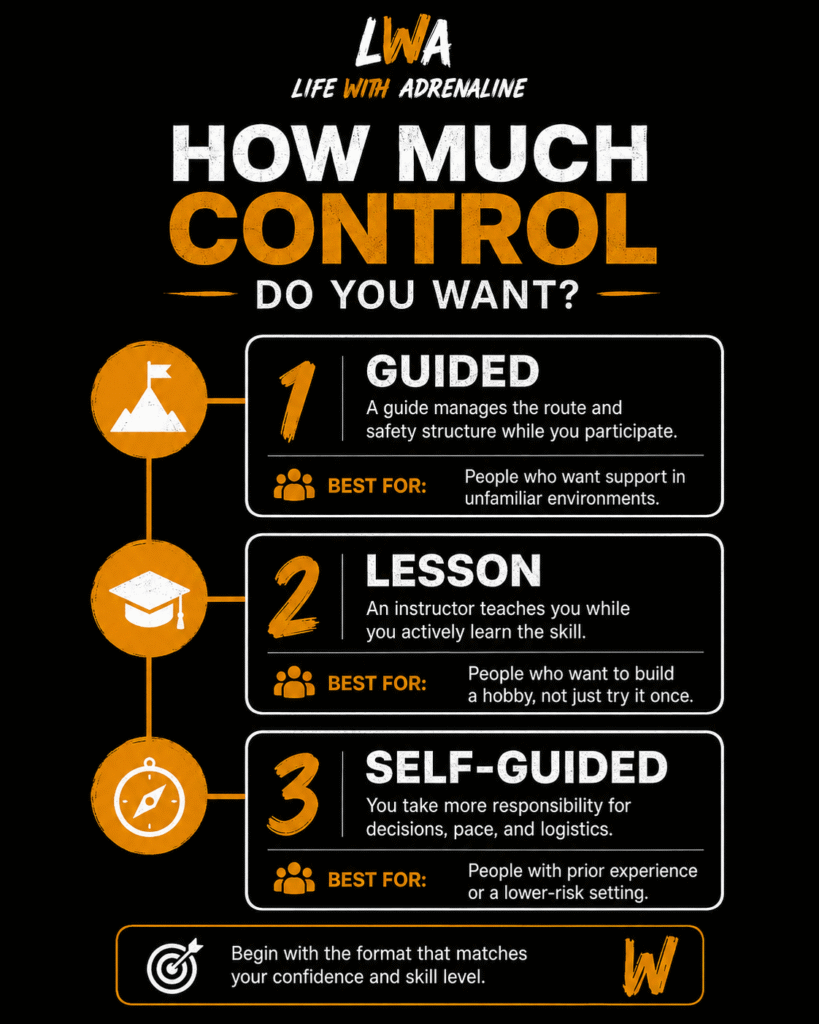
How to choose an adrenaline activity -The Evaluation-
Once you know the activity you want, compare providers using practical questions instead of marketing language.
Is this exact trip designed for beginners?
Do not assume every rafting run, climbing route, mountain-bike trail or canyon is appropriate just because the company accepts first-time customers.
What am I expected to do myself?
Understand who controls the equipment and what instructions you must follow.
What physical restrictions apply?
Age, weight, height, fitness and medical requirements can vary. USPA, for example, notes that individual drop zones set their own weight, height and fitness requirements for skydiving participants. [S4] (uspa.org)
What equipment is included?
Ask before buying gear you may not need.
What is the realistic total time?
Get the full check-in-to-finish estimate, not just the active portion.
What happens if weather changes?
Understand cancellation and rebooking policies before paying.
What will I actually pay?
Compare the checkout total and important optional extras.
Most importantly, do not treat a high review score by itself as proof that an activity or operator is appropriate for you. Reviews can help identify patterns in customer service and logistics, but your decision should also rely on current requirements, trip details, governing guidance and the provider’s own operating information.
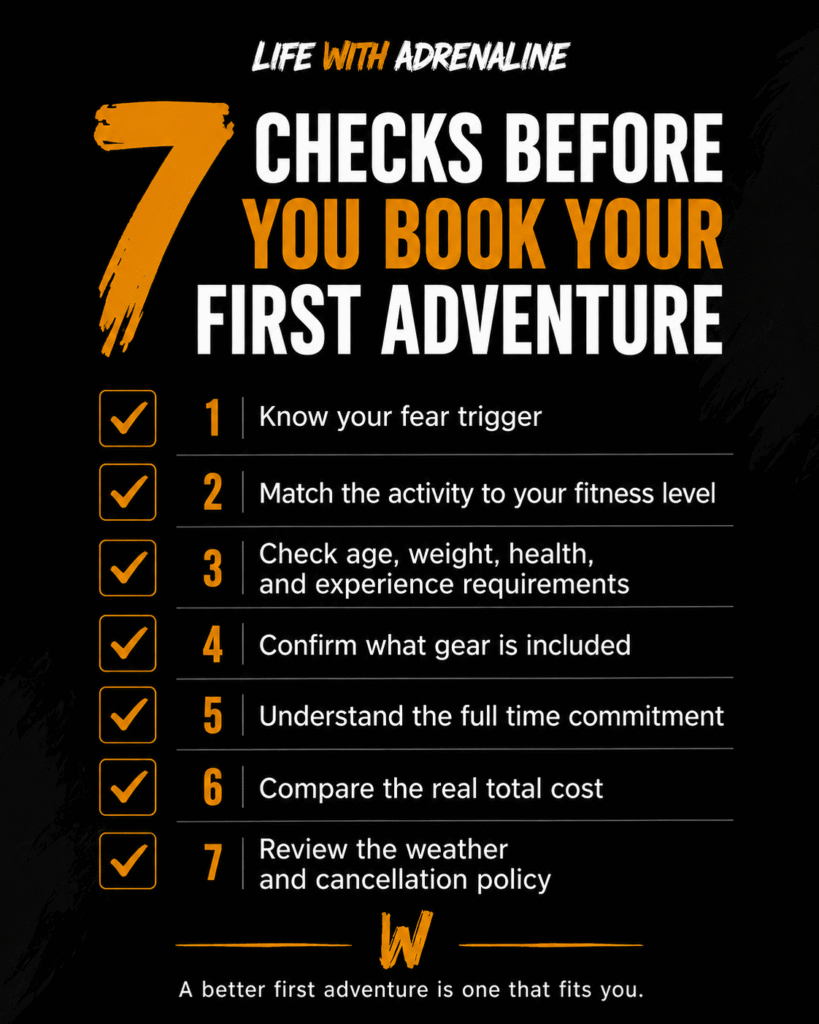
Before-You-Book Checklist
Before paying for your first adventure, confirm:
- I understand what part of the activity scares me.
- The physical demands fit my current ability.
- I know whether this is guided, instructed or self-directed.
- I meet the current age, weight, health and experience requirements.
- I know what equipment is included.
- I understand the full time commitment.
- I checked the full cost rather than only the headline price.
- I understand the weather and cancellation policy.
- I know what happens if conditions change.
- I have a backup plan for weather-dependent activities.
Outdoor conditions can change, and NPS recommends checking conditions, knowing your limits and being prepared to change plans when necessary. [S1][S3] (nps.gov)
Frequently Asked Questions
What is the best adrenaline activity for a complete beginner?
There is no universal best activity.
A better first choice is one where the physical demands are manageable, the beginner format is clear, and only one or two elements seriously challenge your comfort zone.
Someone afraid of heights may prefer a water or speed-based adventure. Someone comfortable with heights but not highly fit may prefer an instructor-led aerial experience over a physically demanding climbing route.
Do I need to be very fit for an adrenaline activity?
Not necessarily.
Physical demand varies widely between activities and even between different versions of the same activity.
Use the CDC’s relative-intensity concept rather than comparing yourself with other people. What matters is how demanding the activity will be for you. [S2] (cdc.gov)
Should my first adrenaline adventure be guided?
For a technical activity you have never done, a beginner lesson or guided format can reduce the amount of independent planning and skill you need on day one.
That does not remove inherent risk, so you should still understand the activity and your responsibilities.
Is tandem skydiving suitable for someone with no experience?
Tandem is specifically one of the ways beginners can make a first skydive. USPA describes it as the most convenient way to experience freefall, with the participant harnessed to an instructor. Requirements still vary by drop zone, and physical or medical restrictions may apply. [S4] (uspa.org)
What if I am nervous right before the activity?
Being nervous does not automatically mean you chose the wrong adventure.
But you should distinguish normal anticipation from a genuine concern about your health, the conditions, the equipment, your understanding of the instructions, or your ability to participate.
If something important does not feel right, do not let social pressure force the decision. NPS explicitly recommends reassessing how you feel during an activity and changing plans when necessary. [S1] (nps.gov)
Final Recommendation
Your first adrenaline adventure should leave you thinking:
“I want to do something like that again.”
Not:
“I survived the most extreme thing I could find.”
Choose an experience with a fear level that excites you, a physical workload you can realistically handle, a beginner format you understand, a schedule that leaves room for delays and a total cost you are comfortable paying.
Start there.
You can always make Adventure #2 harder.
Sources
[S1] U.S. National Park Service — Trip Planning Guide: Health & Safety. Current guidance reviewed August 14, 2026. (nps.gov)
[S2] Centers for Disease Control and Prevention — How to Measure Physical Activity Intensity. Updated December 4, 2025. (cdc.gov)
[S3] U.S. National Park Service — Hike Smart. Updated June 13, 2024. (nps.gov)
[S4] United States Parachute Association — Your First Skydive. Reviewed August 14, 2026. (uspa.org)