Best Adrenaline Activities in California for First-Timers
California is not one adventure destination. A surf lesson in Santa Cruz, a tandem skydive above the coast, a guided raft trip in Gold Country, and a bungee jump reached by a long wilderness hike have almost nothing in common beyond their ability to make your heart race. The real question is not which photograph looks most dramatic. It is which experience fits the trip you can actually take.
For a first visit, start by deciding whether you want to learn a skill, face a height challenge, move with water, or explore rugged terrain. Then choose a California region where the activity has a genuine beginner format. The state is large enough that booking attractions hundreds of miles apart can turn an exciting vacation into a string of expensive drives.
The strongest first-time picks in this guide are a coached surf lesson, a permitted guided rafting trip on a carefully chosen South Fork American River section, a guided redwood canopy tour, and a beginner mountain-bike session with appropriate trails and instruction. Tandem skydiving and bungee jumping are also possible, but their eligibility and logistics create very different decisions. Nothing here is a guarantee of safety; current conditions and operator requirements govern each outing.
Best Adrenaline Activities in California at a Glance
| Activity | Where to start | Main first-timer decision | Primary constraint |
| Surf lesson | Santa Cruz / Central Coast | Want to practice a new ocean skill? | Waves, cold water, currents |
| Guided rafting | Coloma / South Fork American | Prefer teamwork and a guide? | Exact river section and flow |
| Redwood ziplining | Santa Cruz Mountains | Want managed height exposure? | Harness fit, height, weight, age |
| Tandem skydiving | Monterey Bay region | Ready for a major height / freefall challenge? | Age, physical limits, weather |
| Bungee jumping | Bridge to Nowhere, San Gabriel Mountains | Want a long hike plus a jump? | Ten-mile round-trip approach |
| Mountain biking | Mammoth Lakes and other coached areas | Want to learn trail handling? | Skills, trail choice, altitude |
| Dune/off-road outing | Oceano Dunes / Central Coast | Want a vehicle-based sand adventure? | Current land-access rules and safety gear |
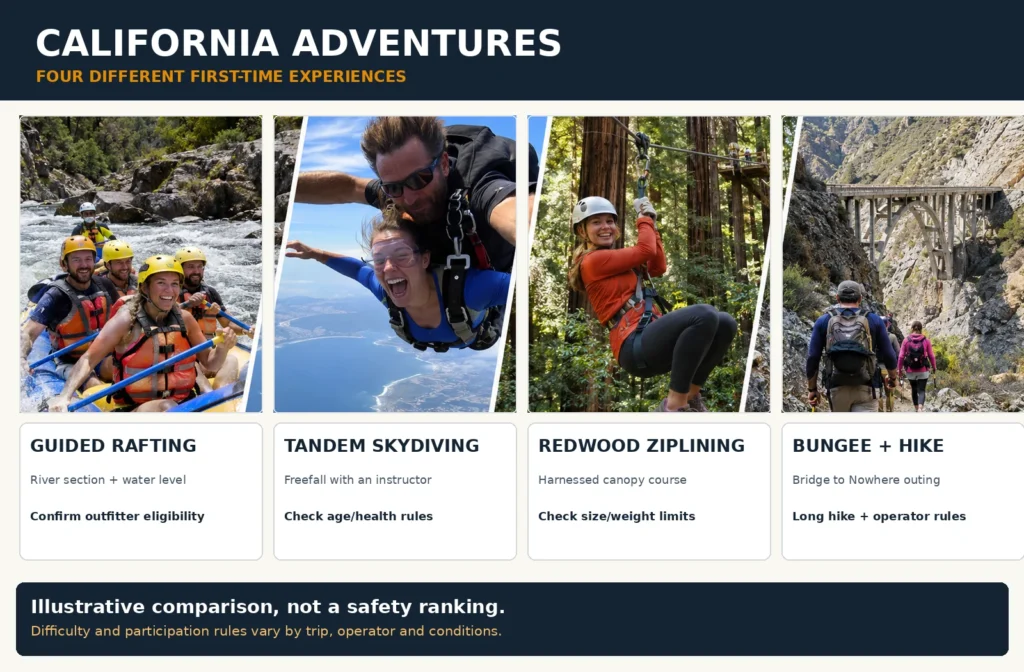
This matrix is an editorial orientation tool, not a ranking of accident risk. A guided trip can still involve substantial hazards, and a route marketed to beginners may not fit someone with limited mobility, poor swimming confidence, vertigo, or a strong dislike of exposure.
1. Surfing in Santa Cruz — Best for Learning an Ocean Skill
A first surf lesson is a different kind of adrenaline experience from a jump or zipline. You spend much of your time reading waves, paddling, practicing balance, and trying again. Progress comes in small attempts rather than one spectacular moment. The satisfaction of standing up, even briefly, can make a modest wave feel much larger than it looks from shore.
Cowell Beach is commonly associated with beginner surfing when conditions suit the group. That last qualification matters. The City of Santa Cruz notes that swells, currents, wind and bottom conditions change, and beginners should not assume a beach is appropriate on every day. The city’s coastal planning material also identifies water-quality concerns at Cowell, so check current notices as well as surf conditions. [S1][S2]
Choose a reputable local instructor who can tell you what conditions are like that morning, where the lesson meets, whether the class is private or shared, and what equipment is included. A soft-top board and a wetsuit may be supplied, but packages differ. Ask how much time is instruction on land versus time in the ocean and what happens if conditions make the planned session unsuitable.
For many new travelers, the hardest part is not standing on the board. It is being comfortable in cold, moving water while listening, paddling and keeping an eye on other surfers. If you are uncomfortable in deeper water or have limited swimming ability, say so before paying. A lesson should be chosen around the actual student rather than the marketing photograph.
What a smart first surf day looks like
Book one session instead of planning a whole weekend around a guaranteed result. Avoid scheduling a high-stakes second activity immediately afterward: you may be more tired than expected, and ocean conditions might move the lesson. Dry clothes, a warm layer, water and enough time to recover are better additions than expensive gear bought before your first session.
2. South Fork American River Rafting — Best for a Guided Group Challenge
The Coloma region is one of California’s clearest options for travelers who want moving-water excitement with professional trip planning. The Bureau of Land Management describes the South Fork American as a popular whitewater destination and specifically recommends permitted commercial operators for those without rafting experience. Different put-in and take-out points offer different outings, which means the name of the river alone does not tell you how intense the day will be. [S3]
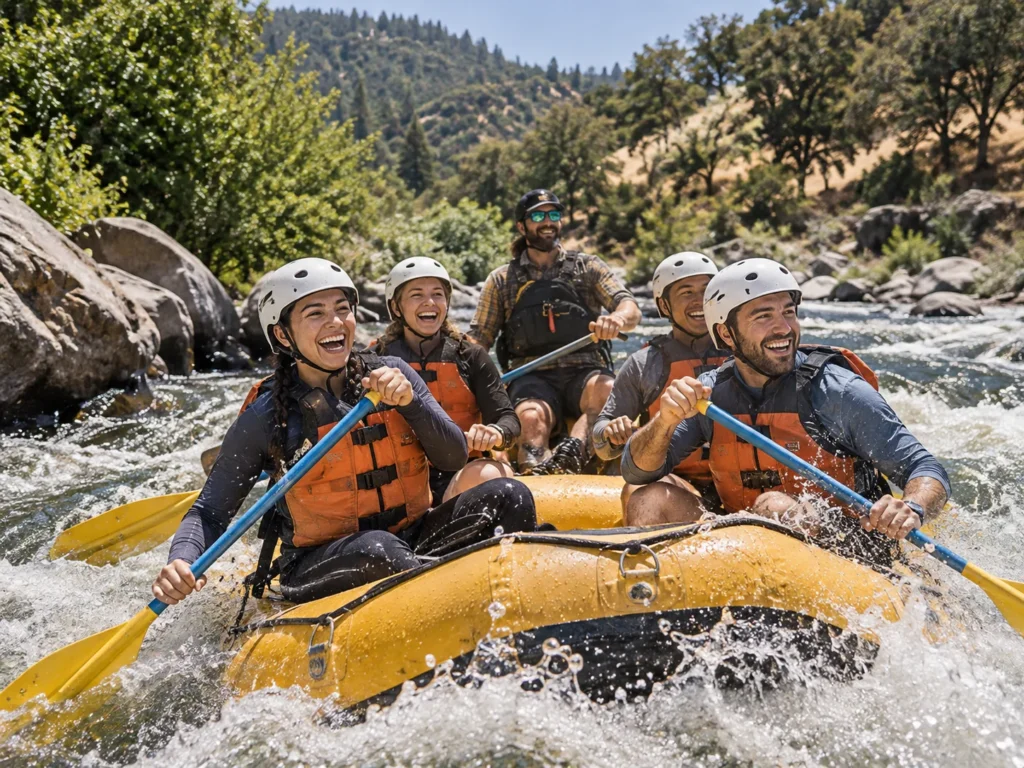
A family-float style segment and a Class III half-day trip are not interchangeable. For example, American River Recreation has published distinct South Fork offerings, including a Class II family float and a Chili Bar half-day trip listed as Class III. As of the November 2026 research check, its schedule page displayed different prices, minimum ages and meeting times by trip. Treat those as examples of how to compare formats, not a promise of future availability or a statewide average. [S4]
Before booking, ask the operator for the exact section, likely rapid classes for that day’s flows, whether every person must paddle, minimum age, swimming expectations, included flotation equipment, shuttle arrangements and weather or water-level changes that could affect the trip. The duration advertised may include meeting, transport and lunch—not just time on the river.
If somebody in your group primarily wants a scenic float rather than repeated splashes, do not solve that by booking the first advertised ‘beginner rafting’ package. Compare the run itself. Our broader guide to beginner whitewater rafting trips in the USA explains why river sections, not state labels, determine the right starting level.
A good fit—and a reason to choose something else
Rafting can suit groups that like listening to a guide and working together, including travelers who want excitement without learning a complex solo sport in one afternoon. It is a weaker choice for someone who cannot tolerate cold water, is unwilling to follow group instructions, or cannot meet an operator’s published participation requirements. There is no universal ‘safe river’ label that replaces actual flow and trip-specific conditions.
3. Redwood Canopy Ziplining — Best for Guided Height Exposure
Near Santa Cruz, Mount Hermon Adventures offers a distinct forest experience rather than a cliff or canyon thrill. The Redwood Canopy Tour is marketed as a guided progression through redwood trees using multiple ziplines, bridges and elevated platforms. It is about the atmosphere and sustained height exposure as much as outright speed. [S5]
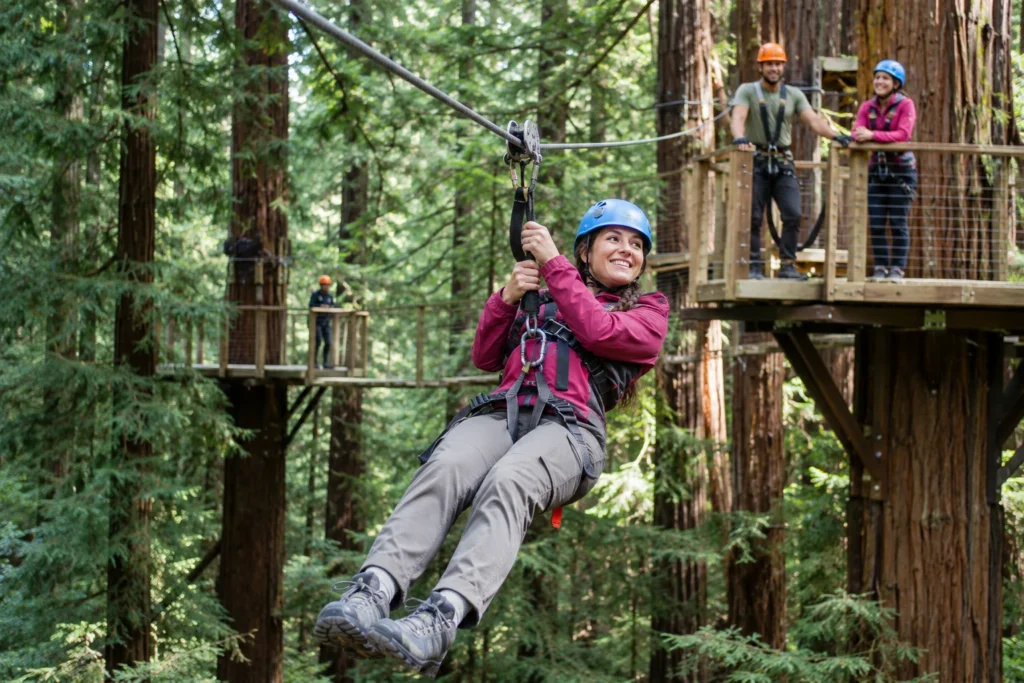
The current operator information lists a minimum age of 10, at least 52 inches of height and a weight range of 75–250 pounds for its Redwood Canopy Tour. These are operator-specific eligibility rules, not rules for every California zipline. Participants also need to arrive for check-in, complete their agreements and comply with clothing and behavior requirements. Verify the latest measurements and waiver terms when reserving. [S6]
A traveler uncomfortable with open heights may find this experience more challenging than the brochure implies. Your body is secured to a cable system, but you still move between platforms and may encounter suspended features and uneven ground. Ask whether you need to operate any braking device, what steps or ladders are involved, and what the tour does if a participant hesitates.
The correct comparison is not simply ‘zipline versus skydive.’ Both involve heights, but the feeling, time commitment and your responsibilities are completely different. Readers curious about very long or fast flights can see our longest and fastest ziplines in the USA, but a record-scale zipline is not automatically the ideal first tour.
4. Tandem Skydiving Near Monterey Bay — Best for a Single Big Leap
A tandem skydive provides a highly concentrated experience: briefing, aircraft ride, exit, freefall and parachute flight. For many people, the anticipation while climbing in the plane is as powerful as the seconds after the exit. Unlike surfing, you are not trying to master a motor skill over an hour. You are participating in a tandem operation with a trained instructor and must meet the drop zone’s requirements.
Skydive Monterey Bay currently states that participants must be at least 18 years old with valid photo identification and asks prospective customers above 200 pounds to contact the center because restrictions may apply. The operator describes weather-dependent scheduling, check-in procedures and specific refund or rescheduling terms. Do not interpret a generic claim such as ‘anyone can tandem skydive’ as permission to ignore individual requirements. [S7]
Plan this as an activity with schedule flexibility, not as an immovable stop between a flight arrival and a dinner reservation. Clouds, wind and operating conditions can delay or cancel a jump. Ask how early you must check in, what clothing is acceptable, how much of the time is on the ground, and when to decide about an optional photo package.
The Monterey region makes sense if you are already visiting Santa Cruz or the Central Coast. It is a poor reason to drive across the state just to capture a particular aerial photograph. For other possible settings, see our best places to skydive in the USA comparison, then verify the chosen drop zone directly.
Who should skip or reconsider this option?
Anyone who does not meet the age or operator fit criteria should choose another experience rather than seek a workaround. Travelers with relevant health or mobility concerns should review the operator’s screening requirements and seek medical advice where appropriate. If you are mainly curious about the sensation but are not ready to commit, a wind-tunnel session elsewhere may make more sense as a separate first step. It is not the same as freefall from an aircraft.
5. Bridge to Nowhere Bungee Jumping — Best for a Full-Day Wilderness Commitment
Bungee America is a striking Southern California option because the jump is inseparable from its approach. The operator says the Bridge to Nowhere sits roughly five miles from the East Fork trailhead in the San Gabriel Mountains and involves a five-mile hike each way. It describes rugged rocky ground and repeated river crossings. That is a full outdoor day before you consider the few seconds of the actual jump. [S8]
The current operator FAQ lists a minimum age of 12 and a standard 90-to-265-pound weight range, with arrangements for some people outside the standard upper threshold. The approach walk, group hiking pace and water crossings are a more meaningful fitness screen here than the jump itself. Confirm current jump packages, trail condition, river crossings and the exact meet-up location with the provider; don’t rely on an old blog price. [S8]
If you want an instant, low-effort thrill, this is the wrong model. If you already enjoy hiking and want the jump to be the climax of a demanding day, it may be exactly the story you want. Bring the clothing and footwear specified by the operator for wet crossings, and do not assume a normal paved-path hiking experience.
Our separate best bungee jumping places in the USA guide explains how a real elastic-cord jump differs from a controlled descent, a BASE jump or a spectacular bridge that has no regularly available commercial bungee operation.
6. Beginner Mountain Biking — Best for Learning a Mountain Skill
California’s mountain biking opportunities vary far more than the word ‘trail’ suggests. Smooth purpose-built beginner paths, technical singletrack, high-altitude lift-served runs and steep downhill routes can all exist inside the same resort region. A mountain-bike vacation should begin with your current braking and turning skills, not with the biggest mountain lift shown in an advertisement.
Mammoth Mountain’s first-timer guidance distinguishes easier bike-park routes from more demanding terrain and emphasizes trail ratings, braking skills, protective equipment and progression. Its published beginner-route descriptions mention wider, smoother trails and some natural features. Check opening dates and lift access each season; snow and weather can affect operations. [S9]
If you can ride comfortably on pavement but have never descended a dirt trail, start with a lesson or dedicated skills session. Ask whether the rental includes a suitable bike, helmet and any pads you need. Decide in advance what you will do if the trail feels too technical. A first ride is successful when you remain in control and leave with enough energy to ride again—not when you finish an advanced descent by sheer determination.
Readers comparing the wider U.S. scene can use our beginner mountain biking destinations guide. California is a reasonable option, but the most beginner-friendly destination overall will depend on season, trail access, lesson availability, travel costs and your willingness to learn a skill.
7. Oceano Dunes — Consider Off-Road Sand Adventure Only After an Access Check
Oceano Dunes on California’s Central Coast can appeal to travelers who like the idea of sand, open terrain and vehicles. But this is one entry where the operational status should be checked immediately before any reservation. The park has faced changing access restrictions and environmental and legal disputes; a previous marketing image of ATVs on sand is not evidence that a particular route is open today. [S10][S11]
California State Parks’ current Oceano Dunes information sets out day-use arrangements and notes that tide, rain and sand conditions can restrict access. Its ATV safety guidance requires helmets and includes special rules for minors and passengers. Those requirements are part of why a beginner should choose an appropriate permitted rental or guided format and read the current park bulletin rather than arriving with assumptions. [S10][S12]
Do not combine a nonrefundable off-highway rental with an inflexible cross-state travel plan until access and the operator’s actual permitted activity are confirmed for your visit date. If those details cannot be verified, choose a coastal hike, surf lesson or another independently bookable activity instead. Leaving an attraction out of the itinerary can be the smartest planning decision.
What About Canyoneering, Rock Climbing and Big Mountain Hikes?
California also offers outstanding granite climbing, desert hiking, coastal routes and guided canyon activities. Those are worth exploring, but listing famous national parks without a real beginner-accessible provider is not especially useful. A climbing lesson at a permitted outdoor site is different from climbing a classic multipitch route. A supervised introductory canyon experience is different from independent canyon travel with technical rope systems.
In parks and public lands, permits, commercial guide authorizations, access limits and seasonal closures can matter. Choose a specific legal activity and a suitable operator, not a social-media location tag. A scenic overlook is not evidence that scrambling or descending there is appropriate or permitted. If you are mainly interested in red rocks or granite rather than freefall and speeds, structure the trip around one guided skill lesson and keep the rest of the day flexible.
Which Part of California Should You Use as Your Base?
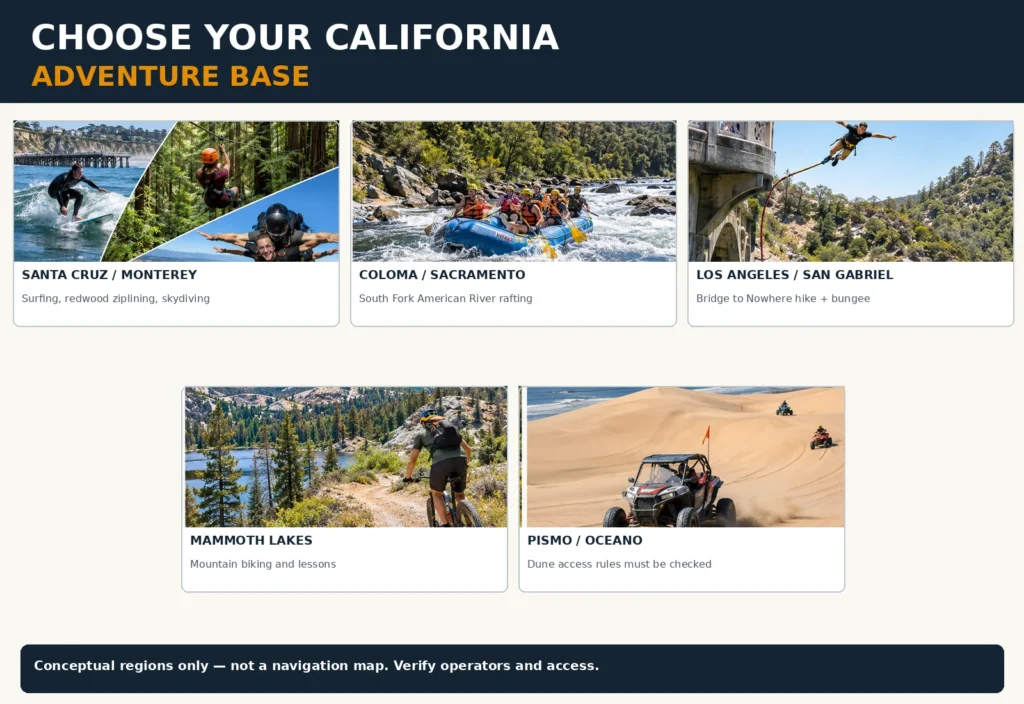
California’s geography can defeat a trip that looks excellent on a pin map. Plan one region at a time. A Central Coast trip around Santa Cruz and Monterey can combine surfing, a redwood canopy tour and perhaps tandem skydiving over several days, subject to operator availability. Those experiences remain very different but they share a more plausible regional travel plan than trying to pair a Monterey jump with an inland mountain-bike day at Mammoth.
The Sacramento / Coloma area is the practical focus for a South Fork American River rafting weekend. A Southern California stay near Los Angeles can make the Bridge to Nowhere trip feasible, but the 10-mile hiking day means it should not be squeezed between other major attractions. Mammoth Lakes works better as a separate seasonal biking and mountain vacation. Oceano Dunes and the Pismo area call for a coast-based plan with a current access check.
| Travel base | Focus activity | Possible companion experience | Important planning tradeoff |
| Santa Cruz / Monterey | Surf lesson, redwood zipline, tandem jump | Coastal sightseeing | Ocean, wind and availability |
| Coloma / Gold Country | Guided rafting | Historic Gold Country attractions | River flow and shuttle logistics |
| Los Angeles / San Gabriel Mountains | Bridge to Nowhere bungee | Lower-exertion city day | Long approach hike |
| Mammoth Lakes / Eastern Sierra | Coached mountain biking | Mountain scenery and easier trails | Altitude and seasonal operations |
| Pismo / Oceano | Conditional off-road outing | Coastal recreation | Changing access restrictions |
The regions are not a one-day route. Driving times vary by traffic, closures, weather and exact start points. If your trip is short, staying within one region generally produces a calmer and more memorable itinerary than checking five attractions across the state.
Three Sample California Adventure Itineraries
Two days: Santa Cruz and the Monterey coast
Day 1: schedule a morning surf lesson when the instructor says conditions fit your group. Leave the afternoon open for recovery, a beach walk and a relaxed meal. Day 2: choose the redwood canopy tour if heights appeal, or a tandem jump only if you meet the drop zone’s requirements and can accommodate weather delays. This is a menu, not a promise that all tours operate on your chosen dates.
Three days: Gold Country rafting weekend
Day 1: travel to the Coloma region and confirm the outfitter’s meeting point. Day 2: take the guided South Fork section suited to the group’s ability, with time for briefing and transport. Day 3: explore local history or add a low-key walk. Do not reserve two unrelated rafting formats just because both carry the same river name; first learn what the actual first day felt like.
Four days: Southern California with a genuine bungee goal
Day 1: arrive and keep the itinerary light. Day 2: dedicate the full day to the Bridge to Nowhere hike and jump, provided your booking is confirmed and trail conditions allow it. Day 3: recover with lower-effort sightseeing. Day 4: use as a departure or optional backup day. If the jump is canceled, follow the operator’s rebooking policy; do not improvise an unauthorized bridge jump.
These itineraries are planning examples, not published packages and not verified transport schedules. Verify each booking separately and preserve free time for weather changes or fatigue.
What Does a California Adventure Weekend Actually Cost?
There is no honest single California ‘adrenaline price.’ A surf lesson, a rafting half-day, a drop-zone tandem jump and a full-day bungee outing use different equipment, labor, access and timing. Even within one activity, what looks like a low price can exclude photographs, fees, lessons, transportation or rentals.
For an illustration of that difference, American River Recreation’s South Fork schedule has published a Class II family float from $59 midweek and a Class III Chili Bar half-day from $89 midweek, with higher listed weekend prices. Those examples refer to specific trips and conditions, not to all rafting in California. Mount Hermon separately publishes seasonal zipline prices; the amount changes by travel date. See official checkout totals for a real quote. [S4][S5]
Instead of treating those prices as interchangeable, write down the full cost of the exact experience: base ticket, unavoidable park or access charges, required rentals, optional media, travel, lodging and meals. If a cancellation becomes a voucher rather than a cash refund, value that differently from an unrestricted refund. The most expensive surprise is often not an optional photo package—it is discovering that the activity is several hours from where you are sleeping.
How Seasons Change a California Adventure Plan
The weather question is not simply summer versus winter. The same coastal area can have cool ocean water in a sunny month, and high mountain venues may still be dealing with snow while Central Coast attractions operate. On the South Fork American, flow and operator scheduling are more informative than assuming that every date inside a broad season offers the same run. In a destination this varied, choosing the month first and the activity second can be a sensible way to build a vacation.
A coastal weekend has more flexibility when you treat an ocean lesson and an aerial activity as conditional bookings rather than guaranteed achievements. Wind and swell do not follow your itinerary, and a visually calm beach from an overlook does not tell you what the break is doing at the lesson’s start time. Before you commit to a nonrefundable room or car, review the cancellation language for all weather-dependent bookings and keep a low-stakes alternative nearby.
Mountain adventures need a different kind of planning. In Mammoth, bike-park operations depend on seasonal access and conditions; a trail that is listed on the resort map is not necessarily open on your desired day. In the San Gabriel Mountains, a river crossing on a bungee hike can become a much more consequential obstacle after rain. That is why calling an attraction ‘year-round’ cannot replace checking the exact date, route and access status. [S8][S9]
Choosing Between a Guided Tour and a Skills Lesson
A lesson is designed to change what you can do. A guided experience can instead be about seeing a place or feeling a sensation while an operator manages key technical tasks. Surfing and mountain biking make that distinction easy to see: the beginner should expect to practice balance, braking or timing and probably make mistakes. A tandem skydive demands attention to instructions and body position, but the instructor carries the central flight responsibilities. Neither is an automatic best choice; they provide different rewards.
For a trip with mixed ages or mixed comfort levels, separate everyone’s constraints instead of trying to make one person follow the most adventurous traveler. Ask if the operator provides a meaningful spectator option, whether a hesitant participant can withdraw before starting, and whether a replacement or reschedule is allowed. Some attractions prohibit spectators from accessing the operational area, so do not assume your friend can watch from the launch point.
If you are buying an experience as a gift, consider whether the recipient actually enjoys the activity’s specific fear trigger. Heights, moving water, cramped equipment, loss of control and strenuous hiking are very different concerns. A voucher that has restrictive dates or no cash refund can be a poor gift even when the scenery is spectacular. A more thoughtful surprise may be the choice between two nearby activities rather than a fixed extreme booking.
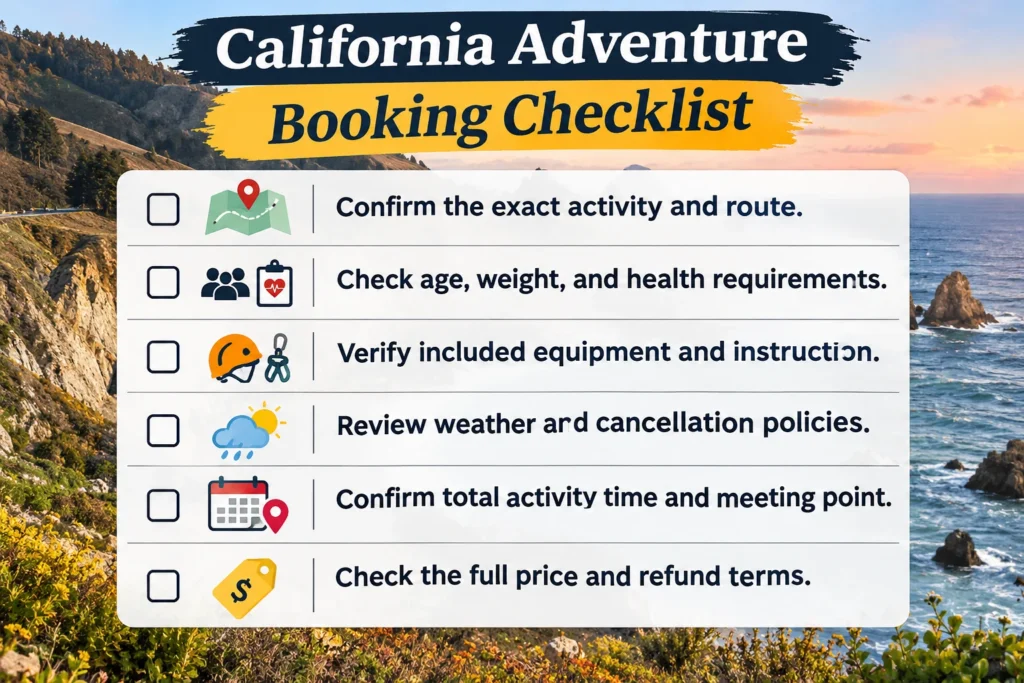
Safety and Eligibility: Six Questions Before Paying
- What is the exact route, wave break, river section, trail or tour? A generic activity name is not enough.
- Which age, weight, height, mobility, swimming or health rules apply to every participant? Confirm directly with the operator.
- What equipment and instruction are supplied, and what must I bring or rent?
- What weather, flow, tide or access conditions could cancel or change the experience?
- What is the total check-in-to-finish time including shuttle, hiking, equipment fitting and waiting?
- How do cancellations, rescheduling, deposits, media packages and nonrefundable travel costs work?
These questions matter even when a tour is professionally guided. A guide manages parts of the activity; guests still have responsibilities, and the environment remains unpredictable. If you have concerns about fitness or medical suitability, resolve them before a nonrefundable payment. If the answers are unclear, a less demanding format is a meaningful choice rather than a compromise.
Frequently Asked Questions
What is the best adrenaline activity in California for a complete beginner?
For many first-time travelers, a professionally coached surf lesson or a guided redwood canopy experience offers a clear introductory format. A suitable permitted rafting trip can be excellent for groups who want to paddle together. The better choice depends on swimming confidence, fear of heights, fitness, age and the region where you are staying. No activity is universally safest.
Can you go skydiving in California with no previous experience?
Yes, tandem skydiving is designed to allow eligible first-time participants to jump with an instructor. Drop zones set participant and operational requirements. For example, Skydive Monterey Bay currently requires participants to be at least 18 with valid identification and to discuss weight restrictions when applicable. Weather may affect the scheduled jump. [S7]
Is Bridge to Nowhere an easy bungee trip from Los Angeles?
Not in the sense of a short roadside attraction. Bungee America describes a five-mile approach hike and five-mile return over rugged terrain with river crossings. Allow a full day, check the current trail condition and confirm participant criteria. [S8]
Is the South Fork American River good for first-time rafters?
It can be, with a correctly chosen commercial trip and current river conditions. The South Fork includes materially different sections, so ask the outfitter about the exact run and participation requirements rather than relying only on the river name. The BLM recommends permitted commercial companies to people without experience. [S3]
Can I combine skydiving, rafting and bungee jumping in one California weekend?
Usually that is a poor plan without substantial travel time. These experiences sit in different parts of a very large state, with separate weather, reservation and physical demands. Select one geographic base and make one major guided experience the priority; treat a second activity as optional rather than essential.
Do I need to buy technical gear before my first California adventure?
Usually not before speaking to the operator. Surf schools may supply boards and wetsuits, rafting outfitters supply core river equipment, and zipline tours issue fitted harness systems. But those are examples, not a universal promise. Confirm inclusions and footwear rules for your exact booking before purchasing anything.
The Better First-Trip Decision
The California adventure that works best is the one you can do well and want to remember. Choose Santa Cruz if you want to practice an ocean skill and explore the redwoods; choose Coloma if your group wants to paddle; choose Monterey if a tandem jump is the centerpiece; choose the San Gabriel Mountains if you truly want an arduous bungee day; choose Mammoth if you want to learn biking in a mountain setting.
Use our how to choose your first adrenaline activity framework if you are still weighing fear, fitness, guidance, time and total cost. The state gives you enough variety that you do not need to force yourself into the most dramatic option. Start with one activity whose responsibilities and requirements you understand, leave time for conditions to change, and make the next adventure a decision rather than an obligation.
Sources and research notes
Source details checked November 12, 2026. Prices, operating access, age rules and participation criteria are subject to change; confirm before booking.
[S1] City of Santa Cruz — Ocean Safety. Official source
[S2] City of Santa Cruz — Beach Vulnerability and Adaptation Strategy, Cowell Beach. Official source
[S3] Bureau of Land Management — South Fork American River. Official source
[S4] American River Recreation — Trip Prices, Schedule and Meeting Times. Official source
[S5] Mount Hermon Adventures — Redwood Canopy Tour. Official source
[S6] Mount Hermon Adventures — Before You Arrive. Official source
[S7] Skydive Monterey Bay — First Skydive Requirements. Official source
[S8] Bungee America — Bridge to Nowhere FAQs. Official source
[S9] Mammoth Mountain — Bike Park First-Timers Guide. Official source
[S10] California State Parks — Oceano Dunes SVRA. Official source
[S11] California Coastal Commission — Oceano Dunes. Official source
[S12] California State Parks — ATV Operation & Safety Requirements. Official source