Moab Canyoneering for Beginners: Best Tours and Routes
Direct answer: For most first-time visitors, the best Moab canyoneering tour depends less on the word “beginner” and more on what makes you uncomfortable. Entrajo / Chamisa is the strongest starting point if you want smaller rappels, water, and more canyon movement. Medieval Chamber / Morning Glory is better if you want the classic Moab scenery and are genuinely willing to complete two long, mandatory rappels. Bow & Arrow is the best fit if you want several rappels and a sense of progression. Rock of Ages is better treated as a step-up for fit, adventurous beginners rather than the default first trip. [S5][S6][S7][S8][S10]
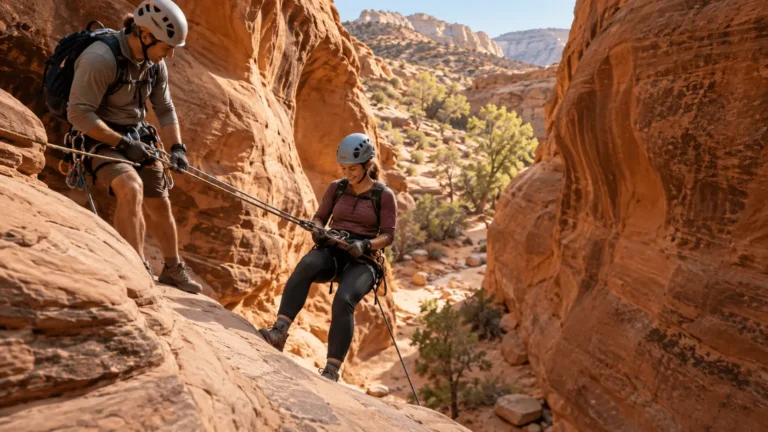
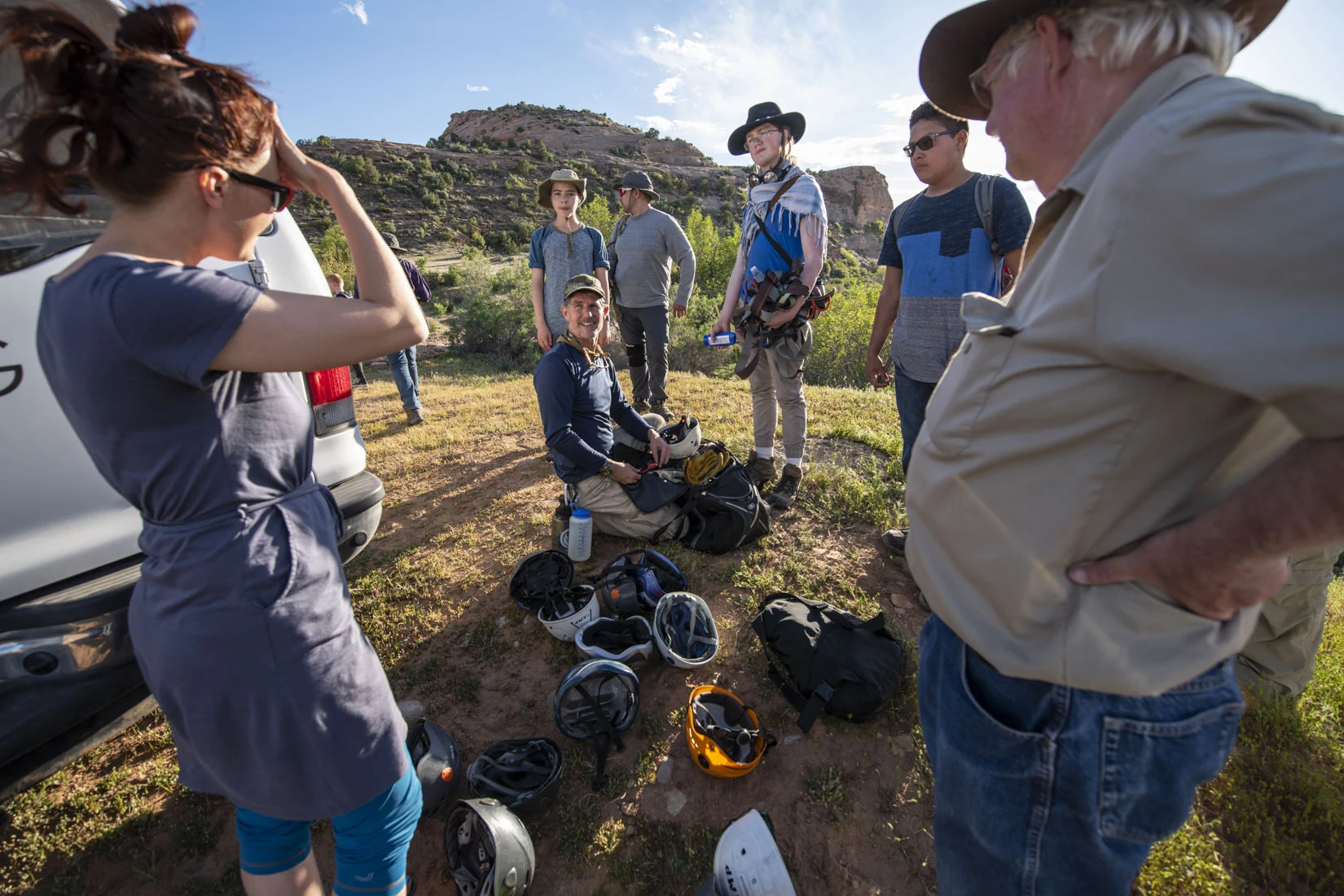
Preparation for rappelling near Moab, Utah. Photo: Eric Delphenich / BLM Utah, via Wikimedia Commons. Public domain in the United States; converted to WebP. This camp photograph does not document a current commercial trip or demonstrate a complete safety procedure. Source photograph.
Moab is unusually good for first-time canyoneers because several commercial half-day trips combine instruction, rappelling, scrambling, and dramatic sandstone scenery without requiring previous technical experience. But the beginner label can be misleading. A route can be easy on the legs and still place you at the top of a 100-foot-plus rappel. Another can use shorter drops but demand more scrambling, wading, and awkward movement. This guide compares the main beginner-oriented Moab routes by the things that actually change your day: exposure, physical effort, water, duration, current price format, and whether the biggest obstacle can be bypassed. Prices and operator rules were checked September 10, 2026 and should be rechecked before booking.
Still comparing this with another kind of adventure? Start Here helps you choose a reading path based on the questions you need answered before booking.
Best Beginner Moab Canyoneering Tours at a Glance
On small screens, scroll comparison tables sideways to see all columns.
| Route | Best for | Rappel profile | Physical / water feel | Typical guided time* | Current price examples* |
|---|---|---|---|---|---|
| Entrajo / Chamisa | Nervous first rappellers; hot-weather variety | Short mandatory rappel; larger rappel varies by operator/format | More scrambling; often wet | Half day | From $110 on one current shared-style listing; private examples from $129 |
| Medieval Chamber / Morning Glory | Classic Moab scenery; big-rappel goal | Two long rappels around 90–120 ft in checked operator formats | Moderate hiking; mostly dry start, creek exit | About 4–6 hr | From $120; private 2026 group pricing from $140 pp for 4+ |
| Bow & Arrow | More rappel repetitions; adventurous families | Four rappels up to about 110 ft in checked formats; one operator lists a bypass for the 110-ft drop | Moderate hike and exposure | About 4–5 hr | From $135; private listing from $169 |
| Rock of Ages / Pool Arch | Fit beginners who want a longer step-up | Multiple rappels and a more committing route | Higher physical commitment | About 5–7 hr | From $170–$219 on checked operator menus |
*Operator-specific examples checked September 10, 2026. Route configuration, season, inclusions, age rules, and prices can differ by operator and departure. These are not market averages. [S5][S6][S7][S8][S10][S13][S15]
What “Beginner-Friendly” Actually Means in Moab
For a first-timer, technical skill is only one part of difficulty. Commercial operators can teach the basic rappel process and manage the rope system, but they cannot make exposure, desert heat, uneven terrain, or fear of heights disappear. That is why two trips sold to beginners can feel completely different.
A useful way to choose is to score yourself on four questions: How do you feel about a long drop? How much hiking and scrambling do you want? Are you comfortable getting wet? And how important is it to have a bypass or lower-commitment option if you reach the rappel and decide the biggest drop is too much?
If you are still comparing destinations rather than individual Moab routes, see our best canyoneering trips in the USA for beginners for other first-timer options across Utah, Colorado, Arizona, and beyond.
A “beginner” label does not tell you whether the challenge comes from height, hiking, water, or route commitment.
This matters most on one-way routes. Red River Adventures and Desert Highlights both describe the Medieval Chamber / Morning Glory itinerary as a route where the two main rappels cannot simply be skipped once the group is committed. Desert Highlights rates the trip as physically easy, but its current trip page still warns that the long rappels are mandatory. That is a perfect example of why “easy” should not be read as “low fear.” [S6][S13]
1. Entrajo / Chamisa Canyon — Best for a Lower-Rappel First Step
Entrajo is the route to examine first if your biggest question is, “What if I freeze at the edge?” Red River Adventures currently describes a short mandatory first rappel of roughly 10–12 feet, followed by a larger second rappel around 70 feet that it lists as optional. Its half-day route is about 2.5 miles and includes scrambling, wading, and sometimes a short swim. The current minimum age on that operator’s page is eight. [S7]
That does not make Entrajo effortless. Desert Highlights rates its version of Entrajo as moderate rather than easy because the loop includes uphill, off-trail scrambling, hands-and-feet movement, and potentially wet potholes. Its 2026 listing shows a 4–6 hour private trip, two rappels around 15 and 80 feet, and an April-to-September season. [S14]
Entrajo-style canyoneering trades some big-rappel exposure for more scrambling, narrow-canyon movement, and potentially wet conditions.
Moab Canyon Tours also markets Entrajo to first-time canyoneers, with a private format starting at $129, a three-person minimum, and a published minimum age of seven. Its current route description lists a different rappel configuration—about 25 and 90 feet—which is exactly why you should read the product page for the operator you are actually booking rather than treating online route numbers as universal. [S11]
Choose Entrajo if: you want a genuine canyon experience with water and scrambling, but you prefer to begin with a smaller mandatory rappel instead of committing immediately to a 90–120-foot descent.
Think twice if: you dislike getting wet, have limited mobility on uneven terrain, or want the simplest walking rather than an obstacle-course feel.
2. Medieval Chamber / Morning Glory — Best for the Classic Big-Rappel Experience
Medieval Chamber, also commonly marketed with Morning Glory, is the iconic choice for travelers who want a dramatic first rappel day rather than the gentlest introduction. Red River Adventures currently lists two rappels at about 90 and 120 feet on a four-mile half-day itinerary, with a minimum age of eight. Desert Highlights lists two rappels around 90 and 100 feet, about three miles of hiking, and an all-year private-trip format. [S6][S13]
The physical profile can be friendlier than those numbers sound. Desert Highlights rates the route “Easy” because the trip is mostly downhill with limited elevation gain. But the psychological commitment is real: its current FAQ states that the trip is one-way and the two rappels are mandatory. Red River Adventures likewise says you cannot skip the rappels and simply return to the trailhead after the route is underway. [S6][S13]
Medieval Chamber-style canyoneering pairs moderate hiking with long rappels, so fear of height can matter more than fitness.
The exit is a major part of the appeal. The route reaches the Morning Glory Natural Bridge area and then follows Grandstaff Canyon. BLM describes the established Grandstaff hiking trail as a stream-crossing route to Morning Glory Natural Bridge, a 243-foot span, with the trailhead about three miles from U.S. 191 along Utah 128. [S4]
Choose Medieval Chamber if: the big rappel is the reason you are going, you can handle a long exposed descent, and you want one of the most recognizable Moab canyoneering settings close to town.
Skip it for your first day if: you are unsure whether you can commit to a 90–120-foot rappel. “I will decide when I get there” is a weak plan on a one-way route with mandatory descents.
3. Bow & Arrow Canyon — Best for Rappel Repetition and Progression
Bow & Arrow is a strong middle ground for a beginner who wants more rope time. Red River Adventures lists four rappels up to roughly 110 feet on a three-mile half-day trip, along with slickrock scenery, petroglyphs, and dinosaur tracks. Its current minimum age is eight. [S8]
Moab Canyon Tours also lists four rappels—approximately 25, 110, 60, and 90 feet—but adds an important detail for nervous participants: it says its 110-foot free-hanging rappel can be bypassed, leaving three other rappels. That private tour currently starts at $169 with a three-person minimum and an age minimum of seven. [S12]
The appeal here is repetition. Your first descent is not your only chance to settle into the movement, and the route can feel more like a progressive canyoneering day than a hike punctuated by two giant drops. Still, a 90-foot rappel is not a low-exposure experience, so the bypass should not be interpreted as turning the route into a casual hike.
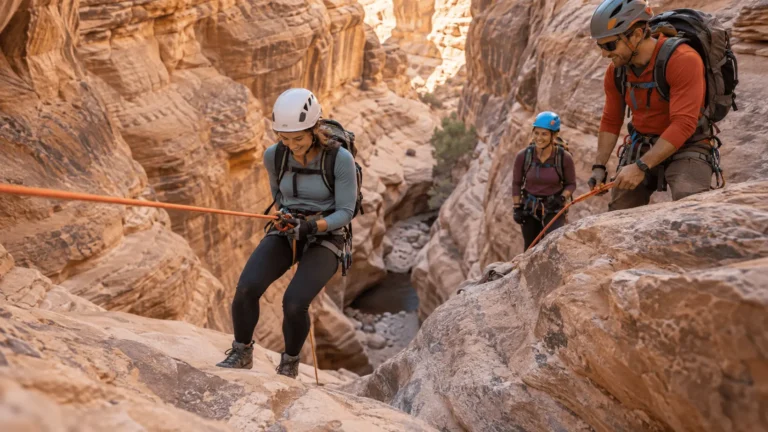
Bow & Arrow is attractive to first-timers who want several rappels and a progressive feel instead of only one or two big descents.
Choose Bow & Arrow if: you want several rappels, you like the idea of building confidence through repetition, and you want scenery plus cultural/geologic points of interest.
Confirm before booking: the exact rappel sequence and bypass options on your departure, because route practices can differ by operator.
4. Rock of Ages / Pool Arch — Best as a Step-Up for Fit Beginners
Rock of Ages is frequently presented as accessible to people without advanced canyoneering skills, but its length makes it a different decision from the three half-day options above. Red River Adventures currently lists it as its longest Moab canyoneering route at about six hours, with a starting price of $170. Moab Canyon Tours lists Rock of Ages from $219, with a 5–7 hour duration and “higher fitness” compared with its half-day beginner trips. [S5][S10]
That extra time matters. You are not just testing how you feel on rappel; you are committing to a longer combination of hiking, scrambling, technical movement, and desert exposure. A fit first-timer who already knows they enjoy long off-trail days may love that. A traveler who has never rappelled and is still unsure about heights will usually learn more about their preferences on a shorter route first.
If a five- to seven-hour canyon day sounds more physically demanding than you want, compare our adrenaline activities that don’t require extreme fitness for lower-effort alternatives.
Choose Rock of Ages if: you are physically comfortable with a longer active day and want the first trip to feel like a real canyon journey rather than a short introduction.
Start elsewhere if: your fitness, heat tolerance, or reaction to rappelling is still an unknown.
How Much Does Beginner Canyoneering in Moab Cost?
There is no honest single “Moab canyoneering price” because the current market mixes shared/group departures, private trips, youth pricing, and routes of very different length. The useful comparison is to look at actual published products and keep the format attached to the price.
| Checked trip example | Published price, Sep. 10, 2026 | Important pricing context |
|---|---|---|
| Red River Adventures — Entrajo | From $110 | Half day; age 8+ on current page |
| Red River Adventures — Medieval Chamber | From $120 | About 4 hr; age 8+ |
| Red River Adventures — Bow & Arrow | From $135 | About 4–5 hr; age 8+ |
| Moab Canyon Tours — Entrajo | $129 | Private tour; 3-person minimum; age 7+ |
| Moab Canyon Tours — Bow & Arrow | $169 | Private tour; 3-person minimum; age 7+ |
| Desert Highlights — Medieval Chamber | $140 pp for 4+; $150 pp for 3; $180 pp for 2; $340 solo | Private; 2026 published rates; tax and guide gratuity extra |
| Moab Adventure Center — Morning Glory or Bow & Arrow | $155 adult / $130 youth | Adult 13+; youth 10–12; about 5 hr |
Treat these as snapshots, not promises. Red River Adventures currently publishes different starting prices by route; Moab Canyon Tours publishes private-tour pricing with a three-person minimum on Entrajo and Bow & Arrow; Desert Highlights uses party-size pricing for its private tours; and Moab Adventure Center publishes separate adult and youth prices. [S5][S10][S11][S12][S13][S15]
Also check what is not in the base price. Desert Highlights explicitly says its Medieval Chamber price excludes tax and guide gratuity. Red River Adventures notes that guide gratuities are customary. Equipment and transportation are included on the checked operator pages, but food and water requirements vary. [S6][S13][S14]
Can You Take a Guided Canyoneering Tour Inside Arches National Park?
No—not as a guided technical canyoneering service under the current Arches National Park rules. This distinction is important because many Moab tours use scenery that looks exactly like what visitors associate with Arches, and some tour descriptions mention views toward the park. The National Park Service states that guided canyoneering services are prohibited in Arches. [S1]
Independent canyoneering inside Arches is a separate activity. NPS currently requires a canyoneering permit, offers free in-person/self-register permits, and lists a $6 online permit option through Recreation.gov. The park also prohibits rappelling off or wrapping rope around named or unnamed arches with openings greater than three feet. Those are rules for competent independent parties, not an invitation for first-time visitors to recreate a commercial tour on their own. [S1]
For a beginner booking a guide, the practical takeaway is simple: expect the technical tour to take place on permitted lands outside the park boundaries even when the trip is described as “near Arches.” Ask the operator for the exact route if location matters to you.
If park-access rules are a major part of your destination decision, our Zion canyoneering guide for beginners explains the different permit, guided-tour, and inside-versus-outside-the-park issues around Zion.
Guided technical canyoneering is prohibited inside Arches National Park; commercial Moab trips operate on permitted lands outside the park.
Best Time for Moab Canyoneering
Spring and fall are the easiest seasons for most travelers to understand because daytime temperatures are generally more compatible with active desert travel than midsummer, but the exact operating season depends on the canyon. Current listings illustrate the difference: Desert Highlights lists Medieval Chamber year-round, while its water-oriented Entrajo trip is April through September. Moab Adventure Center currently lists Morning Glory March through November and Bow & Arrow April through November. [S13][S14][S15]
Summer needs more caution than a simple “go early” recommendation. In an August 4, 2026 safety release, Arches and Canyonlands reported that summer temperatures regularly exceed 100°F (38°C) and advised visitors to avoid strenuous activity between 10 a.m. and 5 p.m. during extreme heat. That guidance comes from the national parks, but the heat hazard applies to the same Moab desert climate in which nearby canyon trips operate. [S2]
Monsoon weather is the other major variable. NPS warns that flash floods can occur even when the sky above you looks sunny, and that heavy rain, lightning, wind, and hail can develop quickly. A guided operator may change routes or cancel when conditions are unsuitable; that is a normal part of canyon risk management, not a reason to pressure the company into running the exact itinerary you booked. [S3][S9]
How Hard Is Canyoneering for a First-Timer?
For most commercial beginner trips, you do not need previous rappelling experience. What you do need is enough mobility and fitness for uneven sandstone, steps, scrambling, and several hours outside. The technical descent can be coached; the hiking and exposure still belong to you. [S5][S10]
Think of difficulty as two separate sliders. The first is physical: miles, elevation, heat, scrambling, water, and time. The second is psychological: standing at an edge, leaning back into the harness, looking down, and continuing on a route with limited exit options. Medieval Chamber can sit lower on the physical slider but higher on the exposure slider. Entrajo can reverse some of that, with smaller rappels but more water and body movement. Bow & Arrow adds repetition. Rock of Ages adds duration.
If canyoneering turns out to be more exposure or physical commitment than you want, compare the best adrenaline activities in Moab for lower-effort, water-based, wheeled, and aerial alternatives.
If anyone in your group is uncertain, choose for the least comfortable person rather than the most enthusiastic one. A successful first canyon should leave the group wanting a harder route next time, not feeling trapped by a trip that was chosen for the biggest photo.
Safety: What Beginners Should Take Seriously
Canyoneering is an inherently risky activity. Guided instruction and managed rope systems can reduce some technical demands on a novice, but they do not remove the possibility of falls, rock hazards, heat illness, flash flooding, difficult footing, equipment problems, or a medical issue in terrain where access can be slow.
Weather deserves special attention because a canyon concentrates consequences. Check the forecast and the operator’s communications before departure. If the operator moves the trip to a different canyon because of weather, treat that as a safety decision rather than a downgrade. Red River Adventures, for example, states that it may shorten a route, change the venue, or cancel if it deems conditions unsafe. [S9]
Heat is equally real. NPS’s 2026 extreme-heat guidance recommends substantial water and adjusting activity to conditions. Your commercial operator may provide its own minimum water recommendation; follow the larger/current requirement that applies to your trip and ask before arrival if the weather is unusually hot. [S2]
Medical restrictions vary by company and route. If you have a condition that could be affected by heat, exposure, strenuous activity, heights, or remote access, review the operator’s current eligibility language and discuss participation with an appropriate healthcare professional. This guide cannot decide individual medical fitness.
What to Wear and Bring
The checked Moab operator pages are consistent on the basics: technical gear such as helmet, harness, ropes, and rappel hardware is generally supplied on guided trips. Personal items are your responsibility. [S5][S11][S13]
Bring personal desert essentials; on the guided trips checked here, the operator generally supplies the technical canyoneering equipment.
- Closed-toe shoes with useful grip. For Entrajo or other wet routes, use footwear you are comfortable soaking.
- Athletic or hiking clothes that allow high steps and scrambling. Avoid clothing you would be upset to scrape on sandstone.
- Water in the quantity required by your operator and conditions. Several checked half-day pages recommend roughly 1–2 liters, but extreme heat can justify more.
- Snacks for a half day; a lunch if your specific full-day trip requires it.
- Sun protection: sunscreen, sunglasses, and a hat for exposed approaches and exits.
- A warm layer in cooler months or for wet canyon conditions.
- Only the pack size your operator recommends. Some companies provide a canyon pack.
Do not buy technical canyoneering gear just for a first guided trip unless the operator specifically tells you to. Some companies require guests to use the operator’s technical equipment for liability and system-compatibility reasons. [S6]
How to Choose the Right Tour in 60 Seconds
- If your biggest concern is rappel height: start by comparing Entrajo formats and ask which rappels are mandatory on your specific departure.
- If your goal is a big, iconic rappel: choose Medieval Chamber / Morning Glory only if everyone accepts two long mandatory descents.
- If you want several chances to practice: compare Bow & Arrow, and confirm whether the largest rappel has a bypass on your operator’s itinerary.
- If you are a strong hiker who wants more commitment: compare Rock of Ages with the half-day routes rather than assuming “longer” automatically means better.
- If you are traveling in midsummer: ask about start time, water, heat, and route-switch policies before paying.
- If a child is participating: use the operator’s current product page—not a general blog—to verify age, size, and route restrictions.
Before-You-Book Checklist
- Exact canyon and route name confirmed.
- Shared/group tour vs. private tour confirmed.
- Current total base price for your party size confirmed; taxes and gratuity policy checked.
- Minimum age and any size, health, or mobility restrictions checked directly with the operator.
- Largest rappel, number of rappels, and which rappels are mandatory confirmed.
- Water/swimming expectations checked for the current canyon conditions.
- Total trip time, meeting time, transportation, and return time confirmed.
- Required shoes, clothing, water, food, and supplied technical gear confirmed.
- Weather / route-change policy and cancellation deadline read before payment.
- If the listing says “near Arches,” exact land/route location understood; do not assume the guided technical trip is inside Arches National Park.
Moab Canyoneering FAQ
Do I need rappelling experience?
Not for the beginner-oriented commercial trips reviewed here. Multiple operators explicitly accept first-time canyoneers and provide technical instruction and equipment. You still need to meet the route’s physical and eligibility requirements. [S5][S10]
What is the easiest Moab canyoneering tour for someone afraid of heights?
No route is universally easiest, but Entrajo deserves the first look because Red River Adventures currently lists a very short mandatory first rappel and an optional larger second rappel. Other operators use different Entrajo rappel configurations, so confirm the exact format before booking. [S7][S11][S14]
Is Morning Glory good for beginners?
Yes for a willing first-time rappeller who wants long descents; not necessarily for someone who needs an easy opt-out. Current Medieval Chamber / Morning Glory listings accept novices, but checked operator descriptions make clear that the long rappels can be mandatory on the one-way route. [S6][S13]
Can kids go canyoneering in Moab?
Some tours accept children, but the minimum is operator- and route-specific. Current examples range from suggested age six on some Desert Highlights private trips, age seven on Moab Canyon Tours listings, age eight on several Red River Adventures trips, and age ten on Moab Adventure Center’s two featured canyon tours. Recheck the exact product before booking. [S6][S10][S13][S15]
Is guided canyoneering allowed in Arches National Park?
No. NPS currently prohibits guided canyoneering services in Arches. Independent canyoneering requires a permit and is subject to specific rules, including restrictions on rappelling from arches. [S1]
What happens if the weather looks bad?
The answer depends on the operator’s policy. Route changes are normal when canyon conditions are unsuitable. For example, Red River Adventures says it may shorten, change venue, or cancel for unsafe conditions; Moab Adventure Center says operator cancellations due to weather receive a full refund on the checked Bow & Arrow product. Read the exact cancellation terms for your booking. [S9][S16]
Final Recommendation
For most cautious first-timers, begin with Entrajo / Chamisa and choose the operator format that gives you the level of rappel commitment you actually want. If the point of the trip is a dramatic 100-foot-class descent, Medieval Chamber / Morning Glory is the more iconic choice—but book it because you want those long rappels, not because a page calls the route easy. [S6][S7][S13]
Choose Bow & Arrow when repetition is part of the appeal. It gives you several rappels and, on at least one current operator itinerary, a way to bypass the largest free-hanging drop. Save Rock of Ages for a first day only if your group is already comfortable with a longer, more physical outdoor commitment. [S8][S10][S12]
The best beginner canyon in Moab is not the one with the smallest number beside “difficulty.” It is the one whose exposure, movement, water, time, and exit commitment match the least comfortable person in your group. Get that choice right, and your first canyoneering day can feel like a progression rather than a test of nerve.
Sources
[S1] https://www.nps.gov/arch/planyourvisit/canyoneer.htm
[S2] https://www.nps.gov/arch/learn/news/08042026.htm
[S3] https://www.nps.gov/arch/planyourvisit/safety.htm
[S4] https://www.blm.gov/visit/grandstaff-canyon-trailhead
[S5] https://redriveradventures.com/moab-utah-canyoneering/
[S6] https://redriveradventures.com/moab-utah-canyoneering/medieval-chamber/
[S7] https://redriveradventures.com/moab-utah-canyoneering/entrajo-canyon/
[S8] https://redriveradventures.com/moab-utah-canyoneering/bow-and-arrow-canyon/
[S9] https://redriveradventures.com/policies/
[S10] https://www.moabcanyontours.com/canyoneering/
[S11] https://www.moabcanyontours.com/canyoneering/entrajo-canyon/
[S12] https://www.moabcanyontours.com/canyoneering/bow-arrow/
[S13] https://deserthighlights.com/tour/medieval-chamber/
[S14] https://deserthighlights.com/tour/entrajo-canyon/
[S15] https://www.moabadventurecenter.com/moab-canyoneering
[S16] https://www.moabadventurecenter.com/tours/canyoneering-moab-bow-and-arrow-canyon