
| Whitewater Rafting Classes Explained guide describes the difficulty of a river or rapid, from Class I (easy moving water) to Class VI (extreme whitewater). They are a planning shorthand, not a guarantee of safety and not a universal rule for who can book a guided rafting trip. For cautious first-timers, Class II is the clearest beginner baseline. Many guided Class III trips — and some Class III-IV trips — accept first-time guests, but only when the operator, current flow, age rules, swimming expectations, and trip format all fit the group. [S1][S2][S4] |
If a rafting company advertises “Class II-III” or “Class III-IV,” the number can look like a simple thrill meter. It is not. The International Scale of River Difficulty was built to compare how demanding whitewater is to navigate, and the scale becomes more consequential as rapids get longer, more powerful, more obstructed, and harder to recover from after a mistake. [S1] For a first-time commercial rafter, the useful question is not “What is the biggest class I can handle?” It is “What does this class mean on this river, at this flow, with this operator?” That distinction makes the rating far more useful when you are choosing a trip.
Whitewater classes at a glance
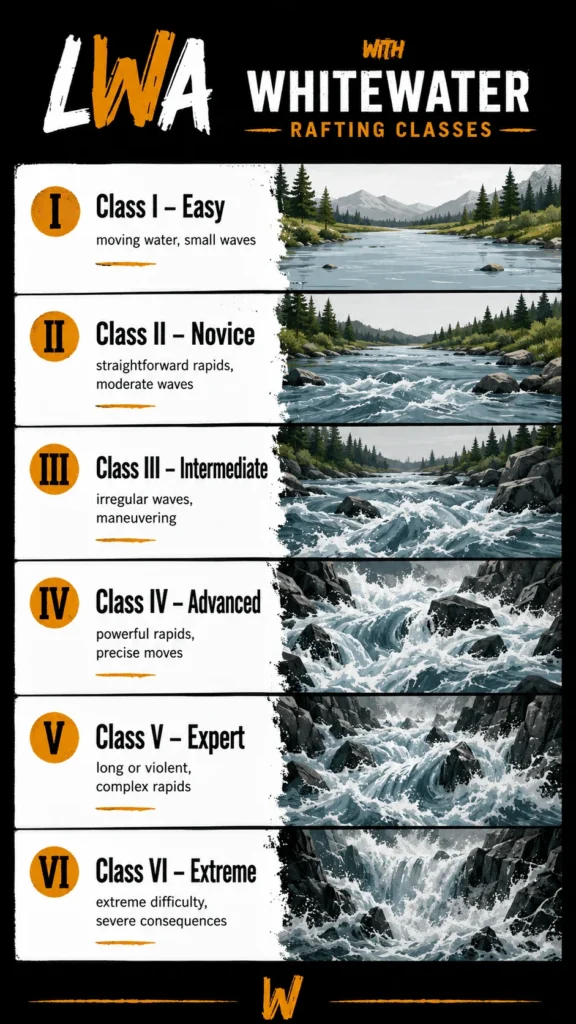
| Class | Official label | What the water involves | What it means for a first-time commercial rafter |
| Class I | Easy / Beginner | Fast-moving water, riffles, small regular waves, few obvious obstacles. | Usually a scenic float or very mild introduction; the experience may involve little technical paddling. |
| Class II | Novice | Straightforward rapids, clear channels, moderate waves, some maneuvering. | The clearest starting point for people who want real moving water without a major technical jump. |
| Class III | Intermediate | Moderate, irregular waves; stronger currents; tighter lines; more boat control and coordinated maneuvering. | Common on commercial trips. Some first-timers can do it with a guide, but “intermediate” still describes the river difficulty. |
| Class IV | Advanced | Powerful, intense but generally predictable rapids; precise moves; larger holes or constricted passages; harder rescue. | Some fully guided trips accept novices, but the consequences of a swim and the demand on the crew are more serious. |
| Class V | Expert | Long, obstructed, violent or highly complex rapids; difficult scouting and rescue; above-average consequences. | Not a default first-time target. Commercial availability and guest requirements are highly river- and operator-specific. |
| Class VI | Extreme | A step beyond Class V, with extreme difficulty, unpredictability and severe consequences; rescue may be impossible. | Not a normal tourist-rafting category. Current NPS wording notes that some Class VI rapids may be run only occasionally by expert teams. |
What whitewater rafting classes actually measure
The official name is the International Scale of River Difficulty. American Whitewater describes it as a system used to compare river difficulty worldwide, while also warning that the scale is not exact and should not replace current, first-hand information about a run. [S1]
That matters because a class rating is not calculated from one formula. It reflects the overall navigational challenge created by things such as wave size, obstacles, current, maneuvering requirements, rapid length, continuity, and the difficulty of recovering from a mistake. As the class rises, the required skill and the consequences of a swim generally rise too. [S1][S2]
The number can also describe different things. A single rapid may be Class IV while the overall river section is mostly Class II-III. American Whitewater specifically notes that running an occasional Class IV rapid is not the same as dealing with an entire run at that level. [S1] When you see a range such as “Class III-IV,” ask whether it describes the whole section, the typical rapids, or the hardest rapid you are expected to run.
Class I: Easy moving water
Class I is fast-moving water with riffles and small waves, with few obstacles that are obvious and relatively easy to avoid. The official scale labels the skill level “Beginner.” [S1][S2]
For a commercial guest, Class I often feels closer to a scenic river float than to the stereotypical image of whitewater rafting. You may still need to listen, balance in the boat, paddle when asked, and wear the required safety equipment, but the river itself is at the low end of the scale.
Choose Class I when the goal is primarily scenery, river access, a gentle family outing, or a low-anxiety first exposure to moving water rather than a high-adrenaline trip.
Class II: Novice whitewater
Class II adds straightforward rapids, medium-sized waves, wider clear channels, and occasional maneuvering. The official label is “Novice.” [S1][S2]
This is the most useful baseline for a cautious first-time rafter who wants to feel real whitewater. There can be splashes and noticeable acceleration, but routes are generally clearer and the navigational demands are lower than on Class III.
Do not translate “novice” into “risk-free.” Cold water, strainers, unusual flows, a remote setting, or a poor route choice can make consequences more serious than the class number suggests. American Whitewater explicitly warns that water level, downed trees, floods, weather, cold conditions, and remoteness can change the practical difficulty of a run. [S1]
Class III: Intermediate — but often available to first-time commercial rafters
Class III is where the river becomes more active. The scale describes moderate, irregular waves, stronger current effects, and maneuvers that may require good boat control in tighter passages or around features. [S2][S6]
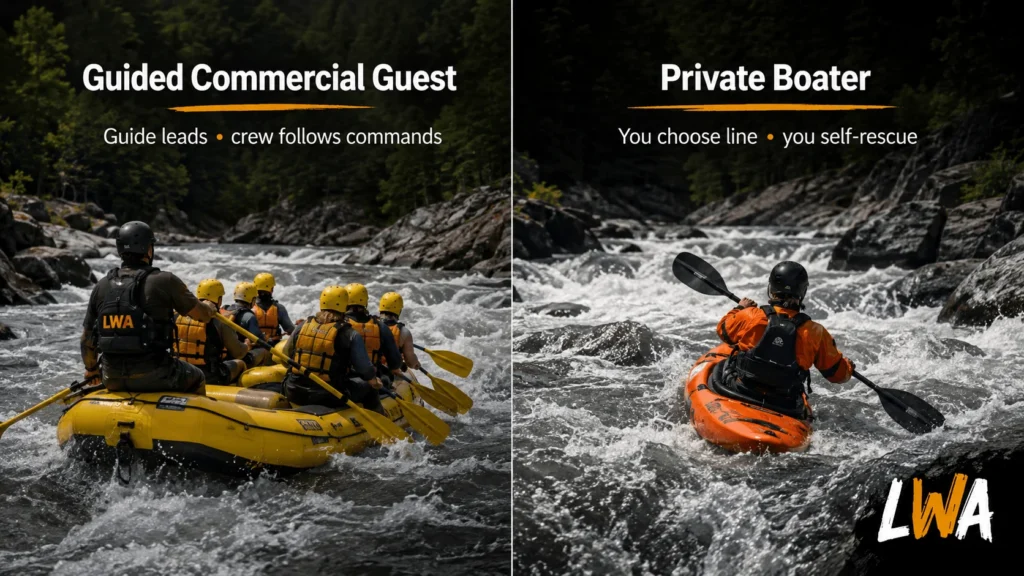
The word “Intermediate” can confuse first-time commercial guests. It describes the whitewater difficulty, not a universal rule saying every passenger must arrive with intermediate rafting skills. A guide can handle the primary river reading and steering while the crew follows paddle commands. That is why many outfitters sell Class III trips to first-timers.
Still, the guided context matters. A Class III commercial trip with an experienced guide is not equivalent to taking your own raft or kayak onto Class III water. If you are new, rely on the specific outfitter’s current eligibility rules, safety briefing, trip description, and river conditions rather than the class label alone. [S3]
Class IV: Advanced whitewater and a meaningful jump in consequence
Class IV rapids are described as intense and powerful, requiring precise handling in turbulent water. They may contain large unavoidable waves or holes, constricted passages, and “must-make” moves above hazards. Risk to swimmers rises, self-rescue can become difficult, and group rescue is more likely to matter. [S2][S6]
That does not mean every guided Class IV commercial trip is limited to experienced rafters. The Ocoee River Corridor, for example, currently advertises fully guided Class III-IV rafting for guests age 12 and older with no prior experience required. [S4] This is an example of why passenger eligibility and river class are two separate questions.
For a first-timer, Class IV should be a deliberate choice rather than a number to collect. Ask how continuous the harder rapids are, what the current flow is doing, what swimming ability or fitness is expected, whether the operator changes age limits at high water, and whether there are easier trip alternatives.
Class V: Expert whitewater
Class V is a major step up. The scale describes extremely long, obstructed, or violent rapids where routes can be complex, scouting can be difficult, swims are dangerous, and rescue may be difficult even for experts. [S2][S6]
For a beginner choosing a commercial rafting vacation, Class V should not be treated as the next logical step after Class IV. Some commercial operations may run sections that include Class V under specific conditions, but the class alone cannot tell you whether a particular guest is suitable. River, flow, guide team, boat type, local regulation, and operator policy all matter.
If a trip includes Class V, read the operator’s current participant requirements carefully and ask direct questions before booking. Do not assume that prior experience is optional just because another river offers guided first-timers on Class IV.
Class VI: Extreme — not simply “unrunnable”
Class VI is the extreme end of the scale. Current National Park Service wording describes it as one grade more difficult than Class V, with extreme difficulty, unpredictability, and danger; errors can have very severe consequences and rescue may be impossible. It is for expert teams after close inspection and at favorable water levels. [S2][S6]
A useful correction to many simplified rafting charts: Class VI does not automatically mean “physically impossible to run.” The current NPS definition says the class may include rapids that are only occasionally run. [S2] For a normal commercial tourist trip, however, Class VI is not a practical target and should not be treated as a bookable “next level.”
Which rafting class is best for beginners?
There is no single class that is universally “safe for beginners.” Class II is the most consistently novice-oriented part of the scale, but a guided Class III trip may be an excellent first rafting experience on one river and an inappropriate choice on another day or another river.
A practical starting point is to match the class to your desired experience and then verify the trip-specific conditions. If you are nervous, traveling with younger children, unsure about swimming, or simply want to learn the rhythm of rafting, start with Class II or a mild Class II-III commercial trip. If you are comfortable with water, ready to paddle actively, and want a more exciting first day, a guided Class III trip may fit well when the operator explicitly accepts first-timers.
Class IV requires more caution. Some fully guided operations do take first-time guests, as the Ocoee example shows, but that should never be generalized to every Class IV river. [S4] The right question is whether the specific trip is designed for first-time commercial guests under the current conditions.
| Trip rating | Who may like it | What to verify before booking |
| Class II | Cautious first-timer; families where permitted; lower-intensity day | Current minimum age; water temperature; swimming expectations; actual rapid mix |
| Class II-III | First-timer wanting more splash and teamwork without jumping straight to sustained harder water | Which rapids are III; current flow; guide format; age/weight/mobility rules |
| Class III | Active beginner who is comfortable getting wet and following fast commands | Whether first-timers are accepted; swim expectations; rapid continuity; current conditions |
| Class III-IV / IV | Thrill-seeking beginner only when a reputable operator explicitly designs the trip for first-timers | Current flow, hard-rapid count, minimum age, physical participation, rescue setup, cancellation/high-water policy |
Why the same river can feel harder on a different day
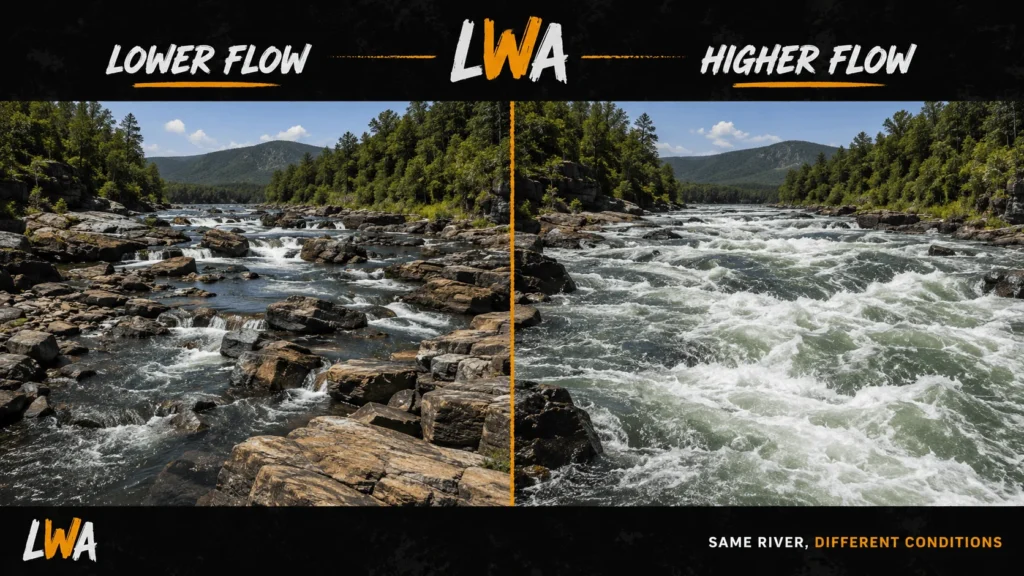
River class is a guide, not a permanent promise. American Whitewater warns that difficulty can change with water level, downed trees, recent floods, geological disturbance, and bad weather. Cold water, high flows, and remote access should also make paddlers leave a larger safety margin. [S1]
The National Park Service makes the same point on the Potomac Gorge: even small changes in water level can dramatically increase whitewater difficulty, sometimes within hours. [S2] A river can also become more demanding at lower water if rocks and technical obstacles become more exposed, so “higher water always equals harder” is too simplistic.
Commercial operators may react by changing routes, raising minimum ages, adding equipment, delaying trips, or cancelling. OARS notes that there is no universal system for outfitter minimum ages and that some operators increase minimum ages during high-water periods because of colder, faster water and a greater chance of involuntary swims. [S5]
What labels like “Class II-III” and “Class III-IV” really mean
A range usually signals that a river section contains more than one level of whitewater. But the exact meaning can vary. It may describe a mostly Class II run with a few Class III rapids, a mix of II and III, or a run whose rating changes with flow.
Do not average the numbers in your head. A Class III-IV trip is not “Class 3.5.” The harder rapids may be short and separated by pools, or the whitewater may be continuous. American Whitewater specifically warns that a single Class IV rapid is different from an entire Class IV run. [S1]
If a booking page uses “+” or “-” labels, treat them as useful but approximate local refinements. Ask the operator what the symbol means on that river and at the expected water level, because the official system itself warns about regional and individual interpretation. [S1]
What the class number does not tell you
A class rating is important, but it does not answer every booking question. It does not automatically tell you the minimum age, whether non-swimmers are accepted, whether you will paddle hard, whether the water is cold, whether the river is remote, how long the difficult section lasts, or whether the operator uses paddle rafts, oar rafts, or another setup.
It also does not prove that an operator is “safe.” River running has inherent risk, and the National Park Service explicitly warns boaters to understand those risks and match the river to their skills and experience. [S3] For a commercial guest, look beyond the class label to the outfitter’s current restrictions, guide system, equipment, briefing, weather policy, and plan for changing water conditions.
Age limits are a good example. OARS states that there is no universal system that all outfitters use to set minimum ages; river rating is one factor among several. [S5] That is why two Class III trips can have different age requirements without either operator necessarily being inconsistent.
How to choose the right rafting class before you book
Use the class as the first filter, then verify the trip itself. A good booking decision should answer these questions:
- What is the advertised river rating, and what is the hardest rapid on the trip?
- Does the operator explicitly accept first-time rafters for this exact trip?
- What are the current minimum age, weight, swimming, mobility, and health requirements?
- How do current flow and weather conditions affect the trip, and can requirements change at high water?
- How physically active is the trip: relaxed riding, regular paddling, or sustained aggressive paddling?
- What safety equipment is supplied, and what clothing or footwear are you required to bring?
- What happens if the river level changes or the operator decides conditions are not suitable?
- Is there a lower-class alternative if someone in your group is unsure about the intensity?
Safety: use the rating as a warning label, not a permission slip
Whitewater rafting is an inherently risky activity. A lower class generally means lower navigational difficulty, but no class makes a river risk-free. The official scale itself tells boaters to use ratings cautiously and gather additional first-hand information. [S1]
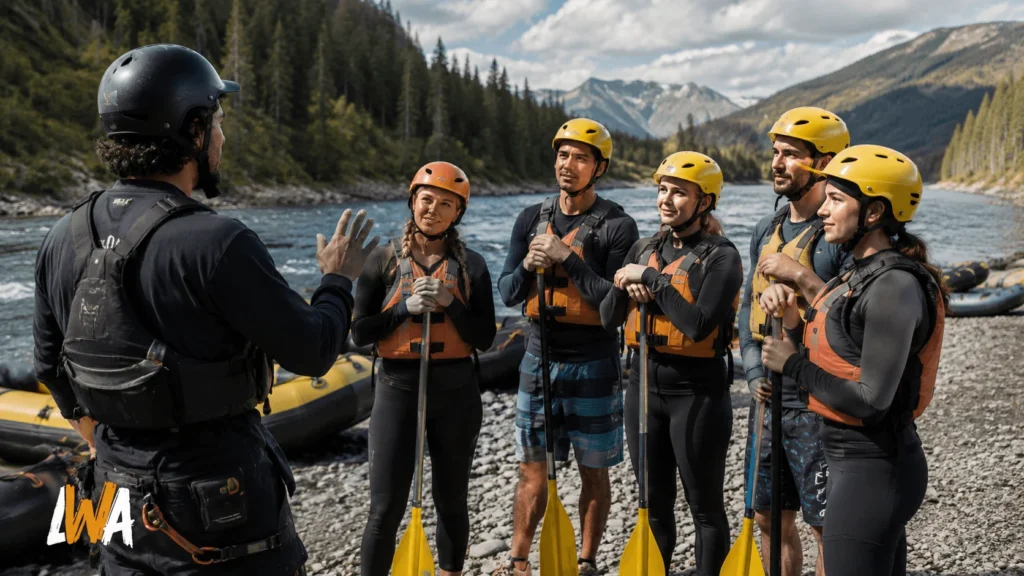
For a guided trip, follow the operator’s current participant rules, attend the full safety briefing, wear the required personal flotation device and other equipment, and tell the operator about any mobility or medical concern that could affect participation. If you have a health question, use the operator’s eligibility criteria and speak with an appropriate healthcare professional rather than relying on a general rafting article.
For private boating, the threshold is much higher: do not assume that being a passenger on a guided Class III or IV raft means you have the skills to lead, kayak, or self-guide a run of the same class. The class labels in the official scale refer to the river challenge and the skills needed to navigate it. [S1][S3]
Frequently asked questions
Are Class II rapids safe for beginners?
Class II is the official “Novice” level and is often the most comfortable entry point, but no class is universally safe. Water level, temperature, obstacles, remoteness, and operator practices still matter. [S1]
Can a first-time rafter do Class III?
Yes, many commercial Class III trips accept first-timers. The guide handles the primary navigation while the crew follows commands. Check the exact operator’s current requirements and conditions rather than assuming all Class III trips are equally beginner-friendly.
Can beginners raft Class IV?
Sometimes, on specific fully guided trips. The Ocoee River Corridor currently accepts first-time guests age 12+ on fully guided Class III-IV trips. [S4] That is an example, not a universal rule for every Class IV river.
Is Class VI the same as “unrunnable”?
Not exactly. Current NPS wording describes Class VI as extreme and notes that it may include rapids that are only occasionally run by expert teams under favorable conditions. [S2][S6] It is not a normal commercial tourist category.
Does water level change a rapid’s class?
It can change the practical difficulty and sometimes the published rating. American Whitewater and the NPS both warn that flow changes can alter river features and consequences. [S1][S2]
What is the biggest difference between Class III and Class IV?
The jump is not just bigger waves. Class IV generally requires more precise moves in more powerful water, and a swim can be harder to self-rescue from. That increase in consequence is one reason to look closely at trip design, flow and guide support. [S2]
Final recommendation
For most cautious first-time rafters, start by looking at guided Class II or Class II-III trips. If you want more action and the outfitter explicitly welcomes beginners, a guided Class III trip can be a strong first choice. Treat Class IV as a trip-specific decision, not a universal beginner category, and do not use Class V or VI as a simple “next step” on a thrill ladder. The best class is the one that matches your group, the river today, and the operator’s current rules — not the biggest number on the booking page.
Sources
Research checked: August 23, 2026. Source IDs in the article correspond to the list below.
[S1] International Scale of River Difficulty — American Whitewater. https://site-media.americanwhitewater.org/Scale-of-River-Difficulty-Safety-Code-2024.pdf
[S2] Kayaking the Potomac Gorge — U.S. National Park Service — Great Falls Park. https://home.nps.gov/grfa/planyourvisit/kayaking.htm
[S3] Whitewater — Private Boater Information — U.S. National Park Service — New River Gorge National Park & Preserve. https://www.nps.gov/neri/planyourvisit/whitewater_private.htm
[S4] Ocoee River in Tennessee — Ocoee River Corridor. https://theocoeeriver.com/
[S5] The Complete Guide to Planning a Multi-day Family Rafting Trip — OARS. https://media.oars.com/wp-content/uploads/2024/03/20171001/Family-Rafting-Guide.pdf[S6] Grading Whitewater — U.S. National Park Service — Canyonlands National Park. https://www.nps.gov/cany/planyourvisit/riverscale.htm?fullweb=1