
Skydiving usually feels less like dropping off a cliff and more like being held against an extremely powerful stream of air. Freefall is fast, loud and intensely stimulating, but the sensation is different from the sudden stomach-drop many people expect from a roller coaster.
For a typical tandem jump, the United States Parachute Association says freefall lasts about 30 to 60 seconds and happens at roughly 120 mph. You can normally breathe during freefall. [S1]
What cannot be predicted so easily is how you will react emotionally. Some first-timers feel euphoric almost immediately. Others stay nervous longer. Some notice a brief dropping sensation during the exit; others do not.
That variation is normal. There is no single physical or emotional experience shared by every first-time skydiver.
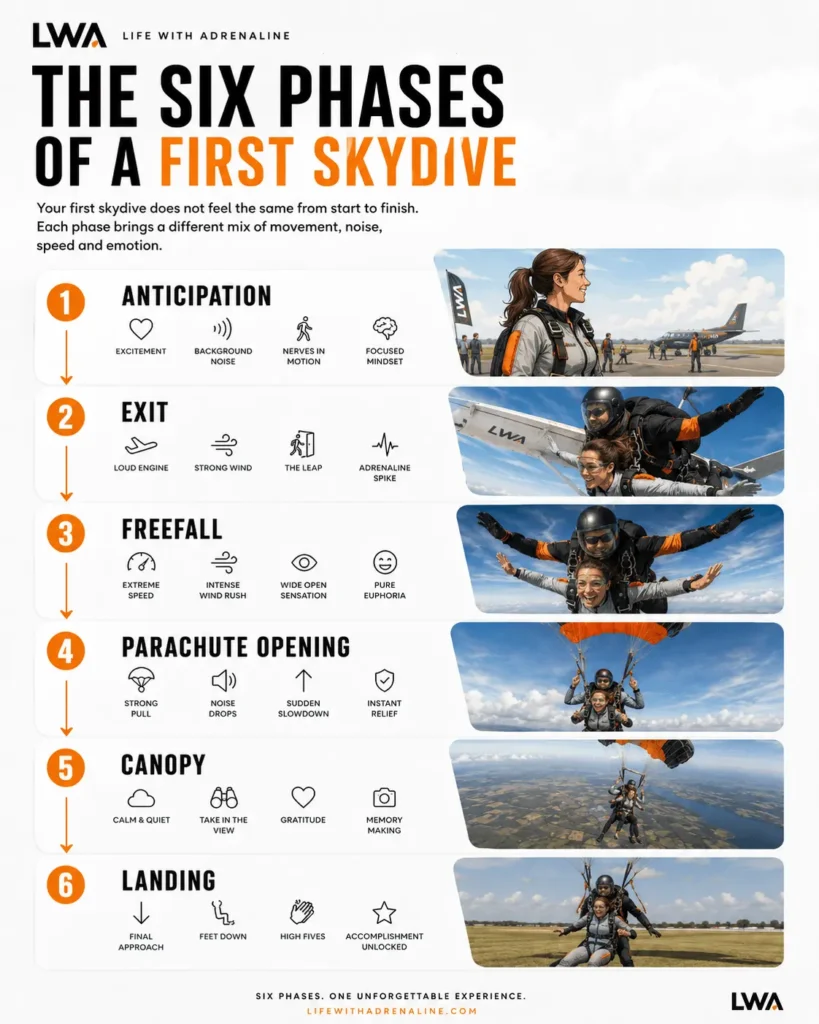
What Skydiving Feels Like at a Glance
| Phase | What You May Feel | What Often Surprises Beginners |
| Plane ride | Excitement, nerves, tight harness, cooler air | Anticipation can feel more intense than freefall |
| Exit | Sudden wind, movement, brief disorientation | It may not feel like the giant vertical drop you imagined |
| Freefall | Strong wind pressure, loud airflow, intense visual awareness | The airflow can make your body feel supported |
| Parachute opening | Firm deceleration through the harness | Freefall noise disappears quickly |
| Canopy ride | Slower movement, quiet, panoramic views | The contrast with freefall can feel dramatic |
| Landing | Ground approaching, leg-position instructions | The instructor manages the landing technique |
Your exact experience depends on the aircraft, exit, altitude, weather, body position, equipment and your own response to the jump.
Is Skydiving Scary?
It certainly can be.
Feeling nervous before your first jump is not evidence that something is going wrong. Skydiving is an unfamiliar situation with obvious consequences, so anticipation can create a strong stress response.
Research involving first-time and experienced skydivers has found measurable psychological and physiological stress responses around skydiving, including a relationship between pre-jump anxiety and cortisol response in first-time participants. [S3]
For many beginners, the hardest moment is therefore not freefall itself.
It is the waiting.
You may feel reasonably calm while signing paperwork or putting on your harness, only to notice your heart beating faster as the airplane climbs. When the door opens and the outside air enters the cabin, the situation suddenly becomes very real.
Operator guides consistently describe this buildup as one of the most intense parts of a first tandem jump. [S5][S8][S9]
But do not assume your fear has to disappear the instant you leave the airplane.
It might.
It might not.
Your goal is not to produce the “correct” emotional reaction. Your job as a tandem student is to listen to your instructor and follow the training you were given.
If you want the full sequence from check-in through landing, read our First-Time Skydiving: What to Expect Before Your First Jump guide.
Does Skydiving Give You That Roller-Coaster Stomach Drop?
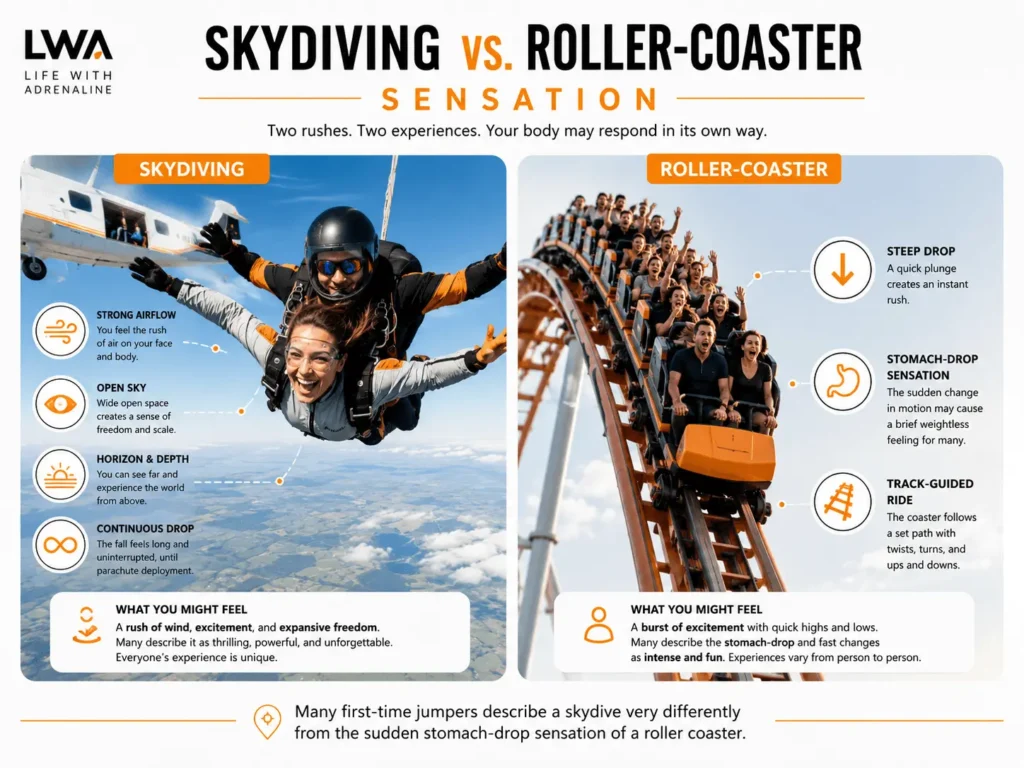
This is probably the biggest misconception about what skydiving feels like.
Several major U.S. drop zones tell first-time customers that freefall generally does not produce the same stomach-drop sensation associated with a steep roller-coaster descent. [S5][S6][S8][S9]
There is a useful reason to treat that as a common experience rather than a guarantee.
You are leaving an airplane that is already moving through the air. After exit, your speed and the aerodynamic force acting on your body change until you settle into freefall. The result feels very different from sitting in a vehicle following a track through a sudden drop.
Skydive Snohomish, for example, describes a progressive acceleration after leaving the aircraft rather than one instantaneous plunge. [S6]
Still, sensations are subjective.
A better expectation is: Do not assume your first skydive will feel like an endless roller-coaster drop, but do not worry if you notice a brief falling or stomach sensation during the exit either.
What Does Freefall Actually Feel Like?

Once you settle into freefall, the dominant physical sensation is usually airflow.
USPA says tandem freefall occurs at about 120 mph. [S1]
At that speed, the wind presses against your face, chest, arms and legs. Operator descriptions often compare it to holding your hand outside a moving car window, except the airflow is acting across much more of your body. [S5][S6][S7]
You are still falling toward the ground, of course.
But your body does not necessarily interpret that speed as the same plunging sensation you get from looking down from a building or descending a roller coaster.
The ground is also far enough away that you do not initially get the same visual impression of objects rushing past you that you experience in a fast car.
Instead, you see a huge horizon and an unusually wide landscape below you.
Expect a Lot of Wind
Freefall is windy enough that you are unlikely to forget it.
Your cheeks may move, loose clothing can flutter and the pressure against your exposed skin is obvious.
This is one reason appropriate clothing and properly fitted goggles matter. For seasonal clothing and footwear advice, see What to Wear Skydiving in Every Season.
Expect Noise Too
The airflow during freefall is loud.
Chicagoland Skydiving Center describes it as loud enough that ordinary conversation is impractical during freefall, with a major reduction in noise once the parachute opens. [S7]
Your instructor will therefore rely heavily on the procedures and signals explained during your pre-jump briefing.
Can You Breathe While Skydiving?
Yes, normally.
USPA’s guidance states that if you can breathe normally on the ground, you can likely breathe during freefall, and notes that some people find breathing through the nose easier. [S1]
The strong airflow can make the experience feel unusual, especially during your first few seconds outside the airplane.
If you catch yourself holding your breath because you are tense, focus on normal breathing rather than trying to take huge breaths against the wind.
And if you have a health condition that affects breathing or your suitability for skydiving, discuss it with the drop zone and an appropriate healthcare professional before jumping. USPA notes that drop zones establish their own physical requirements and that participants may need to disclose conditions that could affect the safety of a jump. [S1]
How Long Does Freefall Feel?
USPA gives a typical tandem freefall duration of 30 to 60 seconds. [S1]
Actual freefall time varies.
USPA’s technical guidance notes that freefall duration and terminal velocity depend on factors including altitude, body and equipment weight, surface-area-to-weight ratio and skydiving discipline. [S2]
Thirty to sixty seconds may sound short when you read it on a screen.
During a first jump, however, your brain is receiving an enormous amount of unfamiliar information at once: wind, noise, movement, views, body position and the realization that you are thousands of feet above the ground.
That can make the experience feel far more substantial than the stopwatch suggests.
What Does the Parachute Opening Feel Like?

The transition from freefall to an open parachute is one of the most noticeable moments of the jump.
You have been moving through loud, powerful airflow. Then the parachute deploys and begins slowing the tandem pair.
You should expect a firm deceleration transmitted through the harness.
Skydive Orange describes it as a noticeable tug through the harness followed by a transition to slower, quieter flight. Skydive Snohomish similarly describes substantial deceleration during canopy deployment. [S5][S6]
The exact sensation varies with equipment, body position and the particular opening.
“Firm” is therefore more useful than promising that every opening will feel completely gentle.
If you have existing neck, back or other medical concerns, review them with the operator and an appropriate healthcare professional before deciding whether to jump.
What Does It Feel Like Under the Parachute?
This is where the experience changes completely.
The roar of freefall falls away.
The speed feels dramatically lower.
Instead of being pressed against the airflow in a belly-to-earth freefall position, you are suspended in the harness beneath a large ram-air parachute.
The result can feel much closer to gliding than falling.
Operator guides commonly describe the canopy portion as quieter and more scenic than freefall. [S5][S7]
You may also feel turns if your instructor maneuvers the parachute.
Some people enjoy those movements. Others prefer a gentler ride.
If you are worried about motion sickness or aggressive turns, tell your tandem instructor before boarding so they know your concern.
What Does Landing Feel Like?
Landing technique depends on conditions and your instructor’s direction.
On many tandem jumps, the student may be instructed to raise their legs while the instructor controls the final approach and landing. Skydive Orange describes tandem landings that may involve a slide or step-down, while emphasizing that the instructor gives the final instructions. [S5]
Do not arrive with a landing technique memorized from a YouTube video or blog article.
Listen to your instructor’s instructions for your jump.
The landing is one of the times when following those instructions matters more than trying to predict exactly what the experience will feel like.
What About Ear Pressure?
This deserves more attention than it receives in many “what does skydiving feel like?” articles.
Changing altitude means changing air pressure.
If your ears and sinuses are clear, you may notice ordinary pressure changes similar in principle to what you experience during aircraft travel.
Congestion is a different issue.
USPA has published specific guidance warning that blocked ears or sinuses can cause significant pain, difficulty equalizing pressure and potentially more serious problems during skydiving. [S4]
If you are sick or significantly congested on jump day, do not simply decide to “push through it.”
Talk to the drop zone and, where appropriate, a healthcare professional.
What Does Skydiving Feel Like After You Land?
This may be the least predictable part.
Research has documented substantial emotional and physiological responses around skydiving, and one peer-reviewed study found that post-jump happiness was associated with faster cortisol recovery in its participants. [S3]
Commercial drop zones commonly describe first-time customers laughing, smiling, shaking or feeling an intense sense of accomplishment after landing. [S5][S8]
But you do not need to react that way.
- Excited
- Relieved
- Proud
- Emotionally overwhelmed
- Quiet
- Tired
- Ready to go again
- Completely satisfied with doing it once
There is no required reaction.
Your first skydive is still your experience.
How to Make Your First Skydive Feel Less Overwhelming
You cannot simulate every sensation before your first real jump, but you can remove some unnecessary uncertainty.
Know the basic sequence of the experience before arriving. Wear clothing that will not become a distraction. Confirm that you meet the operator’s current requirements. Ask questions during training instead of pretending you understand something you do not.
Most importantly, tell your instructor if you are especially nervous.
You do not need to act fearless.
A good first jump is not about proving that you were never scared. It is about knowing what to expect, following your training and making an informed decision about whether the experience is right for you.
If outdoor freefall still feels like too large a first step, indoor skydiving can provide exposure to high-speed airflow without an aircraft exit or parachute descent. Our upcoming Indoor Skydiving vs. Real Skydiving guide compares the two experiences.
Before Your First Skydive
☐ Check the drop zone’s current age, weight, mobility and health requirements.
☐ Tell the operator about any relevant health or mobility concerns.
☐ Do not ignore significant cold, sinus or ear congestion.
☐ Wear secure footwear and appropriate clothing.
☐ Pay attention during the tandem briefing.
☐ Ask your instructor about anything you do not understand.
☐ Expect strong wind and noise during freefall.
☐ Remember that you should normally be able to breathe.
☐ Follow your instructor’s landing instructions rather than advice from videos or social media.
☐ Allow yourself to be nervous without treating nervousness as proof that you cannot do it.
Frequently Asked Questions
Does skydiving feel like falling?
You are physically falling, but many first-time skydiving descriptions say the sensation is closer to being supported by strong airflow than continuously plunging downward. Individual experiences vary. [S5][S6][S7]
Does your stomach drop while skydiving?
Many U.S. operators report that customers do not experience the same stomach-drop sensation as a roller coaster. It should not be treated as a guarantee, however. Your exit and your body’s reaction may feel different from someone else’s. [S5][S6][S9]
Can you breathe during freefall?
Yes. USPA says people who breathe normally on the ground can likely breathe in freefall. [S1]
How fast are you falling?
USPA gives approximately 120 mph as the typical freefall speed. Actual speed varies with several physical and jump-specific factors. [S1][S2]
How long does freefall last?
USPA says tandem freefall generally lasts approximately 30 to 60 seconds. [S1]
Does parachute opening hurt?
You should expect an obvious deceleration and pressure through the harness as the parachute deploys. Operator descriptions commonly characterize it as a firm or noticeable tug rather than a continuation of the freefall sensation, but openings and individual comfort vary. [S5][S6]

Final Recommendation
If fear of the physical sensation is the main thing stopping you from booking a first tandem skydive, the experience may be different from what you are imagining.
Freefall is fast, noisy and intense, but speed does not automatically translate into a continuous stomach-dropping sensation. Strong airflow becomes the dominant physical sensation, and USPA confirms that breathing normally in freefall is generally possible. [S1]
The part you may underestimate is the anticipation.
Standing at the door of an aircraft and knowing you are about to exit is psychologically very different from watching someone else do it.
So do not book because somebody promises you will not be scared.
Book when you understand the experience, meet the operator’s requirements, accept that skydiving involves real risk and decide that the experience is worth confronting that fear.
That is a much better reason to make your first jump.
Sources
[S1] United States Parachute Association — Your First Skydive: https://www.uspa.org/students/your-first-skydive
[S2] United States Parachute Association — Skydiver’s Information Manual, Chapter 3: https://www.uspa.org/sim/3
[S3] Meyer et al. — Experience, cortisol reactivity, and the coordination of emotional responses to skydiving — Frontiers in Human Neuroscience: https://www.frontiersin.org/journals/human-neuroscience/articles/10.3389/fnhum.2015.00138/full
[S4] United States Parachute Association — Real Talk About Skydiving With a Cold: https://www.uspa.org/real-talk-about-skydiving-with-a-cold
[S5] Skydive Orange — What Does Skydiving Feel Like?: https://www.skydiveorange.com/2025/12/22/what-does-skydiving-feel-like/
[S6] Skydive Snohomish — What Will Skydiving Physically Feel Like?: https://www.skydivesnohomish.com/blog/what-does-skydiving-feel-like/
[S7] Chicagoland Skydiving Center — What Does Skydiving Feel Like: https://www.skydivecsc.com/blog/what-does-skydiving-feel-like.
[S8] Skydive STL — What Does Skydiving Feel Like? First-Time Jumper’s Guide: https://skydivingstl.com/blog/what-does-skydiving-feel-like/
[S9] Oklahoma Skydiving Center — What Does It Feel Like to Skydive?: https://oklahomaskydiving.com/blog/what-does-it-feel-like-to-skydive/
Safety Disclaimer
Skydiving involves inherent risk. Participant requirements, equipment, weather limits and operating procedures vary by drop zone. Always follow the instructions of your operator and instructor, review current eligibility requirements, and seek appropriate medical advice if you have a health condition that may affect your ability to participate.