
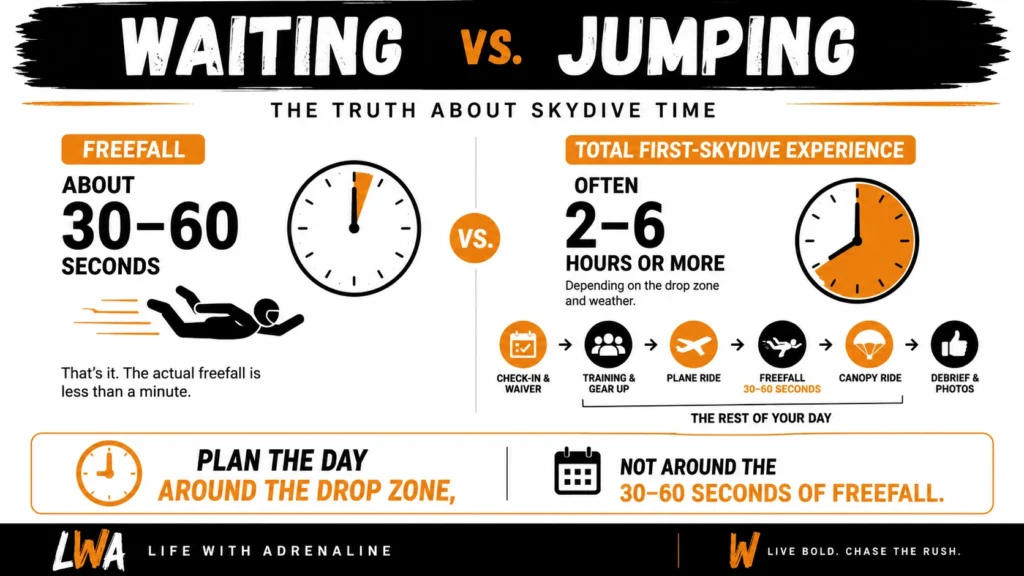
Your first time skydiving is much more structured than “getting in a plane and jumping out.” For a typical tandem skydive, expect to check in, complete paperwork, receive a short ground briefing, get fitted into a harness, wait for your aircraft load, ride to altitude, exit while attached to an instructor, spend roughly 30–60 seconds in freefall, fly under the parachute for several minutes, and then land with your instructor. The actual jump is short. The full experience can take several hours. [S1][S8][S9]
That difference matters.
If you imagine skydiving as one terrifying decision at an airplane door, the experience can feel overwhelming. In reality, your day is broken into a series of smaller steps. You receive instructions before you board, your instructor handles the technical side of the tandem system, and your main job is to listen, follow the body-position and landing instructions you were taught, and speak up when you have a question.
Here is what your first tandem jump is likely to look like from beginning to end.
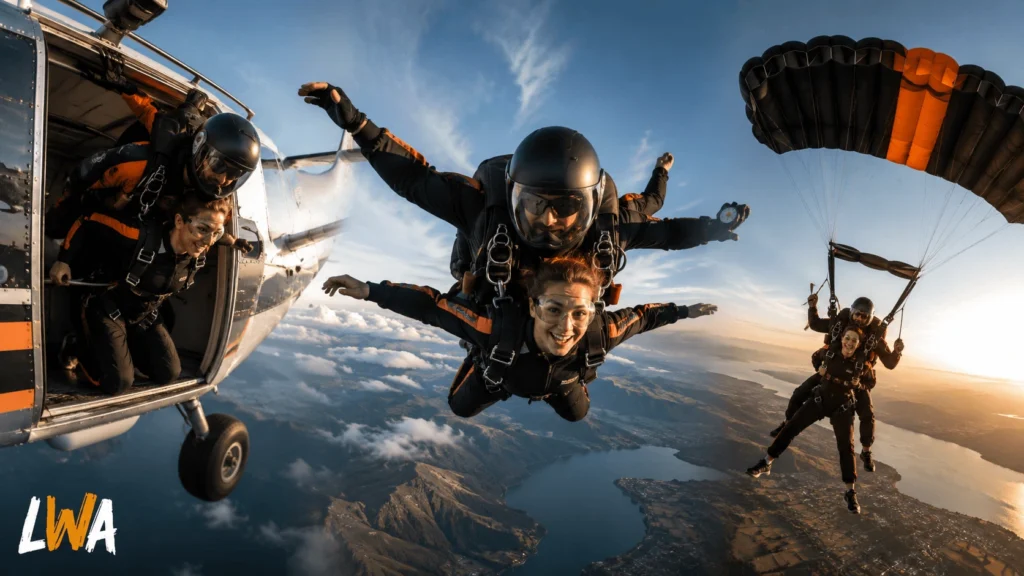
First-Time Skydiving at a Glance
| Stage | What Usually Happens | Time to Expect |
| Check-in | ID, registration, waiver, possible weigh-in | Varies by drop zone |
| Training | Exit, body position, freefall and landing briefing | Often under 30 minutes |
| Gear-up / waiting | Harness, goggles, equipment checks, aircraft scheduling | Highly variable |
| Aircraft ride | Climb to jump altitude | Often around 15–20+ minutes at turbine operations |
| Freefall | Tandem freefall with instructor | Roughly 30–60 seconds |
| Canopy flight | Parachute flight to landing area | Several minutes |
| Total visit | Entire drop-zone experience | Often several hours |
USPA describes tandem training as generally less than 30 minutes and tandem freefall as about 30–60 seconds. Individual operators show why you should not use the freefall time to estimate your day: Skydive Perris currently recommends allowing roughly two to four hours, while Skydive Carolina recommends around four to six hours. Weather or operational delays can extend either estimate. [S1][S8][S9]
Before You Leave Home: Make Sure You Can Actually Jump
One of the easiest ways to ruin your first skydiving day is to discover an eligibility problem after arriving.
Start with your chosen drop zone’s current requirements.
For U.S. commercial tandem skydiving, 18 is the practical minimum you should expect at many USPA-affiliated operations, and a valid government-issued photo ID is commonly required. USPA also notes that age requirements can depend on applicable local rules, so you should confirm the exact policy with the drop zone you plan to use. [S1][S8][S9]
Do not assume there is one nationwide customer weight limit. Operator limits can differ because equipment, instructor weight, harness fit, and local policies differ. As current examples, Skydive Carolina lists a 225-pound tandem limit, while Skydive Perris lists 240 pounds. Those are examples, not universal U.S. standards. [S8][S9]
Health requirements also deserve attention. Operators may ask customers with certain cardiovascular, neurological, back, neck, mobility, ear, sinus, or other medical concerns to discuss skydiving with an appropriate healthcare professional before jumping. The exact decision is operator- and individual-specific, so a general article cannot medically clear you for a skydive. [S8]
And arrive sober. USPA’s current Basic Safety Requirements state that a person should not jump while impaired by alcohol or drugs and should not make or attempt a parachute jump within eight hours of drinking alcohol. [S3]
For clothing, comfortable athletic clothes and secure closed-toe footwear are a strong starting point, but save the detailed seasonal decisions for your operator’s guidance and the weather forecast.
Step 1: Check In and Complete the Paperwork
Your reservation time usually starts the process. It does not necessarily mean the airplane leaves at that exact time.
At check-in, expect staff to verify your reservation and identity, complete any remaining payment or registration steps, and have you review and sign participation documents. Many drop zones also weigh tandem customers because their equipment and operating policies have weight restrictions. [S8][S9]
This is also when you may be offered a photo or video package.
Treat that as optional documentation of the experience, not something you need for the jump itself.
More importantly, use check-in to clarify anything that changed since you booked: weather, expected waiting time, medical questions, clothing concerns, or anything about the instructions you do not understand.
Step 2: Your Tandem Training Is Short, but It Matters
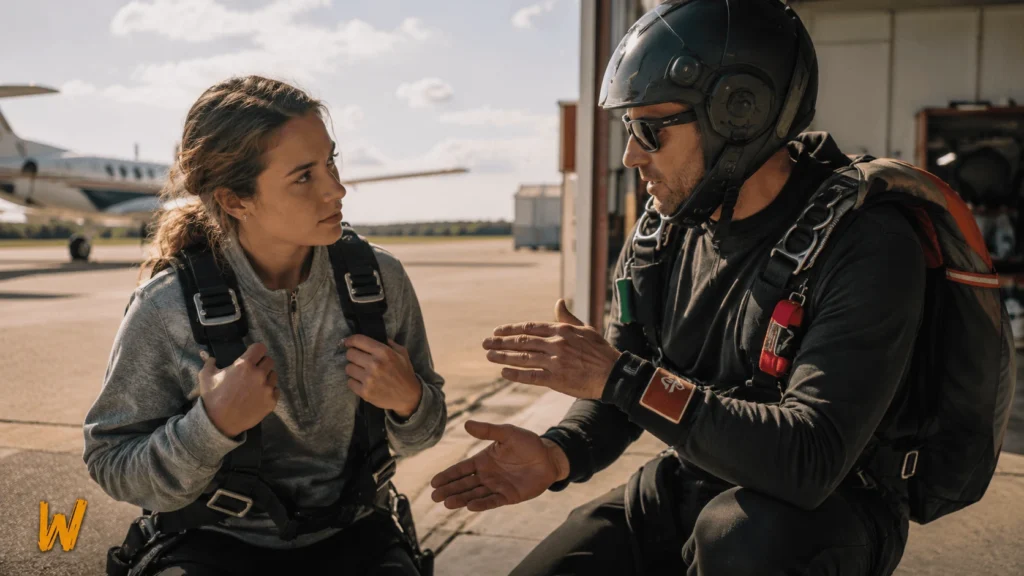
A first tandem skydive does not require the hours of ground school associated with some solo-student training methods. USPA says tandem training is generally less than 30 minutes. [S1]
Short does not mean unimportant.
USPA’s Category A tandem curriculum calls for a briefing before boarding that covers emergency procedures, the exit and freefall position, parachute procedures, and landing procedures. [S2]
Your local briefing may be simpler than the full student curriculum, but you should expect to learn some version of four practical skills:
- how to position your body for the exit;
- how to hold your body in freefall;
- how and when to respond to your instructor;
- what to do with your legs for landing.
You are not expected to become a skydiver in 20 minutes.
You are expected to understand the few actions that directly involve you.
If you do not understand one of them, ask again. There is no advantage in pretending to understand instructions before jumping from an airplane.
Step 3: You Get Geared Up
For a tandem jump, you wear a passenger harness that connects you to the tandem instructor’s parachute system. Goggles are normally provided, and some operations also provide a jumpsuit depending on the drop zone and your clothing. [S8]
The technical equipment belongs to the operator and instructor. You do not need to buy parachute equipment for a first tandem skydive.
A U.S. tandem parachute system is more than a single parachute. Federal tandem rules include requirements for a reserve parachute and an operational Automatic Activation Device on the reserve system. The reserve must also meet applicable packing and equipment requirements. [S4][S5]
An AAD is a backup device. It should not be presented as a guarantee that skydiving is risk-free, and it does not replace correct equipment use or instructor procedures.
This distinction matters: modern equipment contains layers of redundancy, but skydiving remains an activity with inherent risk.
Step 4: Then You May Wait
This is the part first-time customers often underestimate.
Skydiving depends on more than your reservation. Aircraft rotations, instructor availability, changing winds, clouds, weather holds, equipment logistics, and the number of people already scheduled can affect when you board.
Skydive Perris currently advises tandem customers to expect approximately two to four hours at the facility before accounting for weather or other unexpected delays. Skydive Carolina recommends planning for roughly four to six hours. [S8][S9]
That does not mean one operator is necessarily more efficient than another. Different aircraft, operating models, locations, weather patterns, and schedules create different timelines.
Do not put your first skydive between two tightly scheduled appointments.
Treat it as a half-day activity and leave extra space afterward.
Step 5: The Aircraft Ride Is Where It Starts Feeling Real
Eventually your load is called and you board the jump aircraft with your instructor.
The exact airplane varies enormously. Some major drop zones use large turbine aircraft; smaller centers may use smaller jump planes. Seating can feel much more compact and functional than a commercial passenger aircraft.
At Skydive Perris, the current standard tandem experience describes a roughly 15–20 minute climb toward jump altitude. Skydive Orange also describes a 15–20 minute aircraft ride for its operation. Your experience may be different, so treat those numbers as operator examples rather than a nationwide rule. [S8][S10]
During the climb, your instructor will continue preparing you and the equipment.
You do not need to mentally rehearse every possible emergency. You need to remember the simple actions from your briefing and listen to your instructor.
If you have an active cold, significant congestion, or ear/sinus concerns, deal with that question before boarding rather than discovering at altitude that you are uncomfortable. Some operators specifically flag ear and sinus problems among conditions customers should discuss before a jump. [S8]
Step 6: The Door Opens
For many beginners, this is the most intense psychological part of the experience.
Until now, everything has happened on the ground or inside an airplane. An open aircraft door makes the jump suddenly feel immediate.
Your instructor will complete the required setup and position you for exit. On a tandem skydive, you are connected to the instructor. You are not expected to independently launch yourself and stabilize a solo parachute system.
Focus on the body position you were taught.
You do not need to make the exit look impressive. You need to cooperate with the instructor.
Step 7: Freefall Is Fast — and Surprisingly Short
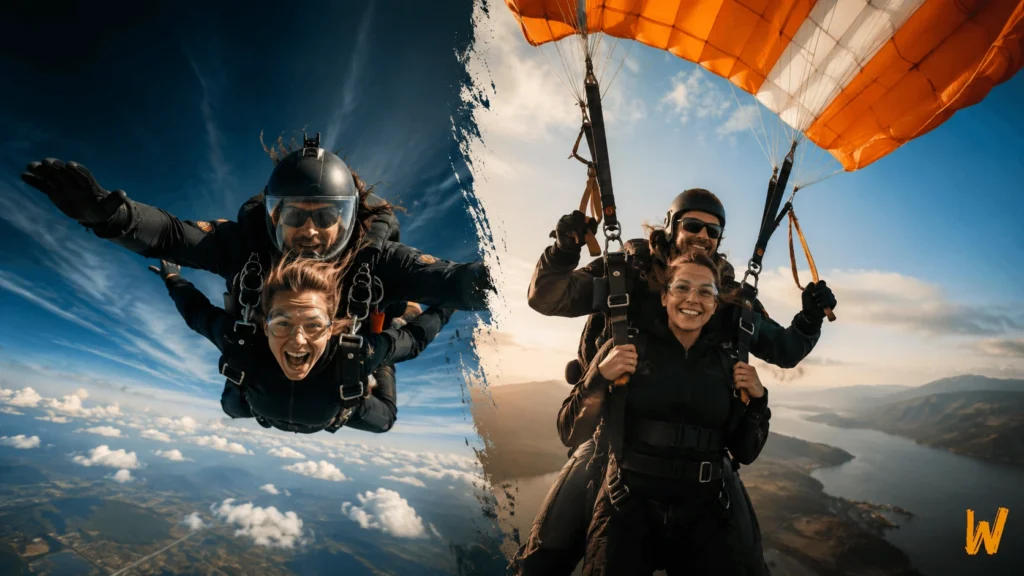
USPA gives a general tandem freefall duration of approximately 30 to 60 seconds. The exact time depends partly on the jump altitude and operation. [S1]
At some U.S. drop zones jumping from around 14,000 feet, operators advertise close to 60 seconds of freefall. [S8]
Expect strong airflow and a lot of noise.
Your instructor is controlling the tandem system, but your body position still matters. Follow the signals and instructions you learned on the ground rather than trying to improvise.
This is also why a first-time tandem jump is very different from simply being a passive amusement-park passenger. You have relatively few responsibilities, but the responsibilities you do have matter.
The good news for nervous beginners is that freefall does not give you much time to overthink what is happening.
Step 8: The Parachute Opens and the Experience Changes
At the planned deployment altitude, the main parachute is deployed.
The transition from freefall to canopy flight produces a noticeable deceleration and changes the pressure you feel in the harness.
Then the experience becomes very different.
The intense airflow of freefall disappears, the descent slows dramatically, and you have several minutes under the canopy before landing. Skydive Perris currently estimates roughly five to ten minutes under canopy for its standard tandem experience, while Skydive Orange describes about five to seven minutes. [S8][S10]
USPA notes that a tandem student may sometimes be allowed to help deploy or steer the parachute, but doing so is not required. [S1]
Whether you are allowed to steer and how much you participate is something to discuss with your instructor.
If you would rather simply enjoy the view, say so.
Step 9: Pay Attention to the Landing Instructions
As the landing area approaches, your instructor will prepare you for touchdown.
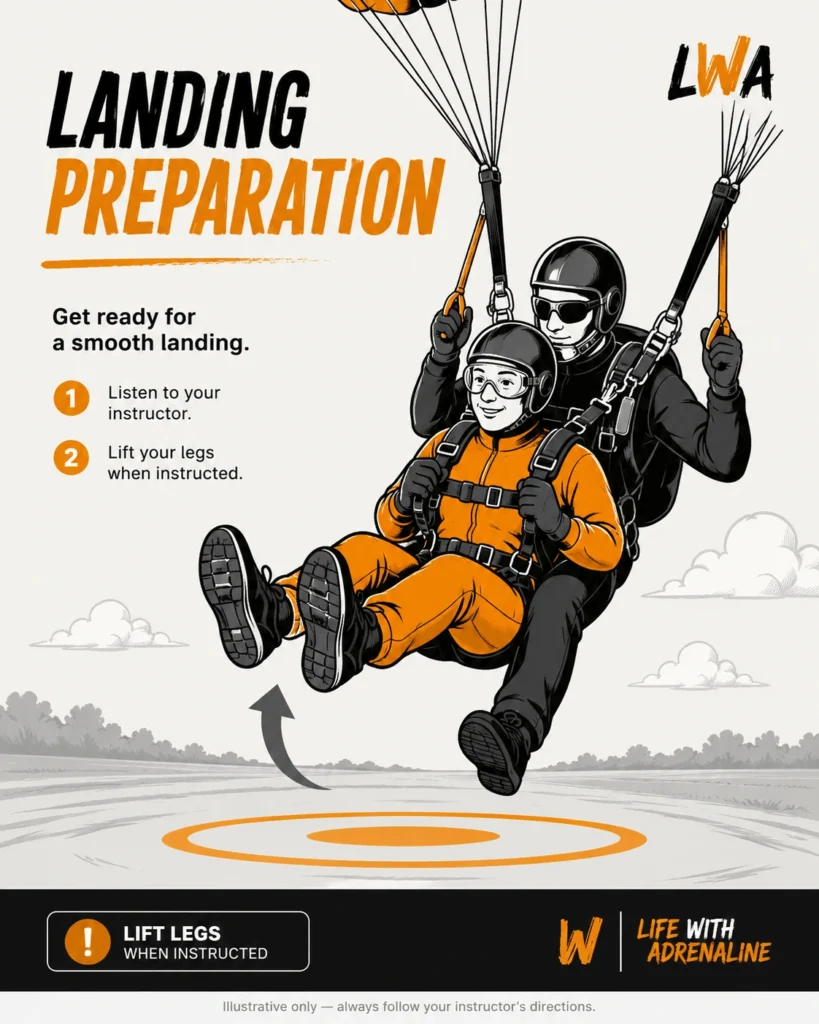
For many tandem students, one of the most important instructions is to raise and hold the legs up when told to do so. USPA’s tandem curriculum specifically includes landing procedures, and current operator instructions emphasize practicing the required landing position before the jump. [S2][S8]
The exact landing can vary with the parachute, wind, terrain, and instructor technique. Some tandem pairs slide in. Other landings may look different.
Do not decide your own landing technique based on a video you saw online. Follow your instructor’s briefing.
Landing deserves that attention. USPA’s 2025 non-fatal incident analysis again identified landing-related events as the largest category among reported incidents across skydiving. Incident-report data should not be interpreted as your personal probability of injury, but it reinforces why landing instructions are not a formality. [S7]
So, How Long Does First-Time Skydiving Actually Take?
If you are asking how long the freefall takes, think in seconds.
If you are asking how long the first-time skydiving experience takes, think in hours.
USPA’s general tandem freefall estimate is 30–60 seconds. Current operator guidance ranges much more widely for total time: roughly two to four hours at Skydive Perris and four to six hours at Skydive Carolina, with weather potentially making the day longer. [S1][S8][S9]
For planning purposes, reserve at least half a day unless your specific operator gives you better current guidance.
Avoid booking an expensive dinner, flight, wedding event, long drive, or other time-sensitive commitment immediately afterward.
Weather does not care about your calendar.
Is First-Time Skydiving Scary?
It can be.
There is no useful reason to tell a nervous first-timer that jumping from an airplane should not feel intimidating.
Fear before a first skydive is different from a safety problem. You can be nervous and still listen clearly, understand your training, and decide that you want to jump.
The part you can reduce is uncertainty.
Know what happens next. Ask questions. Understand your role. Choose a professionally operated drop zone. Give yourself enough time. Do not arrive exhausted, hungover, rushed, or pressured by friends.
And remember that you are allowed to decide that today is not your day.
If the sensation itself is your biggest concern, that deserves its own discussion rather than a few reassuring sentences. See the planned guide What Does Skydiving Feel Like? A First-Timer’s Guide for a deeper look at freefall sensation, breathing, noise, fear, and the transition under canopy.
How Safe Is Tandem Skydiving?
Skydiving involves inherent risk. Serious injury and death are possible.
That sentence should not be hidden behind marketing language.
USPA reported 16 civilian skydiving fatalities in the United States from an estimated 3.47 million skydives in 2025, equivalent to 0.46 fatalities per 100,000 jumps. Importantly, that figure covers civilian skydiving overall. It is not a first-time tandem-specific probability and should not be presented as your personal risk number. [S6]
Tandem skydiving is nevertheless highly structured.
Under federal tandem rules, the parachutist in command must meet specific experience requirements including at least three years in parachuting, a minimum of 500 freefall jumps using a ram-air parachute, and a qualifying master parachute license. Tandem systems are also subject to requirements involving the reserve parachute and an operational AAD. [S4]
At USPA Group Member drop zones, the organization says operators pledge to follow USPA Basic Safety Requirements and use appropriately qualified and current instructional staff. [S1]
Those standards reduce risk. They do not eliminate it.
When comparing drop zones, do not choose solely because one operator claims to be “the safest,” has the highest review score, or uses dramatic marketing language. Look for clear operating requirements, current instructor qualifications, transparent weather policies, professional communication, and willingness to answer safety questions.
First-Time Skydiving Checklist Before You Book
☐ Confirm the drop zone’s current minimum age and ID requirement.
☐ Confirm its exact tandem weight limit and whether you will be weighed with clothes and shoes.
☐ Ask about any health, mobility, medication, ear, sinus, back, neck, or cardiovascular concerns that may affect eligibility.
☐ Plan to arrive completely sober and follow USPA’s eight-hour minimum after alcohol.
☐ Check what clothing and footwear the operator requires.
☐ Ask how much total time you should reserve, not just the scheduled jump time.
☐ Read the weather, cancellation, delay, and rescheduling policy.
☐ Decide whether you want photos or video before being pressured by the excitement of jump day.
☐ Leave extra time after the experience in case weather or aircraft scheduling causes delays.
☐ Ask questions during the briefing until you understand the exit and landing instructions.
First-Time Skydiving FAQ
How long do you freefall on your first skydive?
For a tandem skydive, USPA gives a general freefall range of approximately 30–60 seconds. Higher standard jump altitudes generally provide more freefall, but the exact time depends on the operation. [S1]
How long should I plan to be at the drop zone?
Expect several hours rather than one hour. Current examples range from approximately two to four hours at Skydive Perris to four to six hours at Skydive Carolina, before unusually long weather or operational delays. [S8][S9]
Does my first skydive have to be tandem?
No. USPA recognizes tandem, Accelerated Freefall, Instructor-Assisted Deployment, and Static-Line pathways for first-jump training. Tandem is simply the most convenient way for most recreational first-timers to experience freefall with relatively little ground training. [S1]
Do I have to steer the parachute?
Not necessarily. USPA states that tandem students may sometimes be allowed to deploy or steer the parachute but are not required to. Your instructor and drop zone determine how your jump is conducted. [S1]
Can bad weather delay my jump even if it looks fine on the ground?
Yes. Wind, clouds, rain, visibility, and other aviation or operating conditions can delay or stop jumping. Operators may wait for conditions to improve or reschedule the jump. [S5][S10]
Do I need to be extremely fit to tandem skydive?
Usually not, but tandem skydiving still requires some mobility and participation. Operators impose their own weight, harness-fit, and physical requirements, and you will normally need to perform movements such as maintaining the instructed body position and lifting your legs for landing. Check directly with the operator if you have mobility or health concerns. [S8][S9]
Final Recommendation
For your first time skydiving, do not spend all your energy thinking about the moment you leave the airplane.
Prepare for the entire sequence.
Choose the drop zone carefully. Confirm that you meet its requirements. Reserve half a day. Arrive rested and sober. Listen during the briefing. Ask questions when something is unclear. Follow your instructor during the exit and landing.
Then, when the door finally opens, you will not be trying to figure out what comes next.
You will already know.
Sources
[S1] United States Parachute Association — Your First Skydive: Tandem. https://www.uspa.org/students/your-first-skydive/tandem
[S2] United States Parachute Association — Category A Tandem Training Requirements. https://www.uspa.org/skydiveschool/A
[S3] United States Parachute Association — 2026 Skydiver’s Information Manual, Basic Safety Requirements. https://www.uspa.org/SIM/2-1
[S4] United States Parachute Association / FAA regulation reference — 14 CFR 105.45, Use of Tandem Parachute Systems. https://www.uspa.org/SIM/9/105
[S5] Federal Aviation Administration — AC 105-2E Sport Parachuting. https://www.faa.gov/regulations_policies/advisory_circulars/index.cfm/go/document.information/documentID/1022746
[S6] United States Parachute Association — How Safe Is Skydiving?, updated April 2026. https://www.uspa.org/facts-faqs/safety
[S7] United States Parachute Association — The 2025 Non-Fatal Incident Summary, Part 1: Landing Incidents. https://www.uspa.org/dz-management/dzo-and-jump-pilot-news/article/the-2025-non-fatal-incident-summary-part-1-landing-incidents
[S8] Skydive Perris — Tandem Skydiving FAQs. https://skydiveperris.com/skydiving/tandem/faqs/
[S9] Skydive Carolina — First Time Tandem Skydiving: The Complete Guide to Your First Jump. https://www.skydivecarolina.com/blog/first-time-tandem-skydiving-tips/
[S10] Skydive Orange — Tandem Skydiving FAQ. https://www.skydiveorange.com/first-time-skydiving/faq/