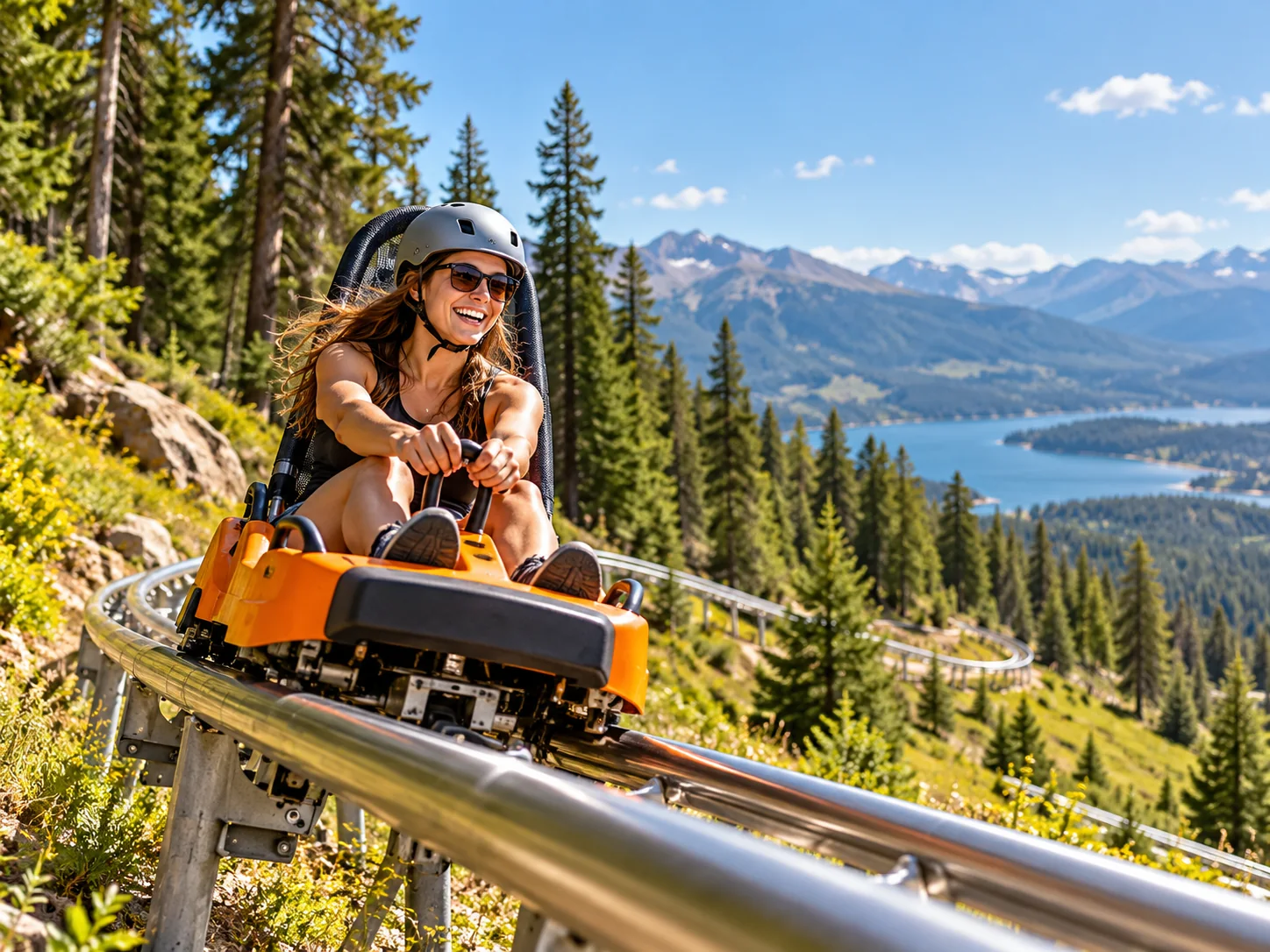
Mountain Coaster vs. Alpine Slide: What’s the Difference?
Two rides can look nearly identical in a mountain resort brochure: a small sled, a downhill course, scenic views, and a brake lever. But the engineering underneath makes a mountain coaster and an alpine slide meaningfully different. A mountain coaster uses a cart retained on a steel rail; a traditional alpine slide places a wheeled sled in an open, shaped trough. Both are controlled attractions—not interchangeable tickets or identical experiences.
The short answer: choose a mountain coaster if you prefer a track-attached cart and the roller-coaster feel of curves, dips, and sometimes an uphill lift in the same vehicle. Choose an alpine slide if you want a classic open-channel descent, where the sled rides in the trough and the attraction often has a separate chairlift trip to the start. Neither is inherently risk-free; weather, braking instructions, and the resort’s age, height, and passenger rules matter more than the name on the sign.
This comparison focuses on the physical formats, not a claim that every coaster is better or safer than every slide. For an actual trip, the exact attraction and its current rules should always be your final reference.
Mountain Coaster vs. Alpine Slide at a Glance
| Question | Mountain coaster / alpine coaster | Traditional alpine slide |
| What guides the vehicle? | Cart is retained on a fixed rail | Wheeled sled travels in an open trough |
| What does it feel like? | Rail-guided curves and dips | Low-slung run through banked open channels |
| Speed control | Usually rider-controlled brake, with ride-specific safeguards | Rider-operated braking mechanism |
| Ride back uphill | Often integrated uphill haul, depending on system | Frequently a separate chairlift or other ascent |
| Rain and closures | Depends on operator, rail system, and forecast | Often more sensitive to wet slide surface; check rules |
| Can children ride? | Age, height and pairing rules vary | Age, height and solo/tandem rules vary |
The table describes common designs rather than a universal engineering standard for all attractions. Some resorts market both activities under similar names. Always inspect the official ride description and restrictions before purchasing.
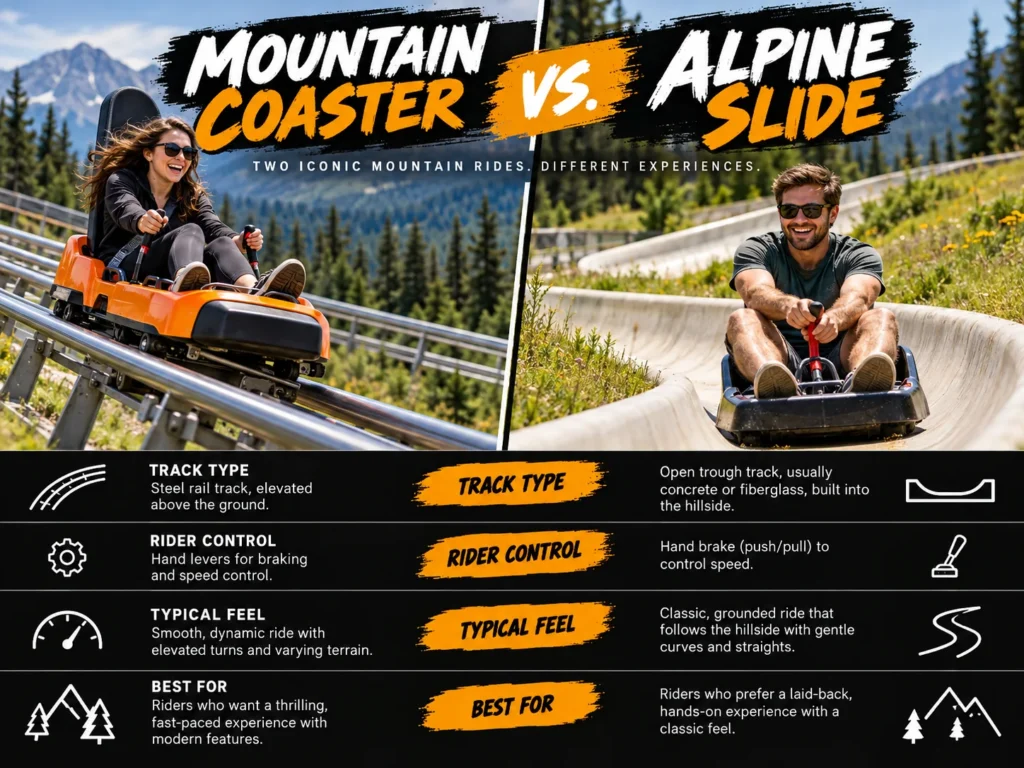
The Biggest Difference Is the Track
Mountain coaster: a retained rail cart
A modern mountain coaster rides on a steel rail with wheels and components that keep its cart on the track. The route can include tight turns, drops, and elevated spans. Many have a brake handle or levers that let the rider manage pace, subject to the mechanical limits of the system. Operators may allow one driver or a driver and passenger in a single cart, but that is not guaranteed at every location.
Because the cart is mechanically guided, the rider does not choose a line through a broad trough. That is the main reason the sensation can resemble a small, gravity-driven roller coaster. “Retained on rails” does not mean injuries are impossible or that the rider can ignore instructions.
Alpine slide: a sled inside an open channel
The traditional alpine slide uses a low wheeled sled running along a smooth, curved channel or trough, typically built from metal, concrete, or fiberglass. The rider applies the brake and must remain correctly positioned. These rides can feel closer to old-fashioned summer tobogganing: you sit very near the track surface, hear the wheels, and experience turns through the banks of the trough.
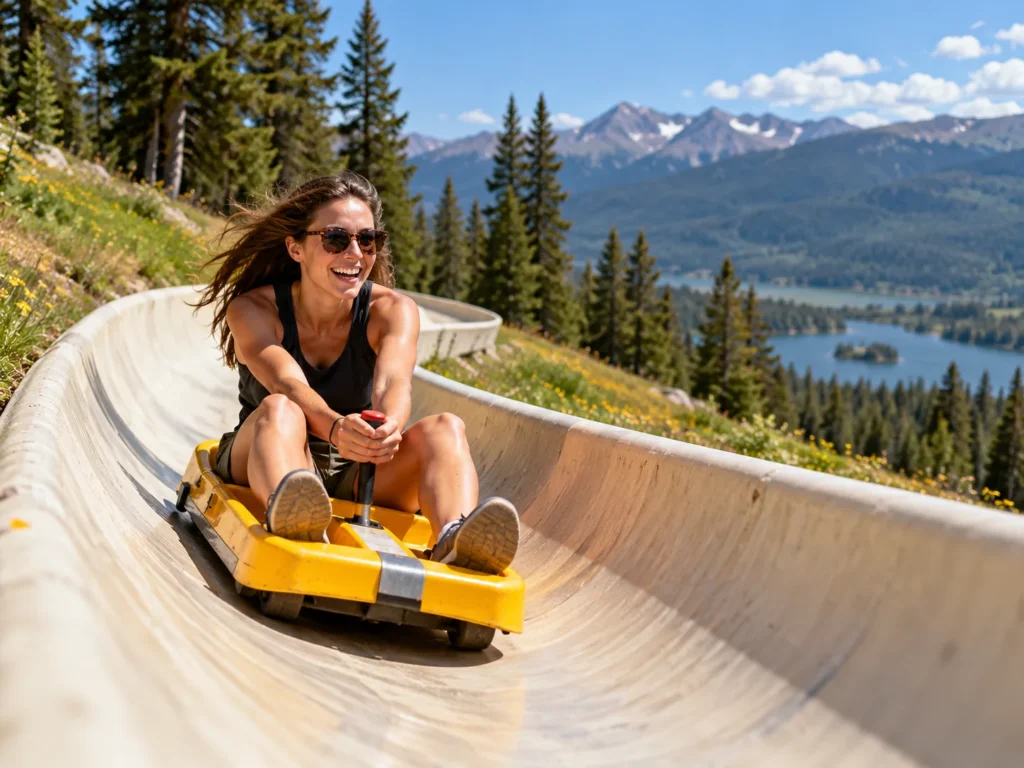
The sled is not attached to a continuous steel rail in the same way as a mountain coaster cart. It is essential to follow the operator’s exact braking, seating, separation, and no-stopping instructions. Do not interpret “more freedom” as permission to steer off course or disregard the track.
What About Speed, Braking, and How Scary They Feel?
Both kinds of ride may give the participant some speed control. That feature is appealing if you want a thrill without the sensation of freefall, but it does not mean you can safely stop anywhere or drive as slowly as you like. Operators explain how to maintain spacing and how brakes behave on their specific attraction.
A rail coaster often feels smoother and more enclosed by its carriage and restraints. An alpine slide may feel more exposed because the seating position is lower and the trough is open. The actual experience also depends on how steep the run is, how quickly you descend, the terrain, and whether you are riding alone or with an approved passenger.
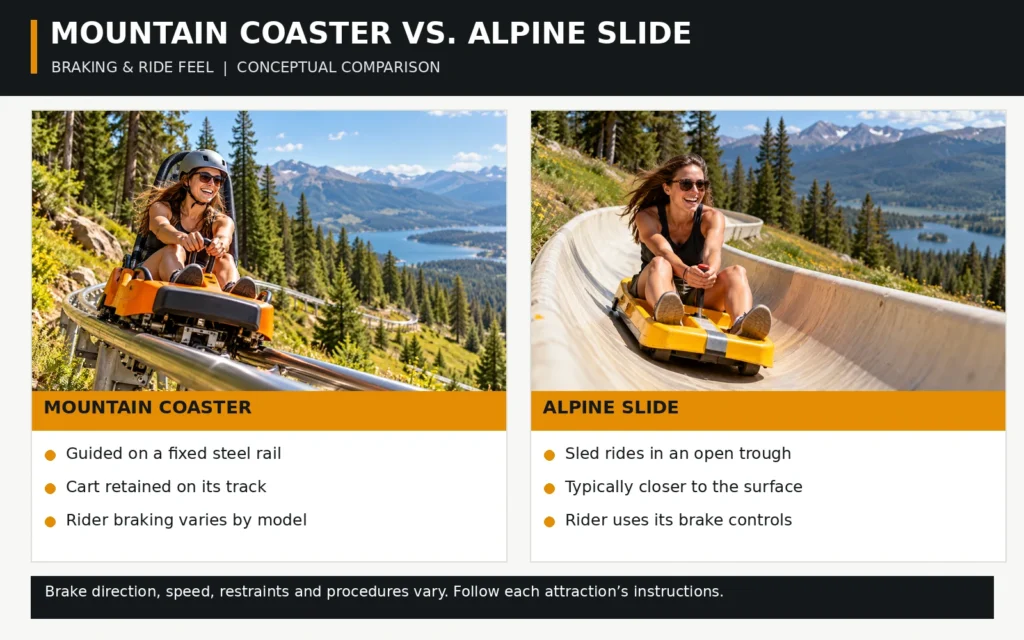
There is no credible universal answer to “which is faster?” A short coaster can be gentler than a long alpine slide, and vice versa. Published top-speed figures are site-specific, sometimes promotional maximums rather than typical speeds. Compare the two rides at the same resort if you want a meaningful reference.
Can You Ride Them in the Rain?
Weather policies are an important practical difference, but they cannot be reduced to “coasters run in rain, slides do not.” Some rail-guided mountain coasters can run in light rain under operator limits; others close or change procedures. Alpine slides may close when trough surfaces become wet because the friction and braking behavior can change.
Lightning, high winds, heavy rain, ice, and poor visibility can also interrupt either format. Even a ride described as “all-weather” does not promise operation in every storm. Check the official weather policy before driving to the resort—and have a backup plan if conditions are unsettled.
A Real Side-by-Side Example: Breckenridge, Colorado
Breckenridge Ski Resort is a useful case because its summer materials describe both the Gold Runner Coaster and traditional Alpine Slides at Peak 8. In the 2026 summer press material, the resort lists Gold Runner as a 2,500-foot elevated track with advertised speeds up to 25 mph. It lists three Alpine Slide lanes, each roughly 2,600 feet long, where participants control their own speed through bends and straightaways.
Those numbers are a published operator snapshot, not measured ride-test results. An extra 100 feet on one advertised course does not make it a more intense activity: slope, speed, track design, braking, and rider comfort matter more. Breckenridge’s lift and admission products, hours and availability also vary by date, so confirm the specific ticket at checkout.
| Breckenridge feature | Gold Runner Coaster | Alpine Slides |
| Format | Steel-rail coaster cart | Sled in an open slide lane |
| Published ride length | 2,500 ft | Three lanes of 2,600 ft each |
| Published speed | Up to 25 mph | No equivalent official speed in sources checked |
| Access | Peak 8 summer operations | Peak 8 summer operations; lift access may apply |
If you are already visiting Breckenridge, start with the format that best matches your comfort, not the length printed on the ticket board. Published details were checked on October 29, 2026; the 2026 summer operating window has ended, so these are planning examples rather than confirmed upcoming departures.
Which One Is Better for Kids and Families?
Neither format comes with a universal minimum age, height, weight, or solo-rider threshold. A child may be allowed to ride with an adult on one mountain coaster but not be tall enough to operate the brake alone. An alpine slide may allow different passenger arrangements. Some attractions also require specific footwear or prohibit loose items.
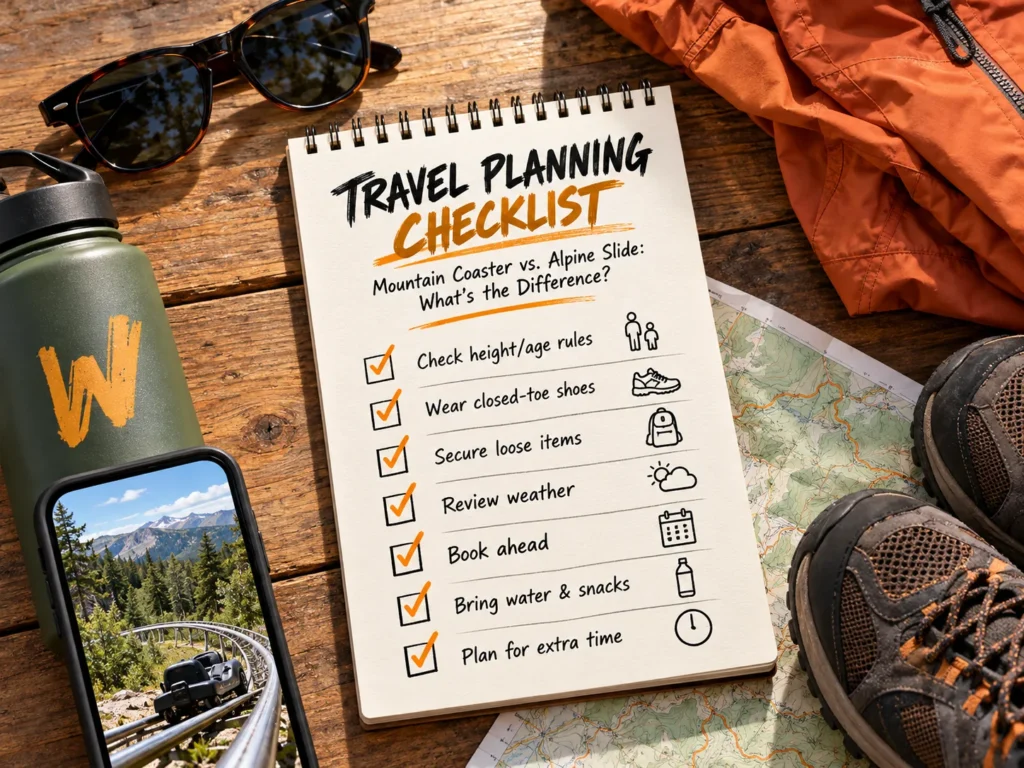
A practical family booking check should include the child’s age and height, whether tandem riding is permitted, which person must operate the brakes, maximum combined weight, and whether the child must be able to sit upright and follow instructions. If you are close to a posted limit, call the operator rather than making assumptions based on another resort.
For a nervous child, consider the noise, open space, speed, and inability to exit once a run has started. A scenic lift, shorter beginner ride, or observation area may be more enjoyable than pushing ahead with a ride that feels overwhelming.
What About Fitness and Accessibility?
Neither ride generally requires the technical training of rock climbing or skiing. But “low exertion” is not the same as universally accessible. You may need to transfer into a low cart, climb steps, use a chairlift, walk on uneven ground, or operate brakes with arms and hands. Some guests may find getting out of a sled harder than the ride itself.
Look for specific entry and exit instructions, accessible loading provisions if available, and restrictions related to mobility or medical conditions. Our guide to adrenaline activities without extreme fitness explains why relatively gentle physical effort still needs to be evaluated separately from operator eligibility.
Which Ride Should You Choose?
| If your priority is… | Start by investigating… | Why |
| A cart that stays on a rail | Mountain coaster | Track-attached carriage and guided turns |
| The traditional summer-toboggan feeling | Alpine slide | Open trough and low sled position |
| A mixed-age family outing | Either—after checking rules | Age, height and tandem arrangements decide eligibility |
| Uncertain weather | Check both operators | Neither has a universal all-weather guarantee |
| Maximum thrills | Compare the exact attractions | Ride geometry and speed are site-specific |
If your main goal is simply to sample an outdoor adrenaline activity, you may also want to consider ziplining or a jet boat ride. Our best beginner adrenaline activities in the USA shows how those choices compare with ride-based experiences without pretending that one activity is right for everyone.
If you have already decided on a rail-guided option, read our best alpine coasters in the USA for a destination-by-destination comparison of prices, scenery, ticket formats, and ride length.
Six Questions to Ask Before Buying Tickets
• Is this attraction a rail-guided mountain coaster or an open-trough alpine slide?
• What are the driver and passenger age, height, weight, and tandem rules?
• How exactly do the brakes work, and what spacing rules apply?
• Does the ticket include the ascent or require a separate lift pass?
• What are the closure, rain-check, refund, and rescheduling policies?
• Can everyone in the group board and exit the vehicle independently, or is assistance available?
Keep the booking confirmation and follow the actual attendant briefing on the day. A generic online explanation cannot replace a ride-specific procedure.
Frequently Asked Questions
Is an alpine coaster the same as a mountain coaster?
Usually, yes: in current U.S. attraction marketing, both commonly describe a cart retained on a rail. However, naming conventions vary, so confirm the physical track design instead of relying only on the label.
Is a mountain coaster safer than an alpine slide?
You cannot make that general claim from the track design alone. The systems differ mechanically, but maintenance, operator instructions, weather, rider behavior, and site-specific rules all affect risk. Neither ride is risk-free.
Can you brake on both rides?
Many rides of both formats allow rider-operated braking. The specific lever, range of control, speed regulation, and spacing instructions vary by attraction. Follow the official demonstration.
Are alpine slides only open in summer?
Traditional open slides frequently operate as seasonal mountain attractions, but the actual calendar depends on location and conditions. Some mountain coasters offer longer seasons. Check the current schedule for the specific resort.
Which is better for a first-time rider who dislikes heights?
An alpine slide may feel closer to the ground; a mountain coaster may provide a more retained carriage. But scenery, elevated track sections, speed and restraint design can change the experience. Watch official ride footage and ask the operator about its gentlest appropriate option.
The Bottom Line
The clearest distinction is not which is “more extreme”: a mountain coaster is a rail-retained cart, while a traditional alpine slide is a sled moving inside an open channel. Both can be memorable, family-oriented mountain attractions, but they demand the same basic discipline—confirm eligibility, follow braking instructions, and let weather and individual comfort shape your plans.
If you can try both at the same destination, such as Breckenridge when the attractions are operating, the difference becomes obvious within a few turns. If you must choose one, start with the vehicle format that feels right to you, then verify the exact day’s schedule and conditions.
Sources and Verification
Breckenridge 2026 summer press release — https://ebs.publicnow.com/view/05DB1CCCB42F9ACA54D51EC31FACBBAB6DD4FD59
Breckenridge operator press kit — https://news.vailresorts.com/BreckSummerTips
Breckenridge 2025 information — https://news.vailresorts.com/BreckSummer25
AlpineSlide.com format comparison (secondary background) — https://alpineslide.com/alpine-slide-vs-mountain-coaster.html
Life With Adrenaline: Alpine Coasters — https://www.lifewithadrenaline.com/best-alpine-coasters-usa/
Life With Adrenaline: Low-Fitness Activities — https://www.lifewithadrenaline.com/activities-without-extreme-fitness/