Best Zipline Destinations in the USA for First-Timers
Your first zipline trip should not begin with a search for the fastest cable in America. A much better question is where you can find a guided experience with a manageable first launch, clear eligibility rules, scenery worth traveling for, and enough time to understand the equipment without feeling rushed. Those details can change the experience far more than a record-breaking speed.
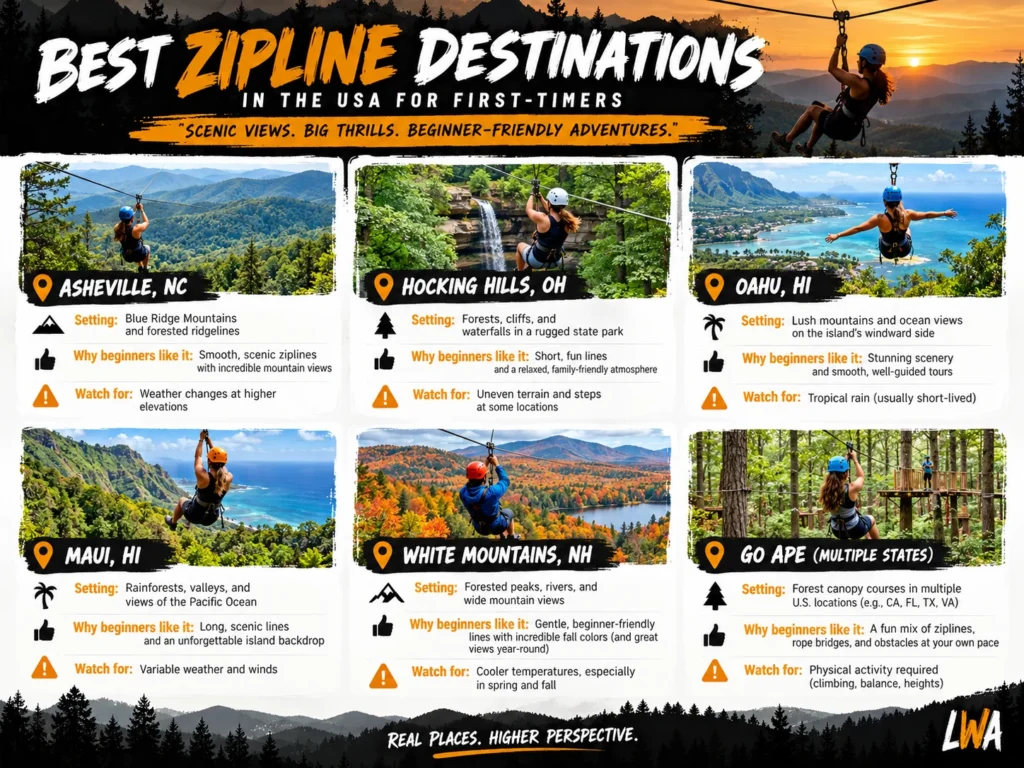
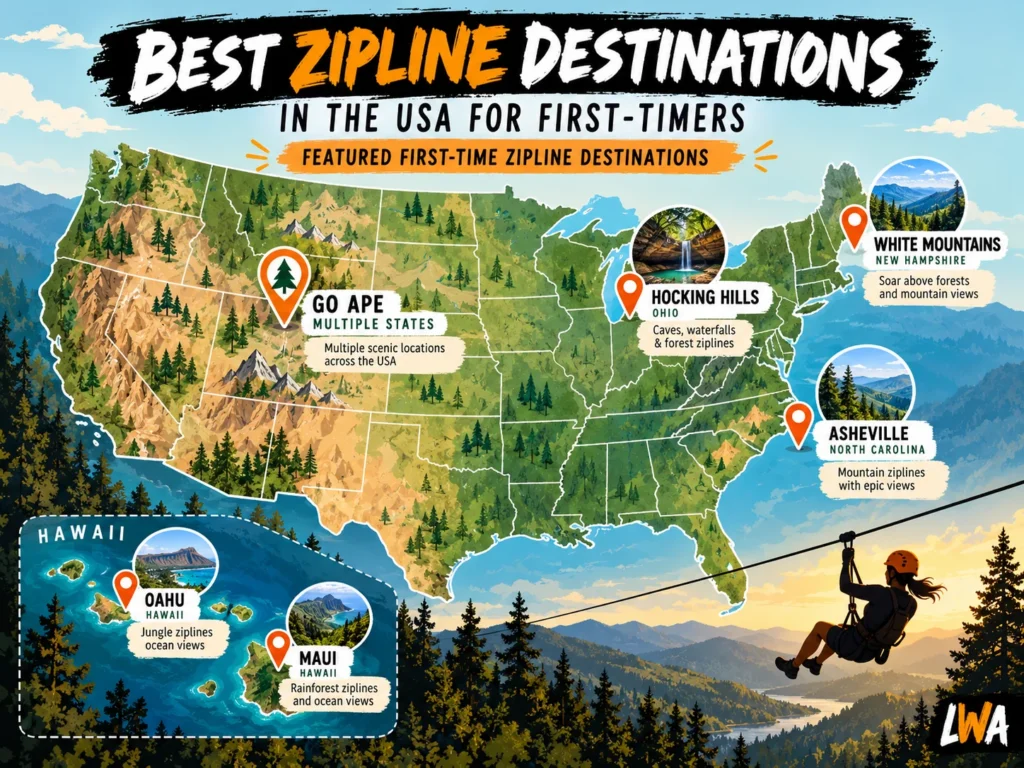
The best zipline destinations in the USA for first-timers include Asheville, North Carolina; Hocking Hills, Ohio; Oahu and Maui in Hawaii; the White Mountains of New Hampshire; and accessible Go Ape parks near major cities. But those are not six interchangeable rides. Some courses are short introductions; others include rappels, bridges, longer walks, or demanding braking techniques. Your preferred format matters as much as the destination.
This guide compares specific tour formats rather than declaring an entire city universally beginner-safe. Eligibility, tour lengths and examples were checked against operator materials in October 2026. Availability, rates and policies can change before your travel date. If you have never zipped before, start with our companion ziplining for beginners guide (article #51; add the verified link once published) to understand harnesses, footwear, health considerations and weight limits.
Quick Answer: Where Should a Beginner Zipline in the USA?
For an approachable mountain-forest introduction, start with Navitat’s Treetop Express near Asheville: three ziplines, a 1.5–2-hour itinerary and a published course progression. For a family-first Hawaii choice, investigate Maui Zipline, which advertises a minimum age of five and a 45–230-pound participation range. For cinematic scenery, Kualoa Ranch in Oahu has a three-hour tour but demands walking, bridges and more exact harness measurements. For a classic Ohio forest-canopy setting, Hocking Hills is compelling if everyone meets its ten-year and 70–250-pound thresholds.
| Location / example | Why consider it | Published participation gate | Beginner caveat |
| Asheville, NC — Navitat Treetop Express | Shorter mountain forest progression | Age 5+; 35–225 lb | Includes rappel and platform leap |
| Hocking Hills, OH — Original Canopy Tour | Woodland canopy destination | Age 10+; 70–250 lb | Participants must ride independently |
| Oahu, HI — Kualoa Ranch | Kaʻaʻawa Valley scenery | Age 10+; 70–280 lb; height 4 ft 8 in–6 ft 9 in | Five trails, bridges and fit limits |
| Maui, HI — Maui Zipline | Family-accessible tropical option | Age 5+; 45–230 lb | Standing, walking and stairs |
| Bretton Woods, NH — Canopy Tour | White Mountains and forest platforms | Age 12+; 90–250 lb | Nine zips, three rappels, hand-braking |
| Go Ape, many states — Treetop Journey | Easy-to-find aerial introduction | Rules vary by specific park/course | Rope obstacles are compulsory |
The table deliberately omits a universal ranking of safety or a claim that all six courses are ideal for every child or adult. Each row describes an option worth researching. Published requirements, weather decisions and available dates remain specific to the exact operator and departure.
How We Chose These Destinations
The strongest first-time candidate is not automatically the cheapest or most photographed. We prioritized: a currently described, bookable operator experience; training and guide involvement; an understandable course sequence; eligibility rules that a family can check before paying; practical access from an airport or visitor town; and at least one way to make a trip satisfying beyond the zipline itself.
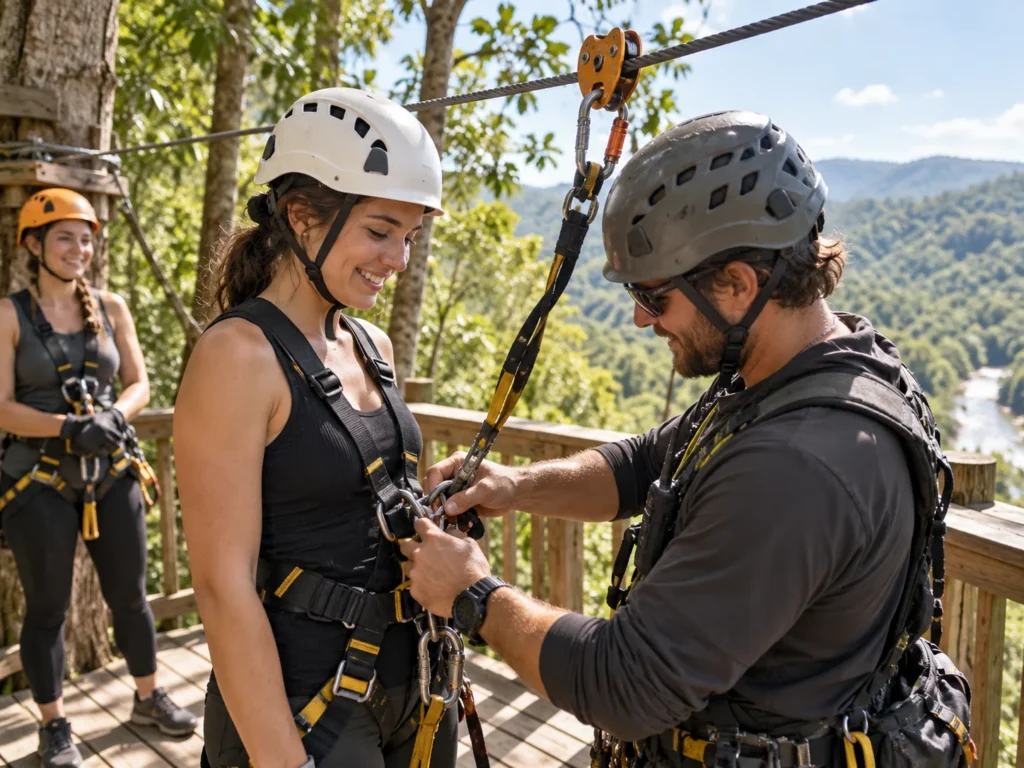
We also penalized hidden complexity. A 90-minute course with a short practice phase may be a better first outing than a full aerial obstacle park in which you have to complete ladders, wobbly bridges and multiple high platforms to reach the zipline. Some people would love those extras; for others, they are the reason to choose a different tour.
This is an editorial shortlist, not a verified independent safety certification, and not a ranking based on sales commissions or unpublished customer-review scores. We have not personally tested each course. Check the precise operator page, terms and opening calendar before booking. Operators’ equipment and procedures are not interchangeable.
1. Asheville, North Carolina — Best Mountain-Forest Starting Point
The Blue Ridge Mountains give Asheville a strong setting for a first zipline weekend: wooded slopes, visitor towns, hiking and the flexibility to combine a single adventure with a more relaxed day. Navitat’s Asheville site, actually near Barnardsville, offers two distinct formats. The shorter Treetop Express is the relevant starting point, not automatically its higher-profile Mountaintop Tour.
Why Treetop Express works for some beginners
The official Treetop Express page lists three zips, lines up to 900 feet long and as high as 75 feet, and a 1.5–2-hour tour. It advertises a daily price of $79 when checked and includes a rappel to the forest floor and a leap from a canopy platform. This is an adventure with multiple elements, not simply stepping from a parking-lot deck onto a low cable.
Participants must be at least five and weigh between 35 and 225 pounds. Children weighing under 55 pounds may ride tandem with an Adventure Guide, with limited tandem availability per tour. Navitat states that participants are weighed at check-in. Its Mountaintop Tour has a different range, 60–265 pounds. Never transfer one tour’s rules to the other.
Who should think twice
If the idea of an assisted rappel or a leap between platforms makes you uncomfortable, speak to the operator before purchasing. The lower published minimum age does not prove that every five-year-old will enjoy the full sequence. Check weather, walking demands, any group supervision rules, and whether a nervous participant can opt out at each stage.
Travel idea: use Asheville or a nearby mountain base for a two-night itinerary, and leave the zipline as one major activity rather than stacking two height challenges on the same day. The exact drive from your accommodation depends on where you stay, so plan using the Barnardsville tour address rather than the word “Asheville” alone.
2. Hocking Hills, Ohio — Best for a Classic Woodland Getaway
For travelers in Ohio or neighboring Midwestern states, the Hocking Hills region offers a different appeal: forested terrain, sandstone formations and a rural weekend atmosphere. Hocking Hills Canopy Tours lists its Original Canopy Tour as a guided forest experience, making it a natural destination to research for first-time riders who are old enough for that specific format.
What the official eligibility rules say
The operator publishes a minimum age of ten and a weight range of 70–250 pounds for the Original Canopy Tour. Guests are weighed at check-in. Children ages ten through fifteen must be accompanied by an adult, but are required to participate independently, not tandem with the accompanying adult. Closed-toe shoes and signed waivers are required.
That independent-riding detail deserves special attention. A child who meets the number on the scale but wants to physically share the zip with a parent should not be assumed eligible for the Original Canopy Tour. Parents should ask how the group sequence works, whether a practice line is included, and how staff help riders who become hesitant.
Why visit for more than a zipline
The landscape is a reason to stay longer. Give yourself time to experience the broader Hocking Hills area rather than turning the outing into a hurried stop between unrelated road trips. Hiking trails and park access have their own parking rules, weather considerations and crowd patterns; never assume the tour ticket includes park permits or other attractions.
Hocking Hills can be a good option for a confident first-timer seeking a more classic forest canopy atmosphere, but it is not the obvious choice for a five- or seven-year-old. Those travelers need a specifically age-appropriate course rather than a workaround to the posted rules.
3. Oahu, Hawaii — Best for a Scenic Valley Zipline
If scenery is the main reason for your trip, Kualoa Ranch’s Jurassic Valley Zipline on Oahu is among the most distinctive settings in this comparison. The operator describes seven tandem sections, two suspension bridges and five short hiking trails through the Kaʻaʻawa Valley. The full tour lasts roughly three hours, including instruction and preparation.
The attractions and the tradeoffs
The valley has recognizable movie and television scenery, but the real choice is an outdoor activity involving repeated movement between platforms rather than a passive film-location tour. Kualoa lists ziplines from about 200 feet to a quarter-mile in length, so riders experience more than a single long launch.
Its current official conditions include a minimum age of ten, weight of 70–280 pounds, height between 4 feet 8 inches and 6 feet 9 inches, waist measurement of 22–50 inches and upper thigh of 18–28 inches. Check-in weighing and closed-toe, closed-heel shoes are specified. These measurements are part of harness eligibility, not cosmetic recommendations.
A first-timer who dislikes bridges, uneven surfaces or multiple transfers may prefer a different activity despite the scenery. If you are traveling with children under ten or a group with very different body sizes, verify everyone’s eligibility before making the ranch tour the centerpiece of your Hawaii itinerary.
Planning the day
Reserve early when visiting on a short vacation because popular departures can sell out. Confirm whether your chosen ticket includes transportation from Waikiki, where to meet the operator, and how much buffer to leave for traffic and check-in. Do not treat Oahu’s coastal viewpoints and Kualoa’s inland valley as the same location. The tour itself is a mountain-valley activity.
4. Maui, Hawaii — Best Family-Style Tropical Alternative
Maui Zipline offers another Hawaii option with an entry point that differs substantially from Kualoa. Its published rules welcome participants starting at age five, with a weight range of 45–230 pounds. Guests under ten require an accompanying adult on the tour, and all minors have check-in and consent requirements.
Its course is marketed around tropical views, gardens and island scenery. For a child or an adult who wants a first managed glide without designing the whole vacation around extreme height, it can be a useful operator to compare. The destination is still Maui, which introduces flight and accommodation costs if you are not already visiting.
What an easy-looking tour still requires
The operator says guests must be able to stand for approximately two hours, walk over moderate terrain, and ascend and descend stairs. The experience is not automatically accessible to anyone who meets the age and weight numbers. The company describes check-in weighing and a strict participation policy, so review it before buying nonrefundable parts of a trip.
Maui Zipline also publishes exclusions for pregnancy and certain serious medical conditions. These are operator participation rules, not a substitute for personal medical advice. If anyone in your group has a relevant limitation, seek direct clarification and avoid assuming a lower platform or shorter cable eliminates the concern.
For a smooth family day, schedule the zipline when children are well rested, allow time to eat and hydrate beforehand, and leave spare clothes and valuables with a nonparticipant if the operator recommends it. Nothing ruins a scenic first ride faster than rushing to a departure or discovering that a participant cannot meet the requirements at check-in.
5. White Mountains, New Hampshire — Best for a More Committed Mountain Tour
The Bretton Woods Canopy Tour offers a beautiful New England alternative, particularly for travelers already interested in the White Mountains. But it is one of the more demanding entries here. The official tour includes nine ziplines, two sky bridges and three rappels. It starts with a scenic gondola ride, an experience that makes the overall day feel like a mountain excursion rather than a roadside attraction.
Who is eligible?
Bretton Woods currently lists a minimum age of twelve, minimum height of 4 feet 6 inches, and a weight range of 90–250 pounds. Its documentation also calls for average physical strength and mobility, comfort on short uneven walks, and the ability to control speed with a gloved hand. Participants may have to pull themselves along a line if they stop short of the platform.
These are significant requirements for beginners. The presence of professional guides does not mean that all movement and braking are managed without rider involvement. This option is better framed as a full-course first adventure for someone who is already confident with heights and physically prepared.
When it makes sense
Choose Bretton Woods when the hiking, gondola, mountain setting and longer series of activities are part of the appeal. If all you want is a brief introductory zip, a shorter course elsewhere will likely align more closely with your purpose. Confirm seasonal schedules even though the operator markets the canopy tour as year-round.
New Hampshire’s scenery can be especially compelling during autumn, but popular foliage travel dates are also busy. Plan lodging separately and do not presume that a resort-area experience automatically includes your lift tickets, parking, meals or accommodation.
6. Go Ape Parks — Best for a Local Trial Before a Destination Trip
Not every first zipline requires buying a plane ticket. Go Ape operates treetop adventure parks in multiple U.S. states, which can give city-based travelers an opportunity to try a lower-intensity aerial activity close to home. The important distinction is between its different product formats, not simply the Go Ape brand.
Go Ape describes Treetop Journey as an introductory ropes-and-zipline experience with tree-to-tree crossings and two ziplines at around 20 feet above the ground. At other venues and on Treetop Adventure courses, the experience may be taller, longer and more physically involved. Each venue has its own age, height and supervision rules.
An obstacle course is not a zipline-only ride
The official FAQ is clear that participants must complete the relevant rope obstacles before reaching the ziplines. Depending on the course, that can include ladders, stairways, bridges and crossings. Someone who wants to fly along a cable but cannot tolerate elevated obstacles should not buy a generic park ticket without reviewing the exact layout.
Go Ape’s published Treetop Adventure page shows a minimum height of 4 feet 7 inches and a maximum weight of 285 pounds, while its FAQ stresses site-specific restrictions. Those figures should not be copied into a Treetop Journey reservation as if every course uses the same limits.
This is the strongest option in the list for testing your reactions before committing to an expensive destination holiday. Search by your local park and the exact tour name, confirm the rules, and choose the lowest-intensity route that still gives you the experience you want.
Other Excellent Places That Are Not Automatically Beginner-First
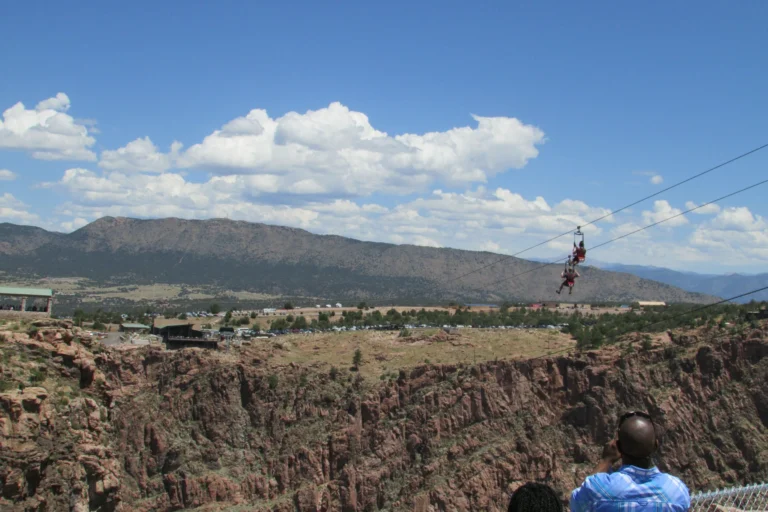
You will find spectacular ziplines in Pigeon Forge, Tennessee; the Royal Gorge in Colorado; and other U.S. mountain and canyon destinations. Some of these attractions are built around long continuous flights, unusually high exposure, or high advertised top speed. Those qualities are exciting, but they are not proof of a gentle learning curve.
Our longest and fastest ziplines in the USA guide covers record-oriented attractions and explains why total-course cable length, single-line length, advertised maximum speed and actual ride intensity need to be separated. Start there if a giant zipline is genuinely your goal, but do not confuse a record-oriented ride with a universal first-timer recommendation.
Similarly, the most glamorous tour video often shows the ten seconds of flight and leaves out approach hikes, stairs, medical exclusions, harness-fit measurements and a required self-braking technique. Read what the whole tour requires, not just the cinematic highlight.
Which Destination Fits Your Travel Style?
| Travel situation | Start researching | Main question |
| Two-night mountain weekend | Asheville / Navitat Treetop Express | Comfortable with a rappel? |
| Midwest forest getaway | Hocking Hills, Ohio | Everyone age 10+ and able to ride independently? |
| Oahu scenic vacation | Kualoa Ranch | Comfortable with bridges and 3-hour activity? |
| Maui family holiday | Maui Zipline | Meet 45–230 lb range and walking/stairs requirement? |
| New England mountain trip | Bretton Woods | Ready for hand-braking, rappels, longer tour? |
| Try it near home first | Go Ape Treetop Journey | Does the exact park offer that introductory course? |
These are starting points for a planning conversation, not bookings or guarantees. Each row should send you to one operator’s current booking page to answer that final question. The right destination is the one you can participate in comfortably, reach affordably, and integrate into the trip you already want to take.
For a solo traveler, group schedules and transfer arrangements are often the decisive details. Some tours operate in guided batches, may require a minimum group size, or may have limited time slots. Ask whether the business accepts solo reservations and whether you can join an existing departure. For families, also ask if an adult can supervise from the ground or must participate on the lines. These questions vary by operator and should not be generalized from one company’s policy to another.
If you are comparing a mainland course with Hawaii, consider the value of a second adventure day. A mainland road trip could combine a morning zipline with an afternoon walk or local meal, while Hawaii may already be full of beach, cultural and scenic plans. Choose the activity because it adds something meaningful to your trip, rather than making an entire expensive journey merely to check one item off a list. The difference is especially important for someone unsure about heights.
How Much Should You Budget for Your First Zipline Trip?
The ticket is only one part of the budget. Navitat Treetop Express listed a $79 daily ticket when checked in October 2026, but it would be misleading to apply that figure to other locations or assume every site publishes the same fees. Rather than inventing a nationwide average, compare the complete checkout amount for the dates that interest you.
Add the necessary travel pieces: transportation to the launch base, rental car if required, local lodging, parking where applicable, meals, taxes, booking fees, and photographs if sold separately. In Hawaii, flights and hotels can dominate the total cost even when the zipline itself is comparable to a mainland excursion. A local Go Ape course may offer the best financial test before a destination trip.
Also ask what “duration” includes. A three-hour adventure may include shuttle, briefing and hiking rather than three hours suspended on cables. Build check-in time and weather buffer into your itinerary. Before paying, compare cancellation terms in case your tour is postponed because of high wind, storms or unsafe conditions.
First-Timer Booking Checklist
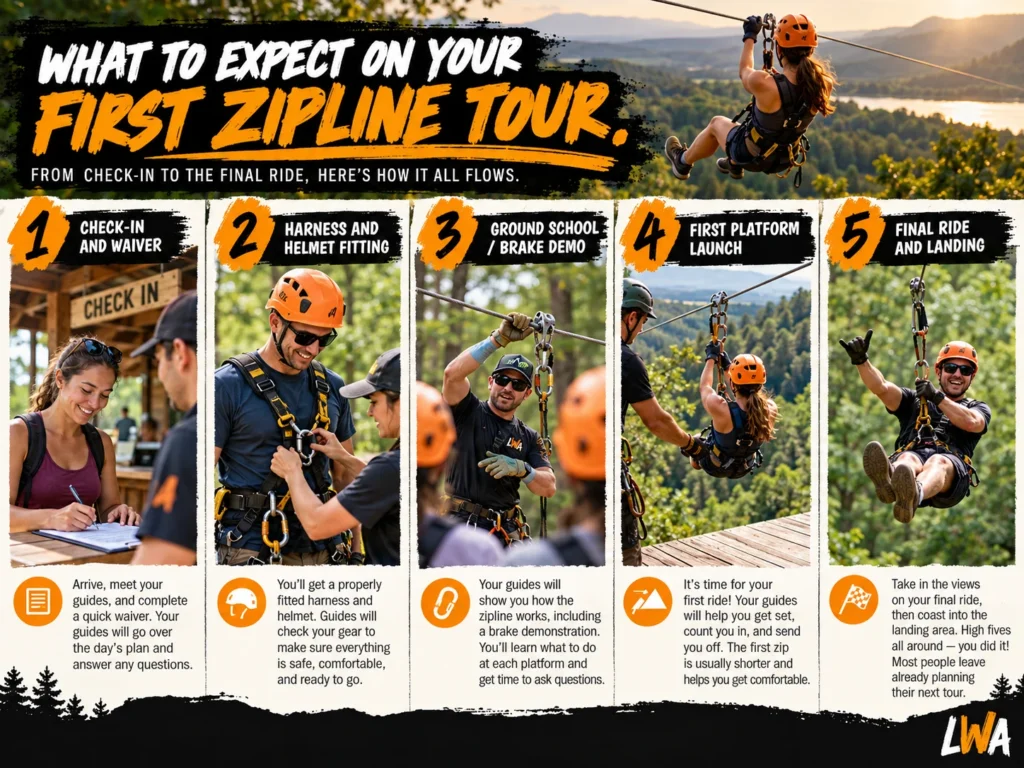
Use this list before reserving: exact course name; minimum and maximum weight; minimum age and height; waist and thigh measurements where published; supervision rules for children; need for walking, stairs, ladders, rappels and bridges; whether riders operate their own brakes; available weather reschedules; full ticket price; footwear and gloves; and the time and location of check-in.
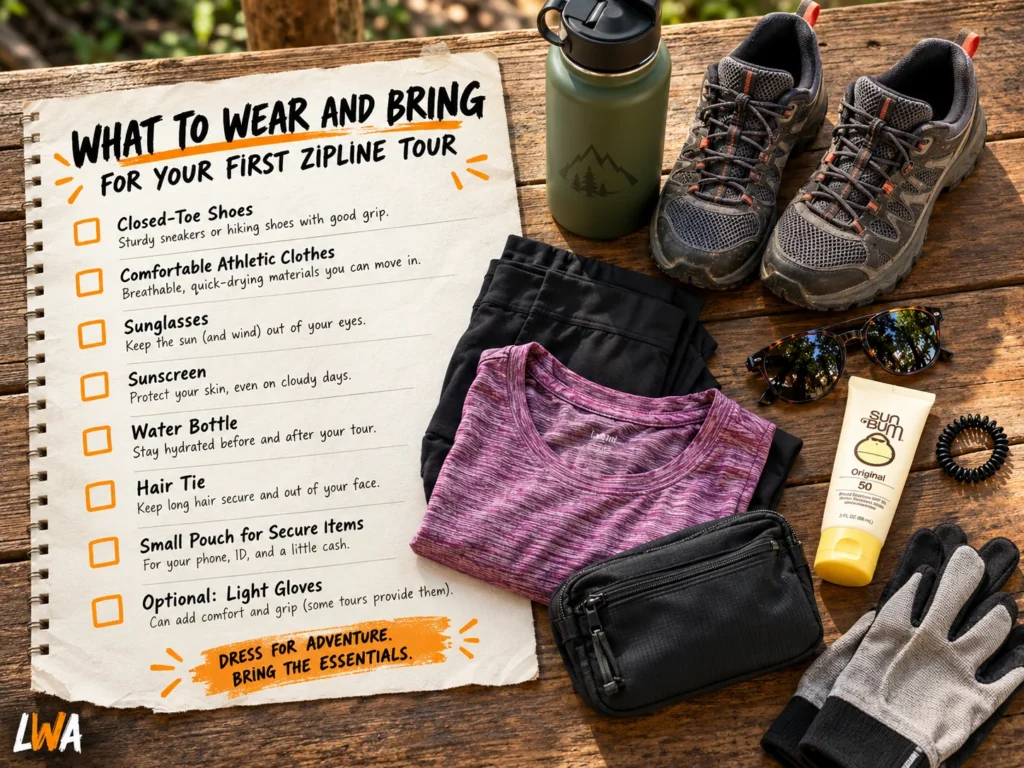
Tell the operator about relevant health or mobility concerns instead of asking a generic travel blog to declare you fit. Don’t try to change your measured weight, clothing or equipment configuration to get around a posted requirement. A harness that does not fit correctly is a reason to choose another course.
If you are deciding among ziplining, rafting, a mountain coaster and other accessible thrills, our best adrenaline activities in the USA for beginners compares the broader tradeoffs. There is no single activity that fits every group’s preferred intensity or budget.
Frequently Asked Questions
What is the best US state for first-time ziplining?
There is no objective single winner. North Carolina offers an accessible mountain-forest option at Navitat; Ohio supports a classic canopy getaway; Hawaii brings exceptional scenery; and local Go Ape parks may be easier for a low-commitment trial. Match the exact course to your age, size, comfort and logistics.
Can a five-year-old go ziplining?
Some operators allow five-year-olds on specifically designed tours. Navitat Treetop Express and Maui Zipline both publish age-five eligibility, subject to additional weight and adult-supervision rules. Other courses here require ages ten or twelve. Verify the specific product rather than assuming a destination-wide rule.
Is there one standard zipline weight limit in the USA?
No. Current examples range from 35–225 pounds at Navitat Treetop Express to 70–280 pounds at Kualoa Ranch, with other courses publishing still different ranges. Equipment fit and course design matter. Limits should be checked immediately before making a reservation.
Do you need previous experience?
Generally, beginner-targeted tours are designed for people without prior zipline experience and include guide instruction. That does not eliminate physical requirements such as stairs, short hikes, rappels or braking. Read the exact course description and ask for clarification before booking.
Are the longest and fastest ziplines best for beginners?
Not necessarily. Record length and maximum speed tell you very little about practice opportunities, guiding, physical demands or a nervous first-timer’s comfort. A shorter, guided progression can be a better fit than a very long single descent.
What should I wear for a first zipline?
Closed-toe shoes and secure, comfortable clothing are recurring requirements. Tie back long hair and avoid loose items. Whether gloves are provided or required differs by operator; never assume you can use a personal camera or phone while on the line.
The Bottom Line
A great first zipline trip begins with the right course rather than the most dramatic destination photograph. Asheville offers a manageable guided progression for many eligible riders, Hocking Hills a classic forest getaway, Oahu an immersive valley itinerary, Maui a family-accessible tropical option, Bretton Woods a more demanding mountain route, and Go Ape an approachable local trial when the correct course is available.
Treat all age and weight figures as operator-specific snapshots, not permanent safety standards. Check eligibility, weather policies and full travel logistics first. Then choose the landscape that makes the experience memorable for the right reasons.
Sources and Verification
Navitat Treetop Express — https://navitat.com/asheville-nc/tours/treetop-express/
Navitat requirements — https://navitat.com/asheville-nc/participant-requirements-policies/
Hocking Hills — https://www.hockinghillscanopytours.com/tour-overview/
Kualoa Ranch — https://www.kualoa.com/tours-and-activities/zipline-tour
Kualoa FAQ — https://www.kualoa.com/faq
Maui Zipline — https://www.mauizipline.com/book-a-tour.php
Bretton Woods — https://www.brettonwoods.com/experiences/canopy-tour/
Go Ape Treetop Adventure — https://www.goape.com/adventures/treetop-adventure/
Go Ape FAQ — https://www.goape.com/faq/
Kapalua Ziplines — https://www.kapaluaziplines.com/faq/