
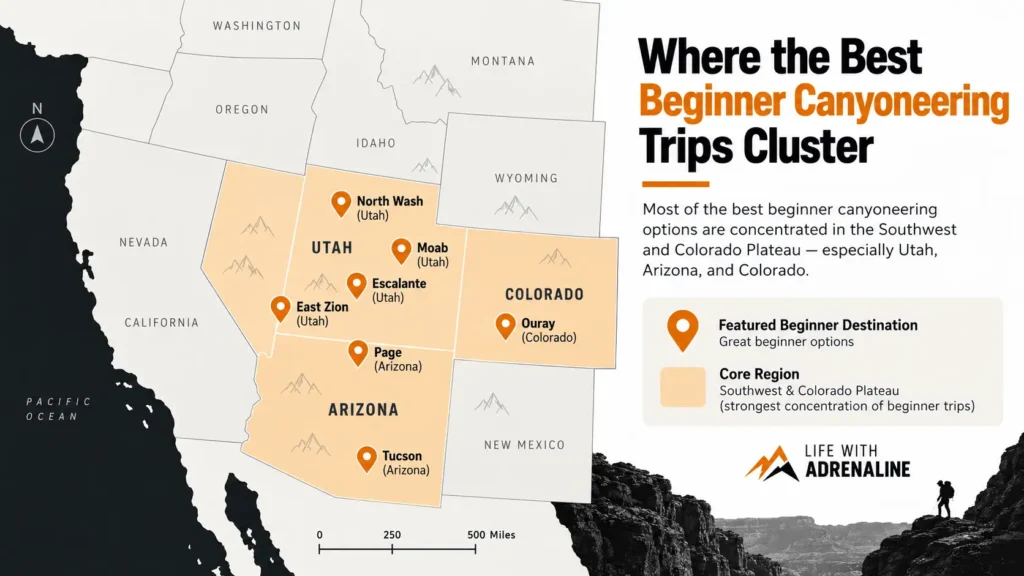
Direct answer: If you want one first canyoneering trip that feels like a real canyon journey without turning the day into a full backcountry test, Morning Glory Arch in Moab is the strongest all-around starting point in this comparison. The current guided format takes about five hours, requires no previous experience, includes two major rappels plus a canyon hike, and is open to guests ages 10 and up. Adult pricing is currently $155 and youth pricing is $130. [S3]
But “best for beginners” changes fast once you add water, hiking, heat, remoteness, or a longer route. Angel Creek in Ouray is a shorter wet-canyon introduction with a highest drop of 35 feet. Tanque Verde in Tucson is a stronger fit for active hikers who want a private half-day. Middle Maidenwater in Utah gives beginners much more practice with downclimbing, stemming, and repeated short rappels, but it asks for better fitness and a six-to-seven-hour commitment. [S5][S6][S8]
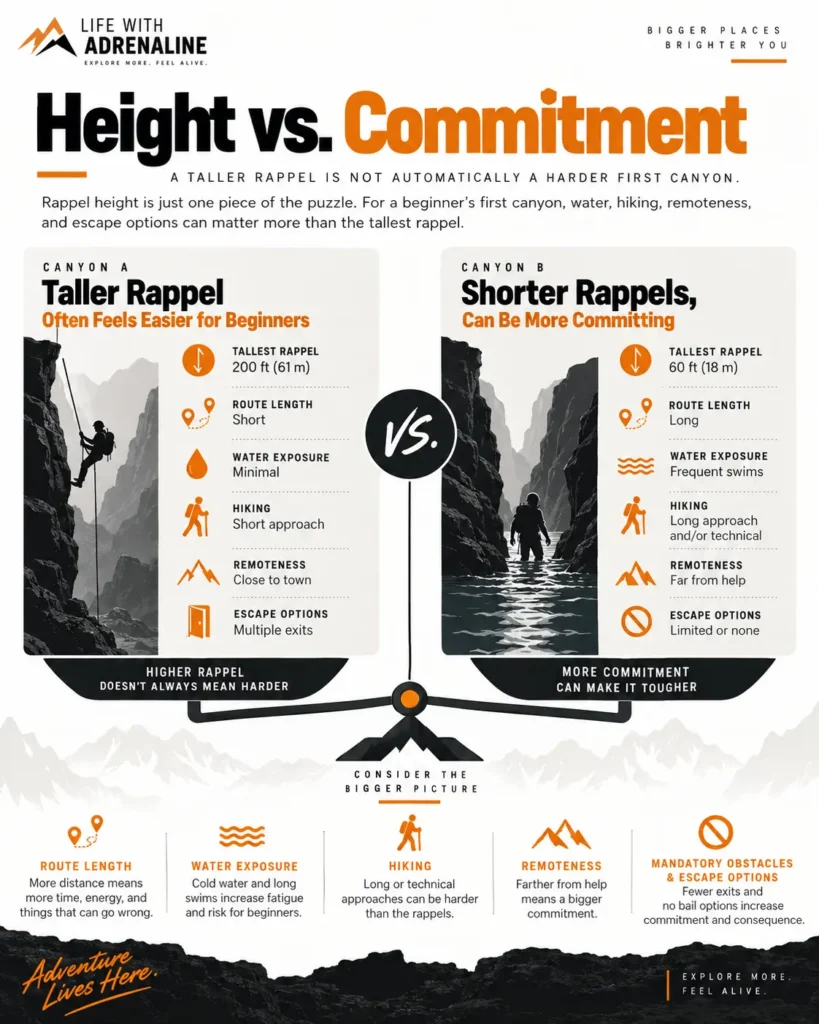
The key is not to choose by rappel height alone. Choose by total commitment: how long you will be in the canyon, how wet you may get, how much hiking and scrambling are required, how remote the route is, whether rappels are mandatory, and what the weather can do to the canyon.
Best Canyoneering Trips at a Glance
Prices below are snapshots checked September 9, 2026. They are examples from the named operator or booking listing, not U.S. market averages. Recheck the exact trip, taxes, fees, availability, participant rules, and cancellation terms before paying.
| Trip | Time | Water | Price checked Sep. 9, 2026 | Key restriction | Best for |
| Morning Glory Arch — Moab, UT | ~5 hr | Mostly dry; stream crossings | Adult $155; youth $130 | 10+ | Best overall |
| Elkheart Canyon — East Zion, UT | 4–5 hr / ~2 mi | Confirm current canyon conditions | Adult $169; youth $159 | 8+; 250-lb canyoneering limit | Zion-area logistics |
| Angel Creek — Ouray, CO | ~1–2.5 hr | Wet / waterfall canyon | $145 | 10+ | Wet-canyon intro |
| Tanque Verde — Tucson, AZ | ~4–5 hr / ~3 mi | Variable; pools/wet rock possible | From $173 | Typical operator minimum age 8; confirm exact trip | Active first-timers |
| Adventure Day — Escalante, UT | Full-day format; 3–4 mi | Route/conditions vary by day | From $225 | 7+ | Wilderness-style intro |
| Middle Maidenwater — North Wash, UT | 6–7 hr | Possible wading / wet feet | $145–$230 by group | Fitness requirement; no minimum age stated on checked page | Skill-building |
| Blue Pools — Page area, AZ | 2–3 hr | Usually dry; may hold water after storms | Operator quote; third-party from $195 | Confirm exact booking restrictions | Short private intro |
What “Beginner-Friendly” Canyoneering Actually Means
Canyoneering is more than rappelling. The National Park Service describes it as a combination of route finding, rappelling, problem solving, swimming, and hiking. A guided beginner trip usually means the operator accepts people with no previous canyoneering or rappelling experience and manages the technical systems. It does not mean the canyon itself has no exposure, no fall hazard, no flash-flood risk, or no physical demand. [S11]
That distinction matters because a first guided trip and an independent technical canyon are two very different levels of responsibility. In Zion, for example, NPS warns that once you complete a first rappel and pull the rope, you may be committed to finishing the canyon. The park also stresses self-rescue skills and specialized equipment for independent technical trips. [S13]
For a first commercial trip, use six filters before you look at the biggest rappel:
1. Route commitment. A short canyon with a straightforward exit is easier to manage psychologically than a long canyon with few escape options. Capitol Reef NPS notes that many canyons require full commitment once started and escape is often not possible. [S1]
2. Water exposure. Dry sandstone canyoneering and waterfall-style canyoning can feel like different sports. Cold water, slippery rock, wetsuits, and swimming add complexity even when the rappels are shorter.
3. Hiking and scrambling. A 40-foot rappel after a mile of uphill hiking and hours of rough terrain can be more tiring than a 100-foot rappel on a shorter guided route.
4. Remoteness. Cell service and rescue access can be limited in canyon country. The farther you are from roads and towns, the more important conservative route choice and guide logistics become. [S1]
5. Weather. Slot canyons can flood even when rain is falling far upstream. BLM specifically warns that narrow slots are especially susceptible to flash flooding and that flooding can occur when it is not raining where you are. [S2]
6. Mandatory moves. Ask whether every rappel, downclimb, squeeze, or water section is required once you enter. A “beginner” route can still contain obstacles that cannot simply be skipped.
1. Morning Glory Arch, Moab, Utah — Best Overall First Canyoneering Trip
Moab earns the top spot because the current Morning Glory format gives a first-timer the major pieces of canyoneering without demanding a full day in a remote slot. Moab Adventure Center lists the trip at about five hours, March through November, with no previous experience required. The operator supplies technical gear, instruction, and transportation. Minimum age is 10; current pricing is $155 for adults 13+ and $130 for youth ages 10–12. [S3]
The route combines two real rappels with a hike through Grandstaff Canyon and stream crossings. The operator describes its Moab routes as mostly dry, though shoes can get wet. That makes Morning Glory a useful middle ground for someone who wants more than a single scenic rappel but is not ready to make cold water or swimming the center of the day. [S3]
The main psychological challenge is height. The operator lists rappels around 100 feet and says every rappel is part of the route. If your concern is exposure rather than fitness, ask exactly how the guide handles nervous first-timers before booking. If your concern is physical effort, the operator says to expect roughly two to three miles of hiking depending on the route. [S3]
Best for: first-timers who want a recognizable desert canyon, real rappelling, moderate total time, and simple commercial logistics.
Think twice if: a 100-foot-class rappel is likely to overwhelm you before you have even learned whether you enjoy being on rope.
2. Elkheart Canyon & UTV Adventure, East Zion, Utah — Best Zion-Area Option for Easy Logistics
For travelers already building a Zion vacation, Elkheart is one of the easiest current guided formats to understand. East Zion’s pricing page lists it as an “Easy” 4–5-hour canyoneering and UTV adventure covering about two miles, with a minimum age of eight. The listed price is $169 for adults and $159 for youth, and the operator publishes a 250-pound canyoneering weight limit. [S4]
The important wording is Zion-area, not “technical guided canyoneering inside Zion National Park.” East Zion’s tourism site describes guided canyoneering and slot-canyon excursions on the plateau and in the communities outside the park’s east gate. Technical canyoneering inside Zion National Park is governed by the park’s Wilderness permit system. [S11][S12]
That separation is useful for beginners. You can book a guided introduction near Zion without pretending that a commercial half-day tour is the same thing as independently running Pine Creek, The Subway, or another technical park route. If Zion canyoneering becomes your main reason for traveling, use the planned dedicated Zion guide for route-specific permit and trip planning rather than stretching this national roundup into a local guide.
Best for: Zion visitors who want a guided slot-canyon day with relatively short listed mileage and clear published restrictions.
Think twice if: you are specifically trying to descend a famous technical route inside Zion National Park; that is a different permit, skills, and planning question.
3. Angel Creek, Ouray, Colorado — Best Wet-Canyon Introduction
Angel Creek is the clearest choice here for a first-timer who actively wants water and waterfalls rather than a mostly dry sandstone canyon. Canyoning Colorado rates the route beginner level, lists a minimum age of 10, a May–September season, and a highest drop of 35 feet. The operator estimates about 10 minutes of approach, 1.5–2 hours of descent, 10–15 minutes of return travel, and roughly 1–2.5 hours total depending on group size and ability. Current price is $145 per person. [S5]
That combination makes the commitment easy to understand: the rappels are relatively modest in height, the approach is short, and the trip is not an all-day desert objective. The tradeoff is water. Wet rock, moving water, canyon temperature, and waterfalls can raise the perceived intensity even when the vertical drops are smaller than Moab’s.
This trip intentionally overlaps with Life With Adrenaline’s waterfall-rappelling guide because it sits on the boundary between beginner canyoneering and wet canyoning. If your main question is “Which U.S. trip lets me rappel in or beside waterfalls?” read the waterfall-rappelling guide instead of treating this national canyoneering roundup as a duplicate.
Best for: first-timers who want a true wet-canyon feel with a shorter overall commitment.
Think twice if: you dislike cold water, slippery rock, or getting fully wet more than you dislike height.
4. Half-Day Tanque Verde Canyon, Tucson, Arizona — Best for Active First-Timers
Tanque Verde is a strong fit for hikers who want a first canyon that feels athletic rather than touristy. Altitude Mountain Guides says no previous canyoneering or rappelling experience is required for its half-day trip and identifies it as the better choice for most first-time canyoneers and families. The current format is approximately four to five hours with around three miles of hiking, multiple rappels, a Tyrolean traverse, all technical equipment included, and pricing from $173 per person. [S6]
This is not the mellowest option in the list. The operator describes several hours of hiking, scrambling, rappelling, and movement through rugged canyon terrain and says a reasonable fitness level is appropriate. Water varies with conditions and is typically optional, but pools, flowing water, or wet rock may be present. [S6]
Season is another reason Tucson belongs in a national comparison. The operator generally runs canyoneering in fall through spring and does not offer canyon trips June through September because of seasonal closures and hot-weather conditions. For winter or shoulder-season travelers who would rather base in a city than a small Utah desert town, that schedule can be an advantage. [S6]
Best for: active beginners, couples, or private groups who already hike comfortably and want varied movement, not just rappelling.
Think twice if: three miles of rugged hiking plus technical obstacles sounds like more work than fun.
5. Canyoneering Adventure Day, Escalante, Utah — Best Full-Day-Style Wilderness Introduction
Escalante is the better choice for travelers who want their first canyoneering day to feel like a desert journey rather than a short activity attached to a broader vacation. Escalante Tours currently lists its Canyoneering Adventure Day from $225 per person, with no experience necessary, children ages seven and up welcome, a typical distance of three to four miles, up to 500 feet of elevation gain/loss, and rappels up to 80 feet. Equipment is included. [S7]
The appeal is progression. You get more time moving through slickrock and canyon terrain than on a short sampler, without jumping immediately to the operator’s High Adventure Day, which recommends prior rappelling and/or rope experience and lists much bigger rappels and more mileage. [S7]
The tradeoff is that Escalante is not the place to ignore weather or logistics. Much of the surrounding canyon country is remote, and slot-canyon conditions can change quickly. Treat the exact canyon and weather plan as a day-of-safety decision, not a promise that the same route will be appropriate in every forecast. BLM’s flash-flood guidance is especially relevant in this landscape. [S2]
Best for: beginners who want a substantial canyon-focused day and are comfortable hiking several miles.
Think twice if: you want the shortest possible introduction or need to stay close to urban services.
6. Middle Maidenwater, North Wash, Utah — Best for Learning Real Canyon Movement
Middle Maidenwater is the most skills-rich beginner option in this list. North Wash Outfitters explicitly markets it as “Perfect for Beginners” and highlights repeated practice with rappelling, downclimbing, sliding, stemming, and partner assists. Published rappels range from about five to 45 feet, which shifts the challenge away from one giant drop and toward learning how to move through a canyon. [S8]
That does not make it low-effort. The trip is listed at six to seven hours and starts with roughly a mile of uphill hiking before the canyon. The operator says participants should be in good physical condition and able to hike all day on rough, uneven, challenging terrain. It may include wading or wet feet depending on conditions. [S8]
Pricing is group-dependent: $230 for one person, $195 per person for two, $165 per person for groups of three to five, and $145 per person for groups of six to ten. The published season is March–May and September–October; the operator does not recommend the canyon during the hottest part of summer. [S8]
This is the trip to choose if your goal is not merely to say you rappelled, but to understand what people mean by downclimbing, stemming, squeezing, and working through repeated obstacles.
Best for: fit beginners who want to build movement skills and are comfortable dedicating most of a day.
Think twice if: you want minimal hiking, a fast half-day, or a highly polished resort-style experience.
7. Blue Pools, Page / Lake Powell Area — Best Short Private Slot-Canyon Intro
Blue Pools is the shortest clearly beginner-oriented slot-canyon trip in this comparison. Canyon Country Outdoors describes it as an excellent beginner choice with three to four rappels, a tallest rappel of 55 feet, a short scramble/hike back to the vehicle, and a typical trip time of two to three hours. Trips are private and technical canyon gear is fitted at the trailhead. The canyon is typically dry but can hold some water after storms. [S9]
The operator does not publish one fixed public price on the page we checked; it says pricing depends on group size and the booking page provides an instant quote. A current AAA Trip Canvas listing for the same Blue Pools format shows tickets starting at $195, with taxes and fees calculated at checkout. Treat that as a booking snapshot, not the operator’s permanent base price. [S9][S10]
That short, private format is useful for travelers who are curious about canyoneering but do not want to spend their entire Page or Lake Powell itinerary inside a canyon. It also gives you a genuine slot environment without choosing one of the area’s more involved full- or half-day routes.
Best for: private groups, nervous beginners, and travelers who want a two-to-three-hour technical canyon experience.
Think twice if: you want a full day of skill-building or a route with more sustained hiking and technical movement.
How to Choose the Right First Canyon for You
If you are still torn between destinations, start with the part of canyoneering that worries you most. Your best trip is often the one that removes one major stressor while keeping the part you actually want.
| If this sounds like you… | Start with | Why |
| You want the simplest all-around first trip | Morning Glory, Moab | Moderate time, no prior experience, mostly dry, real canyon hike + rappels |
| Waterfalls are the main attraction | Angel Creek, Ouray | Short wet-canyon route; highest listed drop 35 ft |
| You are a fit hiker who wants variety | Tanque Verde, Tucson | Hiking, scrambling, rappels, Tyrolean traverse |
| You want a canyon-focused full day | Escalante Adventure Day | 3–4 mi and repeated canyon movement |
| You want to learn stemming/downclimbing | Middle Maidenwater | Multiple short rappels plus partner assists and canyon movement |
| You are nervous about a long commitment | Blue Pools, Page area | Private 2–3 hr format with 3–4 rappels |
| Zion is already your main vacation | Elkheart, East Zion | Guided Zion-area option without treating a technical park route as a casual tour |
There is no reason your first trip has to contain every canyoneering element at once. A mostly dry Moab route can teach you whether you enjoy being on rope. Angel Creek can show you whether moving through water is exciting or uncomfortable. Middle Maidenwater can introduce real canyon movement without making rappel height the headline.
Dry Canyoneering vs. Wet Canyoning: Which Is Better for a Beginner?
For a nervous first-timer, mostly dry canyoneering is usually easier to understand. You can focus on harness comfort, rappelling, foot placement, scrambling, and exposure without simultaneously dealing with cold water or slippery waterfall rock. Morning Glory is the clearest dry-leaning example here. [S3]
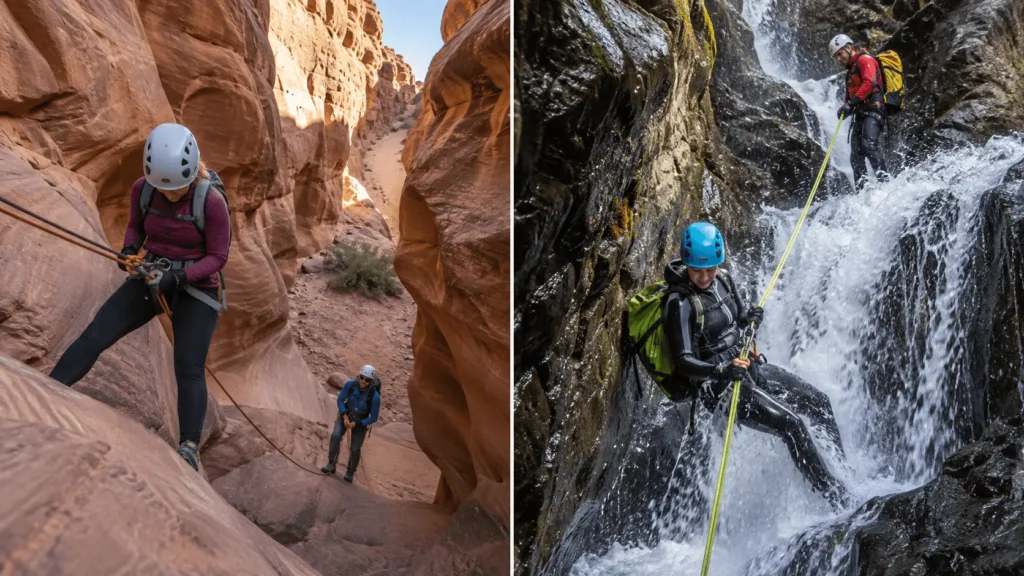
Wet canyoning may feel more intense even with shorter drops. Angel Creek’s highest listed drop is only 35 feet, but the route is built around a mountain-water environment. Tucson can also include pools or flowing water depending on conditions. [S5][S6]
Neither format is universally easier. The right question is which variable you would rather manage first: height and dry exposure, or water and slippery terrain.
How Much Does Beginner Canyoneering Cost in the USA?
Do not use a national “average” price built from unlike trips. A two-hour private canyon, a five-hour commercial route with transport, and a full-day remote objective are different products. In the trips checked for this article, published current examples range from $145 per person for Angel Creek to $225+ for Escalante’s Adventure Day, with group-based pricing in North Wash and a third-party Blue Pools listing from $195. Moab’s Morning Glory is $155 adult / $130 youth, East Zion’s Elkheart is $169 adult / $159 youth, and Tucson’s half-day starts at $173. [S3][S4][S5][S6][S7][S8][S10]
Budget beyond the base rate for taxes or booking fees when applicable, transportation not included in the trip, food, lodging, and gratuity if you choose to tip. Do not assume every operator includes the same items. For example, Moab Adventure Center includes gear and transportation for its canyoneering trips, while North Wash Outfitters lists transportation to and from the trailhead as not included. [S3][S8]
What About Canyoneering Inside Zion National Park?
Zion deserves its own planning logic. NPS says a Wilderness Permit is required for all technical canyoneering trips, including technical routes inside the park. The park’s permit page explains reservation and lottery pathways and requires most Wilderness permits to be obtained in person at the Zion Canyon Visitor Center Wilderness Desk unless you qualify for the park’s express process. [S11][S12]
More importantly, a permit is not a substitute for technical competence. Zion’s safety guidance tells independent parties to be prepared for route-finding problems, specialized equipment, stuck ropes, anchor issues, and self-rescue. It also treats the first rappel as a critical commitment point. [S13]
That is why this national beginner roundup recommends a Zion-area guided commercial trip rather than casually labeling a technical park canyon as a first-timer booking. The planned Zion-specific article should handle permits, beginner route categories, guided options outside the park, and the difference between hiking a slot and technically descending one.
Canyoneering Safety: The Risk Beginners Should Not Underestimate
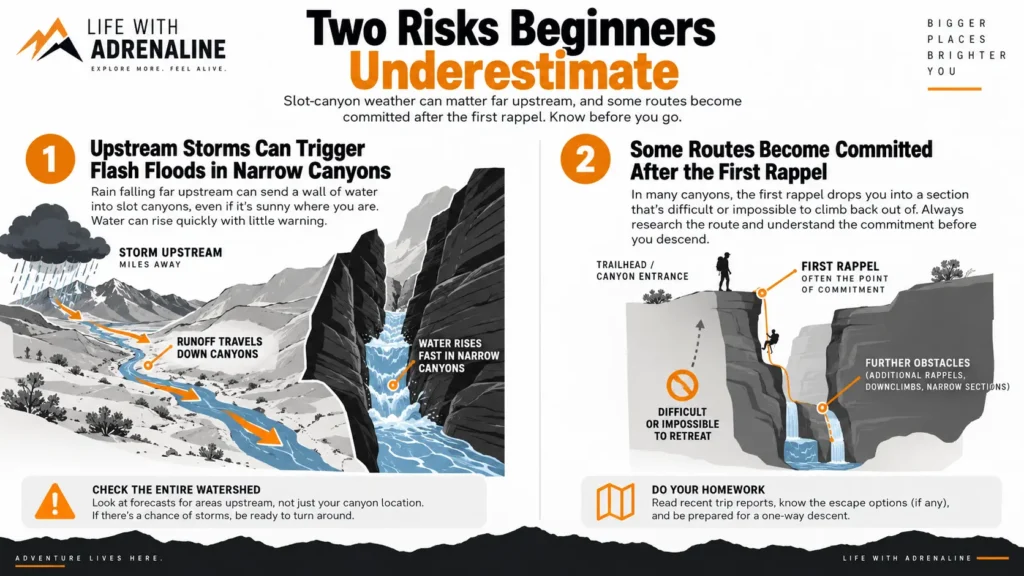
The most important risk is not “being scared of heights.” Canyoneering combines terrain, weather, water, falling hazards, navigation, rope systems, fatigue, and limited exits. Capitol Reef NPS calls canyoneering inherently dangerous and warns that many canyons become fully committed once entered. It also notes that rescue resources can be limited and cell service may be unavailable. [S1]
Flash flooding deserves separate attention. BLM warns that a slot canyon can flood because of rain upstream even when no rain is falling where you are. Never treat blue sky directly overhead as proof that a narrow canyon is safe to enter. Check the relevant weather forecast and follow the guide or land manager’s decision if conditions make a canyon inappropriate. [S2]
On a guided trip, the operator manages the technical rope systems, route selection, and much of the logistics, but you still have responsibilities: disclose relevant limitations honestly, follow footwear and clothing rules, carry the water you are told to carry, listen during the briefing, and speak up before you are committed to an obstacle you do not understand. A guide reduces your planning burden; it does not make an inherently risky environment risk-free.
If you have a medical condition, injury, pregnancy concern, mobility limitation, or medication issue that could affect heat tolerance, balance, hiking, cold-water exposure, or being suspended in a harness, review the operator’s current restrictions and discuss your situation with an appropriate healthcare professional. This article cannot assess individual medical suitability.
Before You Book: 10 Questions to Ask
1. Is this exact trip designed for people with zero rappelling experience?
2. How many rappels are mandatory, and what is the tallest listed rappel?
3. How many miles will we hike, and how much scrambling or downclimbing is involved?
4. Is the canyon normally dry, occasionally wet, or built around flowing water?
5. Will I need a wetsuit, and is it included?
6. What are the current age, weight, footwear, fitness, and health restrictions?
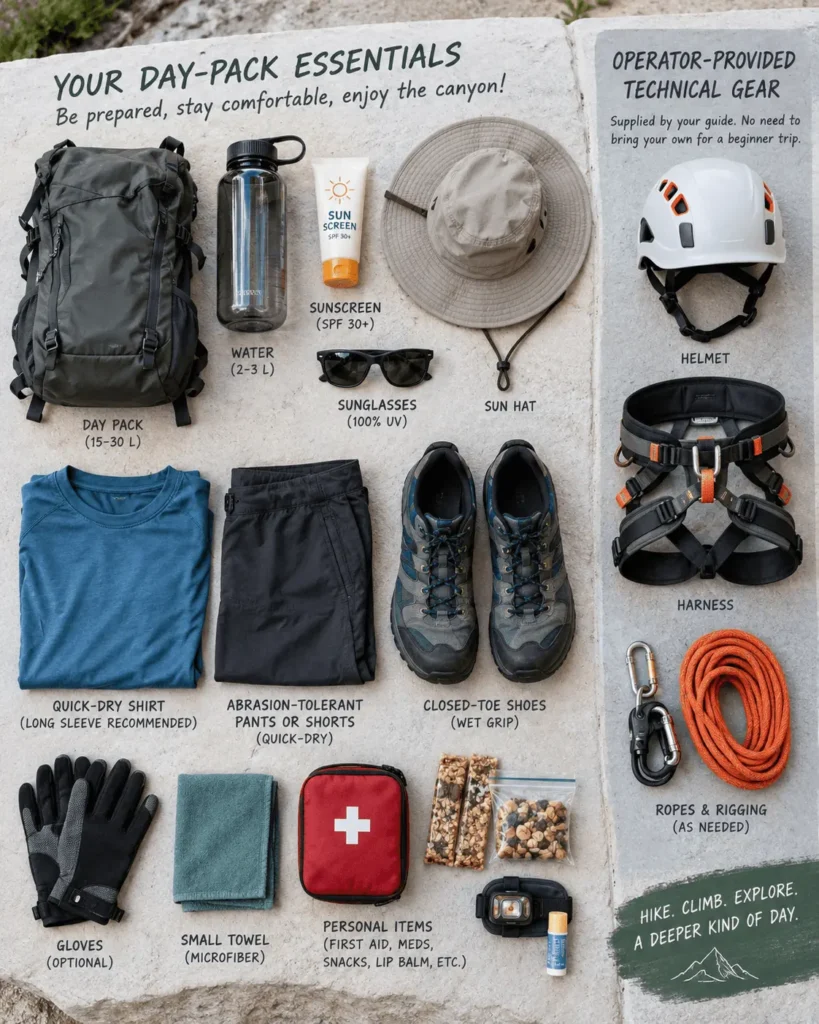
7. What technical equipment does the operator provide, and what must I bring?
8. Does the trip include transportation to the trailhead?
9. What happens if heat, thunderstorms, monsoon moisture, or flash-flood risk changes the plan?
10. What is the current cancellation or rescheduling policy for both customer cancellations and operator weather cancellations?
FAQ
Is canyoneering good for complete beginners?
Yes, when you choose a guided trip that explicitly accepts people with no previous canyoneering or rappelling experience and your fitness matches the route. “Beginner” still varies widely: a two-hour private slot, a wet waterfall canyon, and a seven-hour North Wash day are not equivalent.
Do I need to know how to rappel before a guided trip?
Not for the beginner trips highlighted here. Moab Adventure Center and Altitude Mountain Guides explicitly state that no previous experience is required for their beginner formats, and Escalante’s Adventure Day says no experience is necessary. [S3][S6][S7]
What is the best canyoneering destination in the USA for a first-timer?
Moab is the strongest all-around destination in this comparison because it combines clear beginner commercial formats, moderate time commitment, mostly dry canyon travel, and a town built around outdoor tourism. That is an editorial fit judgment, not a claim that Moab is universally safer or better than every other destination.
Is Zion or Moab better for beginner canyoneering?
Choose Moab if you want a straightforward guided commercial introduction with dry-leaning routes and simple trip comparison. Choose the East Zion area if Zion National Park is already the focus of your vacation. If your goal is technical canyoneering inside Zion itself, treat permits and independent skills as a separate planning problem. [S3][S11][S12]
What should I wear for canyoneering?
Follow the exact operator packing list. As a baseline, the operators checked here commonly require or recommend athletic clothing and sturdy closed-toe footwear with traction; technical gear such as helmets, harnesses, ropes, and rappel devices is supplied on the selected beginner trips. Wet trips may add wetsuits or other canyon-specific clothing. [S3][S6][S8][S9]
Final Recommendation
If you are booking your first canyoneering trip and have no strong preference yet, start with Morning Glory in Moab. It gives you enough rappelling and canyon travel to understand the sport without requiring an all-day commitment or making water the central challenge. [S3]
Choose Angel Creek if waterfalls are the reason you are interested. Choose Tanque Verde if you are already an active hiker and want more varied movement. Choose Escalante if the canyon journey itself is the vacation. Choose Middle Maidenwater if learning repeated canyon movement matters more than a single dramatic rappel. Choose Blue Pools if you want a short private introduction. And choose Elkheart if a Zion-area slot-canyon day fits naturally into an existing Utah road trip. [S4][S5][S6][S7][S8][S9]
Whichever trip you choose, recheck the operator page immediately before booking. Canyoneering is unusually sensitive to weather, heat, water, flash floods, access, and route conditions. The “best” beginner canyon is the one whose current conditions and total commitment match your group—not the one with the tallest rappel in the photo.
Sources
S1: https://www.nps.gov/care/planyourvisit/canyoneering.htm
S2: https://www.blm.gov/flash-floods-tread-safely
S3: https://www.moabadventurecenter.com/moab-canyoneering
S4: https://eastzion.com/adventure-pricing/
S5: https://canyoningcolorado.com/canyoning-tours/angel-creek
S6: https://www.altitudemountainguides.com/tucson-canyoneering
S7: https://escalantetours.com/home/tours/compare-tours/
S8: https://www.northwashoutfitters.com/tour/middle-maidenwater/
S9: https://canyoncountryoutdoors.com/guided-canyoneering-tours-near-page-arizona/
S10: https://www.aaa.com/tripcanvas/thing-to-do/canyoneering-adventure-near-lake-powell-422797P3
S11: https://www.nps.gov/zion/planyourvisit/canyoneering.htm
S12: https://www.nps.gov/zion/planyourvisit/canyoneeringpermits.htm
S13: https://www.nps.gov/zion/planyourvisit/wilderness-safety.htm