
| DIRECT ANSWER For a professionally guided Grand Canyon river trip in 2026, price depends on route, boat type, trip length, and included transportation. Current published examples range from $2,015 for Western River Expeditions’ three-day commercial trip to $3,677 starting for Hatch’s seven-day full-canyon motorized trip, $5,561 for a 14-day Arizona Raft Adventures full-canyon classic trip, and $8,899 for certain 16- or 17-day OARS itineraries. These are specific operator examples, not a market-wide average. [S9][S10][S11][S14] The National Park Service says commercial whitewater trips through Grand Canyon generally last 3 to 18 days and are often reserved one or two years in advance. The cheaper half-day and one-day Colorado River floats around Page and Horseshoe Bend are smooth-water trips above Lees Ferry, not the same multi-day whitewater experience. [S1][S13] |
Grand Canyon rafting is one of those trips where the headline price can hide the decision that matters most. A $3,000 trip and a $6,000 trip may not be competing versions of the same vacation. One may be a short motorized segment with complex transfers; the other may be a two-week oar-powered journey.
The best way to plan is to compare the complete trip design: launch and takeout points, river days, boat type, required hiking, and which flights, shuttles, hotel nights, camping equipment, and meals are included.
This guide focuses on those trade-offs so you can build a budget before you book.
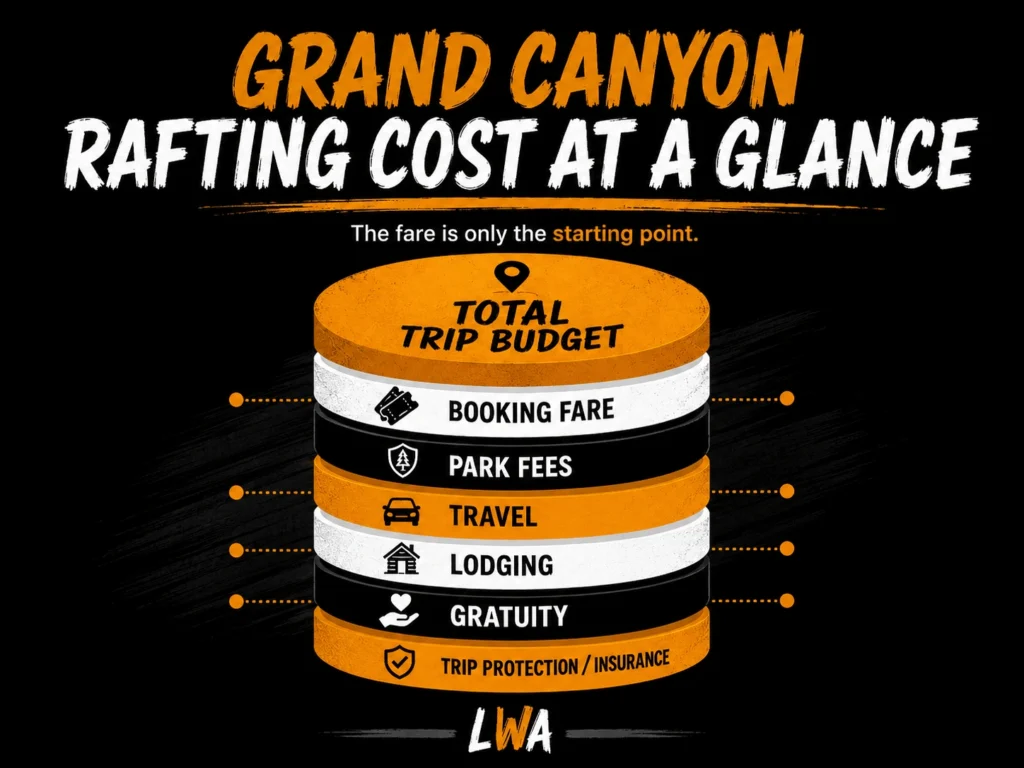
Grand Canyon Rafting Cost at a Glance
There is no single useful “average” Grand Canyon rafting price because operators sell different sections, boat types, durations, and transportation packages. The most honest comparison is to look at current examples and then check what each fare includes.
The examples below were checked on August 26, 2026. They are not rankings and they should not be treated as interchangeable packages.
| 2026 example | Trip format | Published fare | What the price helps illustrate |
| Wilderness River Adventures | Half-day smooth-water Horseshoe Bend float | $129 adult + $15 park entrance fee | A low-cost Colorado River experience, but not Grand Canyon whitewater through the park. |
| Western River Expeditions | 3-day Grand Canyon motorized expedition | $2,015 | A shorter commercial option for travelers with limited vacation time. |
| Hatch River Expeditions | 7-day full-canyon motorized trip | From $3,677 | A one-week full-canyon format with major transport components included. |
| Arizona Raft Adventures | 14-day full-canyon Classic Adventure | $5,561 | A longer human-powered/hybrid-style full-canyon experience. |
| Wilderness River Adventures | 15-day oared trip | $6,700 | A slower, longer non-motorized itinerary. |
| OARS | 16- or 17-day Lees Ferry to Diamond Creek | $8,899 on listed 2026 departures | A premium, long-duration oar-raft option; pricing varies by itinerary and date. |
Those examples show why “Grand Canyon rafting cost” is really a package-design question. A short trip can still be expensive because aircraft, helicopter, ranch, or shuttle logistics are built into the itinerary. A longer oar trip costs more in total, but it also includes many more days of guiding, meals, camping, and river time. [S9][S10][S11][S12][S13][S14]
Do not compare only the sticker price. Compare what you would still need to pay after booking.
What Does the Rafting Price Usually Include?
On a professionally guided multi-day trip, the fare commonly covers guides, the raft, personal flotation devices, major camping equipment, meals on the river, and waterproof storage. Exact inclusions differ by company and itinerary. [S10][S12][S14]
Transportation is where comparisons get complicated. Hatch’s seven-day full-canyon motorized trip includes a pre-trip lodge night, helicopter exit from Whitmore Wash, and return flight to Marble Canyon or Las Vegas. Wilderness River Adventures includes a Las Vegas-to-Page flight on some motorized itineraries. OARS inclusions differ by departure and may list separate park or sleep-kit charges. [S10][S12][S14]
A higher fare can still be a better logistical value if it removes hotel, car-repositioning, or separate-flight costs. Compare inclusions line by line.
Your personal trip budget should also leave room for items that are often outside the river fare:
• Transportation from home to the operator’s meeting city or launch area.
• Pre- and post-trip lodging not included by the operator.
• Park entrance fees when they are not included.
• Guide gratuities.
• Travel insurance or cancellation coverage.
• Personal clothing, footwear, sun protection, and small travel gear.
• Alcohol, specialty beverages, or optional add-ons.
• Extra meals before launch and after takeout.
Guide gratuity is a meaningful budget item. Western River Expeditions and Hatch both publish a suggested guideline of about 10% of trip cost, while OARS suggests roughly 10% to 15%. Those are operator-specific guidelines, not a universal rule. [S16][S17]
A simple planning formula is:
Realistic trip budget = river fare + required fees + uncovered transportation + uncovered lodging + operator-guided gratuity + insurance + personal travel expenses.
For example, Western’s published 2026 seven-day fare is $4,295. Using Western’s own 10% gratuity guideline, the fare plus that suggested guide tip alone is about $4,725 per person before any additional taxes or fees and before your travel to the meeting point. [S9][S16]
That is a much more useful number than treating $4,295 as the total cost of the vacation.
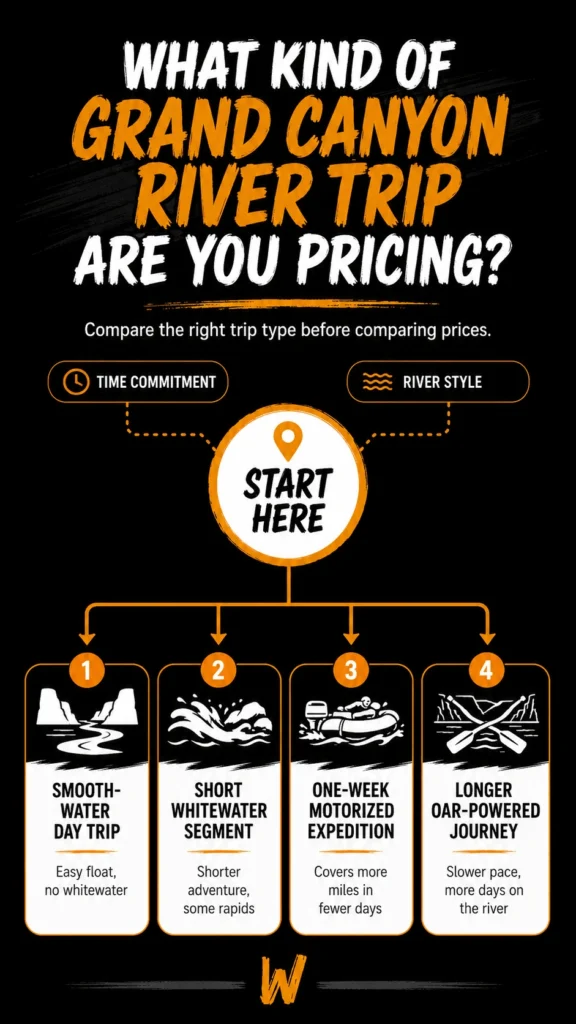
First, Decide What You Mean by “Grand Canyon Rafting”
The phrase “Grand Canyon rafting” is used for experiences that are dramatically different.
The National Park Service separates half-day and full-day smooth-water trips from the multi-day whitewater trips that travel through Grand Canyon. The smooth-water experience runs in the Glen Canyon area between Glen Canyon Dam, Horseshoe Bend, and Lees Ferry. It is scenic and much easier to fit into a normal Arizona road trip, but it is not a substitute for sleeping in the canyon and running the Colorado River’s famous whitewater. [S1][S13]
The multi-day whitewater category is the bucket-list expedition most travelers have in mind. Commercial trips through the park run from roughly 3 to 18 days and are offered by authorized river concessioners using motorized rafts, oar rafts, paddle rafts, hybrid formats, and dories. [S1][S2]
There is also a completely different private option. Noncommercial trips from Lees Ferry to Diamond Creek are self-guided, generally 12 to 25 days, and require a National Park Service permit obtained through a weighted lottery. The NPS specifically states that this is a highly technical river and that a private group must include people with the river-running experience necessary to manage it. You cannot win a private permit and then hire a commercial guide to run the trip for you. [S4][S5]
For a first-time Grand Canyon visitor without advanced whitewater leadership experience, a commercial trip is the straightforward route. The private lottery is not a cheaper version of a guided vacation; it is a different undertaking with different responsibilities.
How Long Is a Grand Canyon Rafting Trip?
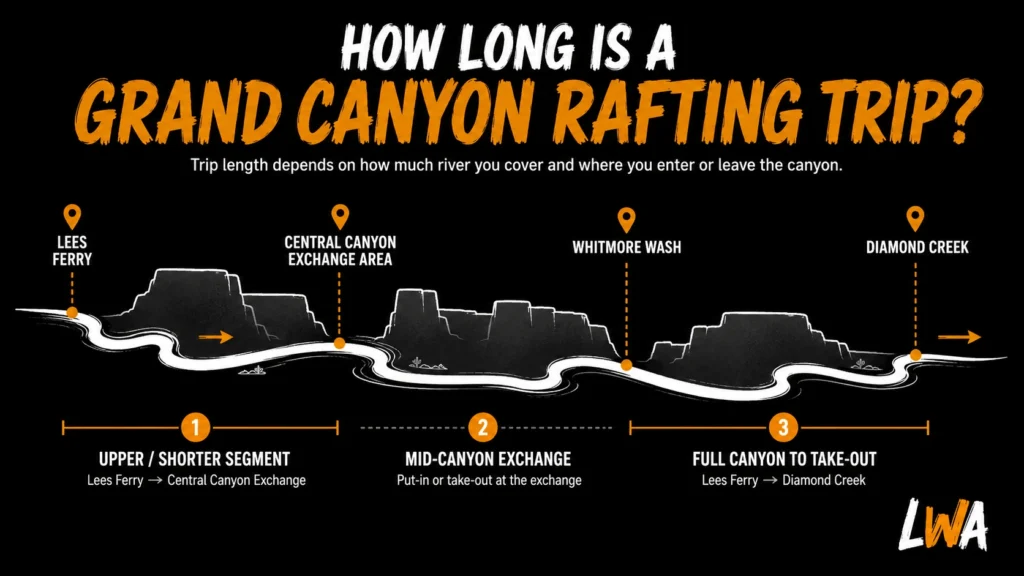
Commercial trip length is largely determined by three things: how much of the canyon you cover, whether the boat is motorized, and whether the itinerary exchanges passengers by trail, helicopter, or road.
The NPS allows commercial trips of about 3 to 18 days through Grand Canyon. Motorized rafts can cover river miles faster, while oar-powered, paddle, hybrid, and dory trips generally take longer and create more time on the water between camps. [S1][S2][S3]
| Time available | Trip style to compare | Why it may fit | Main trade-off |
| Half day / 1 day | Smooth-water float near Horseshoe Bend | Easy to add to a Page or Grand Canyon road trip | Not the multi-day Grand Canyon whitewater expedition. |
| 3–5 days | Short motorized or partial-canyon trips | Lowest time commitment among true commercial whitewater options | You see only part of the corridor or use more complex aircraft/hiking logistics. |
| 6–8 days | Motorized full- or near-full-canyon trips | Can fit the core experience into about one week | Larger motorized craft and faster travel pace. |
| 9–12 days | Longer motor or shorter oar/hybrid itineraries | More time for side hikes and camp life without committing two full weeks | Fewer options and higher total cost than short motor trips. |
| 13–18 days | Oar, paddle, hybrid, or dory full-canyon trips | Slower pace and deeper immersion | Highest vacation-time requirement and often the highest fare. |
If you have one week and want to avoid a strenuous hike into or out of the canyon, compare full-canyon motorized itineraries that launch at Lees Ferry and exit downstream by helicopter, road, or aircraft-linked transfer. If you have two weeks and care more about a slower river pace than minimizing vacation days, compare oar, dory, paddle, and hybrid options.
The word “full canyon” also needs attention. Some operators use Whitmore Wash as the exit point after roughly 188 river miles and fly guests out by helicopter. Other itineraries continue to Diamond Creek, around river mile 225 or 226, and some continue farther downstream. Always compare the actual start and end points, not only the marketing label. [S1][S10][S14]
Upper Canyon, Lower Canyon, or Full Canyon?
Partial-canyon trips can reduce the number of river days, but they often add one of the hardest pieces of the vacation: a long hike between the South Rim and the Colorado River.
Upper Canyon itineraries normally launch at Lees Ferry and end near the central canyon, where guests hike out to the South Rim. Lower Canyon itineraries reverse the process: you hike from the rim down to the river and join a raft for the downstream section. Exact exchange points and trail mileage vary by operator and current park operations. [S10][S11][S14]
Published operator descriptions illustrate that variation. OARS describes a 7.7-mile Bright Angel Trail hike for some Pipe Creek exchanges. Arizona Raft Adventures describes about 7.5 miles on some itineraries. Hatch lists a 9.5-mile hike for certain lower-canyon trips that use a different river meeting point. These are not necessarily conflicting measurements; they reflect different start/end logistics. [S11][S14]
What does not vary is the scale of the climb. The river sits roughly 5,000 vertical feet below the South Rim, and the NPS warns that hiking into or out of the inner canyon is strenuous, especially in hot weather. Summer shade temperatures around Phantom Ranch average about 102°F in June, 104°F in July, and 101°F in August, with full-sun conditions potentially much hotter. [S6]
For many travelers, the Bright Angel hike is not a small transfer between two parts of a rafting trip. It can be the most physically demanding day of the entire vacation.
If your knees, heat tolerance, hiking fitness, or medical situation make that uncertain, do not assume a shorter rafting trip will be easier. A longer full-canyon trip that avoids a rim-to-river exchange may actually be the more comfortable choice.
Motorized vs. Oar-Powered: Which Costs More and Which Fits You Better?
Boat type affects both price and the feel of the trip.
Motorized rafts cover miles more quickly. That is why full-canyon motor trips can fit into roughly a week. They are a strong option for travelers who have limited vacation time or who prefer to minimize the number of nights in camp. Current 2026 examples checked for this article put seven-day motorized trips in roughly the mid-$3,000s to low-$4,000s depending on the operator and package. Hatch lists a starting price of $3,677, Wilderness River Adventures lists $3,860 for a seven-day motor trip, and Western lists $4,295 for its seven-day expedition. These are separate packages with different inclusions, not a single price range for an identical product. [S9][S10][S12]
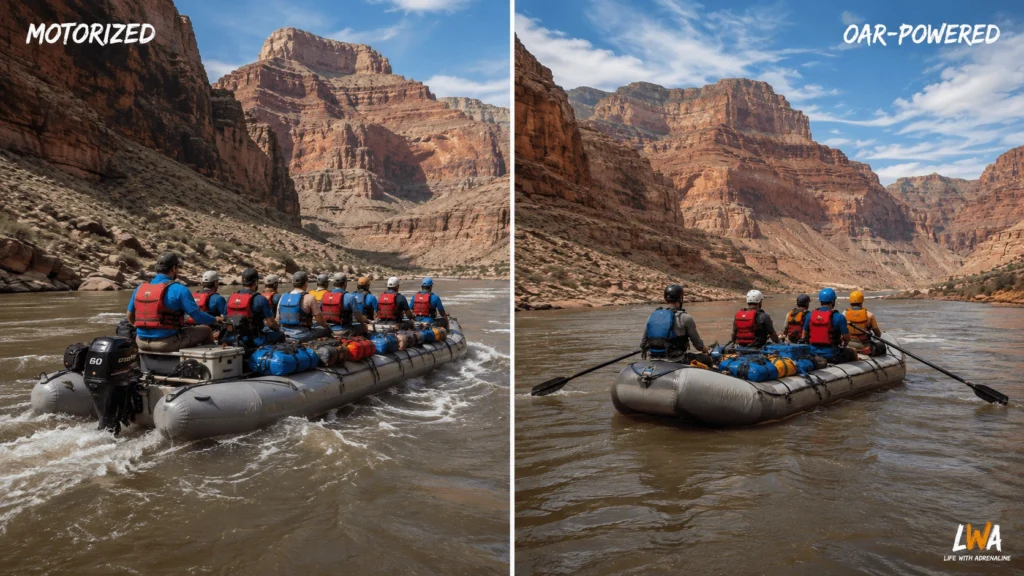
Oar-powered rafts move at the pace of the river and are rowed by guides. Full-canyon itineraries commonly require substantially more days. Hatch lists a 12-day full-canyon oar trip starting at $5,857, Wilderness River Adventures lists a 15-day oared trip at $6,700, and OARS lists certain 16- or 17-day 2026 Lees Ferry-to-Diamond Creek departures at $8,899. [S10][S12][S14]
Paddle, hybrid, and dory trips add other trade-offs. Paddle trips require more active guest participation. Hybrid trips can let guests rotate between oar and paddle craft. Dories are rigid boats with a very different ride and are usually sold as a premium, slower-paced format. Availability varies by concessioner. [S2][S11][S14]
Do not choose boat type from price alone. Choose it from your available days, preferred group style, desire to paddle, tolerance for a larger motorized raft, and how much unhurried canyon time you want.
When Is the Best Time to Raft the Grand Canyon?
For commercial whitewater trips, the practical season is spring through fall. The 2026 National Park Service operating requirements state that commercial trips do not launch from November through March. Motorized launches are limited to April 1 through September 15, while non-motorized commercial trips can continue later into the fall season. [S3]
There is no universally “best” month because the trade-off is mostly temperature versus schedule and boat type.
April and May: Air temperatures are more moderate than midsummer, but the Colorado River is still extremely cold and spring weather can change quickly. May inner-canyon average shade highs are around 91°F. Motorized and non-motorized options are both in season. [S3][S6][S7]
June through August: This is the hot core of the season. Average shade highs near Phantom Ranch are roughly 102°F in June, 104°F in July, and 101°F in August. Summer thunderstorms can also create flash-flood hazards in side canyons. The combination of hot air and cold river water is one of Grand Canyon’s defining environmental contrasts. [S6][S7]
September: Temperatures begin to ease, with average Phantom Ranch shade highs around 95°F. Motorized launches stop after September 15 under current rules, so the second half of the month shifts toward non-motorized trips. [S3][S6]
October: Commercial non-motorized trips can still launch, and average inner-canyon highs are much lower than summer, around the low 80s. Availability is thinner and nights can feel much cooler. [S3][S6]
The river itself does not warm like a normal desert swimming destination. Because water is released from deep in Lake Powell through Glen Canyon Dam, the NPS notes that Colorado River temperatures through Grand Canyon remain near the mid-40s Fahrenheit for much of the year. That cold-water exposure matters even when the air is over 100°F. [S7]
For a first trip, May and September often deserve a close look because they reduce the peak-summer heat, but your preferred boat type, available dates, and operator schedule may matter more than chasing a single “perfect” month.
Do You Need a Permit to Raft the Grand Canyon?
If you book a normal commercial expedition with an authorized concessioner, you do not enter the private river lottery yourself. The operator runs the trip under its National Park Service concession authorization. The NPS maintains the list of authorized companies that may offer commercial trips through the Lees Ferry-to-Diamond Creek corridor. [S2]
If you want to organize a self-guided private trip, the process is completely different. Noncommercial Lees Ferry-to-Diamond Creek permits are assigned through a weighted lottery. The NPS held the main lottery for 2027 launch dates in February 2026 and announced 478 available permits; follow-up lotteries can occur when dates are canceled or remain unassigned. [S5]
Current NPS noncommercial fees include a $25 lottery application fee per launch year, a trip deposit if you win, a $90 river permit cost per participant, and a $20 park entrance fee for participants age 16 and older unless an applicable pass covers them. Additional late-participant charges can apply, and Diamond Creek access can involve separate Hualapai fees. These fees are specifically for noncommercial trips and should not be confused with commercial expedition prices. [S4]
Private trips must be self-guided and technically qualified. The NPS requires at least one qualified boat operator to be present for the entire trip and makes clear that the Colorado River through Grand Canyon is not an appropriate place for an inexperienced group to learn expedition leadership. [S4]
There is also a one-trip-per-year rule for recreational river travel through the Lees Ferry-to-Diamond Creek section, whether the trip is commercial or noncommercial. [S1][S4]
How Far in Advance Should You Book?
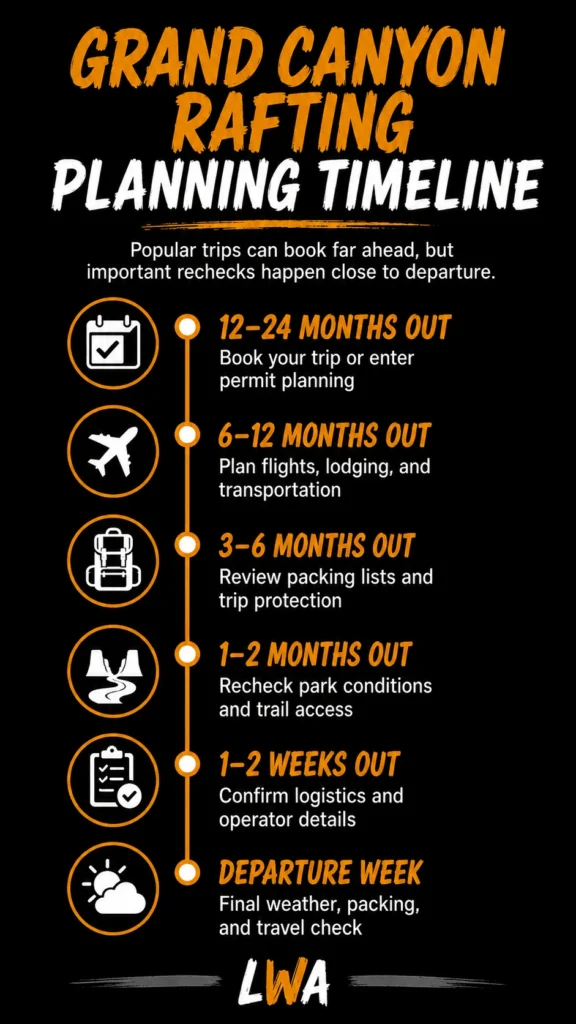
The National Park Service says commercial Grand Canyon trips are often reserved one or two years in advance. Operators also publish schedules far ahead, and desirable dates can sell out well before the season begins. [S1][S16]
For a trip with fixed vacation dates, a particular boat type, or a group of several people, starting 12 to 24 months ahead is a reasonable planning target based on that booking pattern. That is an editorial recommendation, not an NPS rule.
Late openings do happen. Operators maintain waitlists and occasionally publish last-minute space, including for the current season. But waiting for a cancellation is a poor strategy if you need a specific week, a specific trip style, or multiple seats together. [S16]
The most useful sequence is to choose your trip format first, then compare dates across several authorized operators instead of falling in love with one company before you know whether its schedule fits.
Grand Canyon Rafting Logistics: Where Do Trips Start and End?
Grand Canyon rafting logistics are unusually complex because the river corridor is remote and there are very few places to enter or leave the canyon.
Many full-canyon trips launch at Lees Ferry near Marble Canyon. Depending on the itinerary, you may meet the operator in Marble Canyon, Page, Flagstaff, or Las Vegas. Operators then combine vans, charter aircraft, helicopters, and road shuttles to move guests to the launch and back from the takeout. [S10][S12][S14]
A Whitmore Wash exit often involves a helicopter flight to the rim and then a fixed-wing flight or ground transfer. A Diamond Creek takeout uses road access across Hualapai land. Trips that exchange passengers in the central canyon may require the Bright Angel Trail instead of an aircraft exit. [S4][S10][S14]
Before you book flights from home, verify five details on the exact itinerary:
1. The city where you must report before the trip.
2. Whether you must arrive the day before launch.
3. Whether the pre-trip hotel night is included.
4. Where the operator returns you after the river.
5. What time the operator expects you to be back.
Do not assume “starts in Las Vegas” means the raft launches near Las Vegas, or that “ends in Flagstaff” means the river takeout is near Flagstaff. Those cities are transportation hubs for a wilderness trip that may involve several different modes of travel.
What First-Time Rafters Often Underestimate
Grand Canyon rafting is professionally guided, but that does not make it a passive resort vacation.
The water is cold. NPS information places the regulated Colorado River near roughly 46°F for much of the year. A swim or heavy splash can feel shocking even on a hot afternoon. [S7]
The inner canyon is hot. Summer shade temperatures at the river commonly exceed 100°F, and direct sun can be substantially hotter. Heat management matters at camp and on side hikes. [S6]
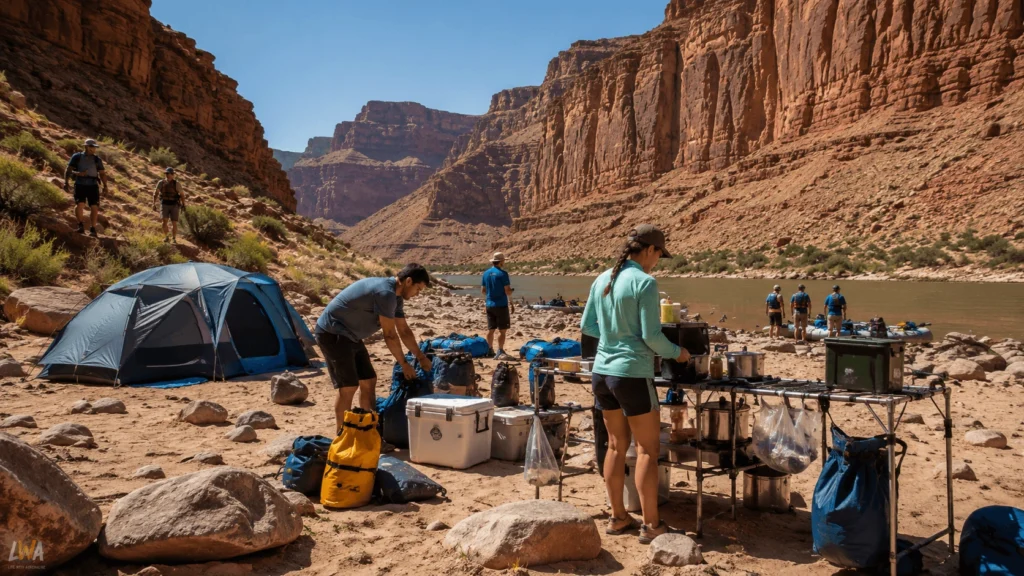
Camping is real camping. On many expeditions you sleep on sandy beaches or rocky river camps, use portable toilet systems, and go without normal hotel bathrooms and hot showers. Operators provide the core system, but you still need to be comfortable living outdoors for several consecutive days. [S10]
Side hikes can be rugged. Even travelers who choose a motorized raft may spend meaningful time walking on uneven, unmaintained terrain. Hike-in and hike-out itineraries are much more demanding. [S6][S10]
Weather can change logistics. Aircraft operations, trail status, water availability, heat, storms, and park construction can all affect the details of a trip. In 2026, Grand Canyon trail and water access has changed several times because of infrastructure work and wildfire impacts. Travelers with a hiking exchange should recheck the NPS “Key Hiking Messages” page close to departure. [S8]
If you have a heart, respiratory, mobility, heat-tolerance, or other medical concern, review the operator’s current participation requirements and discuss your plans with an appropriate healthcare professional. This article cannot determine whether a specific trip is medically appropriate for you.
Which Grand Canyon Rafting Trip Is Best for Your Budget and Schedule?
Start with your hardest constraint.
Long weekend: Compare three- or four-day commercial options. They can provide genuine Grand Canyon whitewater, but they cover only part of the corridor or rely on more complex access logistics.
About one week: Six- to eight-day motorized trips are the most direct way to cover a large portion or all of the classic corridor within normal vacation time. Compare inclusions and access, not only sticker price.
12 to 15 days: Oar, paddle, hybrid, and slower non-motorized trips become realistic. The total fare rises, but so does time in the canyon.
Avoiding a major hike: Choose a full-canyon itinerary that does not require a rim-to-river passenger exchange.
Budget below about $3,000 per person: Current 2026 examples suggest that true multi-day commercial choices are narrower, mainly shorter trips. A half-day Horseshoe Bend float is far cheaper but is a different activity. [S9][S13][S15]
The best-value trip is therefore not automatically the cheapest. It is the trip that gives you the section, pace, access method, and number of days you actually want without forcing you to buy additional logistics you did not budget for.
Before You Book: Grand Canyon Rafting Checklist
Use this checklist on the exact departure you are considering:
• Confirm the launch and takeout points.
• Confirm whether the trip is full canyon, upper canyon, lower canyon, or western/lower-gorge only.
• Confirm the boat type: motor, oar, paddle, hybrid, or dory.
• Check the total river days and the total vacation days including pre-trip arrival.
• Check whether any Bright Angel or other rim-to-river hike is required.
• Read the operator’s current minimum age, mobility, swimming, and medical requirements.
• Verify what camping gear and personal gear are provided.
• List every included flight, helicopter, van, shuttle, hotel night, and meal.
• Add park fees, gratuity guidance, insurance, and travel-to-meeting-point costs.
• Read the deposit, final-payment, transfer, and cancellation policy.
• Recheck current NPS river alerts, trail status, water availability, and weather information before departure.
• Do not book a noncommercial permit unless your group genuinely has the technical experience required by the NPS.
Frequently Asked Questions
How much does it cost to raft the Grand Canyon in 2026?
Specific 2026 commercial examples checked for this guide range from $2,015 for Western River Expeditions’ three-day trip to $8,899 for certain OARS 16- or 17-day Lees Ferry-to-Diamond Creek departures. Seven-day motorized examples are in the mid-$3,000s to low-$4,000s among the operators checked. These are not directly interchangeable packages, so compare route and inclusions before treating the numbers as a price range. [S9][S10][S12][S14]
Can you raft the Grand Canyon in one day?
You can take a half-day or full-day smooth-water Colorado River float near Horseshoe Bend and Lees Ferry, but the NPS distinguishes those trips from the 3- to 18-day commercial whitewater expeditions through Grand Canyon. [S1][S13]
Do I need to win a lottery for a guided Grand Canyon rafting trip?
No. The weighted lottery is for noncommercial self-guided river permits. For a commercial trip, you reserve directly with an authorized concessioner and the company operates under its NPS concession authorization. [S2][S4]
What is the best Grand Canyon rafting trip for a first-timer?
There is no single best format. For many first-time travelers with about a week, a guided motorized full-canyon trip avoids the technical responsibility of a private trip and can avoid a strenuous rim-to-river hiking exchange. Travelers with more time may prefer a slower oar or hybrid trip. The key is matching the trip to your fitness, camping comfort, heat tolerance, budget, and available days.
How much should I budget for guide tips?
Check the operator’s own policy. Western and Hatch suggest around 10% of trip cost, while OARS suggests roughly 10% to 15%. Gratuity is generally not included in the published fare. [S16][S17]
How far ahead should I reserve a commercial Grand Canyon rafting trip?
The NPS says commercial trips are often booked one or two years in advance. If you need a specific week or several seats, start early. Waitlists and last-minute cancellations exist, but they are less reliable. [S1][S16]
Is Grand Canyon rafting suitable for beginners?
A professionally guided commercial trip can be a first rafting experience, but “beginner” does not mean easy. You still face cold water, major rapids, heat, rugged camps, and optional or required hikes. Some itineraries have demanding Bright Angel Trail exchanges. Review the exact operator’s current requirements rather than assuming every Grand Canyon trip has the same physical threshold. [S6][S7][S10]
Final Recommendation
For most first-time travelers who want the classic Grand Canyon river experience without taking two weeks off, start by comparing authorized six- to eight-day motorized trips. They can deliver a full- or near-full-canyon itinerary within a normal one-week vacation window.
Compare the entire package, not just the fare: meeting city, pre-trip lodging, aircraft transfers, takeout location, park fees, gratuity guidance, and whether a major hike is required.
If you have 12 to 15 days and want a slower river pace, compare oar, paddle, hybrid, or dory trips. If you have only a few days, short commercial trips are legitimate options, but understand exactly which section you are buying.
The right trip is the one that balances your budget with enough days, the right access method, and a pace you will enjoy.
Sources
[S1] River Trips and Permits — National Park Service — Grand Canyon National Park. https://www.nps.gov/grca/planyourvisit/whitewater-rafting.htm
[S2] 3 to 18 Day Commercial River Trips: River Concessioners — National Park Service — Grand Canyon National Park. https://www.nps.gov/grca/planyourvisit/river-concessioners.htm
[S3] 2026 Commercial Operating Requirements — National Park Service — Grand Canyon National Park. https://www.nps.gov/grca/learn/management/upload/2026-CORS-508.pdf
[S4] Frequently Asked Questions — Grand Canyon Noncommercial River Permits — National Park Service. https://grcariverpermits.nps.gov/faq.cfm
[S5] Grand Canyon National Park Announces 2027 Noncommercial River Trip Lottery Period — National Park Service. https://www.nps.gov/grca/learn/news/noncommercial-river-lottery-announced-2027.htm
[S6] Summer Hiking — Hike Smart — National Park Service — Grand Canyon National Park. https://www.nps.gov/grca/planyourvisit/hike-smart.htm
[S7] Hydrologic Activity — National Park Service — Grand Canyon National Park. https://www.nps.gov/grca/learn/nature/hydrologicactivity.htm
[S8] Key Hiking Messages — Critical Updates and Closures — National Park Service — Grand Canyon National Park. https://www.nps.gov/grca/planyourvisit/key-messages.htm
[S9] Western River 2026 Rates and Dates — Western River Expeditions. https://www.westernriver.com/rates-dates
[S10] Grand Canyon Trip Pages — Motorized and Oar-Powered — Hatch River Expeditions. https://hatchriverexpeditions.com/explore-trips/
[S11] Reserve a Trip: Classic Adventure 2026 — Arizona Raft Adventures. https://mytrip.azraft.com/reserve/classic-adventure-2026
[S12] Grand Canyon Motor and Oar Trip Rates — Wilderness River Adventures. https://www.riveradventures.com/grand-canyon-rafting/
[S13] Horseshoe Bend Rafting — Half-day — Wilderness River Adventures. https://www.riveradventures.com/horseshoe-bend-rafting/horseshoe-bend-rafting-experience/half-day-rafting-trips
[S14] Grand Canyon Rafting Trips — OARS. https://www.oars.com/grand-canyon-rafting/
[S15] Grand Canyon Rafting Dates & Rates — Outdoors Unlimited. https://outdoorsunlimited.com/dates-and-rates/
[S16] Grand Canyon Vacation Questions — Western River Expeditions. https://www.westernriver.com/grand-canyon-vacation/questions
[S17] Multi-Day River Trip FAQs — OARS. https://www.oars.com/multi-day-river-trip-faqs/