
| Direct answer: For a first via ferrata, choose a genuinely introductory route, use a climbing helmet, harness, and a certified via ferrata lanyard with an energy absorber, and learn the clipping system before you leave easy ground. Do not rely on the route grade alone: exposure, physical effort, weather, altitude, and escape options can make two routes with similar ratings feel very different. If you have never used via ferrata equipment or cannot confidently interpret the local route information, a guided first outing is the simplest way to reduce avoidable uncertainty. [S1][S2][S3] |
Via ferrata can look like the perfect bridge between hiking and rock climbing. Fixed cables, ladders, metal rungs, and bridges make steep terrain more accessible, while a harness and specialized lanyard keep you connected to the safety cable. That accessibility is exactly why beginners need clear information: the hardware makes the route easier to move through, but it does not turn exposed mountain terrain into a risk-free attraction. [S1]
This guide focuses on the decisions that matter before your first day: how to read the grade, what gear you actually need, what to wear, how the clipping system works at a basic level, when weight or age changes the equipment plan, and why weather can be as important as the route rating.
Via Ferrata for Beginners: The Essentials at a Glance
| Decision | Beginner rule of thumb |
| Route choice | Start with the lowest appropriate local grade and verify the scale being used. Prefer short, well-described terrain with manageable exposure and clear retreat/descent information. |
| Technical PPE | Climbing helmet + properly fitted harness + via ferrata-specific energy-absorbing lanyard. Check current labels, condition, instructions, and user range. [S2][S8] |
| Footwear | Grippy approach shoes or sturdy hiking/trail shoes appropriate for the route; check the operator’s recommendation. [S7] |
| Useful extras | Gloves, active layers, weather shell, water, compact snack, sunscreen, sunglasses, and a small secure pack. [S7] |
| First-time format | Guided is the lower-uncertainty option when you are new to the equipment, exposed terrain, or local grading. [S3][S9] |
| Weather | Check the forecast before committing. If thunder is heard or lightning is seen, stop the activity and seek appropriate shelter. [S10] |
What Is a Via Ferrata?
The UIAA defines a via ferrata as an itinerary equipped with fixed features such as a metal cable, ladders, bridges, hooks, and other artificial aids. Participants use specific personal equipment including a harness, helmet, and via ferrata kit. [S1]
The experience is different from both a normal hike and standard roped climbing. You may spend long sections walking or scrambling, then move onto vertical ladders, exposed traverses, bridges, or rock sections where natural footholds matter. Your lanyard connects you to the cable, but a fall can still be serious. The goal is not to “test” the system by falling; it is to move deliberately, stay correctly connected, and select terrain that gives you plenty of margin.
Via Ferrata Grades: Why One Letter Is Not the Whole Story
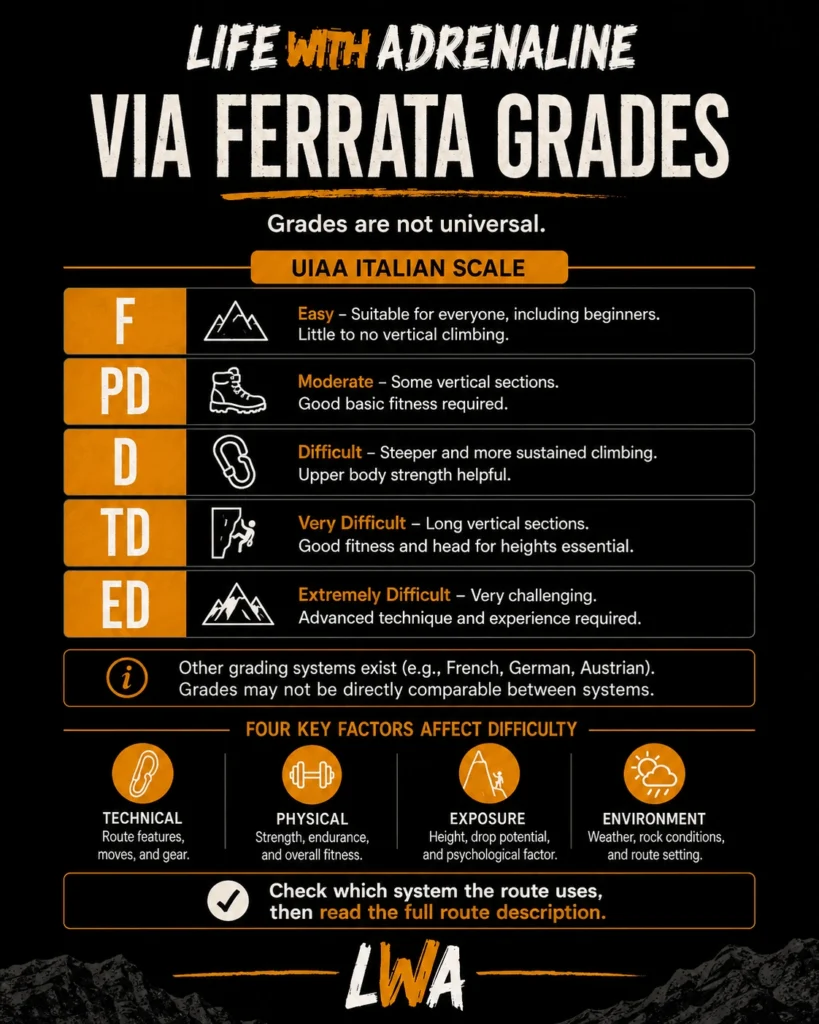
There is no single universal via ferrata grading system. The UIAA lists Italian, Austrian, German, and French systems among the commonly used scales. In 2016, the UIAA adopted the Italian scale as its international standard. Its main grades are F, PD, D, TD, and ED, with separate 1–3 ratings for technical engagement, physical engagement, exposure, and environment. [S1]
| UIAA Italian grade | UIAA description — simplified | Beginner interpretation |
| F | Equipped path; low exposure; long walking sections; fixed protection mainly adds security. | Potential introduction, but verify the route description and local rules. |
| PD | Short via ferrata with low exposure; may include short vertical sections aided by chains, cables, pegs, or stairs. | Often more relevant to beginners, but “PD” is not a universal promise of easy terrain. |
| D | Medium-to-long route; good fitness and technical competence; often vertical, with possible overhangs. | Generally not a first-route target without appropriate skills and support. |
| TD | Exposed and technical sequences; very good fitness and technical competence; vertical/overhanging terrain. | Advanced. |
| ED | Multiple exposed and technical sequences with fewer artificial aids; very good fitness and climbing competence. | Expert terrain. |
Important: you will also see A–E/F, K1–K6, French-style labels, local color systems, and operator-specific “introductory/intermediate/advanced” descriptions. Do not convert grades from memory. Read the route’s own scale, route description, total time, exposure notes, approach/descent information, and operator requirements.
Use This Five-Factor Check Before You Choose a First Route
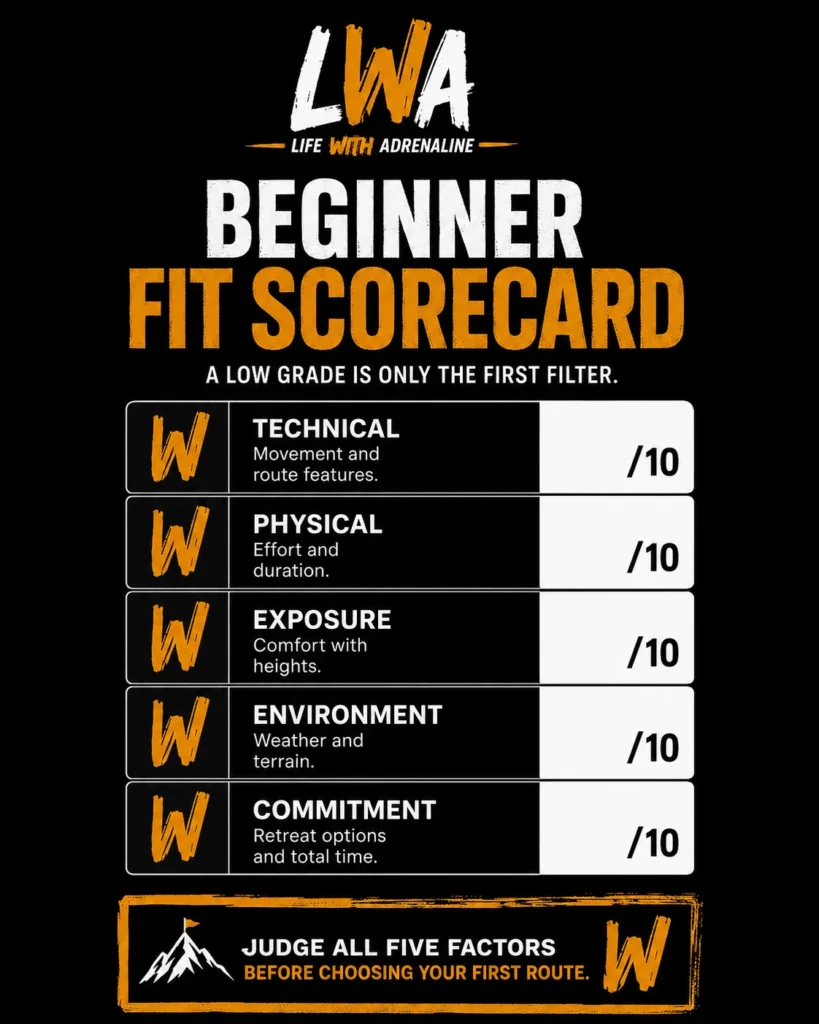
A beginner-friendly grade is a useful first filter, not the full decision. The UIAA’s additional descriptors make this clear: technical difficulty, physical demand, exposure, and environment can be rated separately. Add commitment — how long you are on the route and how easy it is to retreat — and you have a much better first-timer screen. [S1]
| Factor | Ask before booking | Better first-trip profile |
| 1. Technical movement | How much vertical or overhanging terrain? Are natural holds required? Are ladders, bridges, or awkward transfers involved? | Choose simple, well-equipped movement with generous margin. |
| 2. Physical effort | How long is the approach, climb, and descent? Is sustained arm strength required? | Finish fresh rather than learning while exhausted. |
| 3. Exposure | How much open air is below or around you, and how sustained is it? | A technically easy bridge can still be mentally intense. |
| 4. Environment | Altitude, heat, cold, wind, storm potential, wet rock, snow, and remoteness. | Pick stable conditions and conservative terrain. |
| 5. Commitment/escape | Are there escape points? Can you retreat after the hard section? How long to reach shelter or the trailhead? | Prefer clear logistics and a short commitment on day one. |
| Beginner decision rule: If the grade looks easy but the route description also says “very exposed,” “sustained vertical,” “long approach,” “limited escape,” or “high alpine,” treat those as real difficulty — not fine print. |
Via Ferrata Gear: The Three Technical Essentials
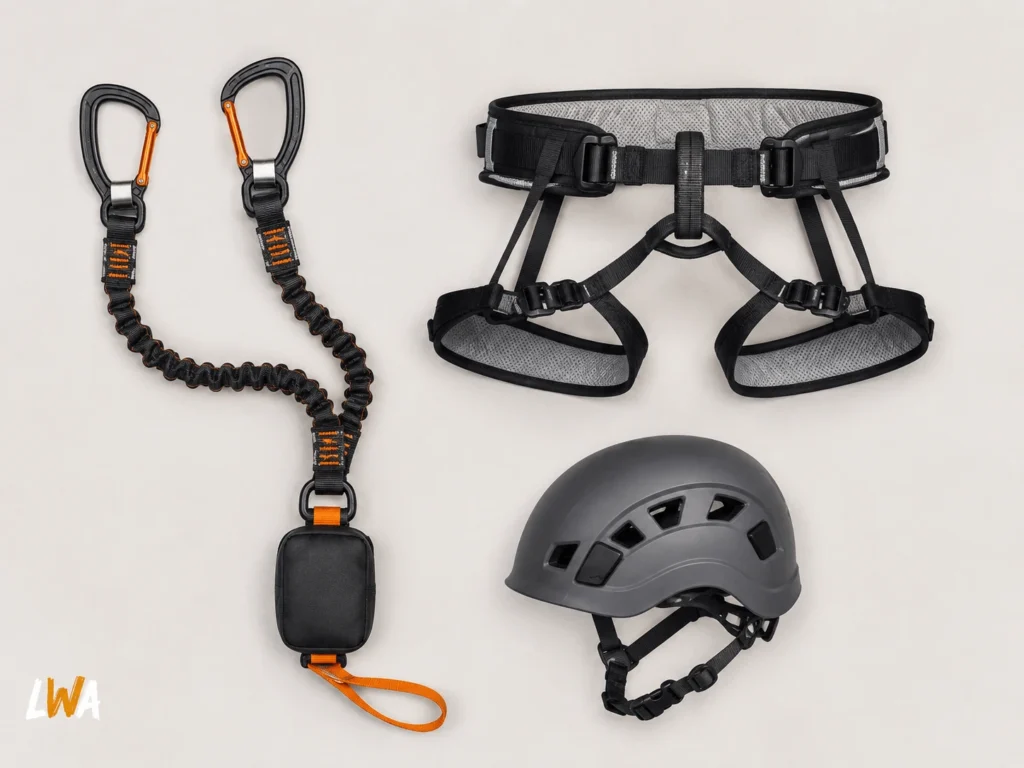
For most via ferrata routes, the technical core is straightforward: a climbing helmet, a properly fitted harness, and a via ferrata-specific lanyard with an energy absorber. The details matter because this is personal protective equipment, not just outdoor accessories.
1. Via ferrata lanyard with an energy absorber
A modern via ferrata set typically has two arms with specialized carabiners connected to an energy absorber. The system is designed for via ferrata falls; it is not interchangeable with a homemade sling setup or a generic non-absorbing tether. Mammut’s current guidance describes the Y-shaped system and says an absorber that has deployed should be replaced rather than reused. [S7]
For standards, the current UIAA 128 Version 5 became effective in November 2025 and is based on EN 958:2024, with additional UIAA requirements. [S2] Check the exact product label and instructions rather than relying on a blog’s old standard date.
Weight range also matters. As one current example, Petzl states that the SCORPIO EASHOOK is designed for users from 40 to 120 kg (about 88 to 265 lb) and lists CE EN 958 and UIAA certification. That does not mean every lanyard has the same range; check the specific model you will use. [S5]
2. Climbing harness
The harness must fit the participant correctly and be compatible with the lanyard attachment method. Petzl’s partner-check guidance calls for the waistbelt to sit above the hips and the harness to be snug. [S4] If you are renting, ask the guide or rental staff to check fit before you start.
3. Climbing helmet
Use a climbing/mountaineering helmet that meets the route or operator’s requirements. Ouray, for example, currently requires an EN 12492-certified helmet, an EN 12277-certified harness, and an EN 958-certified energy-absorbing via ferrata system. [S8] Petzl’s pre-route partner check also includes helmet adjustment and a fastened chinstrap. [S4]
Should You Buy Gear Before Your First Via Ferrata?
Often, no. First check what the operator or route requires and what a guided booking includes. Buying PPE before you understand fit, user range, inspection, compatibility, and the type of route you plan to do can create more confusion than value.
A guided U.S. operation may supply the technical equipment. Jackson Hole Mountain Resort, for example, runs a privately guided via ferrata with beginner routes and says no climbing experience is required on its Casper Buttress options; its guides tailor the challenge to the group. [S9] This is a good model for a first-timer: learn the system on supplied or properly rented equipment, then decide whether owning gear makes sense for repeat use.
If you do buy later, prioritize verified fit, current instructions, appropriate certification, user weight range, and inspection history over color, brand matching, or a small price difference.
What to Wear on a Via Ferrata
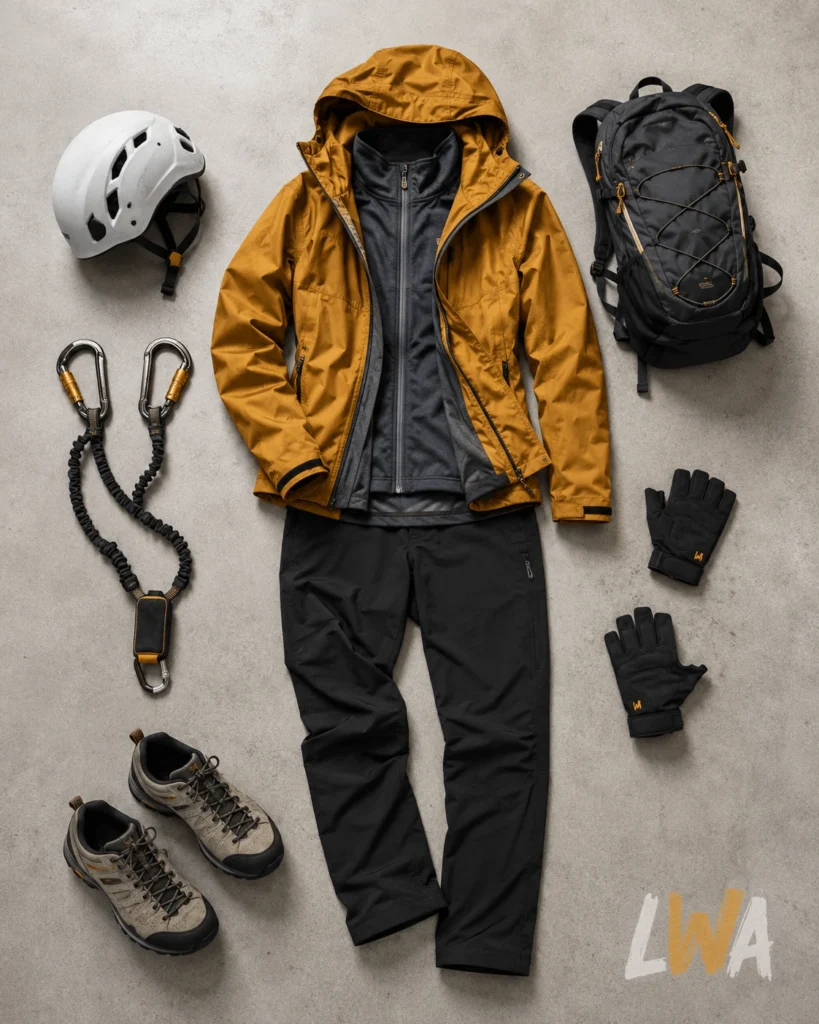
Dress for movement and mountain weather, not for a climbing photo. Clothing should let you step high, reach comfortably, and add or remove layers without loose fabric interfering with the harness or carabiners.
| Item | Beginner recommendation |
| Shoes | Approach shoes or sturdy hiking/trail shoes with a grippy sole. A reasonably supportive sole can help on small metal rungs and rock edges. Check operator-specific footwear rules. [S7] |
| Gloves | Close-fitting via ferrata or climbing gloves can reduce abrasion from repeated contact with cable and metal. [S7] |
| Lower body | Stretch hiking pants, durable leggings, or athletic pants that fit comfortably under a harness. |
| Upper body | Moisture-managing layer plus insulation appropriate to elevation and forecast. |
| Weather layer | Pack a compact rain/wind shell even if the valley forecast looks mild; high terrain can feel very different. |
| Eye/sun protection | Sunglasses that stay secure, sunscreen, and sun protection appropriate for the route. |
| Pack | Small, stable daypack with water, a snack, and only the essentials. Avoid a bulky pack that changes your balance. |
How the Clipping System Works — Basic Safety Principles
A written article cannot replace hands-on instruction. Petzl explicitly recommends specific training and working with a professional before attempting these techniques independently. [S3] Still, three principles are worth understanding before you arrive:
1. Stay tethered to the safety cable. Petzl lists this as the basic rule. [S3]
2. At an intermediate anchor, transfer the two lanyard-end carabiners in sequence so you do not intentionally leave yourself completely disconnected. Your guide or the equipment manufacturer should demonstrate the exact technique on the system you are using.
3. Respect spacing. Petzl’s general guidance says only one person should occupy each cable segment between anchors. [S3] Follow the route or operator’s posted rules if they are more specific.
Petzl also warns not to clip an arm of the lanyard back to the harness in a way that prevents the energy absorber from deploying. [S3] Because lanyard designs differ, follow the exact instructions for your model instead of improvising a “rest” configuration.
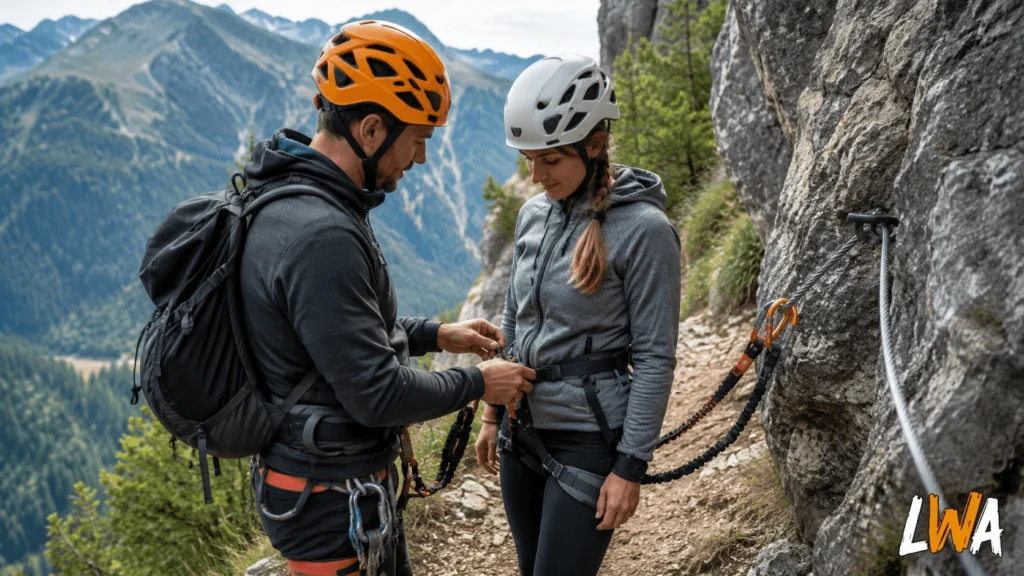
Do a Partner Check Before Leaving Easy Ground
A simple pre-route check catches avoidable setup mistakes. Petzl’s current checklist includes a properly adjusted helmet with the chinstrap fastened, a snug harness above the hips, a lanyard correctly installed on the harness, and functioning carabiners. [S4]
- Helmet secure and chinstrap closed.
- Harness correctly routed, doubled back or buckled as designed, and snug.
- Via ferrata lanyard attached exactly as the manufacturer specifies.
- Energy absorber package intact and not previously deployed.
- Carabiners open, close, and lock correctly.
- Nothing in pockets or on the pack can fall onto people below.
How Fit Do You Need to Be?
There is no single fitness threshold for “via ferrata.” An introductory route may be more like a steep hike with protected sections, while another route can include sustained ladders, vertical movement, long approaches, or overhangs. The UIAA’s own system separates physical engagement from the overall grade for exactly this reason. [S1]
For a first route, look for a description that leaves margin. You should be able to walk the approach and descent, climb stairs or ladders repeatedly, use your legs to step up, and stay coordinated when tired. If the route relies on sustained pulling or difficult overhangs, save it for later.
Fear of heights is separate from fitness. A strong hiker can freeze on an airy bridge; a less athletic person can sometimes move calmly on a short, well-supported route. Exposure should be treated as its own decision factor, not as a test of courage.
Weight Limits, Children, and Special Situations
Do not assume that a standard adult via ferrata lanyard is appropriate for every body weight. Check the exact equipment range and the operator’s current participation rules. Petzl’s current SCORPIO range is 40–120 kg (about 88–265 lb), but other products may differ. [S5]
Children need additional care. Petzl’s technical guidance says that when taking children on via ferrata, rope belaying is required in its recommended system, notes that many children weigh below the SCORPIO lanyard’s 40 kg lower limit, and says users without the necessary rope skills should hire a professional. [S6] This is technical climbing work, not something to improvise from an online diagram.
Operator rules can be more restrictive than equipment limits. For example, Jackson Hole’s 2026 Corbet’s Couloir via ferrata requires guests to be at least 12 years old and over 88 lb. [S9] Always check the exact route you are booking, not just the operator’s general homepage.
Weather Can Change the Difficulty Faster Than the Grade Can
A route rating is not a weather forecast. Wet rock, cold metal, heat, wind, residual snow, or an approaching storm can change a manageable route into a poor choice. Check the local forecast before leaving, understand how long it takes to retreat or reach shelter, and turn around early enough to preserve options.
Lightning deserves a hard rule. The National Weather Service says there is no safe place outside when a thunderstorm is in the area. It recommends stopping the activity and moving to a substantial building or, if one is unavailable, a hard-topped metal vehicle with the windows closed. It also recommends waiting at least 30 minutes after the last thunder before resuming outdoor activity. [S10]
On an exposed metal-equipped route, “we are almost finished” is not a weather plan. If storms are a realistic possibility, choose a route and start time that give you an exit strategy.
Should a Beginner Hire a Via Ferrata Guide?
For many first-timers, yes. A guide does not make an inherently risky mountain activity risk-free, but professional instruction can reduce avoidable uncertainty around equipment fit, clipping technique, route selection, pace, local conditions, and retreat decisions. Petzl recommends working with a professional to confirm that you can perform via ferrata techniques safely and independently before attempting them unsupervised. [S3]
A guide is especially worth considering when any of these apply:
- You have never used a via ferrata lanyard.
- The local grading system is unfamiliar, or the route description is vague.
- You are nervous about sustained exposure or bridges.
- A child is participating, or anyone falls outside the stated user range of the available lanyard.
- The route is remote, high-altitude, weather-sensitive, or has limited escape options.
- You are traveling specifically for the activity and want a route matched to the group rather than gambling on a self-selected line.
Once you have completed a guided day and understand the specific equipment, route information, and local practices, you will be in a much better position to decide whether independent via ferrata is appropriate for your skills.
Before-You-Book Checklist
☐ Identify the exact grading system used by the route or operator.
☐ Read the full route description, not just the headline grade.
☐ Check approach, climbing time, descent time, exposure, escape points, and altitude.
☐ Confirm current age, weight, experience, and mobility requirements.
☐ Ask exactly which technical items the operator provides and which you must bring.
☐ If bringing your own lanyard, verify its current instructions, certification, condition, and user range.
☐ Confirm footwear requirements and pack clothing for the actual elevation and forecast.
☐ Check the cancellation/weather policy and how the operator handles thunderstorms or unsafe conditions.
☐ If a child or out-of-range participant is involved, arrange a qualified guide rather than improvising a rope system.
☐ Have a turn-around plan before the first difficult or exposed section.
Via Ferrata for Beginners: FAQ
Is via ferrata safe for beginners?
Via ferrata is an inherently risky activity, but many routes and guided programs are designed for first-time participants. Beginner suitability depends on route design, exposure, weather, equipment, physical demand, and participant preparation — not just the word “beginner.” Choose conservative terrain and get instruction if you are new to the system.
What grade should a beginner start with?
Start at the low end of the specific grading system used by the route, then verify the route description. On the UIAA-adopted Italian scale, F and PD are the lower grades, but other countries and operators use different systems. Even a low technical grade can feel serious if exposure, weather, or commitment is high. [S1]
Can I use a normal climbing lanyard or sling?
Do not substitute an improvised or generic tether for the via ferrata energy-absorbing system required by the route or operator. Ouray, for example, specifically requires an EN 958-certified energy-absorbing system and warns against non-certified or improvised equipment. [S8]
Do I need climbing shoes?
Usually not for a typical beginner via ferrata. Grippy approach shoes or sturdy hiking/trail shoes are common recommendations. The exact terrain and operator rules should decide your footwear. [S7]
Can I do a via ferrata alone on my first day?
A first solo attempt is a poor time to discover that you misunderstood the equipment, route grade, weather, or descent. If you do not already have the relevant skills from climbing or mountain activities, start with a professional guide or qualified instruction. [S3]
What if I weigh under 88 lb or over 265 lb?
Do not assume a standard lanyard is suitable. The 88–265 lb range corresponds to Petzl’s current 40–120 kg SCORPIO specification, not a universal rule for every product. Check the exact lanyard and operator. Participants outside the available equipment range may need a different system and professional rope belay. [S5][S6]
Final Recommendation
For your first via ferrata, optimize for margin, not bragging rights. Pick a route that is easy to interpret, short enough that fatigue will not dominate the day, and conservative in exposure and weather. Use the correct certified technical equipment, learn the system from a competent professional, and treat the route grade as one input rather than a guarantee.
If you enjoy the first experience, then consider buying your own gear and progressing to longer or more exposed routes. Your second via ferrata is a much better time to optimize equipment. Your first one is the time to learn what the equipment, the grade, and your own comfort level actually mean.
Sources
[S2] UIAA Safety Standard 128, Version 5 (November 2025)
[S3] Petzl — Basic Principles of Via Ferrata
[S4] Petzl — Partner Check for Via Ferrata
[S6] Petzl — Via Ferrata With a Child
[S7] Mammut — Via Ferrata Gear List: What Equipment to Buy?
[S8] The Ouray Via Ferrata — Equipment Rentals and Required Equipment
[S9] Jackson Hole Mountain Resort — Via Ferrata
[S10] National Weather Service — Lightning Safety and Outdoor Sports Activities