
If you are planning your first adventure vacation in the United States, Moab, Utah, is the strongest all-around choice. You can hike, raft, mountain bike, go off-road, try climbing or canyoneering, and visit two national parks from one convenient base. Just as important, you can choose beginner-oriented guided experiences instead of jumping directly into technical terrain. [S8][S9]
But Moab is not right for everyone.
For an easy long weekend, Chattanooga is the simpler choice. For water adventures, consider Kauaʻi or the Florida Keys. For mountains without committing to a backcountry expedition, Lake Tahoe, Colorado Springs, or Grand Teton give you room to choose your own intensity.
The best first adventure vacation is not necessarily the most extreme place you can reach. It is the place where you can try something new, control the difficulty, and still enjoy the rest of your vacation if one activity turns out not to be for you.
Best Adventure Vacations at a Glance
| Rank | Destination | Best For | Good First-Trip Length | Planning Friction |
| 1 | Moab, Utah | Best overall | 4–5 days | Moderate |
| 2 | Chattanooga, Tennessee | Easy adventure weekend | 3–4 days | Low |
| 3 | Asheville, North Carolina | Adventure + city comforts | 3–5 days | Low–Moderate |
| 4 | Sedona, Arizona | Desert hiking + guided off-road fun | 3–4 days | Moderate |
| 5 | Lake Tahoe, CA/NV | Most flexible four-season trip | 4–6 days | Moderate |
| 6 | Kauaʻi, Hawaiʻi | Tropical water + land adventure | 5–7 days | Moderate–High |
| 7 | Colorado Springs, Colorado | Easy-to-intense progression | 3–5 days | Low–Moderate |
| 8 | Zion / Springdale, Utah | Iconic first national-park adventure | 3–4 days | Moderate–High |
| 9 | Acadia / Bar Harbor, Maine | Coastal hiking + cycling | 3–5 days | Moderate |
| 10 | Estes Park / Rocky Mountain NP | First high-mountain vacation | 4–5 days | High in peak season |
| 11 | Jackson / Grand Teton, Wyoming | Mountains + wildlife + paddling | 4–6 days | Moderate–High |
| 12 | Florida Keys, Florida | Beginner-friendly water vacation | 4–6 days | Moderate |
| 13 | Olympic Peninsula, Washington | Maximum landscape variety | 5–7 days | High |
| 14 | Yellowstone | Big-nature road-trip adventure | 4–7 days | High |
| 15 | Seward / Kenai Fjords, Alaska | Guided wilderness introduction | 5–7 days | High |
Planning friction is an editorial assessment, not an official rating. It considers transportation, geographic spread, reservations, seasonal access and how much advance planning a typical first-time traveler may need.
How We Chose These Destinations
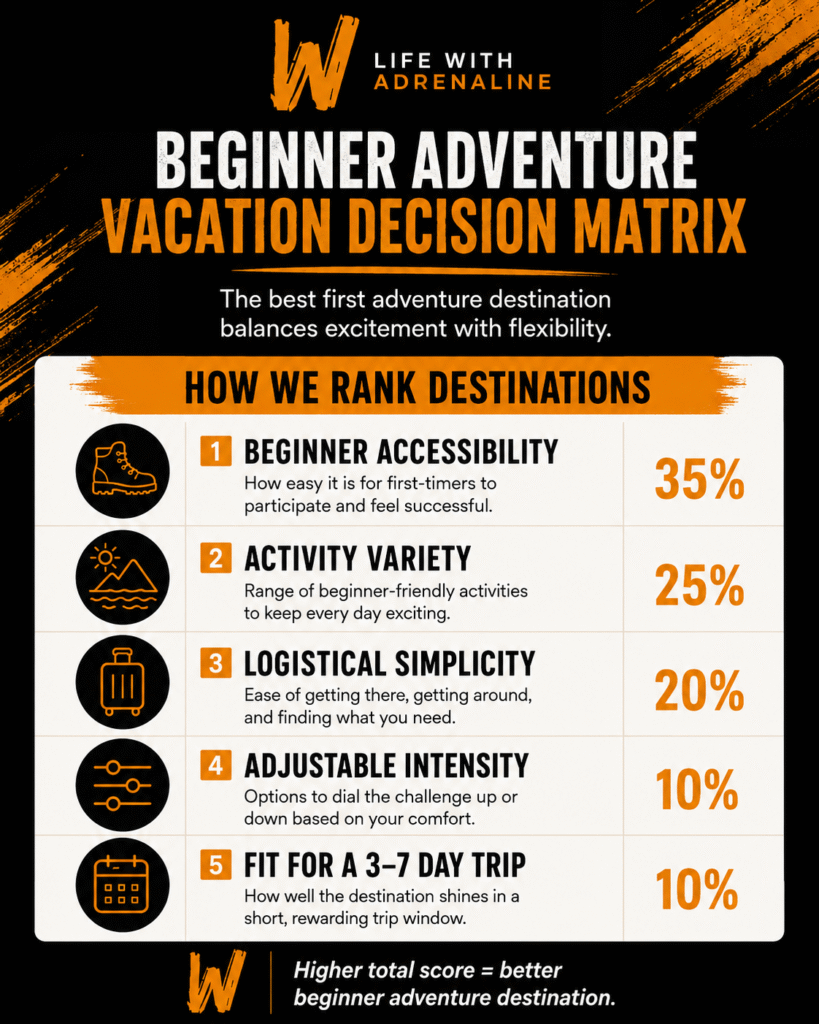
This is not a ranking of America’s most difficult outdoor destinations.
We gave the greatest weight to beginner accessibility, followed by the range of activities available, ease of planning, ability to increase or decrease the intensity, and whether the destination works well within a typical 3–7 day vacation.
We deliberately did not use accident statistics, operator reviews, or an invented “safety score” to rank destinations. Outdoor risk depends on the activity, conditions, operator procedures, your decisions and many other factors that cannot responsibly be reduced to one destination score.
1. Moab, Utah — Best Overall Adventure Vacation for First-Timers
Moab is the best starting point if your idea of an adventure vacation is, “I want to try several things, but I do not know yet which one I will love.”
The town serves as a base for Arches and Canyonlands national parks, while the surrounding area supports hiking, mountain biking, off-roading, rafting, climbing and canyoneering. Discover Moab specifically describes options for different skill levels and points visitors toward local guides. [S8]
That variety matters. You can spend one morning doing a straightforward scenic hike, try a guided rafting or off-road trip the next day, and only then decide whether you want something more demanding.
Another planning advantage in 2026 is that Arches is not requiring advance timed-entry reservations. However, congestion can still cause temporary entrance diversions, and reservations remain necessary for some specific experiences such as Fiery Furnace hikes. [S9]
Best for: first-timers who want variety
Start with: scenic hiking + one guided activity
Increase the intensity with: mountain biking, rafting, climbing or canyoneering appropriate to your ability
Watch out for: desert heat, exposure, hydration and overpacking your itinerary
Why Moab ranks first
You do not have to build the vacation around a single sport. That makes it easier to discover your adventure style without betting the entire trip on one intimidating experience.
2. Chattanooga, Tennessee — Best Adventure Weekend
Chattanooga is one of the easiest destinations on this list to turn into a short active getaway.
You can combine trails around Raccoon Mountain, paddling from convenient Tennessee River access points and guided river experiences without making every day an expedition. Visit Chattanooga notes that gear rentals are available for paddling and describes Ocoee-area options ranging from gentler water to Class IV rafting through local outfitters. [S11]
That gives couples and groups a useful advantage: different people can choose different levels of intensity while still sharing the same destination.
A hesitant beginner might paddle calm water or hike. A friend who wants more adrenaline can look at an appropriate guided whitewater trip.
Best for: a first 3-day adventure getaway
Start with: river paddling and an easy-to-moderate hike
Increase the intensity with: guided whitewater or more challenging mountain-bike terrain
Planning advantage: you do not have to commit to a remote wilderness itinerary
Chattanooga is especially appealing if you want to test whether active travel suits you before using a full week of vacation time.
3. Asheville, North Carolina — Best Mix of Adventure and City Comfort
Asheville works well for travelers who want the outdoors during the day but still want a strong food, lodging and city component after the activity ends.
The French Broad River provides a natural difficulty ladder. Current Explore Asheville information describes calm sections used for relaxed tubing, easy paddling options and guided Class II–III rafting trips, including half-day and full-day formats. [S12]
That is an excellent setup for a beginner because you can choose how active the vacation becomes.
You can also use Asheville as a base for mountain drives and hikes rather than relocating every night.
One important 2026 planning note: while the French Broad is currently described as open for recreation, the tourism authority recommends checking individual access sites and land managers because restoration and access can vary. [S12]
Best for: couples where only one person is highly outdoorsy
Start with: easy paddling, tubing or a day hike
Increase the intensity with: a guided whitewater trip
Watch out for: assuming all river access points have identical current conditions
4. Sedona, Arizona — Best Desert Adventure for Adjustable Intensity
Sedona delivers the visual drama people often want from an adventure trip without forcing them onto a technical route.
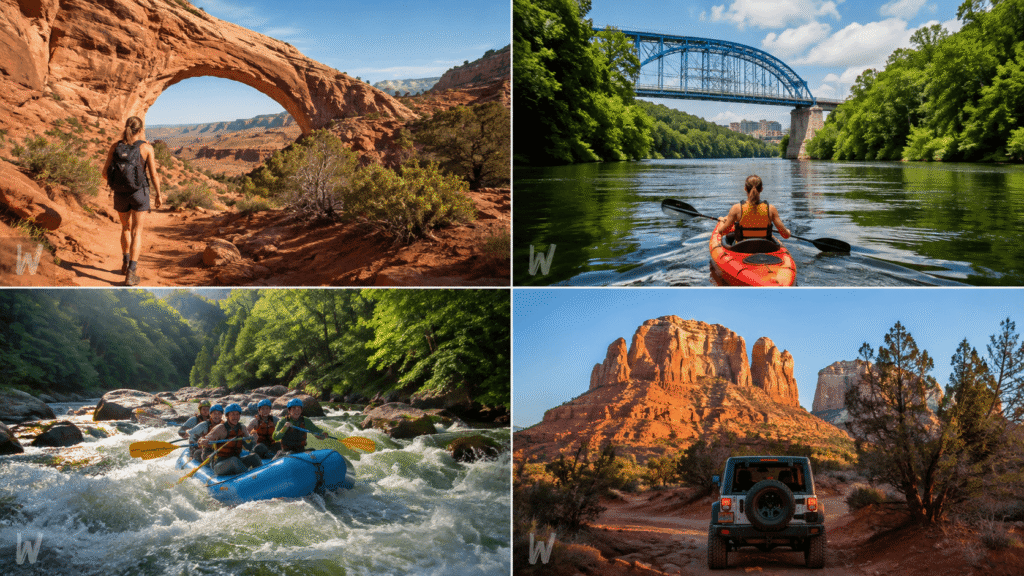
The official tourism bureau promotes a large trail network along with Jeep and ATV tours, while its trail guidance includes short and accessible options. [S10]
That creates a useful beginner formula: hike + scenic drive or guided off-road experience + recovery time.
If a difficult hike feels like too much, you still have ways to experience the red-rock landscape.
Sedona is also a good reminder that “beginner-friendly destination” does not mean every trail is beginner-friendly. Terrain, heat and exposure can change quickly from one route to another.
Best for: people who want impressive scenery with flexible physical effort
Start with: a shorter marked trail
Increase the intensity with: longer hiking, mountain biking or more adventurous guided off-road terrain
Watch out for: choosing hikes from photographs instead of checking distance, elevation and current conditions
For a first-time adventure traveler, the ability to retreat to easier options without ruining the destination is a major strength.
5. Lake Tahoe, California/Nevada — Best Four-Season Adventure Choice
Lake Tahoe is one of the most adaptable destinations on this list because the available activities change with the season.
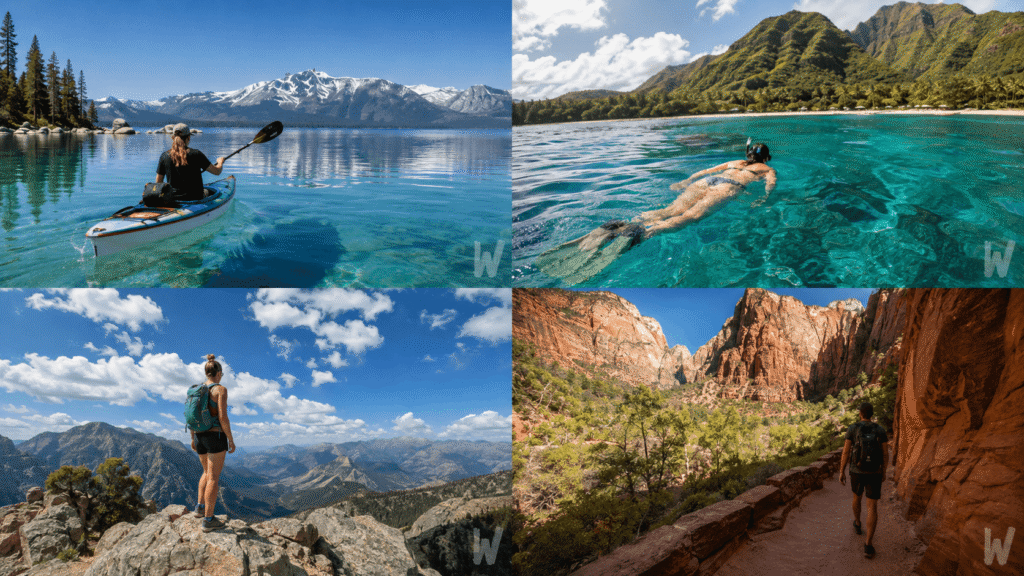
In warmer months, official tourism information highlights hiking, biking, fishing, kayaking and stand-up paddleboarding. Winter shifts toward skiing, sledding and snowshoeing. The area also offers gentler paved cycling routes alongside much harder mountain-bike terrain. [S13]
That makes Tahoe particularly good for groups with mixed confidence levels.
You can build a summer trip around a shoreline paddle, a scenic hike and an easy bike ride without going anywhere near expert mountain terrain.
Or you can use the same destination as a progression point once you become more experienced.
Best for: couples and groups with mixed abilities
Start with: paddling, paved cycling and accessible hiking
Increase the intensity with: mountain biking, longer mountain hikes or winter sports with instruction
Watch out for: treating Tahoe as one compact town; where you stay can substantially affect daily driving
The main advantage is choice. You can make Tahoe relaxing, athletic or adrenaline-heavy depending on the itinerary.
6. Kauaʻi, Hawaiʻi — Best Tropical Adventure Vacation
Kauaʻi combines a beach vacation with enough land and water activities to make a full week feel genuinely active.
The Hawaiʻi Tourism Authority highlights hiking, snorkeling, boat trips, kayaking, Waimea Canyon and the Nāpali Coast. Kauaʻi also has navigable rivers, including the popular Wailua River, while swimming, snorkeling and surf lessons create lower-commitment ways to get on the water. [S14][S15]
For beginners, the attraction is not doing everything. It is being able to alternate adventure with recovery.
A five- to seven-day trip can include a guided water activity, a hiking day, a boat day and several easier beach or sightseeing periods.
GoHawaii notes that summer generally brings calmer ocean conditions, while winter produces bigger waves. Conditions still vary by location and day, so ocean decisions should be based on current local guidance. [S14]
Best for: travelers who want adventure without giving up a tropical vacation
Start with: guided snorkeling, kayaking or an appropriate hike
Watch out for: assuming a beautiful beach automatically means safe swimming conditions
7. Colorado Springs, Colorado — Best Place to Build Up the Intensity
Colorado Springs is particularly good if you want your first trip to contain a visible progression from easy sightseeing to something that feels more adventurous.
Official tourism information intentionally separates experiences by intensity and lists everything from leisurely Garden of the Gods experiences to hiking, cycling, rafting, climbing and via ferrata options. [S16]
That is exactly what many first-timers need.
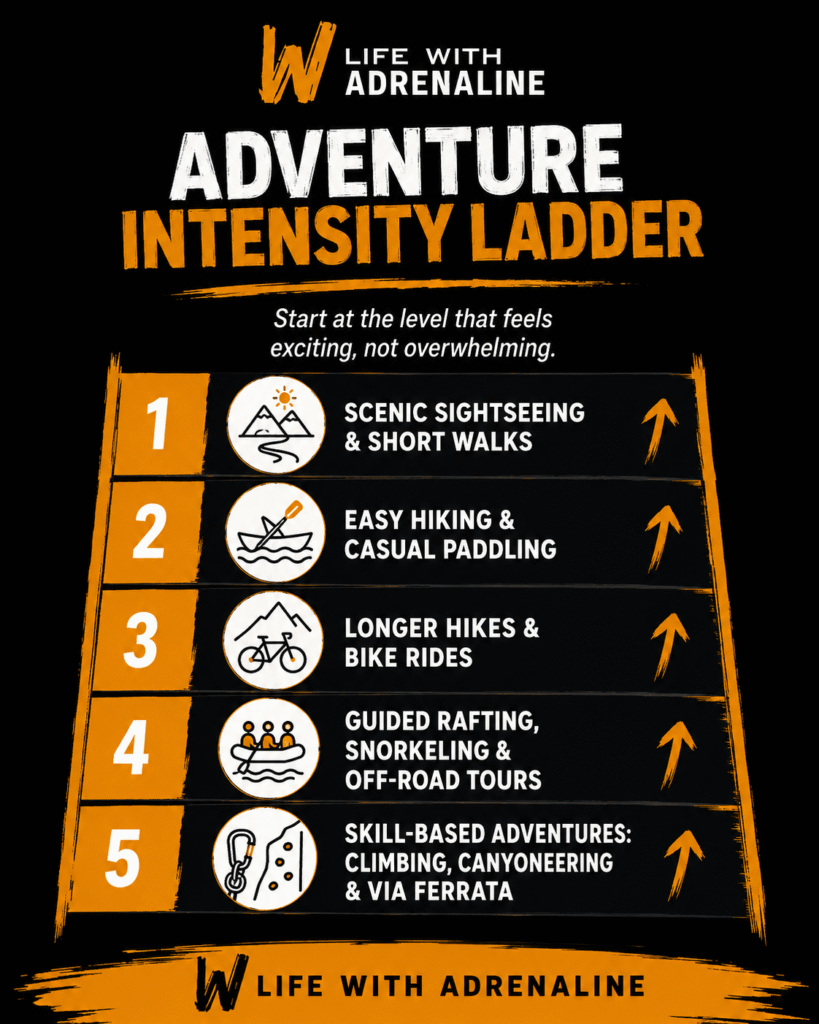
Start with walking or biking. Add a guided activity after you know how you are responding to altitude and physical effort. If you want more adrenaline, you can then investigate a suitable rafting, climbing or height-based experience.
Best for: travelers who want to gradually push their comfort zone
Start with: Garden of the Gods and moderate trails
Increase the intensity with: appropriately graded rafting, climbing or via ferrata experiences
Watch out for: altitude, sun exposure and confusing “available nearby” with “appropriate for my current ability”
Colorado Springs rewards progression rather than forcing commitment.
8. Zion National Park and Springdale, Utah — Best Iconic First National-Park Adventure
Zion can feel far more adventurous than its basic logistics suggest.
During the busy season, the park uses a shuttle system to reduce traffic in Zion Canyon. When the shuttle is operating, personal vehicles are generally not allowed on Zion Canyon Scenic Drive beyond Canyon Junction. [S17]
For a first-time visitor, this can be both a benefit and a constraint.
The benefit is that you can stay around Springdale and access major areas without constantly driving between trailheads. The constraint is that popular periods require patience, early starts and realistic expectations about crowds.
Zion also illustrates why beginners should not choose experiences based solely on fame. The park offers many ways to enjoy canyon scenery without selecting its most exposed or technically demanding routes.
Best for: a first dramatic national-park trip
Start with: established front-country trails and viewpoints
Increase intensity only after: reviewing current route conditions, permit requirements and your comfort with exposure
Watch out for: treating highly photographed advanced routes as mandatory Zion experiences
9. Acadia National Park and Bar Harbor, Maine — Best Coastal Adventure
Acadia is a strong first adventure destination because hiking is only one part of the experience.
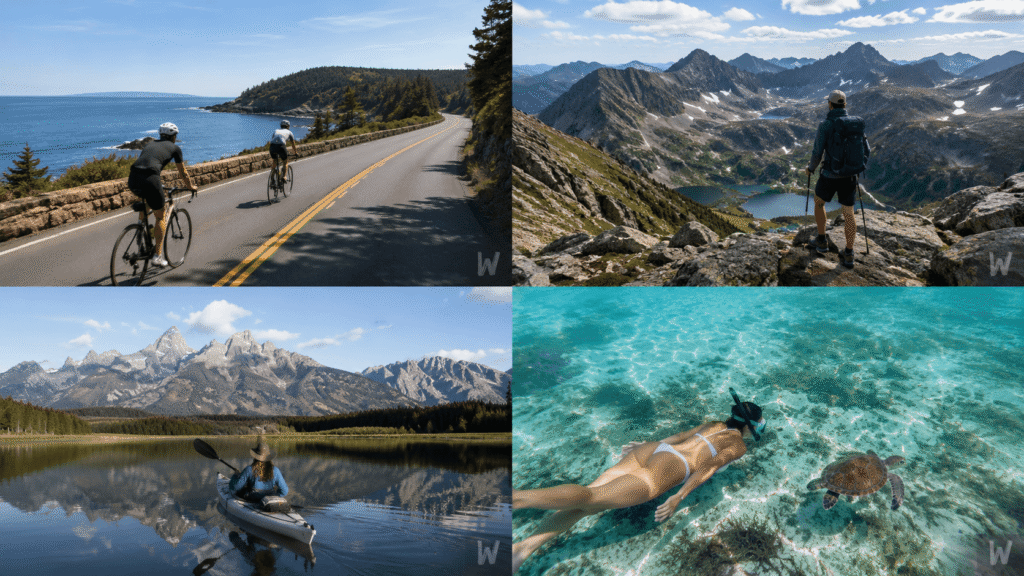
The National Park Service lists hiking, bicycling on 45 miles of historic carriage roads, swimming, boating, tidepooling and other recreation. [S18]
That makes it easier to design an active vacation without making every day a major hike.
You can bike one day, explore shoreline scenery another day and select hiking routes according to your actual comfort level.
There is, however, a specific planning rule worth knowing. In 2026, vehicle reservations are required for Cadillac Summit Road from May 20 through October 25. The NPS releases some reservations well in advance and another portion two days ahead. [S19]
Best for: hiking + cycling + coastal scenery
Start with: carriage-road biking and moderate walks
Increase the intensity with: more demanding mountain trails or guided ocean kayaking
Watch out for: confusing an Acadia entrance pass with the separate Cadillac Summit Road vehicle reservation
10. Estes Park and Rocky Mountain National Park — Best First High-Mountain Vacation
Rocky Mountain National Park is a good next step for beginners who are comfortable with ordinary hiking but want to experience a true high-elevation mountain environment.
It ranks below easier destinations mainly because the planning is more complicated.
For the 2026 season, timed-entry reservations are required for most park access between 9 a.m. and 2 p.m. from May 22 through October 12. A separate Timed Entry + Bear Lake Road option controls access to that popular corridor. [S20]
That does not make the park unsuitable for beginners. It simply means spontaneity is harder during peak periods.
Altitude also matters. A route that looks modest on a map can feel much harder when you are not acclimated.
Best for: beginners ready to move from casual outdoor vacations into mountain travel
Start with: shorter established walks and scenic stops
Do not make day one: your longest or highest hike
Watch out for: altitude, weather changes and assuming trail distance tells the entire difficulty story
11. Jackson and Grand Teton National Park — Best for Mountains, Wildlife and Paddling
Grand Teton offers several kinds of adventure in one landscape: hiking, paddling on lakes, biking, scenic driving, wildlife viewing and more technical climbing for travelers who eventually want it. [S21]
For a first trip, the key is to stay near the lower end of that spectrum.
The National Park Service says the hiking system ranges from short walks to backcountry excursions. It also warns that elevation, steep terrain, sudden weather and bear country add genuine complexity. [S21]
There is another current issue for 2026: construction is affecting parts of the park, so trail access and traffic conditions should be checked before travel. [S21]
Best for: scenic mountain adventure with wildlife interest
Start with: shorter hikes, scenic drives and appropriate paddling
Increase the intensity with: longer hikes under suitable conditions
Watch out for: wildlife safety, elevation, weather and long driving distances
This is a spectacular first mountain trip, but less forgiving of poor preparation than Chattanooga or Asheville.
12. Florida Keys — Best Beginner Water-Adventure Vacation
If hiking is not your idea of an adventure vacation, the Florida Keys deserve serious consideration.
The official destination site describes a chain of islands surrounded by water used for snorkeling, diving, boating and fishing, with different bases such as Key Largo, Islamorada, Marathon, the Lower Keys and Key West. [S22]
For a beginner, Key Largo can be particularly practical because a trip can be built around guided water activities without requiring mountain fitness.
The main decision is not “Can I handle a difficult trail?” It is “Which water activity matches my swimming confidence and comfort level?”
Best for: first-time travelers who prefer water to mountains
Start with: a professionally guided snorkeling or easy paddling experience
Increase the intensity with: training-based diving or more ambitious paddling where appropriate
Watch out for: ocean conditions, heat, sun exposure, seasickness and operator-specific participant rules
The Keys prove an adventure vacation does not need to involve vertical terrain.
13. Olympic Peninsula, Washington — Best for Landscape Variety
Olympic National Park offers mountains, lakes, rainforest and Pacific coastline in one destination.
That diversity is the reason to go, but it is also why Olympic ranks lower for first-timers: the park is geographically spread out.
The NPS’s own trip-planning information illustrates the distances. From Port Angeles, Hurricane Ridge is roughly 45 minutes away, while the Hoh Rain Forest can take more than two hours. The park offers hiking from easy to strenuous, including short popular rainforest walks, but the Hoh area can experience long entrance waits during busy months. [S23]
Best for: travelers who value variety more than convenience
Ideal approach: choose two or three park regions rather than trying to “complete” Olympic
Start with: short rainforest, lake and coastal walks
Increase the intensity with: longer mountain or coastal hikes once conditions are understood
Watch out for: spending half your vacation moving between areas
Olympic becomes much better when you stop treating it like a checklist.
14. Yellowstone National Park — Best Big-Nature Road-Trip Adventure
Yellowstone is different from most destinations on this list.
Much of the first-time adventure comes not from a single adrenaline activity but from moving through a huge landscape of thermal features, wildlife habitat, lakes and trails.
The NPS lists maintained boardwalks around hydrothermal features alongside hiking, biking, horseback riding, boating and guided tours. [S24]
No vehicle reservation is currently required simply to enter Yellowstone, although you still need an entrance pass. [S25]
The complication is distance and seasonality. Many park roads have projected opening and closing dates, and weather can change those dates. [S25]
Best for: first-time travelers who want wildlife and geology more than nonstop adrenaline
Start with: boardwalks, scenic areas and shorter day hikes
Increase the intensity with: guided or more demanding activities after understanding the environment
Watch out for: long drives, wildlife, thermal areas and trying to see the entire park too quickly
In thermal areas, staying on designated boardwalks and trails is a serious safety requirement, not a suggestion.
15. Seward and Kenai Fjords National Park, Alaska — Best Guided Wilderness Introduction
Seward is last in the ranking only because reaching and organizing an Alaska adventure usually demands more planning and budget flexibility than the other options.
It is not last for experience.
Travel Alaska describes guided kayaking options ranging from beginner half-day outings to more ambitious glacier and remote-fjord experiences. It specifically recommends guided trips for visitors without previous kayaking experience. Glacier and wildlife cruises provide another way to experience the region without requiring independent wilderness skills. [S26]
Kenai Fjords is open year-round, but the NPS identifies June, July and August as the primary visitor months, with reduced services in May and September. The road to Exit Glacier is not plowed through winter and can remain inaccessible to automobiles while snow-covered. [S27]
Best for: a first “big” wilderness vacation using professional guides
Start with: a wildlife/glacier cruise and beginner guided kayaking
Watch out for: weather, cold water, seasonal access and building an independent itinerary beyond your experience
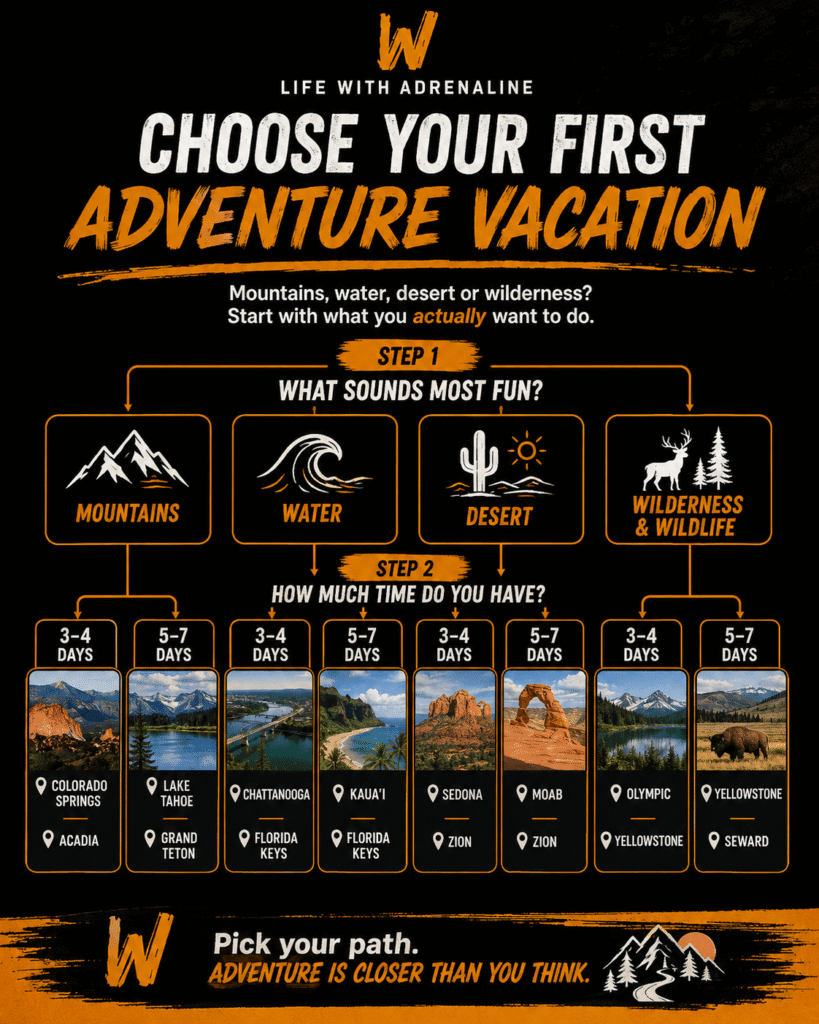
Which Adventure Vacation Should You Choose?
If this is genuinely your first active trip, choose according to what makes you nervous, not just what photograph excites you.
Choose Moab if…
You want the broadest selection of activities and do not yet know whether hiking, rafting, biking or canyoneering will become your favorite.
Choose Chattanooga if…
You want to test adventure travel with a relatively easy three-day getaway.
Choose Asheville if…
You or your partner want good restaurants and comfortable downtime to matter almost as much as the outdoor activities.
Choose Sedona if…
You want dramatic scenery without needing to spend every day on a difficult hike.
Choose Lake Tahoe if…
Your group has different fitness or confidence levels.
Choose Kauaʻi or the Florida Keys if…
You prefer water, snorkeling, kayaking and coastal experiences to mountain hiking.
Choose Colorado Springs if…
You specifically want to start easy and gradually increase the adrenaline.
Choose Zion or Acadia if…
You want your first adventure vacation centered on an iconic national park but still want established visitor infrastructure.
Choose Rocky Mountain or Grand Teton if…
You already enjoy ordinary hiking and want to step into higher mountain environments.
Choose Olympic or Yellowstone if…
You are comfortable with more driving and trip planning in exchange for a much larger landscape.
Choose Seward if…
You want your first wilderness-style vacation to feel genuinely big, and you are willing to pay for professional guidance where it improves access and suitability.
What Will Your Adventure Vacation Actually Cost?
There is no responsible single “average adventure vacation budget” for these destinations.
A three-night Chattanooga road trip and a seven-day fly-in Alaska vacation are not comparable products. Even within one destination, a traveler doing free hiking trails will spend very differently from someone booking rafting, guided climbing, boat tours or private instruction.
Instead, compare the cost drivers.
Usually easier to control
- Number of nights
- Hotel category
- Eating out versus groceries
- Number of guided activities
- Gear you rent instead of buy
- Whether you combine several paid activities
Often harder to control
- Flights
- Rental-car rates
- peak-season lodging
- national-park-area accommodation
- island transportation
- weather-related itinerary changes
Kauaʻi and Alaska can carry more transportation pressure. National-park gateway towns can become expensive during peak demand. Guided technical activities add substantial cost but may also be the appropriate way for a beginner to participate.
Before publishing specific package or hotel prices, those prices should be checked again for the travel dates being discussed.
Guided vs. Independent: Which Is Better for a Beginner?
You do not need a guide for every adventure.
For established front-country trails, scenic cycling or ordinary sightseeing, independent exploration may be entirely appropriate.
A guide becomes more useful when:
- The activity requires equipment you do not own
- You need instruction
- Local conditions are difficult to interpret
- Route finding is complex
- Access is operator-controlled
- Water, climbing or technical terrain is involved
- You want an introduction before attempting the activity independently
A guided experience should not be treated as automatically risk-free. You still need to check the operator’s current participant restrictions, understand the activity and follow instructions.
Adventure Vacation Safety for First-Timers
The goal of a first adventure vacation is not to eliminate risk. Outdoor and adrenaline activities have inherent risks.
The goal is to avoid adding unnecessary risk through bad decisions.
Match the activity, not just the destination, to your ability
A beginner-friendly destination can contain expert-only terrain.
Moab has technical canyons. Lake Tahoe has challenging mountain-bike trails. Grand Teton has genuine alpine terrain. Zion contains exposed routes. Alaska has cold-water and remote wilderness environments.
Being comfortable in one part of a destination does not qualify you for every activity there.
Respect environmental conditions
Weather, heat, cold, elevation, water conditions and wildlife can matter as much as fitness.
Grand Teton currently warns visitors about elevation, rapid weather changes and bear-country precautions. [S21]
Kauaʻi’s official tourism guidance also emphasizes that ocean conditions vary and that visitors should pay attention to lifeguards and current conditions. [S15]
Do not schedule your hardest activity immediately after arrival
This is especially useful at higher elevations.
Give yourself time to understand how you feel, how the weather behaves and how much effort your planned activities actually require.
Read operator restrictions before paying
Age, weight, height, swimming ability, fitness and health restrictions vary by activity and operator.
Do not rely on a roundup article for those final eligibility decisions. Check the specific operator’s current rules immediately before booking.
Before You Book: First Adventure Vacation Checklist
☐ Choose a destination with at least two activities you would enjoy
☐ Identify one low-intensity backup activity
☐ Check current national-park reservations and permits
☐ Check seasonal road and shuttle operations
☐ Verify operator age, weight, health and experience requirements
☐ Check cancellation and weather policies
☐ Decide which equipment is supplied
☐ Rent specialized gear unless buying genuinely makes sense
☐ Check the actual drive time between activities
☐ Leave at least one flexible half-day in the itinerary
☐ Review current weather and local conditions shortly before each activity
☐ Do not make your most demanding activity your first test of the destination
FAQ
What is the best adventure vacation in the USA for beginners?
Moab, Utah is the strongest overall choice for most first-time adventure travelers because one base gives you access to hiking, rafting, mountain biking, off-roading, climbing and canyoneering, with options suitable for different skill levels and local guiding available. [S8]
Chattanooga is a better choice if you want a shorter, easier-to-organize first trip.
Do I need to be very fit for an adventure vacation?
No.
An adventure vacation can include easy hiking, kayaking, guided snorkeling, scenic cycling or other moderate activities.
Fitness becomes more important when you choose longer distances, significant elevation gain, altitude, technical terrain or activities requiring sustained effort.
Select the activity difficulty first rather than assuming the destination itself determines fitness requirements.
What is the best adventure vacation for couples?
For couples with different activity preferences, Asheville, Lake Tahoe and Sedona are particularly flexible because the trip does not need to revolve around one demanding sport.
One person can choose a more adventurous activity while the other still has meaningful alternatives.
Can a three-day weekend be an adventure vacation?
Yes.
Chattanooga, Sedona, Colorado Springs and Asheville are especially suitable for shorter trips if travel time from your home is reasonable.
For Olympic, Yellowstone, Kauaʻi or Alaska, a longer stay generally makes more sense because the transportation effort and geographic scale are greater.
Should first-time adventure travelers book guided tours?
Not for everything.
Guides are most valuable when you need instruction, specialized equipment, technical knowledge or local route expertise.
For ordinary marked hikes or straightforward sightseeing, a guide may add little value. For rafting, climbing, unfamiliar ocean activities, remote paddling or technical terrain, professional guidance can dramatically change what is realistically accessible to a beginner.
Final Recommendation
For most first-time travelers, start with Moab if you have four or five days.
It offers the strongest combination of iconic scenery, multiple adventure types and the ability to choose your own intensity.
Choose Chattanooga instead if you want a lower-commitment three-day test of adventure travel.
Choose Kauaʻi or the Florida Keys if water matters more than mountains.
And if you already enjoy hiking and want the next level of outdoor travel, Rocky Mountain, Grand Teton or Seward can provide a bigger step up — provided you accept the additional planning and environmental complexity.
Your first adventure vacation does not need to prove how extreme you are.
A better first trip is one that leaves you knowing what you want to try next.
Sources
[S8] Discover Moab — Things to Do in Moab. https://www.discovermoab.com/attractions/
[S9] National Park Service — Arches National Park, Plan Your Visit. https://www.nps.gov/arch/planyourvisit/index.htm
[S10] Sedona Tourism Bureau — Visit Sedona. https://visitsedona.com/
[S11] Visit Chattanooga — Wild at Heart / 14 Wild Adventures. https://www.visitchattanooga.com/blog/post/14-wild-adventures-in-chattanooga/
[S12] Explore Asheville — French Broad River Adventures. https://www.exploreasheville.com/article/french-broad-river-asheville-adventures-third-oldest-river-world
[S13] Visit Lake Tahoe — Outdoor Activities. https://visitlaketahoe.com/things-to-do/outdoors/
[S14] Hawaiʻi Tourism Authority — Kauaʻi Travel Information. https://www.gohawaii.com/islands/kauai
[S15] GoHawaii — Kauaʻi Water Activities. https://www.gohawaii.com/islands/kauai/things-to-do/water-activities
[S16] Visit Colorado Springs — Outdoor Adventures. https://www.visitcos.com/things-to-do/outdoors/
[S17] National Park Service — Zion Traffic and Shuttle Information. https://www.nps.gov/zion/planyourvisit/traffic.htm
[S18] National Park Service — Things to Do in Acadia. https://www.nps.gov/acad/planyourvisit/things2do.htm
[S19] National Park Service — Cadillac Summit Road Vehicle Reservations. https://www.nps.gov/acad/planyourvisit/vehicle_reservations.htm
[S20] National Park Service — Rocky Mountain National Park Timed Entry. https://www.nps.gov/romo/planyourvisit/timed-entry-permit-system.htm
[S21] National Park Service — Grand Teton Things to Do and Hiking. https://www.nps.gov/grte/planyourvisit/things2do.htm
[S22] Florida Keys Official Tourism Site. https://fla-keys.com/
[S23] National Park Service — Olympic National Park Trip Ideas. https://www.nps.gov/olym/planyourvisit/tripideas.htm
[S24] National Park Service — Yellowstone Things to Do. https://www.nps.gov/yell/planyourvisit/things2do.htm
[S25] National Park Service — Yellowstone Planning and 2026 Roads. https://www.nps.gov/yell/planyourvisit/index.htm
[S26] Travel Alaska — Seward. https://www.travelalaska.com/destinations/cities-towns/seward [S27] National Park Service — Kenai Fjords Operating Hours & Seasons. https://www.nps.gov/kefj/planyourvisit/hours.htm