
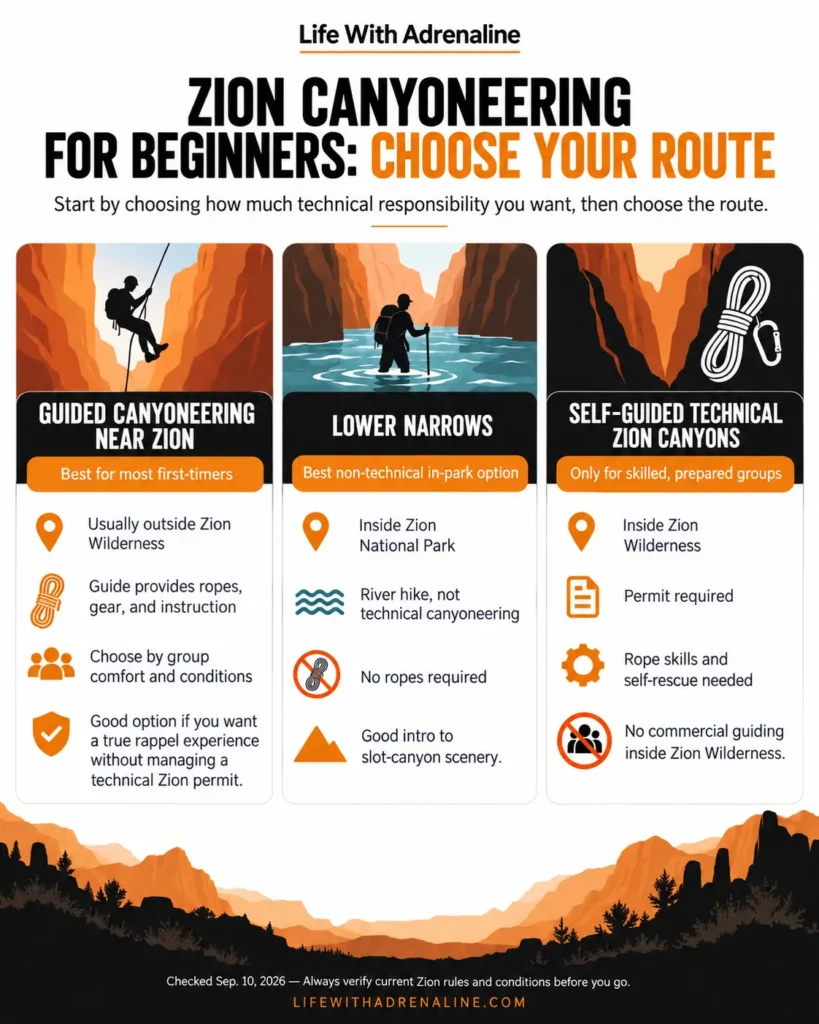
Direct answer: If you are completely new to canyoneering, the easiest way to start around Zion is usually a guided slot-canyon trip outside Zion National Park’s Wilderness, where the guide manages the route, technical systems, and equipment. Commercial guided activities are prohibited in Zion Wilderness, so famous technical canyons inside the park are a different proposition: you need the skills, equipment, route knowledge, and a Zion Wilderness permit to descend them on your own. [S4][S5]
That distinction matters more than any “best beginner route” list. A first-timer can book a half-day guided canyon near Springdale or East Zion with no previous canyoneering experience at some operators, while an in-park technical descent may commit the group to rappels, route finding, cold water, and self-rescue without a commercial guide. [S8][S9][S10]
Zion is one of the best places in the United States to understand what canyoneering actually involves: hiking, route finding, problem solving, rappelling, and sometimes swimming through narrow sandstone terrain. The key is to choose the level of technical responsibility you want before choosing the canyon name that looks best in photos. [S1]
Zion Canyoneering for Beginners at a Glance
| Option | Where? | Support | Zion permit? | Beginner fit | Typical commitment |
| Guided canyon near Zion | Usually outside Zion Wilderness | Professional guide | No Zion Wilderness permit for the guest when outside park | Best fit for most true first-timers | ~3.5–4 hr half-day is common; current examples from $144–$223+ pp depending on group/operator |
| Lower Narrows, bottom-up | Inside Zion | No technical canyoneering guide needed | No Wilderness permit for bottom-up Narrows | Good no-rope slot-canyon introduction | Hike/wade; river conditions still matter |
| Technical canyon inside Zion | Inside Zion Wilderness | Self-guided technical team | Permit required | Only after you have the route-specific skills and equipment | Varies by canyon; reservation/permit fees plus gear, transport, and training |
The table is not a safety ranking. Conditions, water, heat, route choice, participant fitness, and operator requirements can change what is appropriate on a particular day. The purpose is to separate three experiences that are often mixed together under the phrase “Zion canyoneering.”
First, Understand the “Inside Zion” vs. “Near Zion” Difference
When a company in Springdale or East Zion advertises a guided canyoneering or rappelling tour, do not assume that the technical canyon itself is inside Zion National Park. Zion’s current Wilderness regulations prohibit structured or guided activities facilitated by commercial, educational, or similar organizations in Wilderness areas. Those activities are only authorized on frontcountry trails. [S4]
This means a legitimate commercial beginner canyoneering trip typically uses canyon terrain on lands outside Zion Wilderness. East Zion Adventures states this directly: its canyoneering trips use neighboring slot canyons rather than canyons inside Zion National Park. Zion Adventures and Zion Guru similarly sell Zion-area guided canyon experiences built around route selection, rappelling, scrambling, and instruction. [S8][S9][S10]
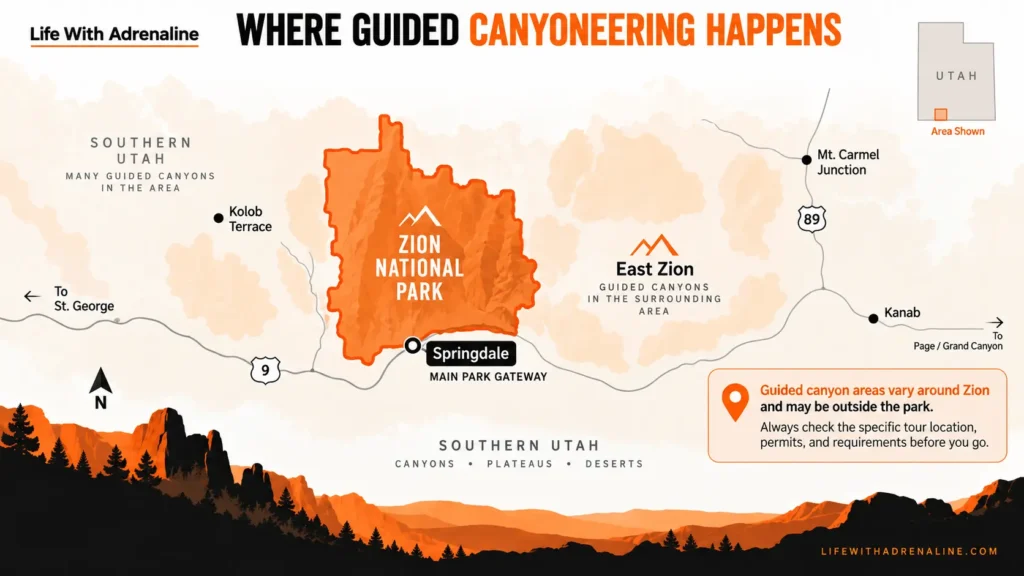
For a beginner, that is often an advantage rather than a compromise. You can learn how a harness feels, how to position your body on rappel, how to move through sandstone, and how you react to exposure without also taking on the full responsibility of route finding and rescue systems in a committing Wilderness canyon.
If your goal is specifically Pine Creek, Keyhole, Orderville, the Subway, or another technical in-park canyon, treat that as a skills and permit project, not simply a tour purchase. The NPS says technical canyoneering requires specialized equipment and the ability to use it, and it recommends training if your group cannot handle problems such as ascending a rope or dealing with issues mid-rappel. [S5]
Guided Canyoneering Near Zion: The Best Starting Point for Most Beginners
A guided half-day is the cleanest first experiment for many travelers. It gives you enough time to learn basic movement and complete real rappels, but it does not consume an entire vacation day. Current operator descriptions also show that beginner trips are commonly adjusted to the group rather than locked to one exact canyon. [S8][S9]
Current Zion-area guided tour price examples
| Operator | Example | Time | Price checked Sep. 10, 2026 | What it means for a beginner |
| Zion Adventures | Half-day group tour | About 4–5 hr door-to-door based on listed start/return windows | $175 per person | No prior experience required; technical gear provided. Private half-day rates rise for smaller groups. [S8] |
| Zion Guru | Half-Day Canyon Quest | 3.5–4 hr | $144–$432 per person by party size | Includes 2–6 rappels; 2026 price scale drops as group size increases. [S9] |
| East Zion Adventures | Elkheart Canyon | 4 hr | From $169 | Operator labels it Beginner; neighboring slot canyon, not Zion Wilderness. [S10] |
These are price snapshots, not a ranking. Taxes, booking fees, gratuities, photography, transportation, private-tour upgrades, or seasonal availability may change the final checkout total. Recheck the exact trip page before paying. Operator pages establish what each company currently sells and requires; they do not prove that one operator is safer or better than another.
Half-day or full-day?
Choose a half-day if your main question is, “Do I enjoy rappelling and moving through a slot canyon?” Zion Adventures currently describes its half-day as the better fit for first-timers and curious beginners, with fewer rappels and simpler canyon features. Zion Guru lists its half-day at 3.5 to 4 hours with 2 to 6 rappels. [S8][S9]
Choose a full-day if you already know you are comfortable hiking on uneven terrain and want more time in the canyon. Zion Adventures lists full-day private trips returning in mid-afternoon, while Zion Guru lists 6.5 to 7.5 hours with 4 to 12 rappels. A longer day can mean more route variety and more time on your feet; it is not automatically a better first experience. [S8][S9]
For mixed-confidence couples or families, ask the operator how route selection changes if one person is nervous about height, tight spaces, or scrambling. A flexible itinerary is more useful than a dramatic maximum-rappel number if half the group is uncertain.
Can a Beginner Go Canyoneering Inside Zion National Park?
Yes, but “beginner” needs a precise definition. Zion has canyon experiences that range from no-rope slot hiking to technical descents. The NPS describes a short trip into the lower Narrows as an introduction to the park’s slot canyons without ropes or other special equipment. It separately says that the Subway and Orderville are for people with expertise and experience. [S1]
Option 1: Lower Narrows from the bottom up – the no-rope introduction
If you want the feeling of entering a huge narrow canyon but are not ready to rappel, the lower Narrows is the simplest place to start conceptually. You hike upstream from the Temple of Sinawava through the Virgin River. A Wilderness permit is not required for the bottom-up Narrows hike. [S3]
That does not make it a casual walk in all conditions. River depth, current, cold, weather, and closures can change quickly. The park closes the Narrows when the Virgin River flow is over 150 cubic feet per second and when the National Weather Service issues a Flash Flood Warning, and visitors should check current conditions immediately before going. [S11]
Option 2: Technical canyons – only after skills come first
Technical canyons inside Zion require descending gear or ropes, and a Wilderness permit is required. The park also recommends at least two people for technical canyons and imposes route-specific group limits: up to 12 for the Subway, Orderville, Keyhole, Pine Creek, and the Narrows, and up to 6 for other canyoneering routes. [S4]
Do not treat “short” as a synonym for beginner. A canyon can be short and still require correct anchor judgment, rope management, cold-water planning, route finding, and the ability to solve a problem while hanging on rope. The NPS explicitly asks self-guided groups whether they can evaluate anchors, create extra friction, ascend a rope, and assist another member. If the answer is no, it recommends taking a class before heading out independently. [S5]
What about The Subway?
The Subway is famous, but it is a poor choice for a casual first technical day. Every trip into Left Fork of North Creek requires a Wilderness permit, all routes require extensive route finding, and paid guided trips are not permitted. The top-down route is a very strenuous 9.5-mile through-hike requiring rappelling skills, 60 feet of rope, extensive route-finding experience, and swimming through very cold pools. [S7]
The bottom-up Subway route removes the rappelling requirement, but it is still described by NPS as a very strenuous 9-mile round trip involving route finding, hiking in water, and scrambling over large boulders. It still requires a permit. [S7]
For a first-time visitor, the better progression is often: guided Zion-area canyon or formal skills training first, then choose an in-park objective that matches what your whole group can actually do. Famous route names should come after competence, not before it.
Zion Canyoneering Permits: What You Actually Need to Know
A common planning mistake is thinking that an online reservation is the permit. It is not. Zion’s current process requires the reservation holder to obtain the Wilderness permit in person at the Zion Canyon Visitor Center Wilderness Desk, usually the day before or the day of the trip. NPS advises allowing at least 20 minutes and bringing vehicle information. [S2]
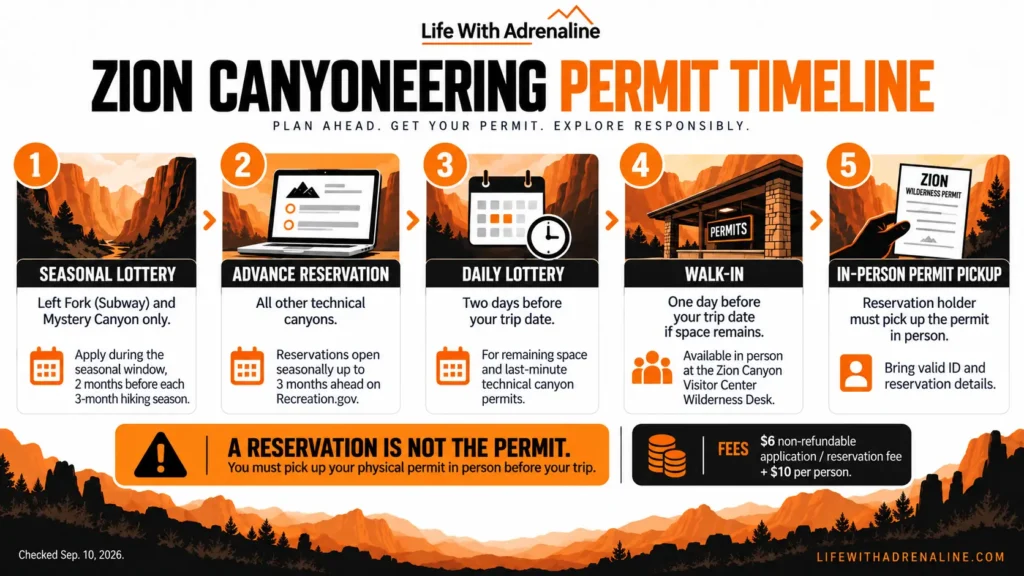
| Method | Used for | Timing | Current fee |
| Seasonal Lottery | Left Fork (Subway) and Mystery Canyon | Apply during the published window for the relevant three-month season | $6 nonrefundable application fee [S2] |
| Advance Reservation | Other listed technical canyons + top-down Narrows | Released seasonally, up to about 3 months ahead; if space remains, can be reserved until 5 p.m. MT the day before | $6 nonrefundable reservation fee [S2] |
| Daily Lottery | Last-minute option when seasonal/advance space is unavailable | Apply 2 days before the trip, 12:00 a.m.–3:00 p.m. MT; drawing around 4:00 p.m. | $6 nonrefundable application fee [S2] |
| Walk-in | Remaining spaces not taken through daily process | In person at the Wilderness Desk, generally 1 day before trip | Current in-person fee structure applies [S2] |
For current day-use canyoneering permits, NPS lists a $6 lottery application or advance reservation fee plus $10 per person, with the per-person fee refundable under the park’s current system. The same fee structure is used for first-come, first-served day-use permits issued in person. [S2]
Permits are limited, non-transferable, and do not guarantee that the canyon will be open when you arrive. Flash floods, rockfall, wildfire, road access, or other conditions can change the plan. Build a backup day into a Zion trip if technical canyoneering is one of your main goals. [S2]
Best Time for Canyoneering in Zion: Think Conditions, Not Just Calendar
There is no universal “best month” for every canyon. Route access, water level, temperature, road conditions, and your group’s cold tolerance all matter. A dry sandstone canyon outside the park and a water-filled in-park route can behave very differently on the same day.
Summer adds two major planning factors. Zion reports that daytime temperatures regularly exceed 100°F (38°C), and mid-to-late summer monsoon storms increase the chance of flash floods. [S11] That does not mean every summer day is unsuitable, but it means your canyon plan must remain flexible and weather-led.
Spring and fall often appeal to first-timers because daytime heat may be less extreme, but this is an editorial planning preference, not a guarantee of easy conditions. Cold water can still be a serious issue in shaded canyons. In winter, road access, ice, short daylight, and cold-water protection can become decisive. Always use the route-specific forecast, NPS alerts, and current operator guidance rather than a generic “best season” label.
Flash Floods Are the Weather Rule You Cannot Negotiate
A slot canyon can be under blue sky and still flood because heavy rain falls elsewhere in its drainage. NPS states that flash floods are unpredictable, can happen at any time of year, and may occur when the sky overhead looks sunny. You cannot outrun one in a narrow canyon. [S6]
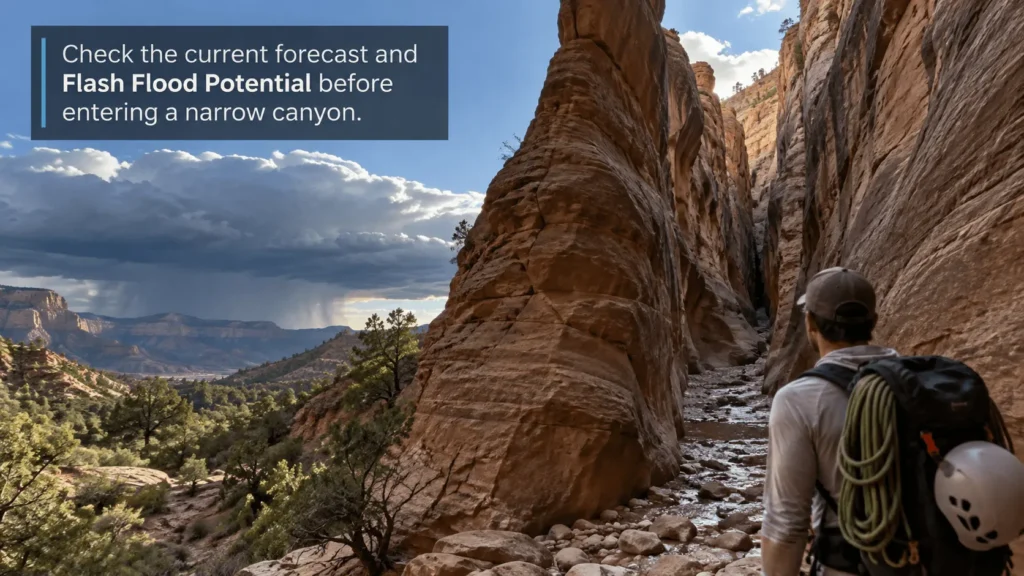
Before entering a narrow canyon, check the National Weather Service forecast and the current Flash Flood Potential rating. Zion uses four categories: Not Expected, Possible, Probable, and Expected. NPS says Possible, Probable, and Expected should all be a serious cause for concern and recommends considering alternatives that avoid narrow canyons, dry washes, and small streams. [S6]
This is one reason guided beginner trips can be useful: a commercial operator can select or change an outside-park route based on current conditions. But a guide does not remove environmental risk, and cancellation rules differ by company. For example, Zion Adventures currently states that customer cancellations within 72 hours are nonrefundable, while a trip the guide determines cannot operate safely may be rescheduled, replaced with a comparable experience, or refunded if an alternative is not possible. [S8]
The Other Risks Beginners Commonly Underestimate
1. Route commitment
In some technical canyons, the first rappel is a real commitment point. NPS warns that after you rappel and pull the rope, you may have to complete the canyon even if it is not the route you intended to enter. [S5] That is very different from a hike where turning around is always an option.
2. Rope and anchor problems
Rappelling is not only “lean back and walk down.” A self-guided group must know the required rope length, how to inspect or replace anchor material when appropriate, how to create extra friction, and how to ascend a rope if necessary. Each member should have appropriate equipment, and NPS recommends helmets for rockfall risk. [S5]
3. Cold water and exposure
Even when the desert air is hot, water-filled slots can stay cold. The Subway’s top-down description specifically calls out deep, very cold pools. [S7] Clothing and thermal protection must be route-specific. Do not copy the gear list from a dry guided canyon and assume it applies to a wet in-park descent.
4. Heat, hiking, and the exit
Canyoneering includes the approach and exit, not just the rappel. Sand, scrambling, sun, steep exits, and long hikes can become the main physical challenge. Bring enough water and food for the full day, and for self-guided Wilderness routes, NPS advises carrying extra clothing, water, food, and a headlamp because unplanned nights occur. [S5]
What to Bring on a Guided Beginner Tour
Follow the exact operator list because gear changes by route and season. Zion Adventures currently says it provides the necessary technical gear for its guided slot-canyon trips. It asks guests to bring water, sun protection, closed-toe athletic or hiking shoes, food, and weather-appropriate clothing. [S8]
- Water: bring the amount your operator specifies; Zion Adventures currently suggests 2–3 liters per person for its guided tour. [S8]
- Closed-toe footwear: choose shoes you can move confidently in on uneven sandstone.
- Synthetic layers: avoid relying on cotton if the operator expects wet or cold conditions.
- Sun protection: desert approaches can be exposed even when the slot itself is shaded.
- Food: a half-day still benefits from snacks; full-day trips commonly require lunch.
- Medication or personal essentials: carry what you normally need, while respecting any operator restrictions.
Do not buy a full technical canyoneering kit just because you are booking one guided day. Use the equipment the operator supplies or specifically requires. If your goal is to become self-guided later, invest after you have taken instruction and understand the systems you intend to use.
How to Choose a Zion Canyoneering Tour Without Overthinking It
Compare the trip using six practical questions, not the most dramatic photo on the booking page.
1. Is this exact trip designed for complete beginners? Ask about the route selected for someone with zero rappelling experience.
2. Is the canyon inside or outside Zion National Park? A technical commercial guided trip should not be sold as an in-Wilderness Zion descent.
3. What is the total time commitment? Include check-in, driving, approach, canyon time, and return, not just the active rappel section.
4. What does the listed price include? Confirm technical gear, transport from the meeting point, taxes/fees, private-tour surcharges, and optional photos.
5. What happens if weather changes? Read the reschedule, cancellation, and operator weather-decision policy before paying.
6. How does the route change for a nervous participant? A first trip is better when the guide can adjust pace and challenge rather than pushing the group toward a fixed “hero” rappel.
Before You Book: Zion Canyoneering Checklist
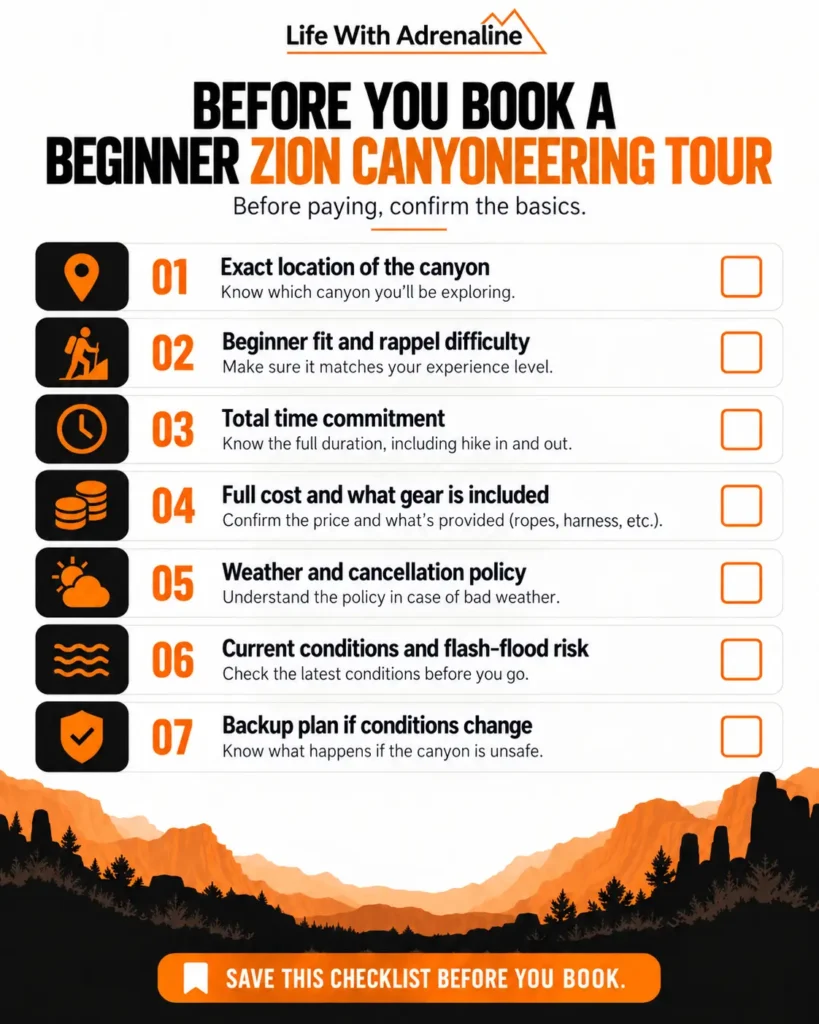
☐ I know whether my trip is inside Zion National Park or in the surrounding area.
☐ If the route is technical and inside Zion, my group has the required skills and I understand the permit process.
☐ If I am a first-timer, I have considered a guided outside-park trip or formal skills instruction before self-guiding.
☐ I checked the current NPS canyon, road, river, and closure information.
☐ I checked the weather forecast and Flash Flood Potential for the exact drainage and day.
☐ I have a backup activity that avoids narrow canyons if conditions change.
☐ I understand the full price, cancellation rules, equipment inclusions, and total trip time.
☐ I told the operator about any relevant mobility, comfort, age, or health concerns and reviewed its current participant requirements.
☐ I have the clothing, shoes, water, food, and personal essentials listed for the exact route.
☐ I am choosing the experience because the commitment fits me, not because the canyon name looks impressive.
Frequently Asked Questions
Can I hire a guide for Pine Creek, Keyhole, or The Subway inside Zion?
Not for a commercial guided technical trip in Zion Wilderness. Current NPS regulations prohibit structured or guided activities facilitated by commercial, educational, or similar organizations within Wilderness areas. [S4] The Subway page also explicitly states that paid guided trips are not permitted. [S7]
Do I need a permit for canyoneering in Zion?
A Wilderness permit is required for all technical canyoneering trips that use descending gear or ropes, for all trips into Left Fork of North Creek (The Subway), and for the top-down Narrows. [S1][S2] You do not need a Wilderness permit for the bottom-up Narrows hike from the Temple of Sinawava. [S3]
What is the best beginner canyoneering route in Zion?
There is no single in-park route that should be treated as the universal first technical canyon. For a complete beginner, a guided canyon outside Zion Wilderness is usually the simpler first step because instruction and technical systems are part of the product. If you want an inside-park introduction without ropes, the lower Narrows is the clearest starting point described by NPS. [S1]
How much does beginner canyoneering near Zion cost?
For September 2026, current half-day examples checked for this article range from $144 per person at the large-group end of Zion Guru’s pricing to $223 per person for two hikers, while Zion Adventures lists a $175 per-person group half-day and East Zion Adventures lists Elkheart Canyon from $169. [S8][S9][S10] Smaller private groups and solo bookings can cost substantially more. Recheck the checkout page because pricing and fees can change.
Is canyoneering safe for beginners?
Canyoneering has inherent risks, including falls, rope-system problems, flash floods, cold water, heat, route-finding errors, and difficult exits. A guided beginner format can reduce the amount of technical responsibility you carry on day one, but it does not remove environmental or activity risk. For self-guided technical routes, the NPS emphasizes planning, proper equipment, route-specific skills, and self-rescue capability. [S5][S6]
What if rain is only forecast at 20% or 30%?
Do not interpret a low rain percentage as “the canyon is safe.” NPS specifically warns that flash floods can occur even when skies overhead are sunny and even when flooding is not expected. Use the current Flash Flood Potential, the drainage-specific forecast, and a conservative backup plan. [S6]
Final Recommendation
For most first-time Zion visitors, start with a guided half-day canyoneering trip outside Zion Wilderness. It gives you a real rappel-and-slot-canyon experience while keeping route selection, technical systems, and instruction with a professional guide. If you discover that you love it, take a skills course and then consider a self-guided in-park technical route that genuinely matches your group’s abilities.
If ropes are the part you are not ready for, choose the lower Narrows as a nontechnical introduction to Zion’s slot-canyon environment instead. If the forecast or Flash Flood Potential is concerning, choose a backup activity. Zion will still be there on a better day.
The best first canyon is not the most famous one. It is the one that lets you finish the day wanting to learn more, with a realistic understanding of what the next level requires.
Sources
[S1] National Park Service — Canyoneering. https://www.nps.gov/zion/planyourvisit/canyoneering.htm
[S2] National Park Service — Canyoneering Permits. https://www.nps.gov/zion/planyourvisit/canyoneeringpermits.htm
[S3] National Park Service — Permits & Reservations. https://www.nps.gov/zion/planyourvisit/permitsandreservations.htm
[S4] National Park Service — Wilderness Regulations. https://www.nps.gov/zion/planyourvisit/wilderness-regulations.htm
[S5] National Park Service — Wilderness Safety. https://www.nps.gov/zion/planyourvisit/wilderness-safety.htm
[S6] National Park Service — Flash Floods. https://www.nps.gov/zion/planyourvisit/flash-flood.htm
[S7] National Park Service — Left Fork (Subway). https://www.nps.gov/zion/planyourvisit/thesubway.htm
[S8] Zion Adventures — Guided Slot Canyon Tour in Southern Utah. https://www.zionadventures.com/canyon-adventure-day.html
[S9] Zion Guru — Zion Canyoneering Trips & Slot Canyon Tours. https://www.zionguru.com/tours/canyoneering
[S10] East Zion Adventures — Canyoneering Tours near Zion National Park. https://eastzionadventures.com/canyoneering-tours/
[S11] National Park Service — Current Conditions. https://www.nps.gov/zion/planyourvisit/conditions.htm